Inside Harrity & Harrity: An AI-Native, Client-Focused, Future-Ready Patent Practice

Inside Harrity & Harrity: An AI-Native, Client-Focused, Future-Ready Patent Practice

What does it really look like to practice patent law at a firm built for the future?

In our recent informational session, Harrity & Harrity offered an inside look at how we’ve designed a patent practice around quality, efficiency, innovation, and flexibility—without relying on the traditional billable-hour model.

During the session, we walked through how Harrity operates as an AI-native firm, with proprietary tools like Patent Pioneer and Patent Navigator embedded directly into day-to-day drafting, prosecution, and review workflows. These systems support consistency, reduce rework, and give practitioners real visibility into quality and efficiency—so attorneys and agents can focus on high-value legal and technical work.

We also covered what makes our practice model different. Harrity is exclusively focused on patent preparation and prosecution, with dedicated drafting and prosecution teams, uniform writing standards, a robust second-review process, and strong operational support. This structure allows our professionals to develop deep expertise while delivering predictable, high-quality outcomes for some of the most innovative companies in the world.

The session also highlighted what many practitioners value most: our remote-first culture and flexible compensation model. Team members choose when, where, and how much they work, with compensation tied to efficiency and production rather than face time. For many, this translates into stronger work-life balance and, often, higher earning potential than at traditional firms.

We discussed Harrity’s collaborative culture, commitment to mentorship and giving back, and what the hiring and interview process looks like for attorneys and agents interested in joining the firm. Finally, we hosted a live Q&A sessions where attendees sent in any questions they still had after the session.

If you’re a patent attorney or agent exploring a more modern, sustainable way to practice—one that values autonomy, quality, and innovation—we invite you to watch the full session and learn what it’s like to build a patent career at Harrity & Harrity!

To learn more about our workplace and career opportunities, visit www.harrityllp.com/careers.

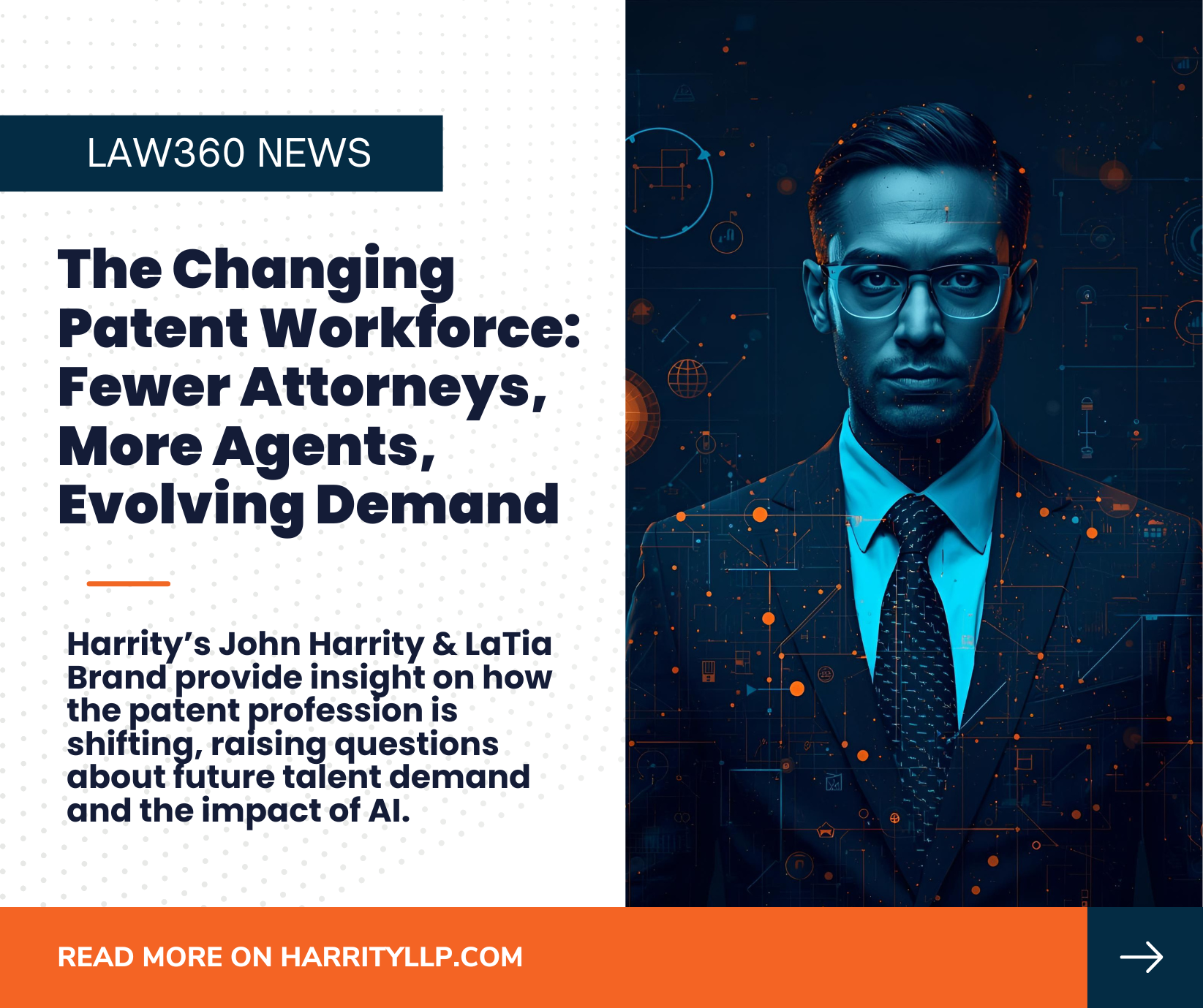
The Changing Patent Workforce: Fewer Attorneys, More Agents, Evolving Demand

The patent profession is experiencing a notable shift. According to recent reporting by Law360, the number of new registrations to practice before the USPTO has dropped significantly since its 2002 peak. While registrations have recovered somewhat—1,003 in 2024, up from a low of 613 in 2022—data suggests the profession is evolving, not expanding.

LaTia Kimmel Brand, patent data analyst at Harrity & Harrity LLP, played a critical role in streamlining this data from the USPTO’s Office of Enrollment and Discipline for analysis. The findings show a clear trend: since 2020, more patent agents than attorneys have been entering the field.

John Harrity, Co-Founding Partner of Harrity & Harrity, questions whether this trend reflects a talent crisis or simply a shift in demand. His firm, which contributed to ADAPT.legal’s analysis, is seeing only modest demand for new hires despite the lower number of entrants. “I’m just not seeing a ton of firms saying, ‘We need, we need, we need,’” he told Law360. He also pointed out that even through the firm’s Patent Pathways® program, aimed at expanding the pipeline in patent law, “there aren’t a ton of people lined up to hire the people that we want to bring into the field.”

Looking ahead, John believes AI may be the more transformative force. “AI is helping significantly reduce the amount of time it takes for Harrity’s firm to prepare patent applications,” he said. But how this will impact the workforce is still an open question: “If [clients] continue to file just the same quantity, we need less bodies in the field. If they file twice as many, we’ll need more bodies in the field.”

The profession may be aging, but it’s also adapting—with patent agents and AI poised to play bigger roles in shaping its future.

Read the full article at Law360.

Want to join the future of patent law? Apply to our openings today at www.harrityllp.com/careers.

Hiring in the Era of AI

AI Is Not Optional—It’s Our Foundation

At Harrity & Harrity, we’re not waiting for the legal industry to catch up—we’re building the model for what’s next.

In a recent interview with Managing IP,  John Harrity shared how our firm is embedding AI into every layer of patent preparation and prosecution. From proprietary tools like Patent Draftr, which has reduced patent drafting turnarounds from around 40 hours to fewer than 10, to a hiring strategy built around adaptability and innovation, we’re setting a new standard.

John explained the significance of this transformation and what it means for hiring decisions: “If you have any hesitation as an attorney or agent about using AI, we are not for you. If you’re against change in any way, this is definitely not the place for you.”

We see the attorney’s role shifting—from drafter to strategist, from doer to decision-maker. “Attorneys will be spot checkers, making sure that AI stays on the rails,” he said. And we believe that even this role will continue to evolve.

We’re not just using AI, we’re transforming because of it. If you’re ready to practice patent law in a way that’s client-focused, future-ready, and built for speed, precision, and innovation, we want to hear from you.

Apply now at www.harrityllp.com/careers. Read the full article from Managing IP here.