Gate Keepers vs. the Hindered: 102 Blocking in Artificial Intelligence for Wireless Telecommunications


By Ayana Marshall, PhD 

In the rapidly evolving sector of wireless telecommunications, Artificial Intelligence (AI) is driving major innovations, from network optimization to intelligent data processing. As companies race to secure patents that protect their innovations, 102 blocking patents play a critical role in shaping the competitive landscape. These patents—granted to earlier innovations—can prevent new applications from being approved. The Patent Pulse™ report delves into this landscape, highlighting the major players that hold blocking patents and those that frequently encounter barriers.  


Gate Keepers: Controlling the Flow of AI Patents in Wireless Telecommunications 

In the AI-driven wireless telecommunications industry, certain companies stand out as “gatekeepers”. Samsung Electronics Co., Ltd. leads this category, with 144 blocking patents. LG Electronics Inc. and Alphabet Inc. follow with 62 and 12 blocking patents, respectively, while companies like Microsoft and Intel also hold portfolios that play a role in defining the boundaries for future innovations.  

The Hindered: Companies Facing Patent Roadblocks 

On the other side of the equation are the companies whose patent applications are frequently hindered by blocking patents. Samsung Electronics Co., Ltd., a top gatekeeper, faces obstacles in 28 instances. Other notable companies on the hindered list include Telefonaktiebolaget LM Ericsson, LG Electronics Inc., and Nokia Corporation 

The Strategic Importance of AI Patents in Wireless Telecommunications 

The AI patent landscape in wireless telecommunications includes companies that own patents that protect early innovations. For companies on the hindered side, understanding the patent ecosystem and finding ways to innovate around existing claims are crucial for maintaining a competitive edge. 

The Harrity Analytics Patent Pulse™ report provides critical insights into this dynamic, helping companies understand where they stand in the race for AI-driven innovation in wireless telecommunications. The data is sourced from the Patent Pulse™ Report on Artificial Intelligence for Wireless Telecommunications.  For more information about the Patent Pulse™ Report visit our website HERE, download a complimentary Patent Pulse Report HERE, or contact Harrity Analytics HERE. 

Unveiling the Brains Behind AI Patenting: Leading Inventors Transforming Technology

By Ayana Marshall, Patent Data Analyst

Artificial intelligence (AI) has come a long way thanks to its top inventors.  Their groundbreaking work has not only pushed AI technology forward but also made it a vital part of different industries.  These innovators have transformed AI from ideas into impactful tools.  This article spotlights these leading inventors, celebrating the individuals whose creativity and foresight have made AI innovations indispensable. 

Leading Inventors in AI: A Perspective Based on Global Patents and Pending Applications 

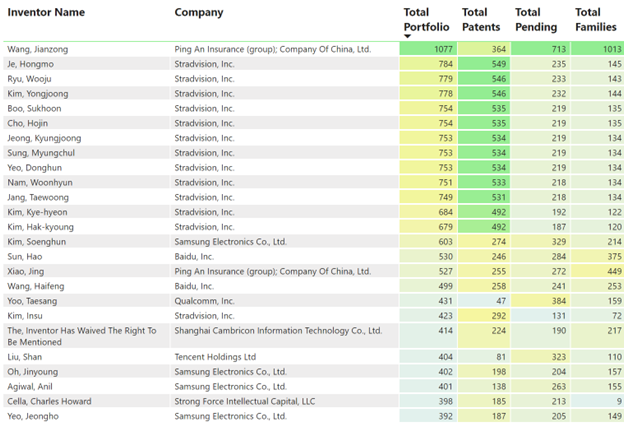
The table above presents a summary of the contributions of leading AI inventors, ranking them by their patent portfolio size.  This table details a list of inventors with their associated patent portfolios, highlighting their active global patents and pending applications.  The following are the highlights: 

  • Global Patent Leader: Jianzong Wang from Ping An Insurance (Group) tops the list with 1,077 total patents and applications. 
  • Granted Patents: Wang currently holds 364 granted patents. 
  • Pending Applications: A considerable number of 713 applications are pending, indicating active innovation. 
  • Patent Families: Wang’s patents are part of a large family of 1,013, suggesting broad and varied technological advancements. 
  • Company Spotlight: Stradvision, Inc. features prominently, with several inventors on the list having a high volume of pending patents, highlighting the company’s intensive R&D focus. 

The gradient coloring starting from green across the table visually emphasizes the inventors with the most extensive patent activities, with darker greens denoting inventors with larger volumes.  This table, therefore, not only highlights individual achievement but also subtly points out the competitive landscape of AI development among leading tech companies. 

Leading Inventors in AI: A Perspective Based on US Patents and Pending Applications 

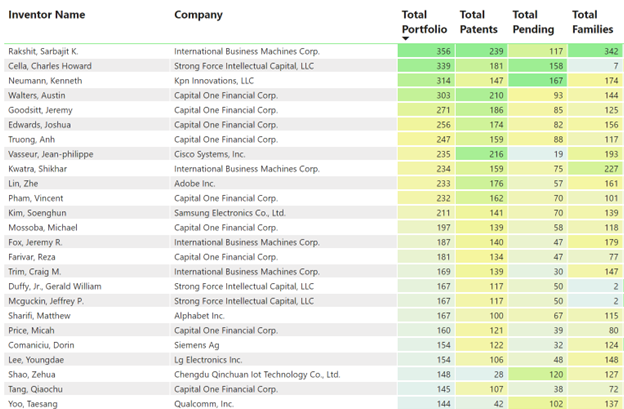
This image details a list of inventors with their associated patent portfolios, highlighting their active US patents and pending applications.  

  • U.S. Patent Front-Runner: Sarbajit K. Rakshit from IBM leads with 356 patents and pending applications in the U.S. 
  • Notable Inventors: Kenneth Neumann of Kpn Innovations, LLC and inventors from Capital One Financial Corporation are also highlighted for their substantial contributions. 
  • Close Contender: Austin Walters of Capital One Financial Corporation has a portfolio close behind with 303 patents and pending applications. 
  • Patents vs. Pending Applications: The table distinguishes between granted patents and pending applications, highlighting active areas of innovation with Neumann leading in pending applications. 
  • Cross-Industry Innovation: Inventors from various companies like Cisco Systems, Adobe, and Samsung demonstrate AI’s wide-ranging impact across different sectors. 

Beyond the Numbers 

In summary, the data from both images offers a look at the AI industry’s inventors and their contributions on a global scale, as well as within the United States.  The inventors listed highlight a robust commitment to innovation, with extensive patent portfolios that include both granted patents and those awaiting approval.  

Notably, the inventors affiliated with companies like Stradvision, Inc., Capital One Financial Corporation, and Ping An Insurance Group demonstrate strides in AI technology globally, as evidenced by their patent counts.  The number of pending applications further suggests that the field is poised for growth with potential new AI solutions on the horizon.  These inventors, therefore, represent the driving force behind the AI sector’s evolution, embodying the industry’s commitment to advancing technology and securing its future development through patent protection. 

This data is sourced from the Harrity Analytics Patent Pulse™ Report on Artificial Intelligence.  For more information about the Patent Pulse™ Report visit our website HERE, download a complimentary Patent Pulse Report HERE, or contact Harrity Analytics HERE. 


Who’s Conquering the AI Globe?  The Patent Showdown Between Reach & Influence

By Ayana Marshall, Patent Data Analyst

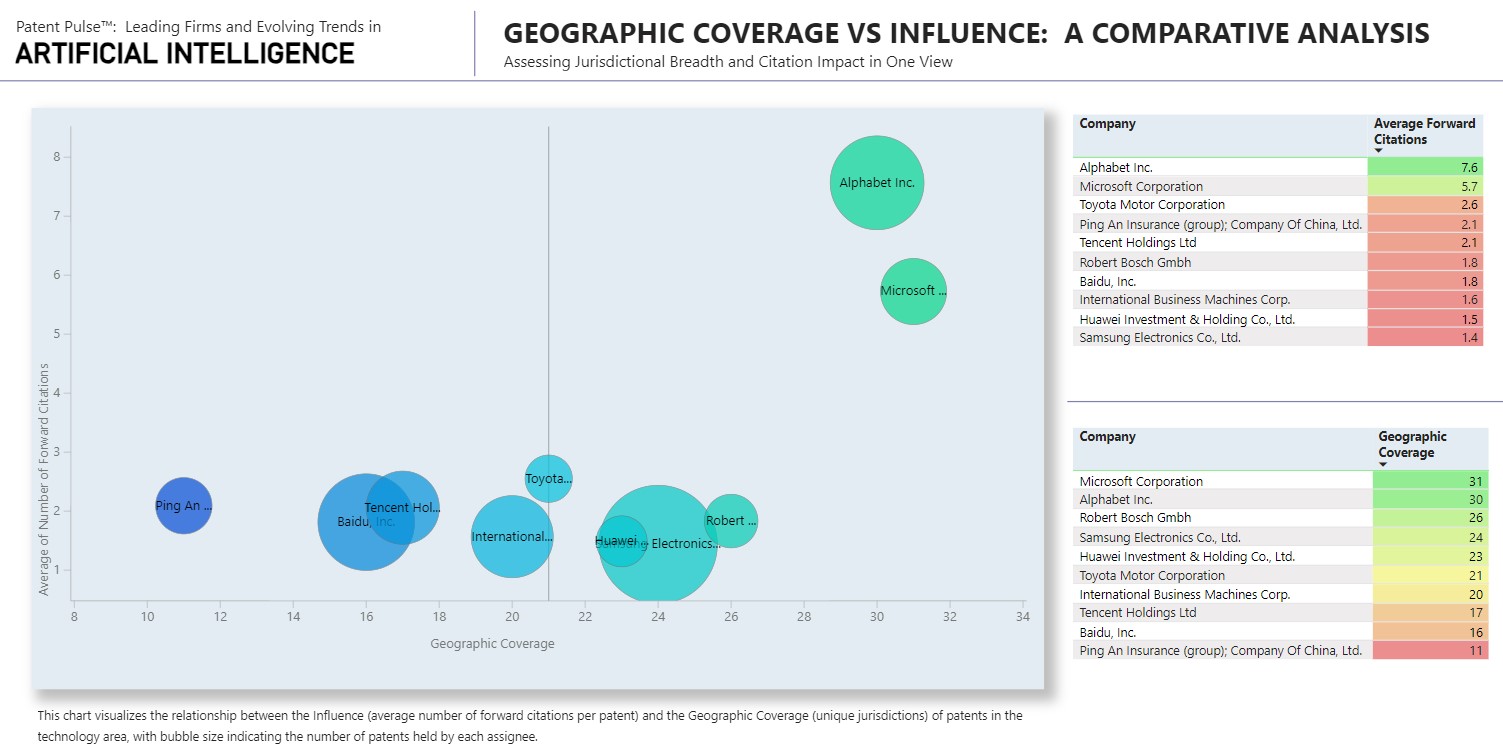
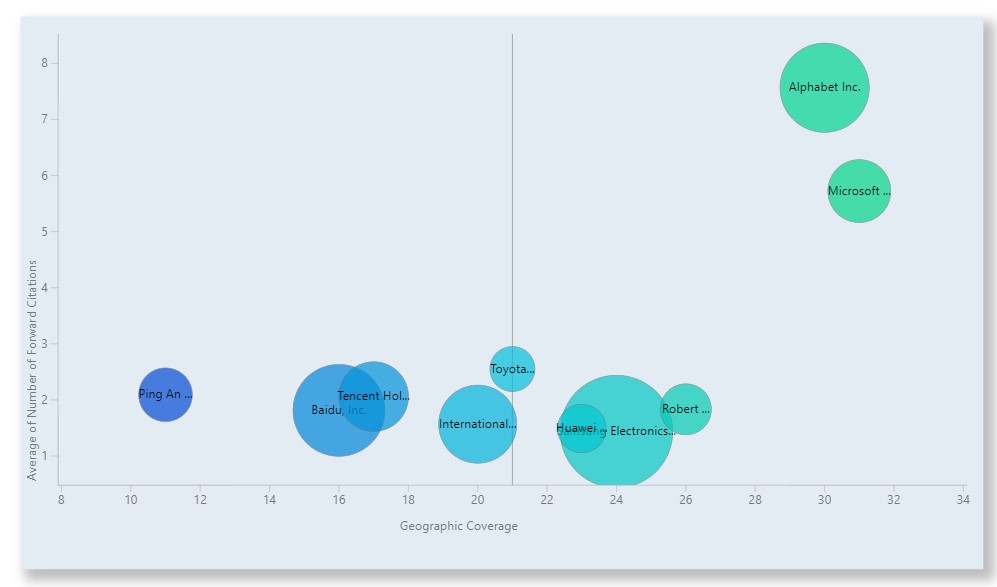
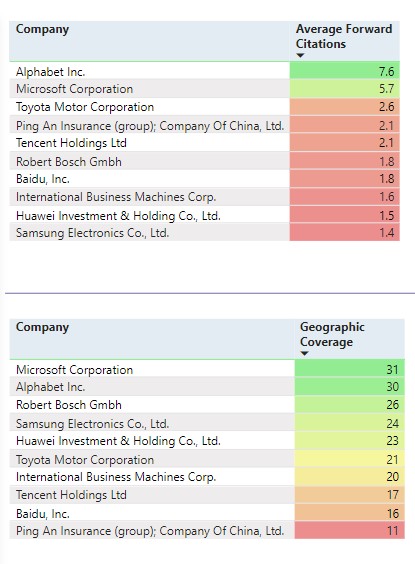
The scope of Artificial Intelligence (AI) patents is a key indicator of innovation and global reach in the field.  The chart in the image arranges the companies by two metrics: the influence of their patents, indicated by average forward citations, and the international expanse of their patent holdings, revealing a strategic dimension to how AI advancements are being staked worldwide. 

Tech Titans in the Spotlight: Microsoft and Alphabet Inc. Lead the Charge 

The bubble chart was used here to assess the breadth of jurisdiction and citation impact of AI patents. Geographic coverage is plotted on the x-axis and average forward citations are plotted on the y-axis.  The following are the highlights from the chart: 

  • Microsoft & Alphabet Inc. Lead: Both companies secure top positions in AI patent rankings, highlighting extensive patent counts and wide international presence. 
  • Citation Impact: Alphabet Inc. has the highest average forward citations with Microsoft closely following. 
  • Other Notable Companies: Toyota Motor Corporation, Samsung Electronics, Huawei, and Robert Bosch. also feature with significant geographic coverage and citation impacts. 
  • Citation Prominence: Baidu, Tencent, and Ping An Insurance are notable because of their citation counts. 

Unveiling the Global AI Innovation Map: A Closer Look at Tech Titans 

The positioning of companies across the chart illuminates the reach of their AI endeavors.  This visual guide offers a look into the scale and influence of each technology titan’s AI patent portfolios.  This data is sourced from the Harrity Analytics Patent Pulse™ Report on Artificial Intelligence.

For more information about the Patent Pulse™ Report visit our website HERE, download a complimentary Patent Pulse Report HERE, or contact Harrity Analytics HERE. 

AI Titans: Who’s Dominating the Patent Universe

By Ayana Marshall, Patent Data Analyst

In the rapidly advancing field of technology, Artificial Intelligence (AI) is a notable area of focus.  This field, where machines are designed to simulate human intelligence, is a center of both innovation and patent competition.  Key players in this arena are major companies that are not only involved in developing AI but also in securing their developments through patents.  These leading companies are actively engaging in AI research and development, and through their patent filings, they are protecting their innovations.  This activity plays a significant role in the ongoing evolution of AI technology and its integration into various industries. 

Global Players: Patent Powerhouses Shaping the Future 

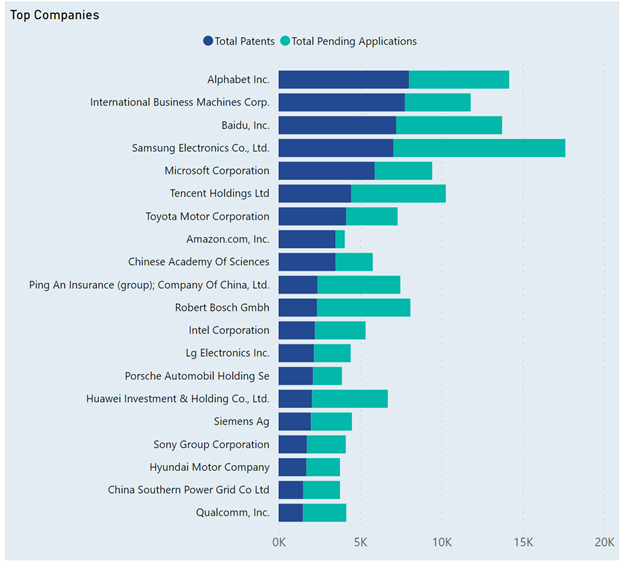
The Top Companies bar chart above illustrates the total patents and total pending applications in AI held by various global corporations.  The following are some highlights: 

  • Leading Patent Holder: Alphabet Inc. holds the highest number of total patents, indicating significant investment in AI. 
  • IBM & Baidu Presence: International Business Machines Corp. (IBM) and Baidu, Inc. follow closely in patent counts, highlighting their roles as major players in AI development. 
  • Samsung’s Pending Applications: Samsung Electronics Co., Ltd. has a notably higher number of pending applications than granted patents. 
  • Varied Company Involvement: Microsoft Corporation, Tencent Holdings Ltd, Toyota Motor Corporation, and Amazon.com, Inc. are also key contenders with substantial patent portfolios. 
  • Ping An Insurance’s AI Focus: Ping An Insurance (Group) Company of China, Ltd. is recognized for its considerable AI patent portfolio. 
  • Manufacturing Companies + AI: Robert Bosch GmbH and Siemens AG, known for manufacturing, have significant AI patent activities, underlining AI’s cross-sector impact. 
  • Technology & Automotive Dominance: The chart emphasizes the strong involvement of technology and automotive companies in AI patent holdings. 

Tracing the Trajectory of AI Patent Publications 

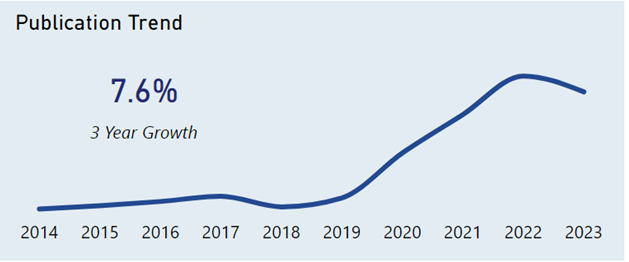
Expanding on the context of patent holdings, the line graph above spans from 2014 to 2023.  The following are the highlights: 

  • Upward Trend:  The Publication Trend shows a fluctuating but overall increasing trend in AI patent publications from 2014 to 2023. 
  • Growth in Publications:  There’s a 7.6% annual increase in AI patent publications in the three years up to 2023. 
  • 2019 as a Milestone Year:  The year 2019 is highlighted as a significant year, marking the start of a noticeable rise in the number of AI patent publications. 

This overview introduces the major industry players and the publication trajectory in AI innovation, offering insights for understanding AI development and patenting.  This data is sourced from the Harrity Analytics Patent Pulse™ Report on Artificial Intelligence. 

For more information about the Patent Pulse™ Report visit our website HERE, download a complimentary Patent Pulse Report HERE, or contact Harrity Analytics HERE.

Harrity Demos Patent Automation Software at IP Summit

SALT LAKE CITY (February 2020) Shawn Lillemo, Harrity’s Software Product Manager and IP attorney, was featured as a panelist and presenter at the 2020 Utah IP Summit last Friday. Shawn led the discussion on the use of automation to improve speed and quality in patent application drafting. The presentation included a demo of one of the Harrity Tools, an in-house automation software developed by Shawn and his team and currently used by Harrity attorneys to reduce errors and time spent on applications.

“The right automation tools can provide application drafters with extra time that can be spent fleshing out additional details of the invention, exploring alternative embodiments, and telling a good story about how the invention solves a technical problem,” stated Shawn on the significance of automation in the patent & legal fields.

In the short time since its launch, the use of Harrity Tools has substantially improved the efficiency of Harrity’s drafting attorneys and has led to a notable increase in the amount of applications drafted and obtained by the firm. To learn more about application drafting automation and other Harrity Tools, visit https://harrityllp.com/services/patent-automation/.