Autonomous Vehicles: Driving Innovation


By Ayana Marshall, PhD

Autonomous Vehicles: Driving Innovation 

Autonomous vehicles (AVs), commonly referred to as self-driving cars, use a combination of sensors, cameras, radar, and artificial intelligence (AI) to navigate their surroundings and make driving decisions without human intervention. 

Patent Age Distribution: Insights into Innovation Maturity 

The age distribution of patents in the autonomous vehicle sector provides valuable insights into the maturity of innovation within this industry. A histogram of patent data reveals that the majority of patents are concentrated in younger age brackets. The largest group of patents falls within the 2–4-year range, followed by those aged 4–6 years, with portfolio sizes steadily decreasing as patents age.  

Forward and Backward Citations: Innovation Interplay 

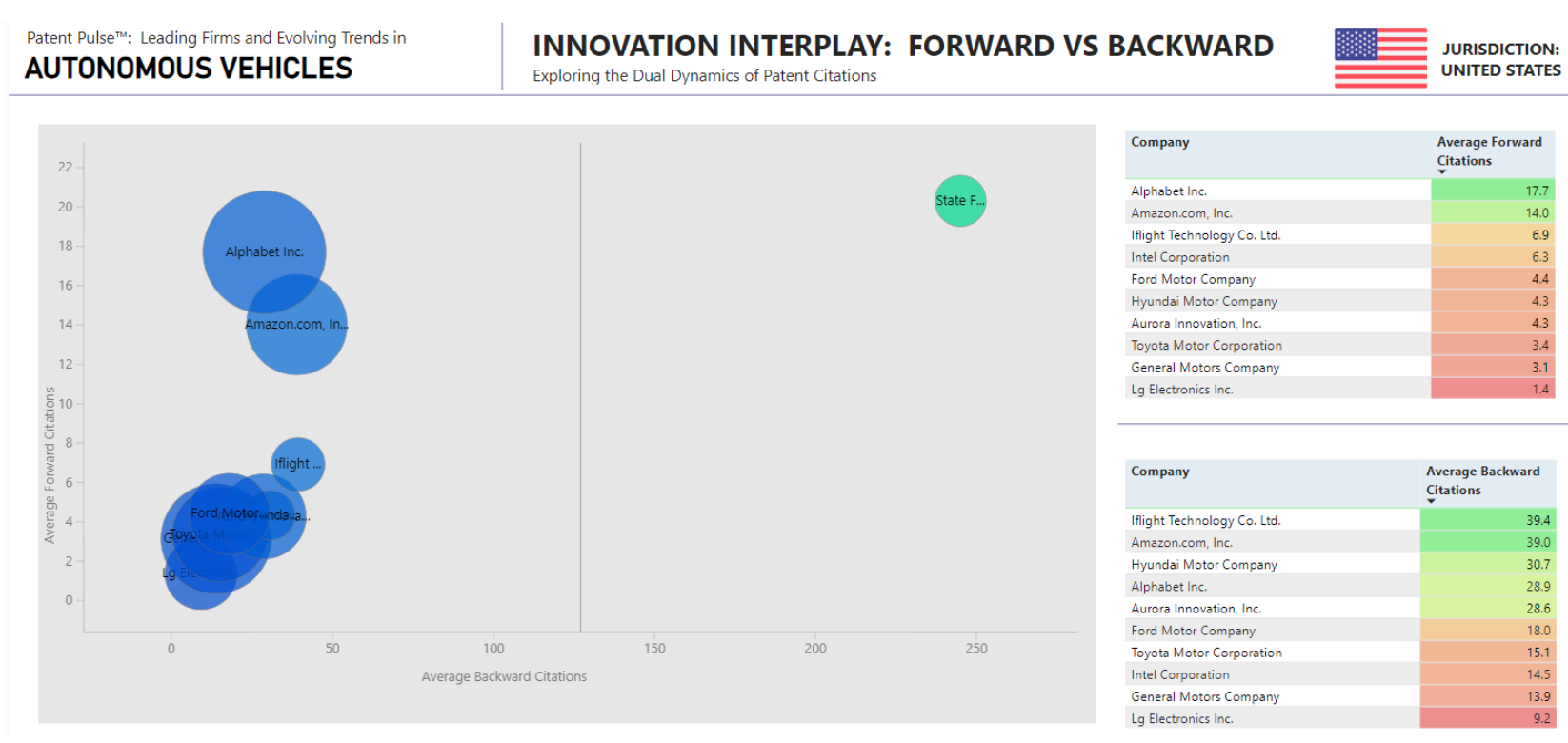
An analysis of patent citation dynamics further illustrates the competitive landscape of the autonomous vehicle industry. Forward citations, which indicate how often a patent is referenced by later inventions, and backward citations, reflecting references to prior patents, provide a comprehensive view of companies’ innovative strategies. Alphabet Inc. and Amazon.com, Inc. lead in forward citations while Iflight Technology Co. Ltd. has the highest average backward citations. This balance between advancing future technologies and leveraging prior knowledge demonstrates the interplay of innovation within the sector. 

Insights from Patent Activity 

The data on autonomous vehicle patents highlights a technology field where companies are both influencing future developments and building on prior achievements through the interplay of forward and backward citations. Together, these insights paint a picture of the autonomous vehicle industry, showcasing the ongoing advancements in this field. 

Data Source 

The data is sourced from the Harrity Analytics Patent Pulse™ Report on Autonomous Vehicles.  For more information about the Patent Pulse™ Report visit our website HERE, download a complimentary Patent Pulse Report HERE, or contact Harrity Analytics HERE. 


Driving the Future: Exploring Patenting in Autonomous Vehicle Technology


By Ayana Marshall, PhD

Autonomous vehicles (AVs), or self-driving cars, rely on sensors, cameras, radar, and artificial intelligence (AI) to navigate and operate without human input. The Society of Automotive Engineers (SAE) defines six levels of automation, ranging from Level 0 (no automation) to Level 5 (full automation in all conditions). As this technology evolves, what role do patents play in shaping its future?  

Patent Leaders in Autonomous Vehicle Technology 

The chart highlights the top companies driving innovation in autonomous vehicle technology based on their total patents and pending applications. Toyota Motor Corporation leads followed by Alphabet Inc., through its subsidiary Waymo, also demonstrates a strong presence, closely followed by General Motors and other major players such as Robert Bosch GmbH, Ford Motor Company, and Amazon.com, Inc. Notably, the variety of companies—ranging from traditional automakers like Hyundai and Nissan to prominent technology companies like Intel and Amazon—illustrates the multidisciplinary nature of autonomous vehicle development.  

Trends in Patent Age and Activity Over Time 

Continuing from the previous discussion on patent activities, the bar chart reflects the trend of patent ages in the autonomous vehicles sector from 2014 to 2023. It shows two sets of data: the number of total patents and total pending patent applications per year. The chart indicates a growing stack of pending applications atop the existing patents over the years. The average age of these patents is noted as 4.8 years.  

Insights from Patent Activity 

The data on autonomous vehicle technology patents reveals a dynamic and competitive landscape, showcasing an active environment of innovation. Leading companies have built substantial patent portfolios, reflecting their commitment to advancing the field. Additionally, the interplay of forward and backward citations highlights the sector’s balance between influencing future developments and building on prior innovations. Together, these insights offer a detailed view of the evolving autonomous vehicle industry. 

The data is sourced from the Harrity Analytics Patent Pulse™ Report on Autonomous Vehicles.  For more information about the Patent Pulse™ Report visit our website HERE, download a complimentary Patent Pulse Report HERE, or contact Harrity Analytics HERE. 


Navigating the Future of Sustainable Transport: Patent Trends in Electric Vehicles and Electrified Roadways


By Ayana Marshall, PhD

Electric vehicles (EVs) and electrified roadways represent two major technological advances in sustainable transportation, each with distinct developments. Electric vehicles have become a cornerstone of efforts to reduce emissions, and many countries are adopting EV technologies. This transition has seen continuous growth in innovation, with countries across Europe and the U.S. investing in charging infrastructure and battery technologies to support the increasing number of EVs on the road. 

Electrified roadways are an emerging technology designed to support electric vehicles by providing a dynamic charging solution as the vehicles move. Sweden is currently leading this effort, constructing the world’s first permanent electrified road on a section of one the highways, expected to be operational by 2025. This road, among several being tested in Europe, will allow vehicles to charge while driving using one of several technologies, including inductive or conductive systems embedded in the road. Electrified roadways could reduce dependency on large vehicle batteries and further accelerate the transition to electric transport by alleviating range anxiety and reducing the demand for stationary charging. 

Patent Trends in Electric Vehicles and Electrified Roadways: A Comparative Analysis 

While both electric vehicles (EVs) and electrified roadways represent key innovations in sustainable transportation, their development trajectories, as seen through patent publications, reveal notable differences. Patent publication trends for Electric Vehicles and Electrified Roadways reveal distinct patterns over the past decade. From 2014 to 2022, electric vehicle-related publications steadily increased but show a -3.1% decline in three-year growth, suggesting a recent slowdown.  

In contrast, Electrified Roadways has seen a more variable trend, with notable peaks around 2018-2019 and 2023, and a significant 35.6% growth over the last three years. This comparison highlights differing trajectories in patent activity, with electrified roadways showing a marked increase in recent innovations compared to the decreasing trend in electric vehicles. 

Top Companies Driving Electrified Roadway Innovation: A Patent Overview 

These trends reflect the growing interest in exploring diverse solutions to increase the sustainability features of the transportation sector, and Electrified Roadways have garnered attention from a range of innovators. The patent landscape in this field includes key players such as Beijing Boyang Dingrong Pv Technology Co., Ltd., Zhong Hui Powerise Wireless Power Technology Ltd., Toyota Motor Corporation and Ford Motor Company, with Toyota standing out due to a number of pending applications. Other major contributors include General Motors and Siemens AG. Academic institutions like South China University of Technology and Nanjing University of Technology are also prominent, along with Hevo Incorporated, which is involved in wireless power transfer solutions. Capactech Limited and other organizations complete this landscape of patent holders in the electrified roadway sector. 

Building on the Past: Key Innovators through the Lens of Backward Citations 
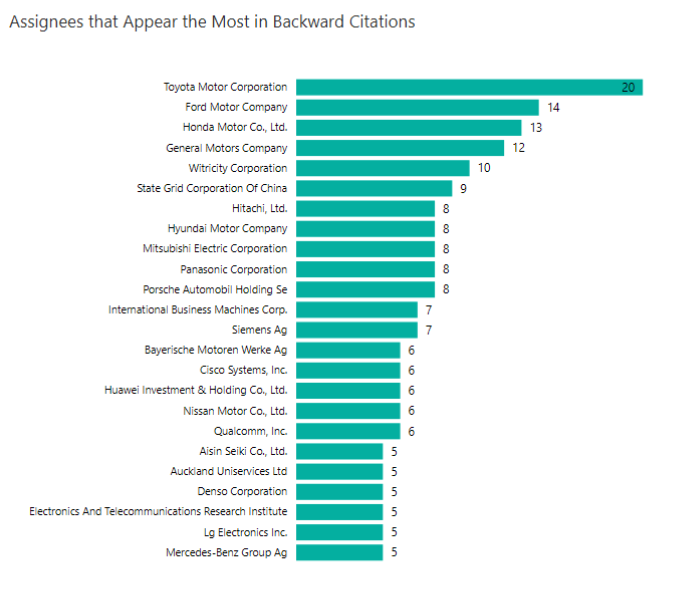
Following the analysis of top companies driving innovation in Electrified Roadways, the data on backward citations further highlights key players in the electric vehicle and roadway sectors. The chart lists the top assignees that appear most frequently in backward citations. Toyota Motor Corporation leads with 20 citations, followed by Ford Motor Company with 14, and Honda Motor Co., Ltd. with 13. Other notable companies include General Motors, WiTricity Corporation, and State Grid Corporation of China, each contributing to significant technological influence through frequent citations. Additional companies such as Hitachi, Ltd., Siemens AG, and Cisco Systems, Inc. are also present, showcasing a wide array of global leaders impacting the development of electric vehicle and roadway technology through their foundational innovations. 

Summarizing the Electric Vehicles and Electrified Roadways Landscape 

The patent trends for Electric Vehicles and Electrified Roadways reveal a landscape focused on transforming the future of transportation. While electric vehicle innovation shows a recent slowdown, electrified roadways are seeing a surge in new developments. Leading companies such as Beijing Boyang Dingrong Pv Technology Co., Ltd., Zhong Hui Powerise Wireless Power Technology Ltd., Toyota, Ford, and Siemens are driving this innovation, and the backward citation data underscores their technological influence, along with other major players like Honda and WiTricity. Together, these trends and key contributors highlight a path towards creating a more efficient and sustainable transportation infrastructure via dynamic charging solutions. 

The data is sourced from the Harrity Analytics Patent Pulse™ Reports on Electric Vehicles and Electrified Roads.  For more information about the Patent Pulse™ Report visit our website HERE, download a complimentary Patent Pulse Report HERE, or contact Harrity Analytics HERE. 

Resources: 

https://thenextweb.com/news/sweden-worlds-first-permanent-e-road-for-ev-charging-while-driving 

https://www.electrive.com/2023/05/09/sweden-pioneers-permanent-electrified-road-to-charge-evs-on-the-move/ 

https://www.popsci.com/technology/sweden-electric-highway/ 

https://mobilityportal.eu/5-european-countries-projects-electrified-roads/ 

https://www.purdue.edu/newsroom/2024/Q2/building-the-first-highway-segment-in-the-u-s-that-can-charge-electric-vehicles-big-and-small-as-they-drive/ 

https://www.archpaper.com/2024/04/electric-charging-roads-next-new-thing/ 

 

Gate Keepers vs. the Hindered: 102 Blocking in Artificial Intelligence for Wireless Telecommunications


By Ayana Marshall, PhD 

In the rapidly evolving sector of wireless telecommunications, Artificial Intelligence (AI) is driving major innovations, from network optimization to intelligent data processing. As companies race to secure patents that protect their innovations, 102 blocking patents play a critical role in shaping the competitive landscape. These patents—granted to earlier innovations—can prevent new applications from being approved. The Patent Pulse™ report delves into this landscape, highlighting the major players that hold blocking patents and those that frequently encounter barriers.  


Gate Keepers: Controlling the Flow of AI Patents in Wireless Telecommunications 

In the AI-driven wireless telecommunications industry, certain companies stand out as “gatekeepers”. Samsung Electronics Co., Ltd. leads this category, with 144 blocking patents. LG Electronics Inc. and Alphabet Inc. follow with 62 and 12 blocking patents, respectively, while companies like Microsoft and Intel also hold portfolios that play a role in defining the boundaries for future innovations.  

The Hindered: Companies Facing Patent Roadblocks 

On the other side of the equation are the companies whose patent applications are frequently hindered by blocking patents. Samsung Electronics Co., Ltd., a top gatekeeper, faces obstacles in 28 instances. Other notable companies on the hindered list include Telefonaktiebolaget LM Ericsson, LG Electronics Inc., and Nokia Corporation 

The Strategic Importance of AI Patents in Wireless Telecommunications 

The AI patent landscape in wireless telecommunications includes companies that own patents that protect early innovations. For companies on the hindered side, understanding the patent ecosystem and finding ways to innovate around existing claims are crucial for maintaining a competitive edge. 

The Harrity Analytics Patent Pulse™ report provides critical insights into this dynamic, helping companies understand where they stand in the race for AI-driven innovation in wireless telecommunications. The data is sourced from the Patent Pulse™ Report on Artificial Intelligence for Wireless Telecommunications.  For more information about the Patent Pulse™ Report visit our website HERE, download a complimentary Patent Pulse Report HERE, or contact Harrity Analytics HERE. 

Neuromorphic Revolution: Patents Fueling the Future of Brain-Inspired Computing

Neuromorphic Revolution: Patents Fueling the Future of Brain-Inspired Computing
By Ayana Marshall, PhD 

Neuromorphic chips and neuromorphic computing are innovative technologies that are promising to revolutionize the way information is processed. Inspired by the architecture and functioning of the human brain, the chips are designed to mimic neural networks, enabling faster, more efficient, and adaptive computing (Mead, 1990; Indiveri & Liu, 2015). The current landscape of neuromorphic chip development is explored through an analysis of patents and pending application data. 

The key players driving innovation in this field are included on the chart. 

  • International Business Machines Corp. (IBM) and Samsung Electronics Co., Ltd. have the most patents and pending applications, which are followed by Intel Corporation.
  • The data also underscores the contributions of South Korean companies and institutions, such as SK Hynix Inc. and Seoul National University. 
  • American corporations in this space include General Motors Company, Microchip Technology Inc., and Qualcomm, Inc. 
  • Applied Brain Research Inc., a Canadian company, is also represented.
  • European and Chinese institutions highlight the diverse range of international players working in the neuromorphic technology space. For example, the Commissariat à l’énergie atomique et aux énergies alternatives (CEA) from France, and Tsinghua University and Peking University from China. 
  • This distribution of patents and pending applications underscores the strategic importance of neuromorphic technology in companies across different regions. 


Neuromorphic Chips: A Snapshot of Key Developments 

  1. Intel’s Loihi 2 Chip: Intel launched the Loihi 2 chip a few years ago, enhancing neuromorphic computing with better performance and scalability, alongside the new Lava software framework for AI applications (Intel Newsroom). More recently, Intel unveiled the largest-ever neuromorphic computer, Hala Point, which is powered by over one thousand Loihi 2 processors. Hala Point is designed to mimic the human brain by processing data through spiking neural networks while achieving massive energy efficiency and computational capacity for AI tasks (Hala Point). 
  1. IBM’s Brain-Inspired Research: IBM is advancing brain-inspired computing, integrating neuromorphic chips into AI and cognitive systems, aiming to revolutionize industries like healthcare and finance (IBM Research Blog).


The chart provides a comparative analysis of key players in the neuromorphic chip industry, focusing on the Technological Diversity and Influence (measured by forward citations per patent) metrics.

International Business Machines Corp. (IBM): Leads in Tech Diversity with a score of 61.
Samsung Electronics Co., Ltd.: Ranks in both Tech Diversity and Influence.
Tsinghua University: Has the highest average forward citations per patent (4.9).
General Motors Company: Notable for a high Influence score (3.6). 

Summarizing the Neuromorphic Chip Landscape 

The data analysis presented throughout this discussion has provided a view of the current landscape in neuromorphic chip innovation. IBM and Samsung Electronics stand out for the volume of their patent portfolios and broad technological diversity. The comparative analysis also highlighted the influence of Tsinghua University through its highly cited patents. Companies such as General Motors and Intel show a balance between technological diversity and influence. Overall, the analysis highlights both patent volume and technological diversity in neuromorphic chip innovation, with key players contributing through either technological breadth or influential patents. 

The data is sourced from the Harrity Analytics Patent Pulse™ Report on Neuromorphic Chips.  For more information about the Patent Pulse™ Report visit our website HERE, download a complimentary Patent Pulse Report HERE, or contact Harrity Analytics HERE. 


Seeing Double: How Digital Twins Are Driving a New Era of Innovation

Seeing Double: How Digital Twins Are Driving a New Era of Innovation
By Ayana Marshall, PhD

As technology continues to advance, digital twins have emerged as a concept that connects the physical and digital realms in innovative ways. These advanced virtual counterparts of physical assets, systems, or processes are transforming how industries approach simulation, optimization, and innovation. Beyond their practical applications, digital twins are becoming central to the growing focus on intellectual property (IP) rights, as companies increasingly file patents to protect their developments. The intersection of digital twins and IP will be explored, examining patent filings and pending applications to shed light on how this technology is influencing the landscape of innovation. 

To understand the growing impact of digital twins, it’s important to examine the key players driving innovation in this field. The figure above highlights companies with the highest number of patents and pending applications related to digital twin technologies, including industry leaders such as IBM, Philips, and Dassault. 

  • IBM (International Business Machines Corp.) holds the highest number of patents and pending applications related to digital twin technologies, as indicated by the chart. 
  • Koninklijke Philips N.V. is another leading company in this area. 
  • Groupe Industriel Marcel Dassault S.A. ranks among the top 3. 
  • Emerson Electric Co. has a notable number of patents and pending applications in this field, as shown in the chart. 
  • Amazon.com, Inc. and Honeywell International Inc. are also prominent in the digital twin landscape, with significant patent and application activity. 
  • Other companies rounding out the top 10 in patents and pending application counts include SAP SE, Autodesk, Inc., Rockwell Automation, and Hexagon AB. 
  • The chart further highlights companies such as Schneider Electric SA, ANSYS, Inc., Posco, Siemens AG, and GE Aerospace with notable patent and application counts. 
  • Institutions like Beihang University and Strong Force Intellectual Capital, LLC also appear in the chart, indicating their involvement in digital twin technologies. 

Building on the insights into the leading companies driving innovation in digital twin technologies, it’s essential to also consider the broader trends in this field. The chart above highlights a significant 85.1% growth in publications over the past three years, underscoring the accelerating interest and activity in digital twin technologies. 

  • The publication trend was relatively flat from 2014 to 2020. 
  • There has been an 85.1% growth in publications related to digital twin technologies over the past three years. 
  • The most significant spike in publication activity occurred from 2021 onwards, as illustrated by the steep upward curve. 

The surge in publication activity in recent years, marked by an 85.1% growth, signals the expanding interest and investment in digital twin technologies. This trend is further supported by the competitive landscape shown in the accompanying chart, where leading companies such as IBM, Philips, and Dassault are not only securing patents but also actively filing pending applications in this field. 

The data is sourced from the Harrity Analytics Patent Pulse™ Report on Digital Twins.  For more information about the Patent Pulse™ Report visit our website HERE, download a complimentary Patent Pulse Report HERE, or contact Harrity Analytics HERE. 

Elaine Spector Presents at 2021 TIGER Innovation Conference: Advancing Equity in Innovation

Harrity’s Elaine Spector, joined by Ayana Marshall, presented on diversity-related issues in the field of IP for Emory Law’s 2021 TIGER Innovation Conference: Advancing Equity in Innovation. The conference explored issues concerning gender and racial gaps in the innovation system such as access to resources for entrepreneurs who are women and people of color and the underrepresentation of diverse inventors in the patent system and included several expert speakers in this area.

Elaine’s presentation focused on Diversity in Patent Law: A Data Analysis of Diversity in the Patent Practice by Technology Background and Region, a topic on which Elaine & data analyst LaTia Brand co-authored an article of the same title. Elaine also discussed several of Harrity’s Diversity Initiatives aimed at addressing the lack of diversity in our field by increasing the pool of diverse candidates and providing resources for those individuals to succeed.

You can watch the full presentation here:
Part 1

Part 2


To learn more about Harrity’s diversity efforts, visit harrityllp.com/diversity. For more diversity resources, check out The Diversity Channel.


Automation in the Patent Field: From Fantasy to Reality

By Robert O’Loughlin, Harrity Associate

Before joining Harrity & Harrity, LLP at the beginning of 2020, I would have summarily dismissed the fairy tale that I could be drafting even half as many patent applications as I am regularly drafting today.  But, alas, here I am, bringing the tale to life.

Harrity, as a firm, has mastered a number of factors that play a large role in taking patent application drafting efficiency from fantasy to reality.  Such factors include, for example, employing a uniform writing style across the firm; utilizing a well-organized and uniform second attorney review structure that serves as the gatekeeper for the high level of quality that Harrity’s clients have come to expect from every piece of work product; having attorneys exclusively draft or prosecute applications to focus on and maximize each attorney’s strengths; and incentivizing efficiency with a pay-per-production compensation model.

One particular factor that deserves attention, however, is Harrity’s development and utilization of proprietary automation software.  It certainly has been no secret, as the decades have worn on, that automating tasks can greatly improve efficiency and, as a result, significantly increase output.  And it is no different in the world of patent application drafting.  Automation also improves the quality of the output, and it frees up an attorney to focus on the more substantive aspects of the application.  The automation software, known as Patent Draftr, at my disposal has been game-changing and has played no small role in making my decision to join Harrity life-changing.

Gone are the days of creating and maintaining folder after folder of template applications, file after file of template drawings, and page after page of boilerplate language.  The automation software (“the tools” as we so affectionately refer to them) takes care of these things.  With two or three mouse clicks to select options from a pull-down menu plugged right into my word processing user interface, I can generate a new patent application document, pre-filled with boilerplate language, templates for frequently used descriptions, client-approved formatting, and flags clearly identifying locations that require my attention.  Indeed, in many cases, even many of the personal preferences of a particular client or in-house attorney may already be incorporated into the document from those first two or three mouse clicks.

A few more clicks of the mouse gets me access to a library of client-specific, frequently-used drawings and drawing descriptions.  In the past, building the skeleton of a patent application meant searching for a previously drafted application that described similar subject matter, skimming the application for relevant language and/or drawings, copying the relevant material, pasting it into the new application, changing reference numbers to match the new figures, and removing material specific to the application from which I copied the material.  That process was only slightly more efficient than writing the entire application from scratch.  Now, a few clicks and I’m off and running.

A click here and a click there is all that is required to cause mirrored claim sets directed to statutory subject matter classes of my choice to appear in the document.  Just as easily, I can cause preliminary descriptions of flow charts to populate the document.  Summary paragraphs and an abstract also are mere mouse clicks away.  Before I even place my fingers on the keyboard, Patent Draftr may have prepared more than half the document for me.

I was skeptical at first, but have come to be a believer in “the tools.”  They fit seamlessly within the Harrity workflow to make my life infinitely easier than the days of old.  But I am not the only one that benefits from the “the tools” and the system in which they are employed.  Perhaps the greatest beneficiaries are the clients.  By automating portions of the patent application preparation process that tend to be otherwise menial tasks, “the tools” allow me to focus my time on the most important aspects of the application preparation – the aspects for which my skills and experience are most useful – understanding the invention, drafting the claims, and carefully describing the details of the invention.  The results: (1) a high quality, valuable, and thorough patent application; and (2) a stress-free patent attorney that can spend the evening resting and looking forward to doing it all over again the next day.


Shawn Lillemo Named Intellectual Property Trailblazer

Harrity & Harrity’s Shawn Lillemo has been named as a 2020 Intellectual Property Trailblazer by the National Law Journal, which recognizes professionals who have moved the needle in the legal industry.

The publication says the following regarding Shawn’s contribution to legal technology:

Pioneer Spirit Launching his intellectual property career, Shawn Lillemo served as a patent examiner at the U.S. Patent and Trademark Office. In 2018, Lillemo jumped at the opportunity to join boutique patent firm Harrity & Harrity, LLP.  “Harrity operates more like a Silicon Valley start-up than a traditional law firm — with a passion to be on the cutting-edge of innovation — in an industry which otherwise hadn’t changed much in a hundred years.”

Trails Blazed Leveraging his skills as a software product manager, Lillemo created several products that allow attorneys to focus more of their time on substantively improving the quality of patents instead of on the menial tasks that can be automated.  Patent Draftr gives attorneys a suite of drafting tools that can “turn a 40-hour task into a 10-hour task.” Patent Searchr gives attorneys a state-of-the-art search engine for private patent portfolios so attorneys can find private and pending patent applications.   Lillemo’s Patent Sortr software replaces the labor-intensive task of creating patent asset taxonomies.  Now asset managers can know in real-time what patent assets they have in any given patent landscape.  “Each product was created with a simple goal: we want to allow our lawyers to be heroes to their clients and then go home. It’s doable if you automate as much as you can.” Harrity’s innovative approach to exceptional client services, led largely by Lillemo, landed the firm the 2020 American Legal Technology Award in the Law Firm category.

Future Explorations “We are on the cusp of many disruptive technologies transforming the way patent attorneys perform their work,” Lillemo believes, “including AI, blockchain distributed everything, and augmented reality.  I want to move Harrity and our clients to the front edge of the adoption curve in a work paradigm shift as significant as the industrial revolution.”


Harrity Wins 2020 American Legal Technology Award

Harrity & Harrity has won the 2020 American Legal Technology Award for the Law Firm category.

For its inaugural awards ceremony, American Legal Technology received over 180 nominations for consideration in 8 categories. Twenty legal industry expert judges chose 3 finalists for each category, announcing winners over video streams from September 7 – September 16.

Harrity was recognized as the winner of the law firm category on September 11, being described as ‘a law firm that utilizes technology to exceed client expectations in a significant, measurable way.’

Watch the award announcement here:


The mission of the American Legal Technology Awards, according to americanlegaltechnology.com, is:
To hold up examples of excellence in creative innovation and technology in the legal industry for the purposes of (1) expanding our understanding of what is possible, (2) encouraging a virtuous cycle of improvement, and (3) creating a more just society.

About Harrity & Harrity, LLP

Harrity & Harrity is a leading patent preparation and prosecution firm specializing in the electrical and mechanical technology areas, and is considered a Go-To Firm for the Patent 300™.  Their clients trust in their high-quality work, experienced people, industry leading innovation, and outstanding service.


Harrity Demos Patent Automation Software at IP Summit

SALT LAKE CITY (February 2020) Shawn Lillemo, Harrity’s Software Product Manager and IP attorney, was featured as a panelist and presenter at the 2020 Utah IP Summit last Friday. Shawn led the discussion on the use of automation to improve speed and quality in patent application drafting. The presentation included a demo of one of the Harrity Tools, an in-house automation software developed by Shawn and his team and currently used by Harrity attorneys to reduce errors and time spent on applications.

“The right automation tools can provide application drafters with extra time that can be spent fleshing out additional details of the invention, exploring alternative embodiments, and telling a good story about how the invention solves a technical problem,” stated Shawn on the significance of automation in the patent & legal fields.

In the short time since its launch, the use of Harrity Tools has substantially improved the efficiency of Harrity’s drafting attorneys and has led to a notable increase in the amount of applications drafted and obtained by the firm. To learn more about application drafting automation and other Harrity Tools, visit https://harrityllp.com/services/patent-automation/.