Harrity Named a Best Law Firm by Best Lawyers®

We are pleased to announce that Harrity & Harrity has been named a Tier 1 firm in the Washington, D.C. region for Patent Law in the 2026 edition of Best Law Firms, ranked by Best Lawyers®.

The Best Law Firms rankings, which date back to 2010, employ a rigorous and transparent methodology: firms must have at least one lawyer recognized in the current edition of Best Lawyers in the relevant practice area and jurisdiction; client and professional references provide feedback on responsiveness, understanding of business needs, cost‑effectiveness, civility and whether they would refer the firm; data is collected from firm submissions, peer ballots, and industry‑leader interviews. The quantitative and qualitative inputs are combined and firms are placed in tiers rather than strict rank positions, reflecting meaningful distinctions in performance.

This Tier 1 recognition underscores the depth of our patent‑law practice, the strength of our client partnerships and the caliber of our service. For clients innovating in the electrical and mechanical technology spaces, art units in which our team has specialized for decades, this ranking offers an independent marker of reliability and excellence.

For our team, this achievement is also a reflection of our core values. Our commitment to quality, timeliness, innovation, and transparent client service align directly with the criteria used by Best Law Firms®. It is a meaningful validation of our ongoing focus on delivering client‑centric outcomes and staying ahead of technological shifts that shape patent strategy.

Looking ahead, we remain focused on building upon this foundation. We will continue to invest in automation, analytics and training that enable our attorneys and agents to deliver even higher value and greater efficiency. Our giving back initiatives likewise remain a priority, as we believe that a stronger patent ecosystem serves both our clients and the community at large.

We are grateful to our clients and peers whose feedback contributed to this recognition. To those exploring a partnership with us, whether you are a Fortune 500 innovator or a patent‑focused in‑house counsel, we invite you to connect and learn why we say, “We Patented Quality®.”

Visit www.harrityllp.com to learn more about our patent services, our automation‑driven approach, and our commitment to quality and innovation.

The Changing Patent Workforce: Fewer Attorneys, More Agents, Evolving Demand

The patent profession is experiencing a notable shift. According to recent reporting by Law360, the number of new registrations to practice before the USPTO has dropped significantly since its 2002 peak. While registrations have recovered somewhat—1,003 in 2024, up from a low of 613 in 2022—data suggests the profession is evolving, not expanding.

LaTia Kimmel Brand, patent data analyst at Harrity & Harrity LLP, played a critical role in streamlining this data from the USPTO’s Office of Enrollment and Discipline for analysis. The findings show a clear trend: since 2020, more patent agents than attorneys have been entering the field.

John Harrity, Co-Founding Partner of Harrity & Harrity, questions whether this trend reflects a talent crisis or simply a shift in demand. His firm, which contributed to ADAPT.legal’s analysis, is seeing only modest demand for new hires despite the lower number of entrants. “I’m just not seeing a ton of firms saying, ‘We need, we need, we need,’” he told Law360. He also pointed out that even through the firm’s Patent Pathways® program, aimed at expanding the pipeline in patent law, “there aren’t a ton of people lined up to hire the people that we want to bring into the field.”

Looking ahead, John believes AI may be the more transformative force. “AI is helping significantly reduce the amount of time it takes for Harrity’s firm to prepare patent applications,” he said. But how this will impact the workforce is still an open question: “If [clients] continue to file just the same quantity, we need less bodies in the field. If they file twice as many, we’ll need more bodies in the field.”

The profession may be aging, but it’s also adapting—with patent agents and AI poised to play bigger roles in shaping its future.

Read the full article at Law360.

Want to join the future of patent law? Apply to our openings today at www.harrityllp.com/careers.

How Banks Are Patenting the Future: Insights from Harrity Analytics’ Rocky Berndsen

How Capital One and Other Banks Are Patenting the Future — Insights from Harrity Analytics’ Rocky Berndsen

Banks are no longer just financial institutions — they’re technology innovators. And the data proves it.

In a recent interview with Bank Automation News, Rocky Berndsen, Head of Harrity Analytics, offered insights into how major banks are rapidly expanding their technology patent portfolios, rivaling traditional tech giants like Google, Amazon, and Microsoft.

Investments in technology in the past decade have “made banks key players in the technology ecosystem,” Berndsen told BAN. These portfolios reflect strengths in cybersecurity, authentication, cloud infrastructure, and AI-enabled solutions — a shift that is reshaping how we view financial institutions.

According to Harrity Analytics’ 2025 AI Patent 100 List, several banks have earned top spots for AI-related patent filings in 2024. Capital One, the highest-ranking bank on the list, was sixth overall, with a 14% year-over-year increase in AI patents — more than 470 in a single year.

Berndsen points to Capital One’s unique positioning as a tech-first organization as an indicator of the ranking: “Capital One, in particular, has publicly embraced its tech-first identity — operating its own cloud infrastructure, building proprietary machine learning platforms and maintaining active engineering teams focused on areas like cybersecurity, data analytics and customer experience innovation.”

Read the full article on Bank Automation News to explore how banks are building innovation infrastructures.

Discover how Harrity Analytics is helping clients uncover insights hidden within patent data, explore our Patent Analytics Services.

Hiring in the Era of AI

AI Is Not Optional—It’s Our Foundation

At Harrity & Harrity, we’re not waiting for the legal industry to catch up—we’re building the model for what’s next.

In a recent interview with Managing IP,  John Harrity shared how our firm is embedding AI into every layer of patent preparation and prosecution. From proprietary tools like Patent Draftr, which has reduced patent drafting turnarounds from around 40 hours to fewer than 10, to a hiring strategy built around adaptability and innovation, we’re setting a new standard.

John explained the significance of this transformation and what it means for hiring decisions: “If you have any hesitation as an attorney or agent about using AI, we are not for you. If you’re against change in any way, this is definitely not the place for you.”

We see the attorney’s role shifting—from drafter to strategist, from doer to decision-maker. “Attorneys will be spot checkers, making sure that AI stays on the rails,” he said. And we believe that even this role will continue to evolve.

We’re not just using AI, we’re transforming because of it. If you’re ready to practice patent law in a way that’s client-focused, future-ready, and built for speed, precision, and innovation, we want to hear from you.

Apply now at www.harrityllp.com/careers. Read the full article from Managing IP here.

Harrity & Harrity Moves Up in Vault’s 2026 Rankings of the Best Midsize Law Firms to Work For

Vault has released its 2026 list of the Best Midsize Law Firms to Work For, and we are pleased to announce that Harrity & Harrity has been recognized as the #4 Best Overall Midsize Firm to Work For! This marks the firm’s fifth year placing in the Top 10, continuing a tradition of excellence that includes multiple #1 rankings in previous years.

This prestigious ranking is based entirely on feedback from associates at law firms with 200 or fewer attorneys and evaluates key dimensions of workplace satisfaction: firm culture, quality of work, hours, transparency, training, mentorship, compensation, and more.

In addition to our #4 overall ranking, Harrity was named:

  • #1 in Inclusion

  • #2 in Associate/Partner Relations, Hours, and Transparency

  • #3 in Technology & Innovation

  • Top 10 in Firm Culture, Formal and Informal Training, Quality of Work, and Satisfaction

The 2026 list also marks a jump from the #7 spot in 2025 to the #4 spot, showcasing our commitment to continuous improvement. We believe a great workplace starts with a strong foundation: one built on accountability, respect, and innovation. Whether it’s our rigorous training program, our long-standing remote model, or our focus on creating accessible pathways to careers in patent law, we’re proud to lead with purpose.

Discover how we’re redefining what it means to be a midsize patent law firm at www.harrityllp.com.

Harrity Ranked #3 on Corporate Philanthropy List by Washington Business Journal

We’re honored to announce that Harrity & Harrity has been named #3 on the 2025 Corporate Philanthropy – Small Companies list by Giving in Greater Washington. This marks another milestone in our ongoing mission to use our success as a platform for giving back.

Through Harrity 4 Charity, we donated more than $450,000 last year, in addition to the contribution of hundreds of volunteer hours, supporting both the DC metro area and the broader community.

Our charitable giving focuses on two primary pillars: health-focused nonprofits and programs that advance accessibility and opportunity in the patent field.

Strategic Partnerships Driving Impact

Our current partnerships include:

  • American Heart Association – Funding heart health research and raising awareness through firm-wide initiatives and annual events.

  • Inova Children’s Hospital – Supporting cutting-edge pediatric care and services that uplift families across the region.

  • ZERO – The End of Prostate Cancer – Backing awareness campaigns and patient support resources, especially within our local community.

  • Patent Pathways® – A nonprofit launched by Harrity in 2021 to help break barriers in the patent field by providing free education, mentorship, and career-building opportunities for individuals pursuing patent law.

In addition to financial contributions, Harrity attorneys and staff regularly volunteer their time through mentoring, pro bono IP work, community service projects, and educational programming.

A Culture of Giving

What makes Harrity 4 Charity unique is that it’s not a seasonal effort, it’s integrated into our firm’s DNA. Team members are encouraged to participate in charitable matching programs, company-wide fundraisers, and hands-on volunteer opportunities throughout the year.

This recognition from Giving in Greater Washington is a reflection of our team’s collective dedication and the impact that can be made when service is built into a firm’s foundation.

About Harrity 4 Charity

Harrity 4 Charity represents a partnering of law firm Harrity & Harrity, LLP, with charities that are near and dear to our hearts. Harrity pledges to give five percent of profits to partner charities and all Harrity employees pledge to donate a portion of their paychecks. Harrity & Harrity is a patent preparation and prosecution firm specializing in the electrical and mechanical technology areas and is considered a Go-To Firm for the Patent 300 ®. Our clients have come to trust in our high-quality work, experienced people, industry leading innovation, and outstanding service. For more information, visit harrityllp.com.

Harrity & Harrity Named a Recommended Firm by Managing IP’s 2025 IP STARS

Harrity & Harrity Named a Recommended Firm by Managing IP

We are proud to share that Harrity & Harrity has been recognized as a Recommended Firm in Virginia in the 2025 IP STARS rankings by Managing Intellectual Property (MIP), a leading guide for identifying top intellectual property practitioners globally.

This recognition reflects the consistent quality and sophistication of our patent practice, which remains focused on delivering excellence in service, innovation, and timeliness for our clients.

Additionally, we are pleased to announce that Paul Harrity and Elaine Spector have each been recognized as 2025 Patent Stars by MIP. This marks Paul’s eighth consecutive year and Elaine’s fifth consecutive year receiving this individual honor—acknowledgments that underscore their continued leadership in the IP field.

The IP STARS rankings are the result of a rigorous, impartial research process that considers client outcomes, peer feedback, and the overall depth of a firm’s practice. We appreciate the opportunity to be evaluated alongside other respected firms and practitioners and extend our gratitude to our clients and peers for their trust and support.

At Harrity & Harrity, we remain committed to raising the bar for excellence and accessibility in patent law while empowering the next generation of patent professionals.

To learn more about our work, visit: www.harrityllp.com

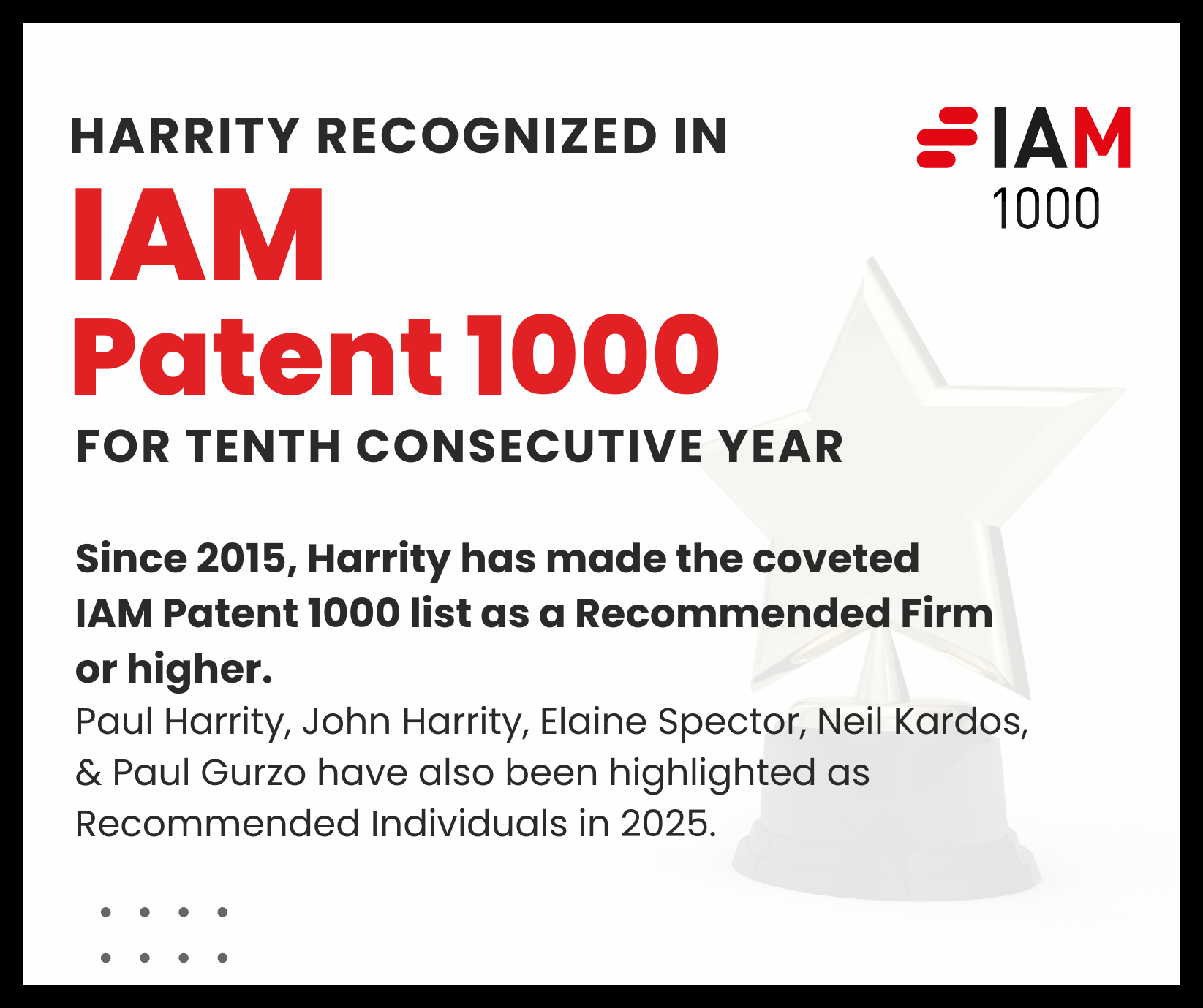
Harrity & Harrity Celebrates 10 Consecutive Years in the IAM Patent 1000

Harrity & Harrity Celebrates 10 Consecutive Years in the IAM Patent 1000

Harrity & Harrity is proud to mark our 10th consecutive year being recognized in the IAM Patent 1000, the definitive guide to the world’s leading patent professionals.

In the newly released 2025 edition, Harrity was again named a Highly Recommended Firm in the DC metro area, an honor we’ve earned seven times over the past decade.

In addition, several of our team members—Paul Harrity, John Harrity, Elaine Spector, Neil Kardos, andPaul Gurzo—were named as Recommended Individuals for their outstanding legal and technical expertise.

The IAM Patent 1000 is respected for its in-depth research and peer feedback, with this year’s analysis based on interviews with nearly 6,000 clients and IP professionals. Their findings highlight what distinguishes top firms today: not just deep technical knowledge, but also strategic foresight, efficient operations, and strong client relationships.

At Harrity, we’ve built our firm around those values. From our commitment to precision and quality, to our focus on accessibility, service, and innovation, we aim to exceed expectations in a rapidly evolving IP landscape.

To learn more about our team and approach, visit www.harrityllp.com.

Harrity Recognized as a 2025 Best Place to Work

Harrity & Harrity Named a Best Place to Work by Washington Business Journal

We are proud to announce that Harrity & Harrity has been named a Best Place to Work for 2025 by the Washington Business Journal, earning a score of 91.57 out of 100. This honor recognizes companies that go above and beyond in cultivating outstanding workplace cultures, based entirely on confidential employee feedback.

The Best Places to Work rankings evaluate key factors such as team dynamics, trust in leadership, communication, and overall employee engagement. Only the highest-scoring companies in the region are awarded this designation.

At Harrity, we’ve long believed that the best legal work starts with a strong internal foundation—one built on mutual respect, innovation, and a commitment to empowering our team. What makes this award especially meaningful is that it comes directly from the voices of our employees:

“The flexible hours allow me to balance my professional and personal life seamlessly… The senior management team is exceptional—they are approachable, supportive, and foster a culture of transparency and respect.”

“Overall, this is by far the best law firm I’ve worked for. Harrity really is remarkable and wonderful.”

“The company’s commitment to growth, both for the business and its employees, inspires me every day to contribute meaningfully and develop my own skills in the process.”

The word most used to describe our firm by our team was “innovative.” To us, innovation is more than technology or process—it’s about rethinking what a law firm can be, and continually evolving to better serve our clients, colleagues, and community.

To learn more about our workplace and career opportunities, visit www.harrityllp.com/careers.

Elaine Spector Named to WIPR Diversity & Inclusion Top 100 for 2025

We are excited to announce that Harrity & Harrity Partner Elaine Spector has been recognized as a Diversity Champion by World IP Review (WIPR) in their 2025 WIPR Diversity & Inclusion Top 100 People.

This prestigious recognition honors individuals who drive meaningful change and create a more accessible and equitable IP community. Elaine was selected through a combination of peer nominations and in-house research conducted by WIPR, underscoring the real-world impact of her efforts.

With over two decades of experience in intellectual property law, Elaine’s leadership extends beyond client service to a broad range of impactful initiatives. She currently serves as Vice Chair of the Intellectual Property Owners Association’s (IPO) Diversity Committee, a Board Member for Patent Pathways®, and an active participant in ADAPT (Advancing Diversity Across Patent Teams) efforts.

Elaine’s personal initiatives include Elevate, Empower, Enlighten (E³), a weekly vlog providing actionable equal opportunity tips, and Voices of Visionaries, a quarterly webinar series featuring insights from leaders who are advancing the future of IP.

In a climate where equal opportunity initiatives face unprecedented challenges, Elaine continues to be a vocal and unwavering advocate. As shared by WIPR, the Diversity & Inclusion Top 100 “offers hope—and leadership.”

Elaine has been outspoken on social media about the need to take a stand against the D&I backlash.

“As lawyers, we are uniquely positioned—and ethically obligated—to speak up, especially when others cannot. Silence may feel safe, but it comes at a cost. Let’s use our voices and our platforms to push back against injustice, misinformation, and intimidation. Now is not the time for indifference.”

At Harrity & Harrity, we are proud to celebrate Elaine’s accomplishments and her dedication to empowering the next generation of IP professionals.

To learn more about Elaine’s initiatives and Harrity’s commitment to breaking barriers in the IP profession, visit Our Commitment to Progress.

Harrity Ranked #1 in 2025 Large Firm Patent Quality Rankings by Patent Bots

Harrity & Harrity is proud to be recognized as the #1 Large Firm in the 2025 Patent Quality Rankings released by Patent Bots, marking our fourth consecutive year in the top spot.

Patent Bots uses advanced machine learning to analyze every patent issued by the USPTO—in 2025, that meant reviewing over 314,000 patents. Rankings are based on the average number of numbering errors, antecedent basis issues, and word support discrepancies, with firms grouped by size. Harrity ranked #1 among large firms (500+ issued patents), earning a Quality Score of 98.6 across 1,161 patents.

At Harrity, we’ve long integrated automation and rigorous review processes into our workflows—not only to minimize errors but to ensure our clients receive patents that are accurate, enforceable, and strategically sound.

Congratulations to all firms recognized for their dedication to raising the bar in patent prosecution.

Learn more about our approach to patent quality at www.harrityllp.com/services.

Harrity Featured in “Lawyer Life, Upgraded” Article on Boosting Productivity

Harrity Featured in “Lawyer Life, Upgraded” Article on Boosting Productivity

We’re excited to share that Harrity & Harrity has been featured in the recent article by Virtual Latinos: “Lawyer Life, Upgraded: Expert Tips to Boost Productivity”.

This insightful article brings together top advice from legal professionals across the industry, offering actionable tips on how to stay productive in an increasingly fast-paced and remote-friendly legal environment. From leveraging virtual assistants to embracing process efficiency, the article reflects the direction modern law firms are headed—leaner, smarter, and more human-centered.

We’re honored to be included among firms leading the charge toward a more efficient legal future. At Harrity, productivity isn’t just about getting more done—it’s about getting the right things done in the most impactful way.

Key topics covered in the article include:

  • How law firms are leveraging virtual assistants and delegation strategies to stay focused on high-value legal work
  • Why creating a systematic, repeatable approach to legal tasks is essential for both efficiency and accuracy
  • The role of a remote-first mindset in supporting flexible work and improving overall productivity

Harrity emphasizes in the article the importance of a streamlined, team-based approach to legal work:

“We’ve built a culture of process improvement and consistency. Every task is systematized, allowing our attorneys and support staff to work together seamlessly—no matter where they are.”

This approach not only improves outcomes for clients but also supports a healthier work-life balance for our team—a core part of our mission.

We’re proud to be recognized for the work we’re doing to modernize the practice of law and create a work environment where innovation and well-being go hand in hand.

👉 Read the full article here:
https://www.virtuallatinos.com/blog/legal-professional-productivity-tips/

To learn more about our team and approach to patent law, visit www.harrityllp.com.

Building Bridges: How Patent Pathways is Shaping a Diverse IP Future Featuring Elaine Spector

In a recent episode of the Knobbe IP+ podcast, Elaine Spector, Partner at Harrity & Harrity and advisory board member of Patent Pathways®, joined Terra Davis, Chief Diversity & Talent Development Officer at Knobbe Martens, for a powerful conversation about increasing diversity in the patent profession.

The discussion highlighted how Patent Pathways®, a program initiated by Harrity & Harrity, is addressing the lack of diversity in the intellectual property field. By creating a pipeline of diverse candidates, the initiative provides under-represented groups with resources such as education, mentorship, and financial support for the patent bar exam. The ultimate goal? To ensure the patent profession reflects the demographics of society at large.

Elaine shared how the program leverages data to identify diversity gaps and collaborates with law firms and corporate sponsors to offer participants comprehensive support. This includes mentorship, financial assistance, and hiring opportunities. Since its inception, Patent Pathways has grown significantly—now supporting 75 participants in its third year—and aims to continue expanding until the term “under-represented” no longer applies in the patent field.

The conversation also addressed how programs like Patent Pathways® are helping to combat the challenges of a shrinking profession by increasing the number of patent agents and attorneys entering the field.

If you’re passionate about fostering a more inclusive IP profession, this episode is a must-listen. Learn how you or your organization can partner with Patent Pathways®, contribute financial support, or engage in its impactful committee work.

Catch the full episode on Apple Podcasts, Spotify, or your preferred platform and learn more about Knobbe IP + Podcast here.

Join us at Patent Pathways®, where we empower individuals with the tools, knowledge, and connections they need to navigate the patent process successfully. Let’s build meaningful relationships that lead to lasting innovation.

Get involved below!

JOIN A PATENT PATHWAYS COMMITTEE
BECOME A MENTOR
BECOME A LAW FIRM PARTNER
BECOME A CORPORATE SPONSOR
APPLY TO PARTICIPATE IN PATENT PATHWAYS

Harrity Attorneys Honored by Best Lawyers®

We are proud to share that three of Harrity & Harrity’s attorneys have been recognized in the prestigious Best Lawyers® awards for 2025, reflecting their dedication to excellence in patent law.

  • Derek Abeyta: Recognized in the Best Lawyers: Ones to Watch® in America category, which honors attorneys early in their careers for outstanding professional achievements.
  • Paul Harrity and Elaine Spector: Both were included in The Best Lawyers in America®, a recognition that highlights lawyers for their professional accomplishments.

About the Recognition

Selections for Best Lawyers® are based entirely on peer review, highlighting the respect and admiration these attorneys have earned from their colleagues. This recognition underscores Harrity & Harrity’s commitment to quality, innovation, and teamwork in intellectual property law.

A Culture of Excellence

These honors reflect the collective efforts of our team and our focus on delivering exceptional client service while fostering a culture of diversity, collaboration, and efficiency. At Harrity, we take pride in the work we do to help protect innovations and support the needs of our clients.

Please join us in congratulating Derek, Paul, and Elaine on their recognition by Best Lawyers®! Their hard work exemplifies the values we strive for at Harrity & Harrity.

To learn more about our team and approach to patent law, visit www.harrityllp.com.

Harrity & Harrity Named a 2024 Best Family-Led Law Firm by Virginia Lawyers Weekly

Harrity & Harrity Named a 2024 Best Family-Led Law Firm by Virginia Lawyers Weekly

We are honored to announce that Harrity & Harrity has been featured as a Best Family-Led Law Firm for 2024 by Virginia Lawyers Weekly! This recognition highlights the profound impact of family-led law firms across the state of Virginia and celebrates their ability to foster continuity, innovation, and community engagement.

Founded by brothers John and Paul Harrity, Harrity & Harrity has grown into a leading intellectual property law firm with a strong focus on patent preparation and prosecution. Over the past 25 years, our firm has built a reputation for excellence by cultivating a collaborative culture that values teamwork, diversity, and efficiency.

What makes this recognition particularly meaningful is that it celebrates not just the professional achievements of family-led firms, but also their roles as pillars of their communities. At Harrity, this commitment extends far beyond the office walls. Through initiatives like Patent Pathways®, Harrity 4 Charity, the Minority Firm Incubator, and the Harrity for Parity Women’s Patent Workshop, we strive to give back to our communities, expand opportunities for underrepresented groups, and create a lasting, positive impact.

As we continue to innovate and evolve, we are proud to be recognized alongside other distinguished firms that share our values and dedication to service. Thank you to Virginia Lawyers Weekly for this honor, and congratulations to all the other firms recognized this year.

Visit our website to learn more about our story and ongoing initiatives: www.harrityllp.com.

A Second Chance at Life: The Power of CPR and Advocacy for Change

A Second Chance at Life: The Power of CPR and Advocacy for Change

At 49 years old, John Harrity was living his healthiest life with no signs of heart disease. Then, out of the blue, a Widowmaker heart attack changed everything. What could have been a tragic ending instead became a story of survival—thanks to CPR and quick action by a friend.

In those critical moments, a 911 dispatcher guided John’s friend through performing CPR, sustaining his life until professional help arrived. John’s survival highlights the incredible life-saving power of CPR, yet many are not as fortunate. The availability and accessibility of this knowledge can mean the difference between life and death, regardless of age, gender, or background.

John has since partnered with the American Heart Association (AHA) to raise awareness and improve outcomes for others. Together, they aim to close gaps in care, particularly those driven by gender disparities in CPR administration. At the AHA’s recent Scientific Sessions, new research emphasized how 911 dispatchers play a pivotal role in bridging these gaps, ensuring that both men and women receive timely, life-saving intervention.

Hear John’s story below.


John’s message is clear: education and preparation save lives. By learning CPR and advocating for equitable access to life-saving knowledge, we can create a future where more people have a fighting chance.

Give the Gift of Hope This Holiday Season

This holiday season, you have the opportunity to join the fight for heart health and support life-saving initiatives. Harrity 4 Charity is committed to making a difference. We are matching up to $25,000 in donations made to the American Heart Association through the end of the year.

Your contribution can help fund groundbreaking research, educational programs, and resources that save lives. Every dollar you give will have double the impact, ensuring that more families have the chance to celebrate another holiday together.

Take action today. Donate to the American Heart Association and help us build a healthier, safer future for everyone. Together, we can close gaps, save lives, and create lasting change.

Make Your Donation Here

Let’s make this season one of generosity, hope, and life-saving impact.


About Harrity 4 Charity

Harrity 4 Charity represents a partnering of law firm Harrity & Harrity, LLP, with charities that are near and dear to our hearts. Harrity pledges to give five percent of profits to partner charities and all Harrity employees pledge to donate a portion of their paychecks. Harrity & Harrity is a patent preparation and prosecution firm specializing in the electrical and mechanical technology areas and is considered a Go-To Firm for the Patent 300 ™. Our clients have come to trust in our high-quality work, experienced people, industry leading innovation, and outstanding service. For more information, visit harrityllp.com.

Autonomous Vehicles: Driving Innovation


By Ayana Marshall, PhD

Autonomous Vehicles: Driving Innovation 

Autonomous vehicles (AVs), commonly referred to as self-driving cars, use a combination of sensors, cameras, radar, and artificial intelligence (AI) to navigate their surroundings and make driving decisions without human intervention. 

Patent Age Distribution: Insights into Innovation Maturity 

The age distribution of patents in the autonomous vehicle sector provides valuable insights into the maturity of innovation within this industry. A histogram of patent data reveals that the majority of patents are concentrated in younger age brackets. The largest group of patents falls within the 2–4-year range, followed by those aged 4–6 years, with portfolio sizes steadily decreasing as patents age.  

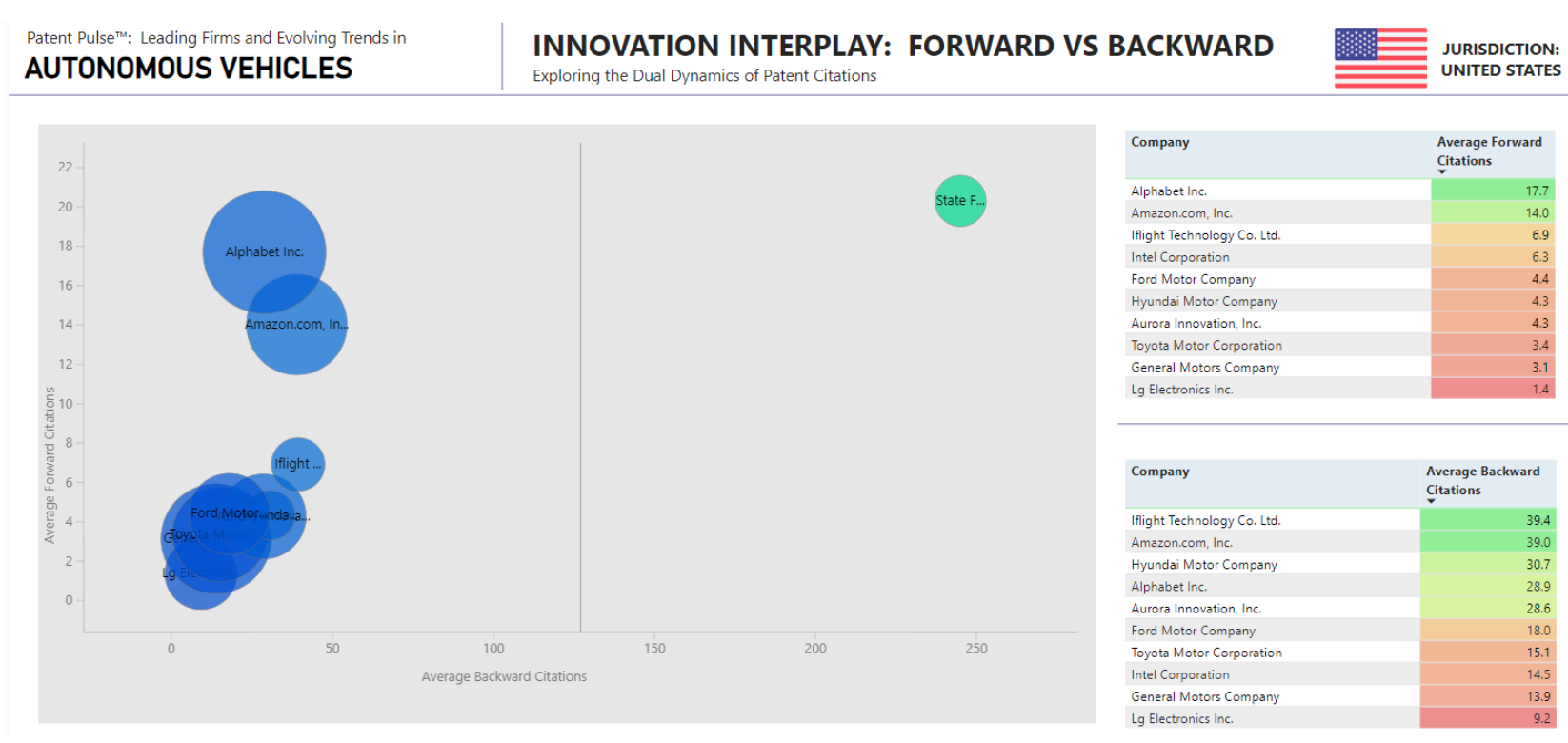
Forward and Backward Citations: Innovation Interplay 

An analysis of patent citation dynamics further illustrates the competitive landscape of the autonomous vehicle industry. Forward citations, which indicate how often a patent is referenced by later inventions, and backward citations, reflecting references to prior patents, provide a comprehensive view of companies’ innovative strategies. Alphabet Inc. and Amazon.com, Inc. lead in forward citations while Iflight Technology Co. Ltd. has the highest average backward citations. This balance between advancing future technologies and leveraging prior knowledge demonstrates the interplay of innovation within the sector. 

Insights from Patent Activity 

The data on autonomous vehicle patents highlights a technology field where companies are both influencing future developments and building on prior achievements through the interplay of forward and backward citations. Together, these insights paint a picture of the autonomous vehicle industry, showcasing the ongoing advancements in this field. 

Data Source 

The data is sourced from the Harrity Analytics Patent Pulse™ Report on Autonomous Vehicles.  For more information about the Patent Pulse™ Report visit our website HERE, download a complimentary Patent Pulse Report HERE, or contact Harrity Analytics HERE. 


Driving the Future: Exploring Patenting in Autonomous Vehicle Technology


By Ayana Marshall, PhD

Autonomous vehicles (AVs), or self-driving cars, rely on sensors, cameras, radar, and artificial intelligence (AI) to navigate and operate without human input. The Society of Automotive Engineers (SAE) defines six levels of automation, ranging from Level 0 (no automation) to Level 5 (full automation in all conditions). As this technology evolves, what role do patents play in shaping its future?  

Patent Leaders in Autonomous Vehicle Technology 

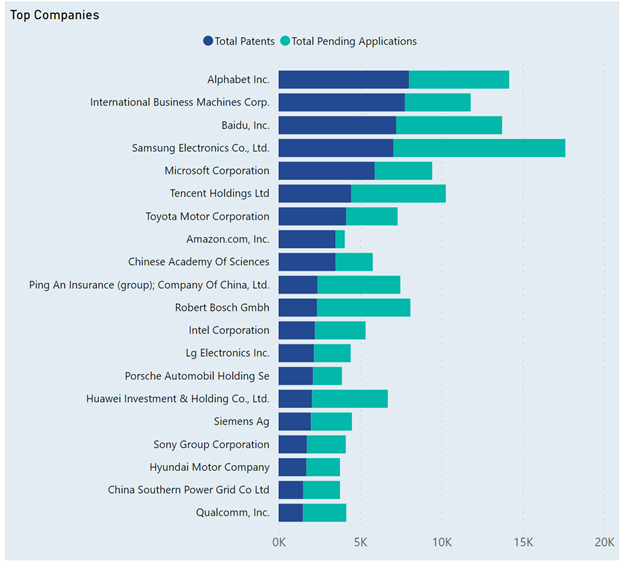
The chart highlights the top companies driving innovation in autonomous vehicle technology based on their total patents and pending applications. Toyota Motor Corporation leads followed by Alphabet Inc., through its subsidiary Waymo, also demonstrates a strong presence, closely followed by General Motors and other major players such as Robert Bosch GmbH, Ford Motor Company, and Amazon.com, Inc. Notably, the variety of companies—ranging from traditional automakers like Hyundai and Nissan to prominent technology companies like Intel and Amazon—illustrates the multidisciplinary nature of autonomous vehicle development.  

Trends in Patent Age and Activity Over Time 

Continuing from the previous discussion on patent activities, the bar chart reflects the trend of patent ages in the autonomous vehicles sector from 2014 to 2023. It shows two sets of data: the number of total patents and total pending patent applications per year. The chart indicates a growing stack of pending applications atop the existing patents over the years. The average age of these patents is noted as 4.8 years.  

Insights from Patent Activity 

The data on autonomous vehicle technology patents reveals a dynamic and competitive landscape, showcasing an active environment of innovation. Leading companies have built substantial patent portfolios, reflecting their commitment to advancing the field. Additionally, the interplay of forward and backward citations highlights the sector’s balance between influencing future developments and building on prior innovations. Together, these insights offer a detailed view of the evolving autonomous vehicle industry. 

The data is sourced from the Harrity Analytics Patent Pulse™ Report on Autonomous Vehicles.  For more information about the Patent Pulse™ Report visit our website HERE, download a complimentary Patent Pulse Report HERE, or contact Harrity Analytics HERE. 


Harrity 4 Charity Announces 2024 Charitable Contribution Matching Campaigns

Harrity 4 Charity, the giving-back initiative of Harrity LLP, is excited to announce our 2024 Giving Matches. Now through the end of the year, we will be matching gifts made to our Harrity 4 Charity partners.

Harrity 4 Charity will be matching donations gifted to Inova Children’s Hospital, ZERO—The End of Prostate Cancer, Patent Pathways®, and the American Heart Association for our 2024 matching campaign! Please consider making a donation to have your impact doubled.

Patent Pathways®

Running through 12/31, Harrity 4 Charity is matching donations made to Patent Pathways®! Every donation up to $25,000 will be matched to provide essential trainings that support equal opportunity in the patent field. Click here to donate to Patent Pathways®.

Inova Children’s Hospital

Harrity 4 Charity will double $75,000 of donations made to Inova Children’s Hospital from now until the end of the year. All donations will go directly towards purchasing toys and books during the holidays for Poppy’s Toy Drive — an initiative started by eight-year old cancer survivor, Poppy, who spent 160 days at Inova in 2018. More than that, your gift also provides ongoing support for children undergoing treatment and surgery at Inova Children’s Hospital all year long. Click here to donate to Poppy’s Toy Express and Inova Children’s.

American Heart Association

Harrity 4 Charity will be continuing our support of the American heart association with an end of year matching campaign up to $25,000! Donations made to the American Heart Association, the largest non-profit organization dedicated to fighting heart disease, through the upcoming Lawyers Have Heart event will be doubled through 12/31. Click here to donate and to register for the 2025 LHH 5K, 10K and Fun Walk on May 17th, virtually or in-person. You can also make a donation by simply texting ‘RUNLHH’ to 41444.

ZERO: The End of Prostate Cancer

Harrity 4 Charity is proud to support ZERO: The End of Prostate Cancer with a one-day 4X match! Stay tuned for the full match amount and date, which will be announced in December. You can join the fight against prostate cancer and support prostate cancer education, testing, patient support, research and advocacy by donating here.


About Harrity 4 Charity

Harrity 4 Charity represents a partnering of law firm Harrity & Harrity, LLP, with charities that are near and dear to our hearts. Harrity pledges to give five percent of profits to partner charities and all Harrity employees pledge to donate a portion of their paychecks. Harrity & Harrity is a patent preparation and prosecution firm specializing in the electrical and mechanical technology areas and is considered a Go-To Firm for the Patent 300 ®. Our clients have come to trust in our high-quality work, experienced people, industry leading innovation, and outstanding service. For more information, visit harrityllp.com.

Navigating the Future of Sustainable Transport: Patent Trends in Electric Vehicles and Electrified Roadways


By Ayana Marshall, PhD

Electric vehicles (EVs) and electrified roadways represent two major technological advances in sustainable transportation, each with distinct developments. Electric vehicles have become a cornerstone of efforts to reduce emissions, and many countries are adopting EV technologies. This transition has seen continuous growth in innovation, with countries across Europe and the U.S. investing in charging infrastructure and battery technologies to support the increasing number of EVs on the road. 

Electrified roadways are an emerging technology designed to support electric vehicles by providing a dynamic charging solution as the vehicles move. Sweden is currently leading this effort, constructing the world’s first permanent electrified road on a section of one the highways, expected to be operational by 2025. This road, among several being tested in Europe, will allow vehicles to charge while driving using one of several technologies, including inductive or conductive systems embedded in the road. Electrified roadways could reduce dependency on large vehicle batteries and further accelerate the transition to electric transport by alleviating range anxiety and reducing the demand for stationary charging. 

Patent Trends in Electric Vehicles and Electrified Roadways: A Comparative Analysis 

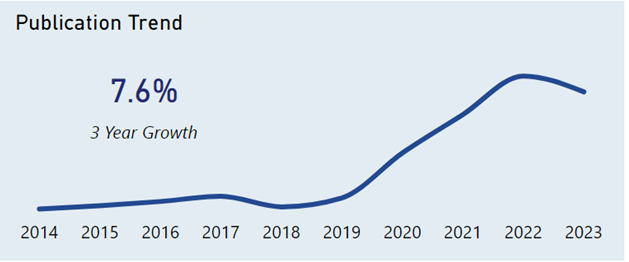
While both electric vehicles (EVs) and electrified roadways represent key innovations in sustainable transportation, their development trajectories, as seen through patent publications, reveal notable differences. Patent publication trends for Electric Vehicles and Electrified Roadways reveal distinct patterns over the past decade. From 2014 to 2022, electric vehicle-related publications steadily increased but show a -3.1% decline in three-year growth, suggesting a recent slowdown.  

In contrast, Electrified Roadways has seen a more variable trend, with notable peaks around 2018-2019 and 2023, and a significant 35.6% growth over the last three years. This comparison highlights differing trajectories in patent activity, with electrified roadways showing a marked increase in recent innovations compared to the decreasing trend in electric vehicles. 

Top Companies Driving Electrified Roadway Innovation: A Patent Overview 

These trends reflect the growing interest in exploring diverse solutions to increase the sustainability features of the transportation sector, and Electrified Roadways have garnered attention from a range of innovators. The patent landscape in this field includes key players such as Beijing Boyang Dingrong Pv Technology Co., Ltd., Zhong Hui Powerise Wireless Power Technology Ltd., Toyota Motor Corporation and Ford Motor Company, with Toyota standing out due to a number of pending applications. Other major contributors include General Motors and Siemens AG. Academic institutions like South China University of Technology and Nanjing University of Technology are also prominent, along with Hevo Incorporated, which is involved in wireless power transfer solutions. Capactech Limited and other organizations complete this landscape of patent holders in the electrified roadway sector. 

Building on the Past: Key Innovators through the Lens of Backward Citations 

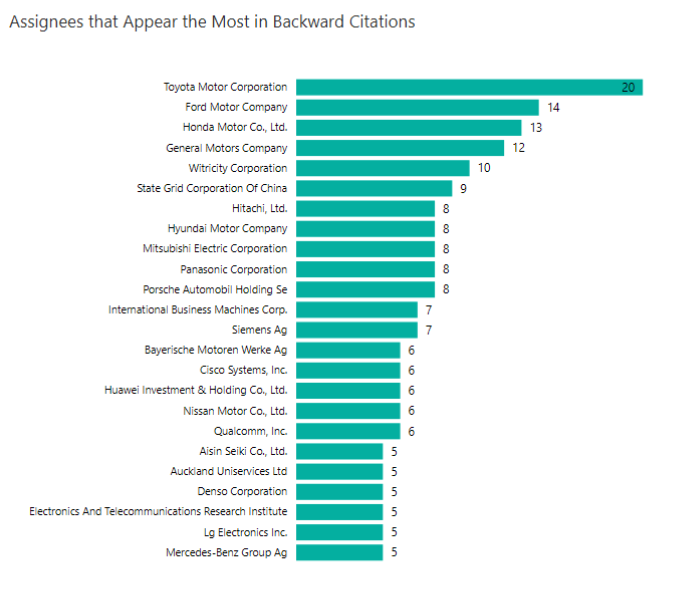
Following the analysis of top companies driving innovation in Electrified Roadways, the data on backward citations further highlights key players in the electric vehicle and roadway sectors. The chart lists the top assignees that appear most frequently in backward citations. Toyota Motor Corporation leads with 20 citations, followed by Ford Motor Company with 14, and Honda Motor Co., Ltd. with 13. Other notable companies include General Motors, WiTricity Corporation, and State Grid Corporation of China, each contributing to significant technological influence through frequent citations. Additional companies such as Hitachi, Ltd., Siemens AG, and Cisco Systems, Inc. are also present, showcasing a wide array of global leaders impacting the development of electric vehicle and roadway technology through their foundational innovations. 

Summarizing the Electric Vehicles and Electrified Roadways Landscape 

The patent trends for Electric Vehicles and Electrified Roadways reveal a landscape focused on transforming the future of transportation. While electric vehicle innovation shows a recent slowdown, electrified roadways are seeing a surge in new developments. Leading companies such as Beijing Boyang Dingrong Pv Technology Co., Ltd., Zhong Hui Powerise Wireless Power Technology Ltd., Toyota, Ford, and Siemens are driving this innovation, and the backward citation data underscores their technological influence, along with other major players like Honda and WiTricity. Together, these trends and key contributors highlight a path towards creating a more efficient and sustainable transportation infrastructure via dynamic charging solutions. 

The data is sourced from the Harrity Analytics Patent Pulse™ Reports on Electric Vehicles and Electrified Roads.  For more information about the Patent Pulse™ Report visit our website HERE, download a complimentary Patent Pulse Report HERE, or contact Harrity Analytics HERE. 

Resources: 

https://thenextweb.com/news/sweden-worlds-first-permanent-e-road-for-ev-charging-while-driving 

https://www.electrive.com/2023/05/09/sweden-pioneers-permanent-electrified-road-to-charge-evs-on-the-move/ 

https://www.popsci.com/technology/sweden-electric-highway/ 

https://mobilityportal.eu/5-european-countries-projects-electrified-roads/ 

https://www.purdue.edu/newsroom/2024/Q2/building-the-first-highway-segment-in-the-u-s-that-can-charge-electric-vehicles-big-and-small-as-they-drive/ 

https://www.archpaper.com/2024/04/electric-charging-roads-next-new-thing/ 


Gate Keepers vs. the Hindered: 102 Blocking in Artificial Intelligence for Wireless Telecommunications


By Ayana Marshall, PhD 

In the rapidly evolving sector of wireless telecommunications, Artificial Intelligence (AI) is driving major innovations, from network optimization to intelligent data processing. As companies race to secure patents that protect their innovations, 102 blocking patents play a critical role in shaping the competitive landscape. These patents—granted to earlier innovations—can prevent new applications from being approved. The Patent Pulse™ report delves into this landscape, highlighting the major players that hold blocking patents and those that frequently encounter barriers.  


Gate Keepers: Controlling the Flow of AI Patents in Wireless Telecommunications 

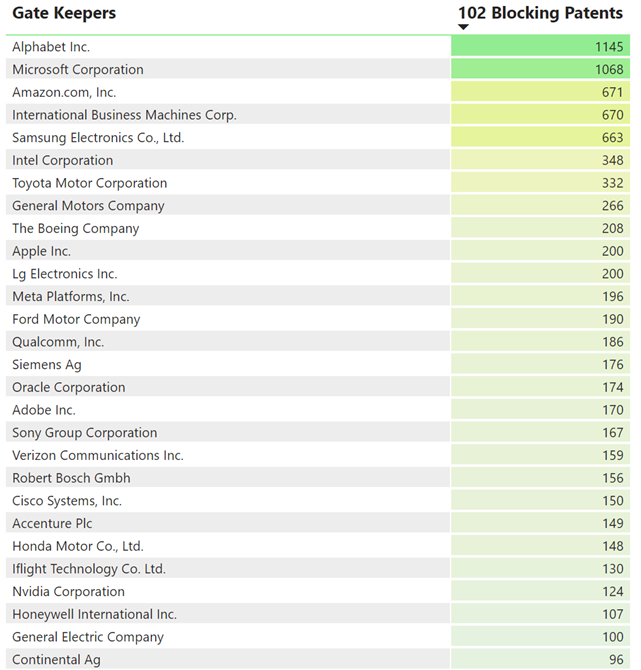
In the AI-driven wireless telecommunications industry, certain companies stand out as “gatekeepers”. Samsung Electronics Co., Ltd. leads this category, with 144 blocking patents. LG Electronics Inc. and Alphabet Inc. follow with 62 and 12 blocking patents, respectively, while companies like Microsoft and Intel also hold portfolios that play a role in defining the boundaries for future innovations.  

The Hindered: Companies Facing Patent Roadblocks 

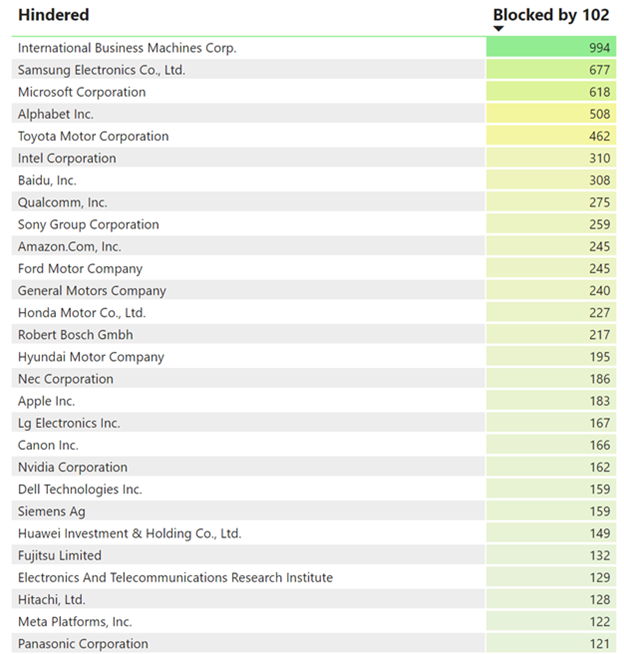
On the other side of the equation are the companies whose patent applications are frequently hindered by blocking patents. Samsung Electronics Co., Ltd., a top gatekeeper, faces obstacles in 28 instances. Other notable companies on the hindered list include Telefonaktiebolaget LM Ericsson, LG Electronics Inc., and Nokia Corporation 

The Strategic Importance of AI Patents in Wireless Telecommunications 

The AI patent landscape in wireless telecommunications includes companies that own patents that protect early innovations. For companies on the hindered side, understanding the patent ecosystem and finding ways to innovate around existing claims are crucial for maintaining a competitive edge. 

The Harrity Analytics Patent Pulse™ report provides critical insights into this dynamic, helping companies understand where they stand in the race for AI-driven innovation in wireless telecommunications. The data is sourced from the Patent Pulse™ Report on Artificial Intelligence for Wireless Telecommunications.  For more information about the Patent Pulse™ Report visit our website HERE, download a complimentary Patent Pulse Report HERE, or contact Harrity Analytics HERE. 

Tech Titans 2024: Top 25 Innovators in 3D Printing

Introduction

The field of 3D printing continues to revolutionize industries across the globe, from aerospace to healthcare, enabling the creation of complex, customized components with unprecedented precision. As the technology advances, so does the competitive landscape, with companies vying for leadership through innovation and patent portfolios. In this annual edition of “Tech Titans,” we spotlight the top 25 companies that are driving the future of 3D printing through their patents and pending applications. These innovators are not only shaping the present but also paving the way for tomorrow’s breakthroughs.

Top 25 Companies Patenting in 3D Printing Technology

Ranking Company Total Patents and Pending Applications Key Highlight
1 GE Aerospace 3,130 GE Aerospace maintains its dominance with an expansive portfolio, leading in additive manufacturing.
2 HP Inc. 2,831 HP Inc. is a major player in 3D printing, with a steady increase in patent filings over the past five years.
3 RTX Corporation 1,908 RTX Corporation makes significant strides in aerospace and defense sectors through 3D printing.
4 Stratasys Ltd. 1,588 Stratasys leads in polymer technologies, influencing industries from healthcare to automotive.
5 Xerox Corporation 1,477 Xerox focuses on industrial applications and materials innovation in 3D printing.
6 The Boeing Company 1,232 Boeing heavily invests in 3D printing for aerospace, focusing on reducing component weight.
7 Seiko Epson Corporation 1,004 Seiko Epson advances in precision engineering with high-resolution 3D printing technologies.
8 Safran SA 990 Safran focuses on using 3D printing in aerospace for component production and material performance.
9 3D Systems Corporation 934 3D Systems innovates in hardware and software, enabling new possibilities in manufacturing and healthcare.
10 Chinese Academy of Sciences 844 Chinese Academy of Sciences pushes boundaries in 3D printing technology across various scientific fields.
11 Siemens AG 760 Siemens optimizes manufacturing processes with 3D printing across multiple industries.
12 Mitsubishi Gas Chemical Company, Inc. 664 Mitsubishi Gas Chemical pioneers new materials for 3D printing, enhancing durability and versatility.
13 Xian Jiaotong University 602 Xian Jiaotong University leads in bioprinting and advanced materials research.
14 Ricoh Company Ltd. 654 Ricoh expands its portfolio in additive manufacturing, focusing on industrial applications.
15 EOS GmbH Electro Optical Systems 641 EOS GmbH is a leader in metal 3D printing, providing solutions for high-performance industrial applications.
16 Resonac Corporation 613 Resonac innovates in chemical engineering, using 3D printing for advanced material production.
17 Arkema SA 589 Arkema develops specialty materials for 3D printing, enhancing printed objects’ properties.
18 Canon Inc. 559 Canon leverages precision machinery expertise to advance 3D printing in optics and electronics.
19 Robert Bosch GmbH 542 Bosch integrates 3D printing into manufacturing to improve efficiency in automotive and industrial sectors.
20 BASF SE 530 BASF focuses on developing new materials that enhance the mechanical properties of 3D printed parts.
21 Applied Materials, Inc. 516 Applied Materials utilizes 3D printing for semiconductor manufacturing, driving electronics innovation.
22 Huazhong University of Science & Technology 516 Huazhong University advances 3D printing technologies for medical applications, particularly in bioprinting.
23 Nike, Inc. 491 Nike revolutionizes sportswear with 3D printing, particularly in footwear design and customization.
24 Siemens Energy AG 489 Siemens Energy uses 3D printing to enhance energy efficiency and sustainability in power generation.
25 Shenzen Creality 3D Technology 294 Creality drives consumer-grade 3D printing, making it more accessible to hobbyists and small businesses.


In-Depth Analysis

The 3D printing landscape is characterized by significant competition among both industrial giants and emerging innovators. Companies with a high “blocking patent index,” such as Stratasys Ltd. and 3D Systems Corporation, are using their portfolios to create competitive barriers, making it more challenging for others to enter the market. The high “average number of forward citations” seen in companies like Carbon Inc. and EOS GmbH suggests that these portfolios are influential in driving the direction of future innovations.

3d printing

Looking ahead, the continued evolution of materials science, coupled with advancements in precision manufacturing, will likely expand the applications of 3D printing across new industries. Companies that can effectively combine innovation with strategic patenting will remain at the forefront of this rapidly evolving field.

Patent Analytics On-Demand

Explore our Patent Analytics Services to gain insights into the latest trends, competitor activities, and strategic opportunities in your technology area. Our tools and expertise help you stay ahead of the curve in the rapidly evolving world of advanced robotics.  Learn more about our services HERE.

Conclusion

The top 25 innovators in 3D printing are not just leading the market—they are shaping the future of manufacturing and design. Stay tuned for our next installment of “Tech Titans,” where we will explore the cutting-edge developments in another transformative technology.

Neuromorphic Revolution: Patents Fueling the Future of Brain-Inspired Computing

Neuromorphic Revolution: Patents Fueling the Future of Brain-Inspired Computing
By Ayana Marshall, PhD 

Neuromorphic chips and neuromorphic computing are innovative technologies that are promising to revolutionize the way information is processed. Inspired by the architecture and functioning of the human brain, the chips are designed to mimic neural networks, enabling faster, more efficient, and adaptive computing (Mead, 1990; Indiveri & Liu, 2015). The current landscape of neuromorphic chip development is explored through an analysis of patents and pending application data. 

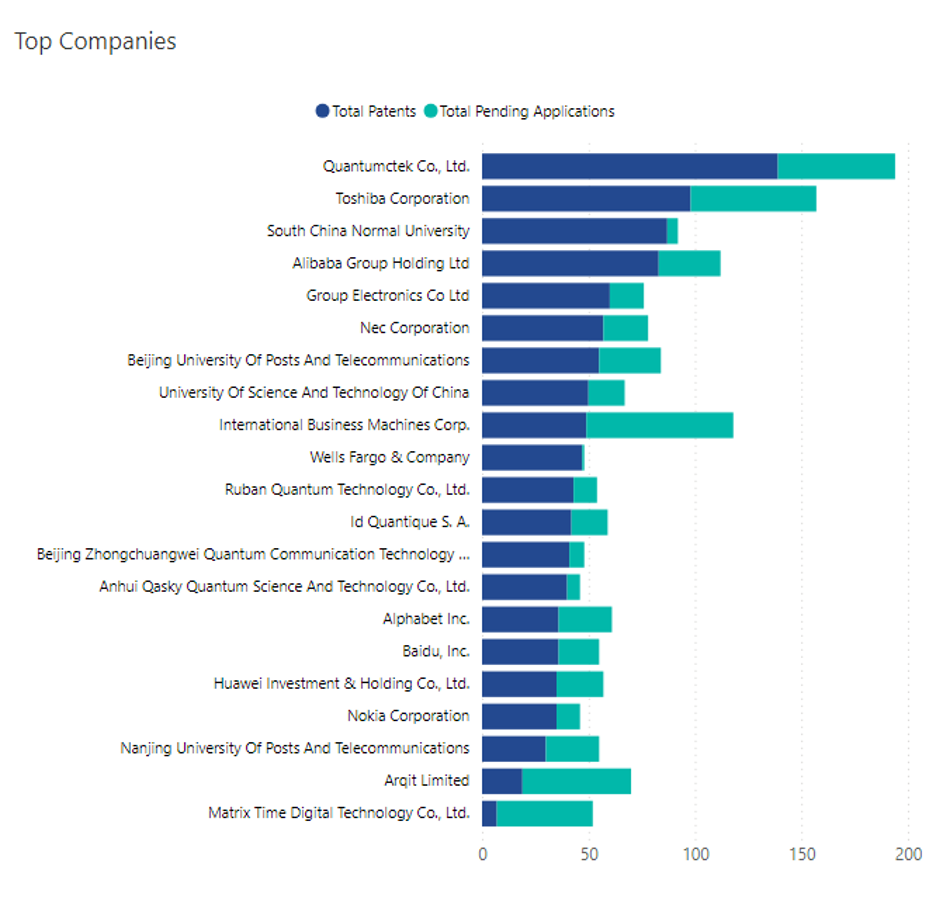
The key players driving innovation in this field are included on the chart. 

  • International Business Machines Corp. (IBM) and Samsung Electronics Co., Ltd. have the most patents and pending applications, which are followed by Intel Corporation.
  • The data also underscores the contributions of South Korean companies and institutions, such as SK Hynix Inc. and Seoul National University. 
  • American corporations in this space include General Motors Company, Microchip Technology Inc., and Qualcomm, Inc. 
  • Applied Brain Research Inc., a Canadian company, is also represented.
  • European and Chinese institutions highlight the diverse range of international players working in the neuromorphic technology space. For example, the Commissariat à l’énergie atomique et aux énergies alternatives (CEA) from France, and Tsinghua University and Peking University from China. 
  • This distribution of patents and pending applications underscores the strategic importance of neuromorphic technology in companies across different regions. 


Neuromorphic Chips: A Snapshot of Key Developments 

  1. Intel’s Loihi 2 Chip: Intel launched the Loihi 2 chip a few years ago, enhancing neuromorphic computing with better performance and scalability, alongside the new Lava software framework for AI applications (Intel Newsroom). More recently, Intel unveiled the largest-ever neuromorphic computer, Hala Point, which is powered by over one thousand Loihi 2 processors. Hala Point is designed to mimic the human brain by processing data through spiking neural networks while achieving massive energy efficiency and computational capacity for AI tasks (Hala Point). 
  1. IBM’s Brain-Inspired Research: IBM is advancing brain-inspired computing, integrating neuromorphic chips into AI and cognitive systems, aiming to revolutionize industries like healthcare and finance (IBM Research Blog).


The chart provides a comparative analysis of key players in the neuromorphic chip industry, focusing on the Technological Diversity and Influence (measured by forward citations per patent) metrics.

International Business Machines Corp. (IBM): Leads in Tech Diversity with a score of 61.
Samsung Electronics Co., Ltd.: Ranks in both Tech Diversity and Influence.
Tsinghua University: Has the highest average forward citations per patent (4.9).
General Motors Company: Notable for a high Influence score (3.6). 

Summarizing the Neuromorphic Chip Landscape 

The data analysis presented throughout this discussion has provided a view of the current landscape in neuromorphic chip innovation. IBM and Samsung Electronics stand out for the volume of their patent portfolios and broad technological diversity. The comparative analysis also highlighted the influence of Tsinghua University through its highly cited patents. Companies such as General Motors and Intel show a balance between technological diversity and influence. Overall, the analysis highlights both patent volume and technological diversity in neuromorphic chip innovation, with key players contributing through either technological breadth or influential patents. 

The data is sourced from the Harrity Analytics Patent Pulse™ Report on Neuromorphic Chips.  For more information about the Patent Pulse™ Report visit our website HERE, download a complimentary Patent Pulse Report HERE, or contact Harrity Analytics HERE. 


Closing the Innovation Gap: How Patent Pathways is Driving Diversity in Patent Law

On Friday, September 20, 2024, Harrity Partner and Patent Pathways’ Board Member Elaine Spector participated in a pivotal discussion at the Innovator Diversity Pilots Conference, held at Emory University’s School of Law. The conference, hosted in the esteemed Tull Auditorium, brought together a range of voices dedicated to fostering inclusion in the intellectual property and innovation ecosystem. Elaine was joined by Braxton Davis, Senior Patent Counsel at Meta, in a conversation that highlighted the challenges facing underrepresented groups in patent law and the importance of programs designed to address these disparities.


Breaking Barriers in Patent Law

Patent law remains a field where many individuals from historically marginalized groups—especially women, people of color, and those from lower-income backgrounds—face substantial barriers to entry. The path to becoming a patent practitioner can be daunting, not due to a lack of talent or ambition, but due to structural barriers such as financial constraints, a lack of mentorship, and limited awareness of the career pathways available in this field. As a result, the innovation ecosystem misses out on a wealth of ideas and perspectives, perpetuating an “innovation gap” that limits the diverse contributions crucial for groundbreaking advancements.

This gap is particularly concerning given that innovation thrives on diverse perspectives. Without the inclusion of voices from underrepresented groups, the field of intellectual property loses out on fresh ideas and solutions that could drive meaningful progress in technology and beyond.

How Patent Pathways is Driving Change

To address these challenges, programs like Patent Pathways play a vital role. By offering free, virtual education, practical training, one-on-one mentorship, and financial support, Patent Pathways is dedicated to breaking down the barriers that often prevent underrepresented individuals with STEM degrees from pursuing careers in patent law. These resources provide aspiring patent professionals the tools they need to take and pass the patent bar exam, positioning them for success in a highly specialized field.

This kind of support is more than just educational—it’s transformational. By building a network of mentors, offering hands-on experience, and providing financial assistance, Patent Pathways is not just creating opportunities for individuals, but also fostering a more inclusive and innovative patent law landscape.

How You Can Help

The conversation at the Innovator Diversity Pilots Conference underscores the need for active participation in fostering diversity in patent law. Patent Pathways is committed to being part of the solution, but our impact can be greater with the support of volunteers, partners, sponsors, and participants.

Here’s how you can get involved:

  • Volunteer: Offer your expertise as a mentor to aspiring patent agents and attorneys. Your guidance can be instrumental in helping them navigate the patent bar exam and their subsequent careers in the field.
  • Partner: If you represent a corporation, law firm, or educational institution, consider partnering with Patent Pathways to provide additional resources such as internships, pro bono support, or financial contributions to help our participants succeed.
  • Sponsor: Your sponsorship can make a real difference in the lives of aspiring patent practitioners by covering essential costs such as exam fees, study materials, and other program-related expenses.
  • Participate: If you’re a STEM graduate from an underrepresented community interested in patent law, we encourage you to join our next cohort. You’ll have access to educational resources, mentorship, and financial assistance designed to help you take the next step in your career.

Building a More Inclusive Future in Patent Law

Innovator Diversity Pilots Conference made one thing clear: diversity in patent law is not just about fairness; it’s about the future of innovation. By creating pathways for underrepresented individuals to enter the field, we open the door to new ideas, unique perspectives, and innovations that benefit us all.

At Patent Pathways, we believe that while talent is equally distributed, opportunity is not. But with the right resources, guidance, and support, we can change that.

Take action today! Whether you’re an individual looking to mentor or a company wanting to create lasting change, Patent Pathways offers meaningful ways to get involved. Visit Patent Pathways to learn more about how you can support our mission to make patent law more inclusive and accessible.

Together, we can close the innovation gap and build a more diverse and dynamic future for patent law. Let’s create change—one pathway at a time.

JOIN A PATENT PATHWAYS COMMITTEE
BECOME A MENTOR
BECOME A LAW FIRM PARTNER
BECOME A CORPORATE SPONSOR
APPLY TO PARTICIPATE IN PATENT PATHWAYS


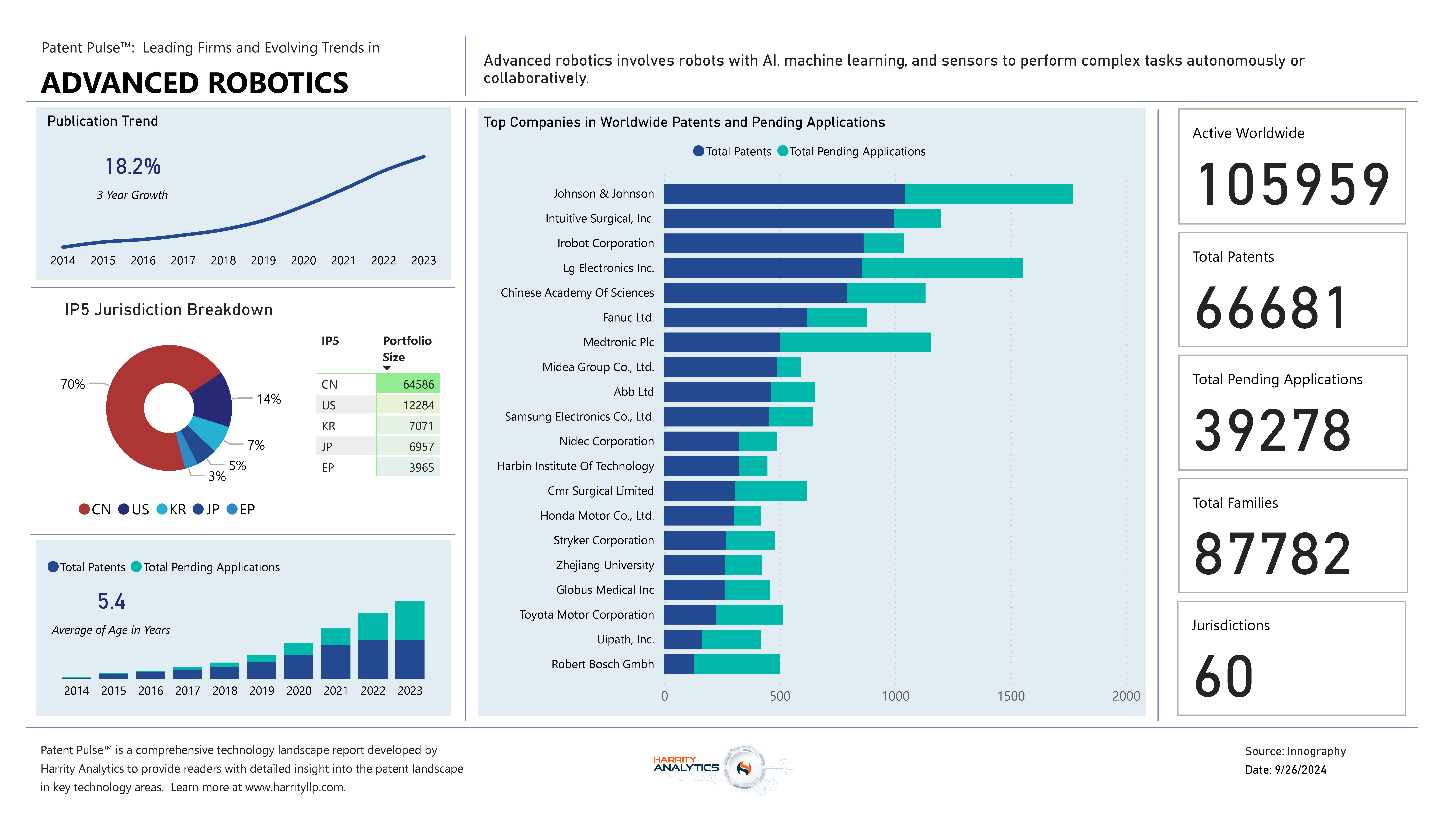
Tech Titans 2024: Top 25 Advanced Robotics Innovators

Introduction

In the ever-evolving world of advanced robotics, innovation drives the industry forward, shaping the future of automation, artificial intelligence, and human-robot collaboration. This year’s “Tech Titans” post highlights the top 25 companies leading the charge in advanced robotics patents and pending applications. These companies are not only shaping the landscape today but also laying the groundwork for the technological advancements of tomorrow.

Trends and Competitive Landscape

The data in this year’s report highlights several key trends in the advanced robotics industry:

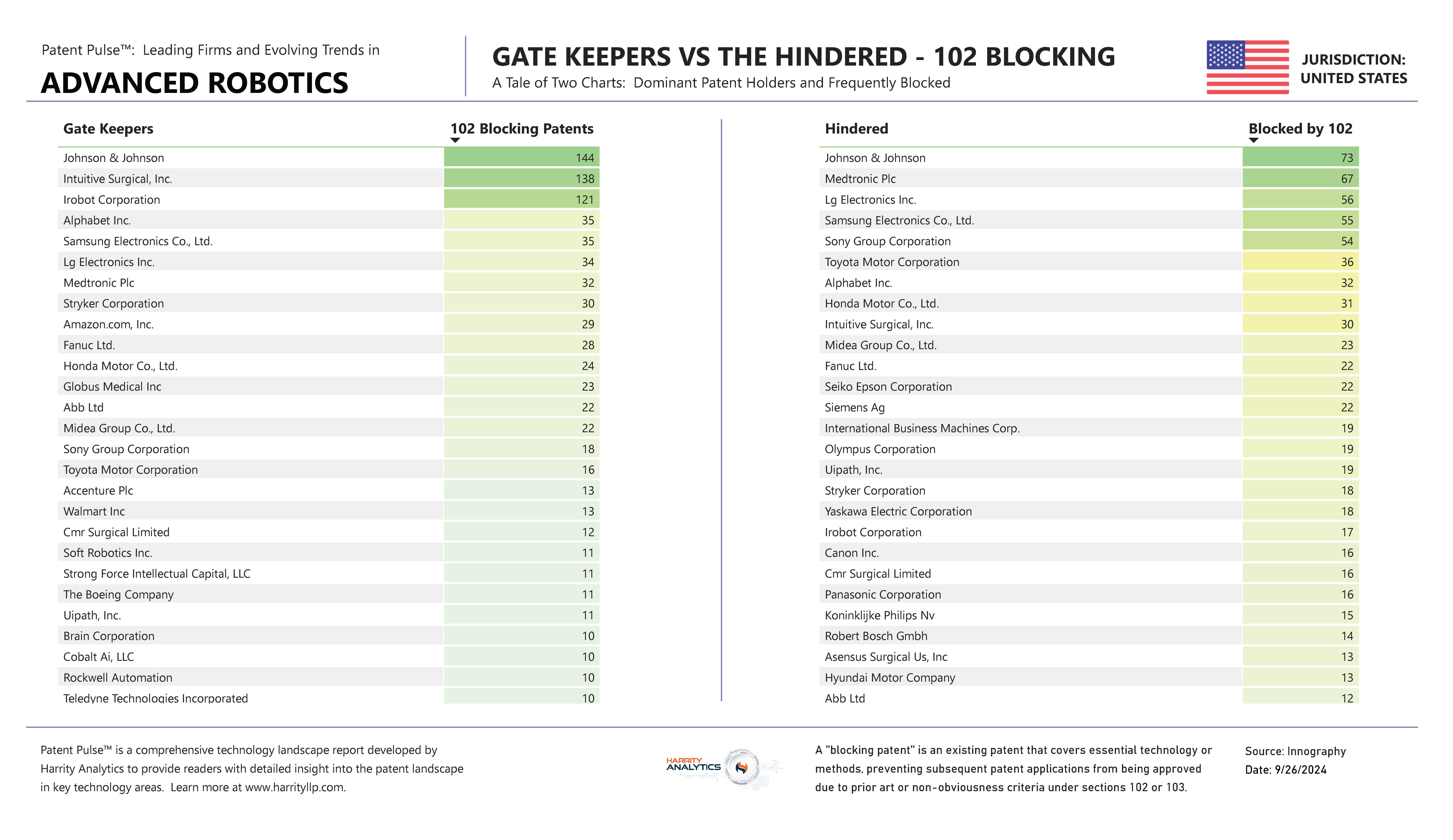
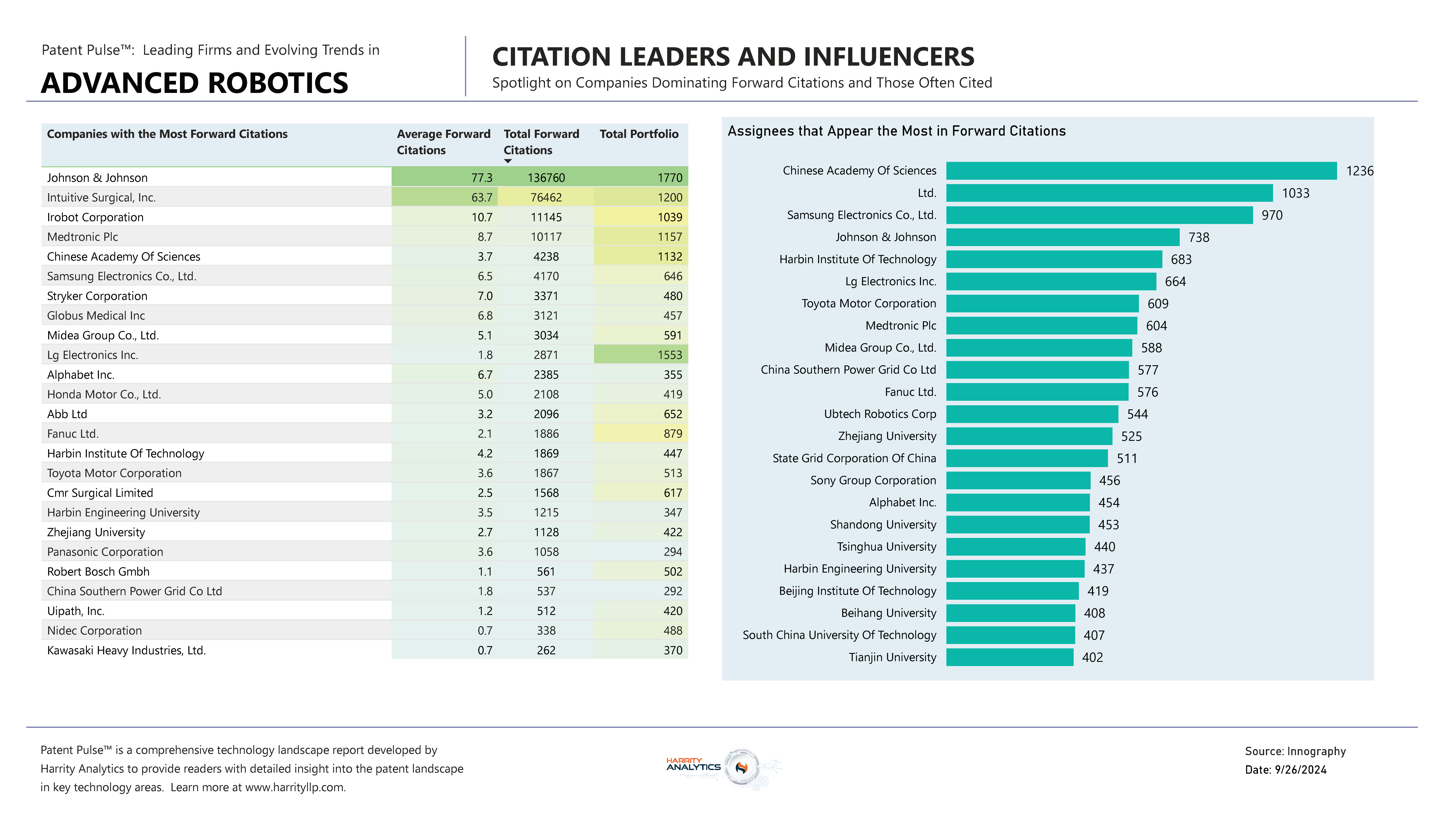
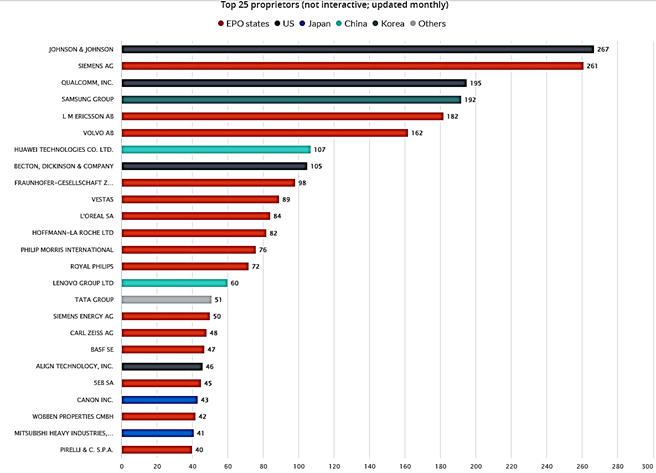
  1. Blocking Patent Index and Forward Citations: Companies with a high Blocking Patent Index and a significant number of forward citations, such as Johnson & Johnson and Intuitive Surgical, indicate strong and influential patent portfolios. These companies are effectively shaping the direction of technological advancements in robotics.
  2. Global Distribution of Patents: The top innovators are not limited to a single region; companies from the United States, China, and Japan dominate the list, reflecting the global nature of robotics innovation.
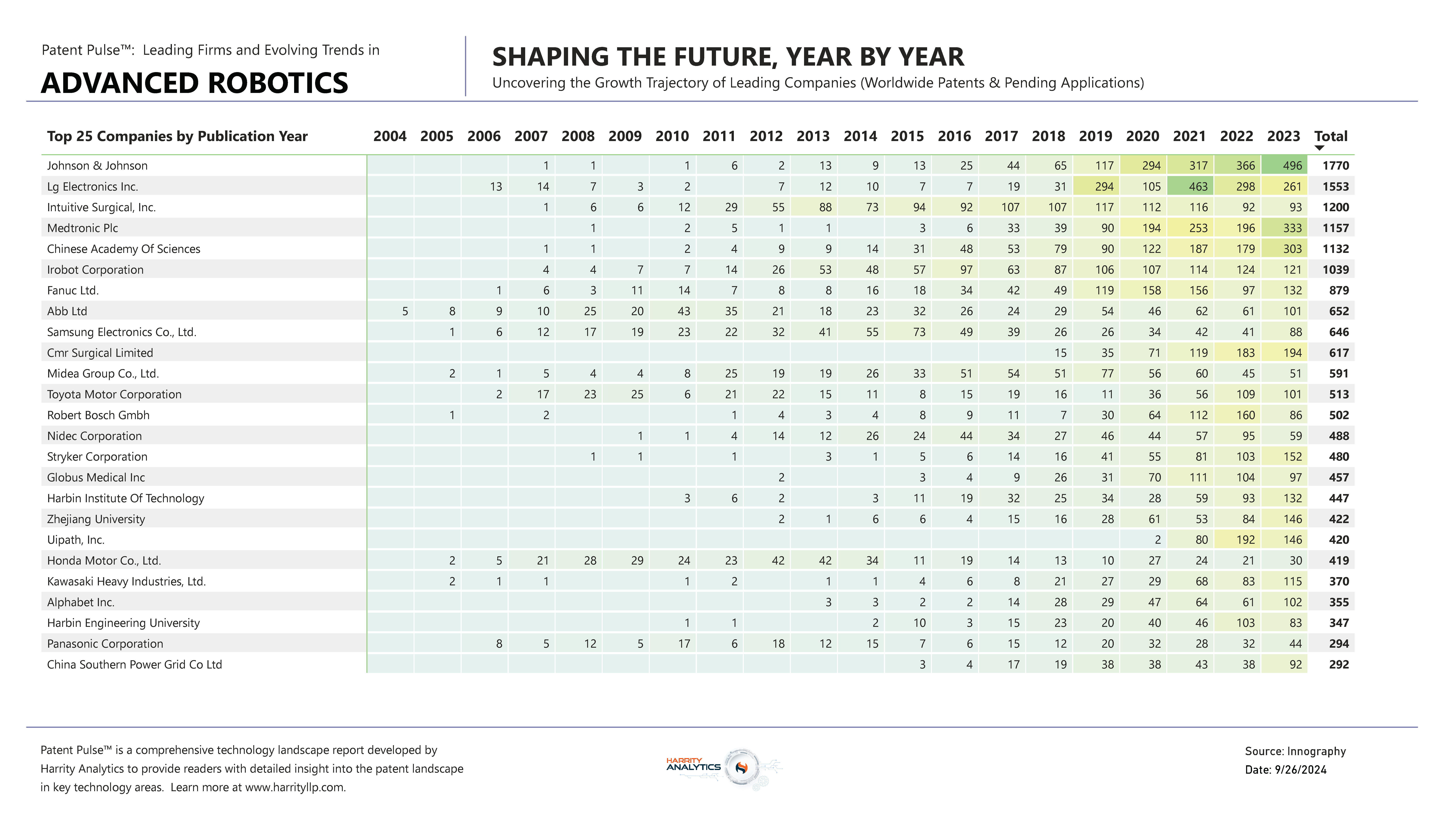
  3. Emerging Players: Companies like Cmr Surgical Limited and Globus Medical are rapidly expanding their patent portfolios, signaling their growing influence in the robotics sector.

Future Outlook

Looking ahead, the competition in advanced robotics is expected to intensify as companies continue to innovate and protect their technological advancements. The ongoing growth in AI and machine learning integration will likely drive further developments in autonomous and collaborative robotics.

Patent Analytics On-Demand

Explore our Patent Analytics Services to gain insights into the latest trends, competitor activities, and strategic opportunities in your technology area. Our tools and expertise help you stay ahead of the curve in the rapidly evolving world of advanced robotics.

Patent Analytics On-Demand

Conclusion

The “Tech Titans 2024” post showcases the leading innovators in advanced robotics, highlighting their significant contributions to the field. As these companies continue to shape the future of robotics, we look forward to exploring more advancements in the coming years. Stay tuned for our next post in this series, where we dive into another groundbreaking technology area.

Seeing Double: How Digital Twins Are Driving a New Era of Innovation

Seeing Double: How Digital Twins Are Driving a New Era of Innovation
By Ayana Marshall, PhD

As technology continues to advance, digital twins have emerged as a concept that connects the physical and digital realms in innovative ways. These advanced virtual counterparts of physical assets, systems, or processes are transforming how industries approach simulation, optimization, and innovation. Beyond their practical applications, digital twins are becoming central to the growing focus on intellectual property (IP) rights, as companies increasingly file patents to protect their developments. The intersection of digital twins and IP will be explored, examining patent filings and pending applications to shed light on how this technology is influencing the landscape of innovation. 

To understand the growing impact of digital twins, it’s important to examine the key players driving innovation in this field. The figure above highlights companies with the highest number of patents and pending applications related to digital twin technologies, including industry leaders such as IBM, Philips, and Dassault. 

  • IBM (International Business Machines Corp.) holds the highest number of patents and pending applications related to digital twin technologies, as indicated by the chart. 
  • Koninklijke Philips N.V. is another leading company in this area. 
  • Groupe Industriel Marcel Dassault S.A. ranks among the top 3. 
  • Emerson Electric Co. has a notable number of patents and pending applications in this field, as shown in the chart. 
  • Amazon.com, Inc. and Honeywell International Inc. are also prominent in the digital twin landscape, with significant patent and application activity. 
  • Other companies rounding out the top 10 in patents and pending application counts include SAP SE, Autodesk, Inc., Rockwell Automation, and Hexagon AB. 
  • The chart further highlights companies such as Schneider Electric SA, ANSYS, Inc., Posco, Siemens AG, and GE Aerospace with notable patent and application counts. 
  • Institutions like Beihang University and Strong Force Intellectual Capital, LLC also appear in the chart, indicating their involvement in digital twin technologies. 

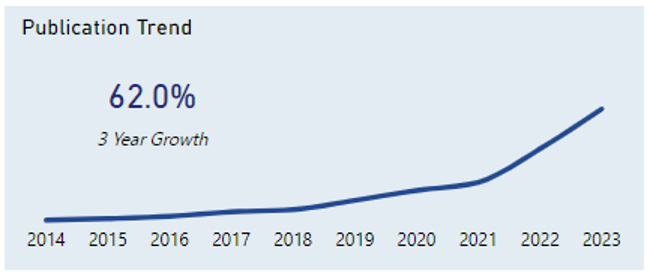
Building on the insights into the leading companies driving innovation in digital twin technologies, it’s essential to also consider the broader trends in this field. The chart above highlights a significant 85.1% growth in publications over the past three years, underscoring the accelerating interest and activity in digital twin technologies. 

  • The publication trend was relatively flat from 2014 to 2020. 
  • There has been an 85.1% growth in publications related to digital twin technologies over the past three years. 
  • The most significant spike in publication activity occurred from 2021 onwards, as illustrated by the steep upward curve. 

The surge in publication activity in recent years, marked by an 85.1% growth, signals the expanding interest and investment in digital twin technologies. This trend is further supported by the competitive landscape shown in the accompanying chart, where leading companies such as IBM, Philips, and Dassault are not only securing patents but also actively filing pending applications in this field. 

The data is sourced from the Harrity Analytics Patent Pulse™ Report on Digital Twins.  For more information about the Patent Pulse™ Report visit our website HERE, download a complimentary Patent Pulse Report HERE, or contact Harrity Analytics HERE. 

Building Meaningful Professional Relationships on LinkedIn and Beyond

Building Meaningful Relationships on LinkedIn and Beyond

In today’s fast-paced, digital-first world, LinkedIn has evolved beyond just a networking platform. It has become an essential tool for building lasting, meaningful relationships that extend far beyond the virtual space. Especially for underrepresented innovators and entrepreneurs, LinkedIn provides an incredible opportunity to connect with industry leaders, mentors, and peers who can support your journey in the patent process and entrepreneurial endeavors.

In our latest Patent Pathways® session, Harrity’s John Harrity & Elaine Spector join us to teach how you can leverage LinkedIn to build authentic, long-term relationships that matter.

1. Lead with Value, Not Self-Promotion
The first rule of building meaningful relationships is to provide value before asking for anything in return. Whether it’s sharing insightful content, offering advice, or commenting on someone’s post with thoughtful feedback, leading with value shows that you are genuinely interested in contributing to the conversation.

Start by identifying what you can offer to others, whether it’s knowledge from your field, feedback on a project, or even offering to make connections. Building relationships is not about instant results—it’s about laying a foundation of trust and reciprocity.

2. Personalize Your Connections
One of the biggest mistakes people make when trying to build relationships on LinkedIn is sending generic connection requests. Take a moment to write a personalized message that explains why you want to connect and how you admire the person’s work or accomplishments.

This small step can make a huge difference in standing out from the hundreds of other requests professionals receive. Show that you’ve done your homework and have a genuine interest in who they are and what they do. It’s the beginning of a relationship, so start strong with a personal touch.

3. Engage Consistently, Not Just When You Need Something
Building relationships isn’t a one-time effort. It requires consistent engagement and nurturing over time. Comment on posts, share insightful articles, and celebrate your connections’ successes. Regular interactions help you stay top-of-mind and show that you’re genuinely invested in the relationship.

Being visible through consistent engagement also allows people to get familiar with your personal brand and expertise. When the time comes that you need advice or assistance, it won’t feel like you’re only reaching out for a favor.

4. Offer Support to Build Trust
One of the most powerful ways to foster long-term relationships is by offering your support, especially to those navigating complex processes like patents. Offer to make introductions, share resources, or give feedback on an idea or project.

When people feel supported, they are more likely to trust you and be open to building a relationship. In the world of patents and entrepreneurship, having a network of people you trust can lead to invaluable opportunities, collaborations, and insights.

5. Take Relationships Offline
While LinkedIn is a fantastic platform for initial introductions, meaningful relationships often flourish when they extend beyond the virtual world. Don’t hesitate to suggest a coffee chat, video call, or meeting at a networking event. These real-world interactions can cement connections and make you more memorable.

Relationships are built on trust and shared experiences, which are more easily formed in person or during direct communication. Whether it’s through a Zoom call or an in-person event, take the initiative to deepen your relationships beyond LinkedIn.

6. Be Authentic
At the core of every meaningful relationship is authenticity. People appreciate realness. Don’t try to be someone you’re not or overinflate your accomplishments. Be open about your journey, challenges, and ambitions. The more genuine you are, the more likely people are to connect with you on a deeper level.

In the innovation and patent world, authenticity is key. Whether you’re an entrepreneur pitching a new idea or an inventor seeking guidance, showing your true self will attract the right kind of people who align with your values and vision.

7. Stay in Touch and Follow Up
Building a relationship is just the beginning—maintaining it is the challenge. Follow up periodically with connections you’ve made, and keep them updated on your journey. Whether it’s a quick message to check in, or sharing a relevant article, staying in touch ensures the relationship doesn’t fade.

If you’ve had a meaningful conversation or received valuable advice, take the time to follow up with a thank-you message. These small actions build goodwill and solidify your relationships for the long term.

Beyond LinkedIn: Taking Relationship Building to the Next Level
While LinkedIn is a powerful tool, it’s just one part of the relationship-building equation. Joining industry groups, attending conferences, and participating in mentorship programs are also great ways to expand your network and nurture meaningful connections.

For underrepresented inventors and entrepreneurs, Patent Pathways® offers an incredible community of support. We not only guide you through the patent process but also help you build relationships that can lead to funding, mentorship, and new opportunities.

Building meaningful relationships takes time and effort, but the rewards are priceless. By investing in your network, leading with value, and being authentic, you can create a community of support that will not only help you achieve your goals but also open doors you never thought possible.

Stay connected, stay curious, and always look for ways to build bridges that go beyond the digital world.

Watch the full webinar here:

Ready to Build Your Network?

Join us at Patent Pathways®, where we empower underrepresented innovators with the tools, knowledge, and connections they need to navigate the patent process successfully. Let’s build meaningful relationships that lead to lasting innovation.

Get involved below!

JOIN A PATENT PATHWAYS COMMITTEE
BECOME A MENTOR
BECOME A LAW FIRM PARTNER
BECOME A CORPORATE SPONSOR
APPLY TO PARTICIPATE IN PATENT PATHWAYS

Recognized as a CPP Compliant Law Firm by National Council on Patent Practicum

Recognized as a CPP Compliant Law Firm by National Council on Patent Practicum

Fairfax, VA – September 2024 – Harrity & Harrity, LLP, a leading patent law firm, is pleased to announce its designation as a Certified Patent Professional (CPP) Compliant Firm. This prestigious recognition underscores the firm’s unwavering commitment to delivering exceptional service and expertise in patent law.

The rigorous CPP designation program, administered by the National Council of Patent Practicum, signifies that at least 70% of Harrity’s patent practitioners have demonstrated the highest level of knowledge and experience. This ensures clients consistently receive top-tier legal representation throughout the complex patent preparation and prosecution process.

“In an industry where precision, innovation, and quality are essential, this recognition highlights our firm’s unwavering commitment to excellence,” says Paul Harrity, Managing Partner at Harrity & Harrity. “Our focus on delivering superior results, fostering strong client relationships, and embracing diversity and inclusion ensures we exceed client expectations and provide the highest level of service in every aspect of patent law. We are delighted to receive this recognition from NCPP as a testament to our dedication.”

Earning CPP compliance places Harrity among an elite group, with less than 1% of patent law firms nationwide achieving this distinction. This designation serves as a powerful testament to the firm’s unwavering dedication to excellence and its commitment to providing clients with the most comprehensive and effective patent legal services available.

About Harrity & Harrity

Harrity & Harrity LLP is a top patent law firm specializing in electrical, mechanical, software, and semiconductor technologies. With over 15 years of experience on average, our team delivers high-quality patent prosecution, preparation, and consulting services through a client-focused, innovative approach. We utilize cutting-edge technology and a second-attorney review process to ensure accuracy and timeliness, allowing clients to focus on innovation. Our commitment to excellence, diversity, and inclusion strengthens our ability to provide tailored solutions for protecting intellectual property.

About the National Council on Patent Practicum

The National Council on Patent Practicum, Inc. (NCPP), a 501(c)(3) non-profit, oversees the development and operation of the Certified Patent Practitioner (CPP) program. The CPP credential is a professional designation that distinguishes those who have demonstrated experience, proficiency, knowledge, and understanding of patent drafting and prosecution through dedicated involvement in the patent preparation and prosecution processes.

Learn more about our services at www.harrityllp.com/services.

Celebrating Women’s Equality Day: Reflecting on Progress and Empowering Future Generations

August 26th is not just another date on the calendar—it’s Women’s Equality Day, a day dedicated to honoring the hard-won battles for women’s rights and recognizing the journey toward true equality. As we commemorate the anniversary of the 19th Amendment, which granted women the right to vote, it’s essential to reflect on the progress we’ve made, the challenges we’ve overcome, and the work that still lies ahead.

Women’s Equality Day marks the adoption of the 19th Amendment in 1920, a pivotal moment in history that gave women the right to vote. This victory was a monumental step forward, but it’s important to remember that the fight for gender equality didn’t end there. In fact, it wasn’t until 1974—over half a century later—that women gained the right to apply for credit cards in their own names without needing a male cosigner. The idea that our mothers and grandmothers needed permission to manage their finances independently is almost unimaginable today.

Reflecting on these milestones, one can’t help but feel a deep sense of gratitude for the independence women now enjoy. The ability to swipe our own credit cards, sign our own leases, and purchase our own homes are freedoms that previous generations fought tirelessly to secure. These rights are not just conveniences; they are the building blocks that have enabled women to thrive in all aspects of life, including in professional arenas like patent law.

As a patent attorney, I am deeply aware of how these rights have empowered me to pursue my career and support other women in theirs. The progress we’ve made allows us to contribute fully to society, but we must not become complacent. While we celebrate the advancements, we must also remain vigilant in our efforts to achieve true equality. This Women’s Equality Day, let’s take a moment to appreciate the rights we have, acknowledge the work still to be done, and commit to using our voices—especially through voting—to continue pushing for change.

Women’s Equality Day serves as both a celebration of the progress we’ve made and a reminder of the ongoing fight for gender equality. The freedoms we enjoy today are the result of relentless advocacy and perseverance by the women who came before us. As we honor their legacy, let’s also recommit to advancing the cause for future generations. Exercise your right to vote, support one another, and continue striving for a world where true equality is a reality for all women.

Want more Driving Diversity? Check out other videos with Elaine Spector here!

Challenging the “Diversity Hire” Label: The Need for Equal Standards in the Workplace


In recent discussions about diversity and inclusion, one phrase continues to surface, often with detrimental effects: “diversity hire.” This term, far from being a compliment, often serves to undermine the hard work and achievements of women and individuals from diverse backgrounds. It’s a label that carries with it an assumption of inadequacy, which can be incredibly damaging in professional environments, particularly within the legal field. This blog delves into the double standards that persist in our industry and the importance of creating a workplace where every individual is judged by their abilities and contributions, not by outdated and biased perceptions.

Challenging the “Diversity Hire” Label

The term “diversity hire” is more than just a label—it’s a judgment that can have profound implications for those it’s applied to. When someone is referred to as a “diversity hire,” it diminishes their qualifications and suggests that their presence in the workplace is due more to a desire to meet diversity quotas than to their own merit and capabilities.

This label becomes even more insidious when we consider how mistakes are treated differently depending on who makes them. For example, when a man, particularly a white man, makes an error, it is often seen as a simple human mistake—an opportunity to learn and grow. However, when a woman or someone from a diverse background makes a similar mistake, it can quickly be attributed to their status as a “diversity hire.” This double standard not only undermines the confidence of these professionals but also perpetuates harmful stereotypes that they are less capable or deserving.

The Reality of Double Standards in the Workplace

At Harrity, we’re acutely aware of these double standards, especially through our Minority Firm Incubator program, which supports minority-owned law firms. Participants in this program have shared that the pressure they feel is immense—one mistake, and they fear they’re out. This “one and done” mentality seems to be applied disproportionately to minority professionals, raising a crucial question: is this the same standard applied to white men in our field?

The answer, as many have observed, appears to be no. This discrepancy reveals a deeper, systemic issue where the achievements of diverse professionals are often undervalued, and their missteps are disproportionately magnified. It’s a stark reminder that while we have made significant strides in promoting diversity, there is still much work to be done to ensure that all individuals are treated equitably and that their contributions are recognized fairly.

Toward a Workplace Free of Bias

It’s important to clarify that this issue isn’t about placing blame on any particular group. Rather, it’s about addressing the biases that still exist in many workplaces. These biases, whether conscious or unconscious, can distort perceptions and create an uneven playing field. The goal is to foster a professional environment where everyone is judged solely on their abilities, contributions, and potential—not on outdated and biased perceptions.

Achieving this will require ongoing effort and commitment from all of us. We must continue to challenge the stereotypes that undermine the achievements of women and individuals from diverse backgrounds and advocate for standards that are applied consistently and fairly across the board.

Words carry power, and the term “diversity hire” is one that we must challenge and reconsider. In our pursuit of a more inclusive and equitable workplace, it’s essential to recognize and dismantle the biases that contribute to unequal treatment. By holding all professionals to the same standard and valuing their contributions equally, we can build a legal profession that truly reflects the diversity of talent within our society. Let’s strive for a future where everyone, regardless of background, is given the respect and recognition they deserve—where no one is reduced to a label but is instead celebrated for their skills, dedication, and impact.

Want more Driving Diversity? Check out other videos with Elaine Spector here!

Strategic Growth: Navigating Self-Improvement in a Demanding Professional Landscape

Welcome back to our weekly conversation with #DearSandy, where we tackle the intricacies of professional development and offer guidance on overcoming some of the workplace’s toughest challenges.

In any career, especially in high-pressure environments, the pursuit of personal and professional growth is a constant endeavor. Whether you’re an experienced professional or just getting started, the desire to better oneself is a sign of ambition and a commitment to excellence. But with so many areas to potentially improve, it’s easy to feel overwhelmed about where to start.

This week’s “Dear Sandy” addresses a common dilemma: how to set and achieve self-improvement goals while managing the day-to-day demands of a busy work life.


Dear Sandy,

I’ve been with the firm for a couple of years and have truly enjoyed my work and the opportunities I’ve been given. However, as I look to the future, I want to ensure that I continue to grow both personally and professionally. I’m keen on making some self-improvements but feel overwhelmed by where to start. Could you provide some guidance on effective strategies for self-improvement within our professional setting? How can I set realistic goals and effectively work towards them while balancing my workload?

Sincerely,
Aspiring for Improvement


Dear Aspiring for Improvement,

Your desire to continue growing is commendable, and recognizing the need for self-improvement is the first critical step in your journey. Personal and professional growth is a continuous process, and with a strategic approach, you can make this journey both manageable and rewarding. Here’s how to get started:

1. Self-Assessment:
Start by evaluating your current skill set and responsibilities. Take a close look at areas where you excel and those where you believe there’s room for growth. Whether it’s honing technical skills, enhancing your communication abilities, or developing leadership qualities, understanding your starting point is essential for setting meaningful goals.

2. Set Specific, Measurable Goals:
Once you’ve identified the areas you want to improve, it’s time to set goals that are specific, measurable, achievable, relevant, and time-bound (SMART). For example, if you’re aiming to enhance your project management skills, you might set a goal to complete a relevant certification within the next six months. SMART goals provide structure, making it easier to track your progress and stay motivated.

3. Seek Constructive Feedback:
Feedback from colleagues, supervisors, and mentors is invaluable. Regularly ask for their input on your work to gain insights that might not be apparent through self-reflection alone. This external perspective can highlight strengths you might have overlooked and pinpoint areas needing further attention.

4. Utilize Available Resources:
Don’t overlook the professional development resources your firm offers, such as training sessions, mentorship programs, and access to educational courses. These tools are designed to support your growth, so make full use of them as you chart your self-improvement path.

5. Balance Work and Growth:
Achieving your self-improvement goals shouldn’t come at the expense of your well-being. Strive for a balance by setting realistic goals that align with your workload. Incorporate self-improvement activities into your routine without overloading yourself—this will help prevent burnout and ensure steady progress.

6. Reflect and Adapt:
As you work towards your goals, regularly reflect on your progress. Self-improvement is an evolving process, and it’s important to be flexible. Adjust your goals as needed to keep them aligned with your professional development and personal aspirations.


Remember, self-improvement is a journey, not a race. Celebrate your progress, no matter how small, and keep pushing forward with determination. Your commitment to personal growth is a powerful asset, and with the right approach, you’ll continue to thrive both personally and professionally.

Warm regards,
Sandy

Redefining Rainmaking: Empowering Women to Lead in Law

In a recent conversation, Elaine Spector explored the powerful yet often misunderstood concept of rainmaking in the legal profession. Her insights reveal the untapped potential among women, urging them to embrace their natural relationship-building abilities and redefine what it means to be a rainmaker.

Challenging Misconceptions About Rainmaking

Rainmaking has long been shrouded in misconceptions. According to Elaine, the traditional view of a rainmaker—a charismatic, outgoing individual who thrives in social settings—does not align with the true essence of this role. She emphasizes that rainmaking is not about being the life of the party or excelling in small talk; it’s about building genuine relationships and earning trust.

Women, she notes, are naturally adept at these skills. Yet, despite this, women are often underrepresented among rainmakers in law firms. The key to changing this dynamic lies in embracing rainmaking as a natural extension of who women are, rather than forcing themselves to fit into a mold that doesn’t reflect their strengths.

Why Rainmaking is Essential for Women

Elaine makes it clear that rainmaking is not just a skill; it’s a gateway to greater influence, career advancement, and financial reward. For women in law, stepping into the role of a rainmaker is about more than just personal growth—it’s about breaking barriers and ensuring that diverse voices are heard at the highest levels of decision-making.

The importance of rainmaking extends beyond individual careers; it’s about creating a more inclusive and balanced professional environment. By becoming rainmakers, women contribute to a culture where leadership reflects the diversity of the talent within the firm.

Practical Steps for Women to Start Rainmaking

So, how can women begin their journey toward becoming effective rainmakers? Elaine offers practical advice, encouraging women to take small, intentional steps. Whether it’s joining a professional organization, volunteering for a leadership role, attending industry conferences, or reconnecting with former colleagues, every effort helps build a network of relationships that can lead to meaningful professional opportunities.

In addition, Elaine shares exciting news about an upcoming workshop on relationship-building in the post-pandemic world. Hosted by John Harrity as part of the Patent Pathways Program, this free event on September 10th is open to everyone. It’s designed to provide women with the tools they need to transform everyday interactions into rainmaking opportunities. The workshop promises a hands-on approach, emphasizing authenticity and the power of genuine connections.

Rainmaking isn’t about transforming yourself into something you’re not; it’s about embracing your authentic self and leveraging the relationships you naturally build. For women in law, this means recognizing the power they already hold and stepping confidently into rainmaking roles. By doing so, they can advance their careers and contribute to a more diverse, inclusive legal profession. The upcoming workshop is an excellent starting point for anyone ready to take the first step toward unlocking their rainmaking potential. Don’t miss this opportunity to learn, connect, and grow.

Want more Driving Diversity? Check out other videos with Elaine Spector here!

Orange Grove Creative Co legal marketing

Orange Grove Creative Co. to Revolutionize Legal Marketing for Patent Law Firms

Marketing Team at Harrity & Harrity Launches Orange Grove Creative Co. to Revolutionize Legal Marketing for Patent Law Firms 

August 7, 2024 – Fairfax, VA – The marketing team at Harrity & Harrity, a renowned boutique patent law firm, proudly announces the launch of Orange Grove Creative Co., a Harrity Brand. This new digital marketing group is poised to transform the legal marketing landscape by turning clients’ visions into influence through innovative strategies, compelling storytelling, and bespoke digital solutions. 

A Fresh Approach to Legal Marketing 

In a market characterized by record volumes of worldwide patent applications and steady annual growth in the IP law sector since 2019, the need for competitive placement among patent law firms has never been more critical. Orange Grove Creative Co. addresses this demand by helping patent law firms expand their client bases, enhance visibility, establish credibility, and foster growth in an aggressive landscape through robust digital marketing solutions. 

Why Choose Orange Grove Creative Co.? 

As a small, niche agency, Orange Grove Creative Co. has the autonomy to offer specialized expertise, cost-effective and transparent pricing, personalized attention, and a focus on each client’s individual success. With deep understanding and a proven track record of marketing to this unique audience, Orange Grove Creative Co. leverages its familiarity of the patent industry to effectively connect with and engage its target demographic. The backing of Harrity & Harrity provides a foundation of credibility and resources, enhancing operational capabilities and instilling client confidence – all crucial elements for law firms looking to enhance their marketing efforts.

Meet Our Team 

The cornerstone of Orange Grove Creative Co.’s success is its dynamic team of multi-talented professionals: 

  • Samantha Sullivan, Director of Marketing: With a wealth of experience in legal marketing, Samantha leads the strategic vision for all campaigns, crafting custom solutions to meet each client’s individual goals. 
  • Alyssa Montalvo, Brand Supervisor: Alyssa’s expertise in branding ensures that every client’s unique voice is visualized, amplified, and distinguished in the market. 
  • Hazel Jimenez, Project Supervisor: Hazel’s project management skills guarantee seamless execution and adaptability in an innovative and eloquent manner. 

Together, this team brings a combined 25 years of experience in legal marketing, branding, and digital media, focusing on creating a powerful digital presence and telling brand stories that drive visibility, rapport, and opportunities. 

Patent law firms looking to stand out in a crowded marketplace and drive their competitive advantage are invited to discover the difference that Orange Grove Creative Co. can make. For more information, visit harrityllp.com/orangegrovecreativeco or contact us at orangegrove@harrityllp.com. 

About Orange Grove Creative Co. 

Orange Grove Creative Co. is a digital marketing firm specializing in legal marketing for small law firms. As a Harrity Brand, we leverage innovative strategies, compelling storytelling, and bespoke digital solutions to amplify our clients’ unique voices and drive competitive advantage. Our mission is to revolutionize the legal marketing landscape by providing fresh, value-adding approaches that enhance visibility, build brand awareness, and generate meaningful business opportunities. 

Media Contact:
Samantha Sullivan
ssullivan@harrityllp.com

Embracing Authenticity in the Professional Space: A Lesson in Diversity

In the ever-evolving landscape of the professional world, redefining what it means to be authentic in the workplace has become more crucial than ever. Elaine Spector recently shared a poignant reflection on this very topic. Her insights not only challenge the status quo but also celebrate the diverse ways women express their professional identities.

Elaine’s Personal Journey to Understanding

Elaine, who had grown comfortable with her femininity after years of being a tomboy, initially encouraged women to embrace their femininity in professional spaces without feeling pressured to conform to traditionally masculine behaviors. However, feedback from a dear friend highlighted the nuances and complexities surrounding this issue. The friend reminded her that professionalism has historically been defined by men, pointing out that traditional expectations, such as wearing a skirt in court, continue to persist in some areas.

Diverse Expressions of Womanhood

One woman’s experience further illuminated the diversity within womanhood. This woman, identifying as a lesbian with a masculine tomboy side, shared that makeup and fashion were not significant to her professional identity. She expressed frustration with the emphasis some professional women place on looks, emphasizing that these elements do not define “woman” for her. Instead, she finds her identity and professional distinction in her approach to people and problem-solving.

The Core of Professionalism

The core takeaway from these reflections is the importance of authenticity. For some, this might mean wearing makeup and dressing in a way that aligns with their sense of femininity. For others, it means rejecting these traditional markers and focusing on their skills and interactions. The key is that professionalism should be defined by one’s approach to work and relationships, not by adherence to outdated gender norms.

This enlightening discussion, underscores the necessity of recognizing and respecting the diverse ways women choose to present themselves professionally. Authenticity, rather than conformity, should be the cornerstone of professional identity. By embracing our unique approaches and perspectives, we contribute to a richer, more inclusive professional environment.

Want more Driving Diversity? Check out other videos with Elaine Spector here!

Mastering Precision in Patent Law: Strategies to Enhance Attention to Detail

Welcome back to our weekly dive into workplace wisdom with #DearSandy. Each week, we explore the complexities of office dynamics and discover practical advice for some of the most challenging situations.

In the professional world, especially in fields that demand high accuracy like patent law, maintaining attention to detail can be a formidable challenge. Ensuring every document is meticulously prepared and error-free is crucial. If you’re struggling to meet these exacting standards, don’t worry—many have been in your shoes. This week’s “Dear Sandy” delves into effective strategies to boost your attention to detail and excel in your role.

Dear Sandy,

I’ve recently joined a patent law firm and I’m having trouble maintaining the high level of attention to detail that this field demands. Despite my efforts, I occasionally miss small but crucial details in our documentation, which has led to some corrections from my supervisors. I really want to improve and ensure the quality of my work meets the firm’s standards. Do you have any advice on how I can enhance my attention to detail? Any strategies or tools that could help me would be greatly appreciated.

Sincerely,
Eager but Erring

Dear Eager but Erring,

It’s fantastic that you’re actively seeking to improve—this is the first and most crucial step toward growth. Attention to detail is critical in patent law, but it’s a skill that can be honed with practice and the right strategies. Here are some actionable tips to help you enhance your precision:

Break Tasks into Smaller Steps
Tackling an entire document at once can be overwhelming, leading to missed details. Break your work into smaller, more manageable sections. This allows you to focus intensely on each part without feeling overwhelmed.

Use Checklists
Create a detailed checklist for each type of document or task. This acts as a fail-safe to ensure all necessary aspects are covered. Over time, this process will become second nature and significantly reduce errors.

Limit Distractions
In a world full of constant notifications and interruptions, finding quiet time to concentrate can vastly improve your accuracy. Dedicate specific blocks of time to focus solely on tasks requiring high attention to detail.

Regular Reviews
Once a task is completed, take a break before reviewing your work. A fresh perspective can help you spot errors more effectively. Additionally, consider peer reviews—a colleague’s fresh set of eyes might catch something you missed.

Leverage Technology
There are numerous tools and software designed to minimize errors. Utilize software that checks for common mistakes or project management tools that track deadlines and requirements, supporting accuracy and efficiency.

Training and Continuous Learning
Engage in workshops or training sessions focused on precision and attention to detail. Continuous learning not only sharpens your skills but also keeps you updated on best practices in your field.

Remember, perfection isn’t about never making mistakes but about learning and improving from them. Your commitment to excellence is already a significant asset. Keep striving forward, and you’ll see your efforts pay off.

Warm regards,
Sandy

Quantum Leap: Quantum Cryptography Patent & Pending Application Holders

By Ayana Marshall, Ph.D, Patent Data Analyst

Quantum cryptography is advancing rapidly due to the imminent threat posed by quantum computing to traditional cryptographic methods. Significant progress in both quantum computing capabilities and the development of quantum-resistant cryptographic algorithms is driving this advancement1-6. The potential for quantum computers to break current encryption systems such as Rivest-Shamir-Adleman (RSA) and Elliptic Curve Cryptography (ECC) is a major driving force behind the urgency to develop quantum-resistant cryptography1-6. Various technology companies and academic institutions are actively innovating and protecting their advancements through patent filings. This chart showcases the organizations that are shaping the future of secure communication in an era where quantum computers present both unprecedented opportunities and significant challenges.

  • Quantumctek Co., Ltd.: Leading with several patents and pending applications.
  • Toshiba Corporation, South China Normal University, and Alibaba Group Holding Ltd: Each displays similar patent activity to each other.
  • Group Electronics Co Ltd and NEC Corporation: Round out the top 6 both with similar quantities of patents and pending applications.
  • University of Science and Technology of China and IBM: Represents the involvement of academic institutions and corporate entities in the field.
  • Huawei and Baidu: Displays corporate giants that are actively participating.

QuantumCTek In the News

Transitioning from a broader look at the top companies in quantum cryptography, the focus now shifts to QuantumCTek Co., Ltd., the leader in patents and pending applications. The following are some of their recent innovations and received investments:

  • They have developed a ruthenium oxide thermometer that is used for tracking the temperature of quantum chips which allows for quantum computer stability and accuracy​7​.
  • They received a 504-qubit superconducting quantum computing chip named “Xiaohong,” aimed at advancing quantum computing measurement and control systems​8​.
  • China Telecom Quantum Information Technology Group Co., Ltd. has invested approximately 1.9 billion yuan to acquire a 23% stake in QuantumCTek​9​.

Quantum Cryptography Patents on the Rise: A Publication Trend Analysis

  • Upward Trend: The publication trend in quantum cryptography publications has shown a significant upward trajectory, as illustrated in the above chart.
  • Growth in Publications: The three-year growth indicates a 62% increase in quantum cryptography publications. This trend underscores the increasing focus on quantum cryptography, driven by advancements in quantum computing and the pressing need for secure communication methods.
  • Recent Growth: Also displayed is the transition from minimal publication in quantum cryptography from 2014 to 2018 to an incline 2019 and onward.


Driving Innovation and Security: The Rise of Quantum Cryptography Publications

The surge in quantum cryptography publications highlights the critical importance of this technology, which is developing methods aimed towards ensuring secure communications and protecting against future quantum threats. It is crucial for protecting critical infrastructures such as financial systems, healthcare, and national security networks, which rely on robust encryption to defend against sophisticated cyber threats. As the data indicates, companies like QuantumCTek are at the forefront of this field, actively securing their innovations through patenting. Overall, the growing number of patents and pending applications underscores the importance and potential commercial viability of quantum cryptography, reflecting a global push to harness and protect intellectual property in this pivotal technology sector.

This data is sourced from the Harrity Analytics Patent Pulse™ Report on Artificial Intelligence.  For more information about the Patent Pulse™ Report visit our website HERE, download a complimentary Patent Pulse Report HERE, or contact Harrity Analytics HERE. 

References:

  1. Post-Quantum Cryptography
  2. Quantum Cryptography
  3. World Economic Forum
  4. VIPRE
  5. ar5iv​​
  6. Newsroom
  7. com
  8. The Quantum Insider
  9. MarketScreener


Redefining Networking: Embracing New Avenues for Professional Connections

In today’s fast-paced professional world, networking and building relationships have dramatically evolved. Gone are the days when business connections were forged exclusively on the golf course or over formal meetings. Women professionals are now redefining networking by embracing activities that promote well-being, creativity, and genuine connections. This shift not only enhances professional relationships but also contributes to personal growth and a sense of community.

Elaine Spector recently shared an inspiring example that underscores this shift. Elaine came across a LinkedIn post about a group of women practicing yoga together, highlighting an innovative approach to networking. This simple yet powerful activity has sparked a broader discussion about incorporating wellness into professional networking routines. Combining yoga with networking represents a refreshing departure from traditional methods, showcasing how women are finding new and meaningful ways to connect.

Networking through yoga is just one example of the creative avenues available today. Whether through lunch dates, shopping sprees, or running groups, the possibilities are endless. These activities not only offer professional connection opportunities but also promote a healthier, more balanced lifestyle.

Reflecting on the past, Elaine recounted how she once took golf lessons over 25 years ago to fit into the then-popular networking activity. Despite becoming quite skilled, her experience underscored the limited options available at that time for building professional relationships.

Today, professionals are fortunate to have a wide array of choices that allow them to tailor their networking efforts to their personal interests and lifestyles. This shift empowers individuals to form deeper, more meaningful connections based on shared experiences and passions.

Elaine encourages others to share their favorite unconventional networking activities. The excitement of discovering new ways to connect and build relationships is palpable. Whether it’s a shared hobby, a wellness activity, or something entirely unique, finding what resonates and strengthens professional bonds is key. Embracing and celebrating the diverse ways to support each other professionally and personally is crucial.

Networking has evolved from rigid, traditional activities to more dynamic and personalized experiences. By embracing activities like yoga, running, and other interest-based gatherings, women are not only building stronger professional networks but also fostering a sense of community and well-being. As new ways to connect are explored, it’s important to celebrate the diversity of networking approaches and the enriched relationships they bring. Sharing favorite networking activities can inspire others to think outside the box in their professional journeys.

We encourage all professionals to embrace these innovative networking methods. By coming together, we can drive meaningful change and foster a more inclusive and connected professional environment.

Want more Driving Diversity? Check out other videos with Elaine Spector here!

How to Address Broken Promises at Work: A Constructive Approach

Welcome back to our weekly dive into workplace wisdom with #DearSandy. Each week, we explore the complexities of office dynamics and discover practical advice for some of the most challenging situations.

In the professional world, it’s not uncommon to encounter challenges that test our patience and resilience. One such challenge is dealing with unfulfilled promises from your boss. These unmet expectations can erode trust and dampen motivation, making it crucial to address the issue constructively. In this week’s “Dear Sandy,” we tackle the delicate matter of handling broken promises at work to foster a stronger, more cohesive team environment.

Dear Sandy,

I’m facing a challenging situation at work and I hope you can provide me some advice. My boss has repeatedly made promises to me regarding various aspects of my job, like project opportunities. However, these promises have not been fulfilled, and it’s starting to impact my motivation and trust in my leadership. I truly want to address this issue constructively because I believe in our team’s potential and want us to succeed together. How can I approach my boss about these broken promises in a way that is professional and conducive to building a stronger team?

Frustrated Team Player


Dear Frustrated Team Player,

It sounds like you’re in a difficult position, but your desire to resolve this constructively is the right approach to fostering a better working environment.

Firstly, it’s important to prepare for this conversation by gathering specific instances where project opportunities were discussed but did not materialize. This isn’t to keep score, but to clearly illustrate your concerns. When you speak to your boss, request a private meeting at a time when neither of you are rushed or stressed.

Begin the conversation with appreciation and positive intentions. For example, you might start with, “I really value your leadership and our team’s goals, and I want to discuss something important to ensure we can continue to work effectively together.” This sets a collaborative tone.

Present your observations factually and express how the situation makes you feel, without sounding accusatory. Use “I” statements, such as, “I feel concerned when I see discussions about project opportunities that don’t materialize, as it affects my ability to contribute effectively.”

It’s crucial to be open to hearing your boss’s side of the story. There may be factors you’re unaware of that have influenced these decisions. This conversation is as much about listening as it is about being heard.

Finally, propose a solution or ask for suggestions on how future disappointments can be minimized. Perhaps a more transparent way of communicating decisions or a regular check-in could be helpful.

Remember, the goal is to build trust and open lines of communication. It’s possible that your boss is unaware of the impact of these unmet promises, and your initiative to address it respectfully can set the stage for more reliable and supportive teamwork.

Sincerely,

Sandy

Finding Your Place: Thriving in a New Work Environment

Welcome back to our weekly dive into workplace wisdom with #DearSandy. Each week, we explore the complexities of office dynamics and discover practical advice for some of the most challenging situations.

The excitement of starting a new job can quickly turn into uncertainty if you feel out of sync with your team or the company culture. This situation is particularly challenging in specialized fields like patent law, where both the work and the environment can feel unfamiliar. If you’re questioning whether you belong at your new firm, you’re not alone. Let’s explore how to navigate this transitional period and find your footing.

Dear Sandy,

I’ve been with the firm for a few months now, and I’m starting to feel like I might not be the best fit here. While I appreciate the opportunity and find the work in patent law intriguing, I’m struggling to connect with my team and often feel out of step with the firm’s culture. I’m not sure if it’s just the initial adjustment period or if this is a sign that I should consider other options. I don’t want to make a hasty decision, but I also don’t want to stay somewhere I don’t belong. Any advice on how to navigate this situation?

Feeling Out of Place


Dear Feeling Out of Place,

Feeling like you’re not fitting in at a new job can be quite challenging, but it’s not uncommon, especially in a field as specialized and demanding as patent law. Before making any decisions, it’s important to give yourself some time to adjust; sometimes, the initial months at a new firm can be the hardest due to the steep learning curve and settling into a new environment.

Seek Feedback and Guidance: Talk to your supervisor or a mentor within the firm about how you’re feeling. They can provide you with constructive feedback on your work and help you understand more about the firm’s culture and expectations. This can also open up opportunities for you to engage in different kinds of projects or work with new teams.

Connect More with Colleagues: Sometimes, feeling out of place can stem from not having formed strong connections with colleagues. Try to engage more with your team and other peers. Attend social events, participate in firm-wide activities, or simply start by having lunch with different groups. Building relationships can often help in feeling more integrated.

Evaluate Your Expectations and Fit: Consider what aspects of the firm’s culture feel misaligned with your expectations or values. Is it the work style, communication, or perhaps the social aspect of the workplace? Identifying these can help you discuss with HR or your mentor about possible adjustments or even lead you to reflect on what you truly seek in your professional environment.

Professional Development: If the work itself feels overwhelming, consider asking for more training or resources to help you improve your skills. Sometimes, feeling more competent in our roles can significantly improve how we perceive our fit in a place.

Give It Time: Lastly, allow yourself a bit more time to adapt. Often, initial perceptions change as we grow more accustomed to new environments and roles.

If, after taking these steps, you still feel that your values and needs are not met, it might be worth considering other options. Remember, the right fit is important not only for the firm but also for your own professional satisfaction and growth.

Wishing you all the best as you navigate this period of transition. Remember, every challenge is also an opportunity for growth.

Warm regards,

Sandy

Confronting AI Bias and Enhancing Diversity

In the dynamic landscape of technology, diversity and inclusion have never been more essential. As the Intellectual Property Owners (IPO) Annual Meeting in Chicago approaches this September, these themes will be a central focus. Harrity & Harrity is proud to present a special program titled “Making Room for Diversity,” which will explore pressing issues in artificial intelligence (AI), including the significant impact of biased training data on AI models.

Elaine Spector recently shared a personal experience that highlights the importance of this issue. Her daughter, inspired by Elaine, is pursuing a career in engineering and took an online AI class over the summer. The course concluded with group presentations, which Elaine and other parents were invited to attend. Elaine was particularly impressed by her daughter’s presentation, which, unsurprisingly, was outstanding.

One presentation that caught Elaine’s attention focused on the analysis of how biased training data can affect AI models. The students emphasized a crucial point: biased data leads to biased outcomes. This problem is especially concerning in the context of face recognition software, where such biases can result in significant inaccuracies and unfair treatment of specific groups.

Addressing AI bias is not merely an academic challenge but a real-world issue with far-reaching implications. Ensuring fairness and equity in AI systems is vital. This is why Harrity & Harrity is bringing this critical discussion to the IPO Annual Meeting. The “Making Room for Diversity” program will feature a networking lunch and workshop dedicated to addressing these challenging issues within our profession.

Scheduled for Sunday, just before the afternoon committee meetings, this event is designed to be both informative and engaging. It will provide a unique opportunity for attendees to connect with peers and discuss strategies for enhancing diversity and inclusion in the field of technology and intellectual property.

We encourage all attendees of the IPO Annual Meeting to participate in this important event. By coming together, we can drive meaningful change and foster a more inclusive technological future.

Link to registration for the IPO Annual Meeting can be found here: IPO Annual Meeting Registration.

We look forward to seeing you in September!

Want more Driving Diversity? Check out other videos with Elaine Spector here!

Rediscovering Your Work Passion: Overcoming the Mid-Career Slump

Welcome back to our weekly dive into workplace wisdom with #DearSandy. Each week, we explore the complexities of office dynamics and discover practical advice for some of the most challenging situations.

Starting a new job often comes with a burst of excitement and ambition. However, as time passes, it’s not uncommon to find yourself feeling unmotivated and stuck in a routine. If this sounds familiar, you’re certainly not alone. The good news is that it’s entirely possible to reignite that initial passion and make your work life feel fulfilling once again. Let’s dive into a recent reader’s question about feeling stuck in their job and explore some actionable advice on how to get back on track.

Dear Sandy,

I’ve been with the firm for a couple of years now, and initially, I was very excited about my role and the impact I could have. Lately, however, I’ve been feeling increasingly unmotivated. Every day feels the same, and I’m struggling to find the passion I once had for my work. I still want to contribute meaningfully, but I’m not sure how to shake this slump. What advice can you give to someone feeling stuck in their job?

Dear Stuck in a Slump,

Firstly, it’s important to recognize that what you’re experiencing is quite common, and it’s okay to feel this way. Motivation can ebb and flow, and it’s natural for enthusiasm to wane after the initial excitement wears off. Here are a few steps you can take to reignite your passion:

Seek New Challenges
Sometimes, a lack of motivation stems from feeling unchallenged or routine-bound. Talk to your supervisor about taking on a new project or learning a new skill that aligns with your interests. This can bring a fresh sense of purpose to your role.

Set Personal Goals
Personal development goals can significantly enhance your professional life. Whether it’s improving a skill, learning a new area in your field, or aiming for a promotion, having clear objectives can give you something to strive towards.

Connect with Your Colleagues
Often, a sense of community at work can enhance your job satisfaction. Participate in firm activities, or simply spend more time connecting with colleagues. Sharing ideas and challenges can provide new perspectives and rekindle your enthusiasm.

Reflect on Your Impact
Remind yourself of the reasons you chose this career path. Consider the impact your work has on others, including how it supports the broader goals of your organization. Recognizing the value of your work can renew your sense of purpose.

Consider Professional Help
If your lack of motivation is deep and persistent, it might help to talk to a professional counselor. They can provide strategies to manage your feelings more effectively.

Remember, it’s perfectly normal to seek change and growth. Use this time to explore what truly motivates you and how you can align those drivers with your career at the firm. You’re not alone in this journey, and there are many resources within our firm to support you.

Wishing you the best,

Sandy

Rainmaking for Introverted Lawyers: Harnessing Your Strengths for Success

Rainmaking, or the art of generating business, is essential for career progression in law firms. However, for many introverted lawyers, traditional networking can be daunting. In the latest ‘Driving Diversity’ episode, Elaine Spector shares her personal strategies on how introverts can successfully navigate rainmaking by leveraging their strengths and building trust through meaningful engagement in professional organizations.

Rethinking Traditional Networking

Elaine opens by acknowledging the vital role rainmaking plays in career advancement within law firms. She empathizes with introverts who find traditional networking challenging but reassures that there are subtler and equally effective methods to achieve success. The focus is on finding approaches that align with an introvert’s natural tendencies, making the process more comfortable and effective.

Effective Strategies for Introverts

A powerful strategy Elaine recommends is joining and actively participating in professional organizations. This involvement allows introverted lawyers to contribute without the pressure of traditional networking settings. Volunteering for committees, collaborating on projects, or helping organize events are excellent ways to build connections.

Although these activities require time and effort, they are immensely beneficial. They provide a platform to showcase dedication and expertise, gradually building trust and forming strong professional relationships. Over time, these connections often lead to business opportunities as colleagues and peers recognize the individual’s reliability and commitment.

Building Trust Through Consistency

Elaine shares personal anecdotes to highlight how her volunteer work within organizations has led to significant business opportunities. The relationships she formed were rooted in trust and mutual respect, essential components for successful rainmaking. This trust is built over time through consistent and reliable performance.

By consistently delivering results and maintaining a high level of professionalism, introverted lawyers can demonstrate their value to potential clients and colleagues. This approach not only aids in business development but also fosters a supportive professional network for ongoing career growth.

Rainmaking doesn’t have to be synonymous with extroversion. For introverted lawyers, finding alternative methods to build relationships and generate business is crucial. By engaging in organizational activities and consistently proving their capabilities, introverts can successfully navigate the rainmaking process without stepping too far out of their comfort zone. The key lies in dedication, trust-building, and leveraging one’s strengths. Do you have any rainmaking tips for introverts? Share your thoughts and continue the conversation on making rain in the legal profession.

Want more Driving Diversity? Check out other videos with Elaine Spector here!

Mastering the Art of Deep Work: Essential Reads to Elevate Your Focus

Welcome back to our weekly dive into workplace wisdom with #DearSandy. Each week, we explore the complexities of office dynamics and discover practical advice for some of the most challenging situations.

In our fast-paced, distraction-laden world, the ability to concentrate deeply and produce high-quality work is becoming a rare and valuable skill. Whether you’re looking to enhance your productivity, achieve your goals, or simply make the most out of every day, embracing the concept of “deep work” can be transformative. Today, we explore some essential reads that can guide you on your journey to mastering this powerful skill.


Dear Sandy,

I’ve been trying to improve my focus and depth, aiming to make the most out of every day. I’ve heard a lot about “deep work” and its benefits, and I’d like to dive deeper into this concept. Could you recommend some books that would help me become more proficient in deep work?

Eager to Focus


Dear Eager to Focus,

It’s wonderful to hear that you’re keen on enhancing your ability to focus deeply! Deep work is indeed a powerful skill. Here are a few books that can guide you on your journey to mastering deep work:

  1. “Deep Work: Rules for Focused Success in a Distracted World” by Cal Newport This book is a cornerstone when it comes to understanding and implementing deep work. Newport defines deep work as the ability to focus without distraction on a cognitively demanding task. The book provides actionable advice on how to integrate deep work into your daily routine, making it a must-read for anyone serious about improving their focus.
  2. “Flow: The Psychology of Optimal Experience” by Mihaly Csikszentmihalyi Although not exclusively about deep work, this book explores the state of ‘Flow,’ which is closely related. It describes how people can achieve great satisfaction and productivity by engaging in activities that challenge their skills and concentration. Understanding flow can help you create conditions for deep work in your life.
  3. “The War of Art: Break Through the Blocks and Win Your Inner Creative Battles” by Steven Pressfield Suitable for creative professionals and anyone facing regular resistance in their tasks, this book addresses the challenges of procrastination and resistance. It’s very useful for learning to sit down and focus on deep work, offering inspiration and practical advice to overcome obstacles.
  4. “Make Time: How to Focus on What Matters Every Day” by Jake Knapp and John Zeratsky This practical guide offers strategies to create a more focused environment and beat distractions. It provides insights on how to redesign your day to prioritize important tasks that require deep work. With its user-friendly approach, “Make Time” can help you make consistent progress on your most significant goals.
  5. “Mindfulness for Beginners: Reclaiming the Present Moment—and Your Life” by Jon Kabat-Zinn While not directly related to deep work, mastering mindfulness can greatly enhance your ability to concentrate deeply. This book is a great start for anyone looking to be more present and less distracted, laying a solid foundation for deep work practices.

By delving into these books, you’ll gain insights and techniques that can not only boost your productivity but also your satisfaction with your work. Remember, the ability to do deep work is not just about managing time but also about managing your attention.

Keep focusing,

Sandy

Unleashing Potential: Harnessing AI for Personal and Professional Growth

Welcome back to our weekly dive into workplace wisdom with #DearSandy. Each week, we explore the complexities of office dynamics and discover practical advice for some of the most challenging situations.

In today’s fast-paced digital landscape, artificial intelligence (AI) stands at the forefront of technological innovation, promising to transform our professional capabilities and personal productivity. As businesses increasingly integrate AI into their operations, individuals are also exploring how this powerful tool can elevate their own skill sets and efficiency. This week, we address a compelling question from a reader eager to embark on their AI journey. Join us as we delve into practical strategies for leveraging AI to unlock your full potential.


Dear Sandy,

I’m intrigued by the potential of artificial intelligence and how it might enhance my skills and productivity. I’m eager to start using AI tools for personal development but am unsure how to begin. What’s the best way to approach this personal learning journey?

Eagerly Awaiting Advice


Dear Eagerly Awaiting Advice,

Your enthusiasm for artificial intelligence is inspiring. AI indeed offers remarkable opportunities for personal and professional enhancement. To help you embark on your AI journey, here are some structured steps to guide you:

1. Educate Yourself

Start with the Basics: Begin by building a strong foundation in AI. Focus on areas that spark your interest or hold the most relevance to your career. Online resources such as Coursera, edX, and LinkedIn Learning provide excellent introductory courses that can help you get started.

2. Define Personal Goals

Set Clear Objectives: Determine what you aim to achieve with AI. Whether it’s automating routine tasks, enhancing your analytical skills, or improving overall efficiency, having clear goals will help you stay focused and motivated on your learning path.

3. Experiment with Tools

Hands-On Experience: Experiment with various AI tools and software that align with your goals. Platforms like TensorFlow, H2O.ai, and IBM Watson offer free trials or open-source versions, enabling you to gain practical experience without financial constraints.

4. Join Communities

Engage with Enthusiasts: Participate in online communities and forums where AI professionals and enthusiasts gather. Websites like Reddit’s r/MachineLearning, Stack Overflow, and LinkedIn groups provide valuable support, answer questions, and share insights that can enhance your learning experience.

5. Apply Your Knowledge

Start Small: Apply AI solutions to specific tasks to gain hands-on experience. This practical approach will help you understand the real-world implications of AI and how it can improve your daily activities. Whether it’s using AI for data analysis, automating responses, or optimizing workflows, practical application is crucial.

6. Stay Updated

Continuous Learning: The AI field is constantly evolving. Stay informed about the latest developments by following industry leaders on social media, subscribing to newsletters like AI Weekly, and attending relevant webinars and conferences. Keeping up-to-date ensures your skills remain relevant and cutting-edge.

By following these steps, you’ll be well-equipped to integrate AI into your personal and professional toolkit, enhancing your skills and productivity. Embrace this exciting journey with curiosity and confidence, and you’ll find yourself on the path to significant growth and achievement.

Best wishes,

Sandy

Breaking IP Barriers: Law 360 Q&A With Harrity’s Elaine Spector

In a refreshing Q&A with Law360, Elaine Spector, a partner at Harrity & Harrity LLP, shares her journey in patent law, shedding light on the challenges and triumphs of being a woman in a male-dominated field. Spector, who specializes in electromechanical technologies, has been instrumental in shaping leave policies at multiple firms, including Harrity, to better support parents in the legal profession.

Spector shares that she’s just as proud to be a mother of three children as she is to be an attorney, going so far as to list “Wife and Mom” as a two-decade-long career on LinkedIn.

“She says she wants to normalize the fact that parents can speak openly about their families and the effort they take, without coming off as lacking dedication to their legal work — something that has not always been possible.”

Spector’s interest in patent law began at a family party when she expressed her dual passion for engineering and law. This led her to pursue a degree in mechanical engineering at the University of Maryland, where she was one of only a few women in her class. Despite facing gender biases, Spector excelled and passed the patent bar exam in her second year of law school at the University of Baltimore.

Spector recounts her early career experiences, including an uncomfortable lunch at an elite country club where she was the only woman. Despite such challenges, she remained determined and focused on her career. Her tenacity paid off as she moved through various prestigious firms, eventually joining Harrity & Harrity in 2017.

A significant part of Spector’s story revolves around her efforts to balance a demanding career with motherhood. She and a colleague successfully advocated for a 12-week maternity leave policy at their firm, a significant improvement over the existing two-week leave. However, Spector still faced obstacles, such as a denied request for additional unpaid leave after her second child, leading her to seek more flexible opportunities elsewhere.

At Harrity & Harrity, Spector has continued to champion for parental leave policies, ensuring that all parents, including support staff, receive the leave they need. The firm now offers 12-16 weeks of paid leave for birthing parents and four weeks of bonding leave for non-birthing parents.

Spector’s journey is a testament to the importance of inclusivity and support for parents in the legal profession. Her story highlights the need for firms to adapt and provide flexible working conditions to retain talented professionals, especially women who are often forced to choose between career and family.

Spector’s efforts have not only impacted her own career but have also paved the way for future generations of attorneys. By normalizing discussions about family and advocating for better leave policies, she has contributed significantly to making the IP law field more inclusive.

Elaine Spector’s story is part of an ongoing series by Law360, highlighting the experiences of attorneys who are breaking barriers in the IP law field. Read her full interview here.

Transforming Setbacks into Stepping Stones: Handling Workplace Mistakes with Confidence

Welcome back to our weekly dive into workplace wisdom with #DearSandy. Each week, we explore the complexities of office dynamics and discover practical advice for some of the most challenging situations.

In the legal profession, precision is paramount, and errors can feel like the end of the world—especially for those just starting out. This week, we’re exploring the experience of a junior attorney facing a significant mistake and how to navigate the aftermath with poise and professionalism. This isn’t just about damage control; it’s about turning a misstep into a major learning opportunity.


Dear Sandy,

I’m a junior attorney at a law firm and I’ve just realized that I made a significant error in one of my cases. I inadvertently missed a filing deadline, and this might be costly to the firm. I’m terrified of the repercussions and am unsure how to approach this with my supervisors. How should I communicate this mistake?

Worried in Washington


Dear Worried in Washington,

First and foremost, it’s important to address the issue promptly and directly. Here’s how you can handle it:

1. Get the Facts Straight

Collect all the details about the mistake: what happened, why it happened, and the potential fallout. Think about some possible solutions to minimize the impact.

2. Request a Private Meeting

Speak to your supervisor as soon as possible and ask for a private meeting. Discussing this face-to-face shows maturity and a willingness to confront the issue head-on.

3. Be Transparent

In your meeting, be completely honest about the mistake. Explain clearly what went wrong and the implications. Taking ownership of the error is crucial—avoid making excuses.

4. Offer Solutions

After explaining the situation, present the solutions you’ve prepared. Demonstrating a proactive approach to fixing the problem shows initiative and responsibility.

5. Ask for Advice

Seek guidance on how to prevent similar errors in the future. Showing that you want to learn and improve from this experience can help rebuild trust.

6. Follow Up Professionally

After your meeting, send a follow-up email summarizing the discussion and the agreed-upon steps. This not only reinforces your professionalism but also ensures clarity on the next actions.

Remember, everyone makes mistakes, but how you handle them can define your career. By addressing the issue responsibly, you can earn respect and trust even in difficult situations.


Embracing Growth Through Challenges

Mistakes are part of the journey, but they don’t have to derail your career. Handling errors with integrity and a proactive mindset not only mitigates the immediate problem but also positions you as a professional who is dedicated to growth and excellence.

Stay strong, learn from the experience, and turn this moment into a stepping stone for future success.

Stay committed and resilient,

Sandy

Maximizing Productivity and Earnings for Attorneys: Essential Strategies

Welcome back to our weekly dive into workplace wisdom with #DearSandy. Each week, we explore the complexities of office dynamics and discover practical advice for some of the most challenging situations.

In the fast-paced legal world, efficiency is a key driver of success. For attorneys, mastering time management and leveraging the right tools can significantly enhance both productivity and earning potential. Whether you’re handling case files, staying updated on legal developments, or maintaining timely communication with clients, there’s always room for improvement. This week we’re exploring some strategies and tools that can help attorneys streamline their workflows and boost their income.


Dear Sandy,

As an attorney at our firm, I’m always looking for ways to enhance my performance and increase my earnings. Managing case files, keeping up with legal developments, and maintaining timely communication with clients are all areas where I feel I could improve my efficiency. I’d love to know what tools or methods you recommend for someone looking to maximize their productivity and ultimately, their earning potential.

Eager for Efficiency


Dear Eager for Efficiency,

You’re not alone in aiming to boost efficiency and earnings; many attorneys seek ways to enhance their financial success through better time management. Here are a few strategies and tools that can help you streamline your workflow and potentially increase your income:

  1. Leverage Technology:
    • Utilize Automation Tools Developed by the Firm: Embrace the automation tools that our firm has developed. These tools are tailored to our operations and can significantly reduce the time you spend on routine tasks, allowing you to handle more cases or complex matters that might lead to higher earnings.
  2. Interview and Collaborate:
    • Learn from Efficient Colleagues: Interview and work with the firm’s attorneys and agents who are known for their efficiency. Understand their processes and techniques, and consider how you can apply similar strategies in your own practice.
  3. Prioritize and Plan:
    • Task Management Systems: Using software like Trello, Asana, or Monday.com can help keep your tasks organized and prioritized. These platforms allow you to visualize your workload and deadlines, making it easier to manage time effectively and focus on high-value tasks.
    • The Pomodoro Technique: Employing this time management method, which involves working in focused sprints followed by short breaks, can improve your concentration and stamina, helping you accomplish more in less time.
  4. Delegate When Possible:
    • Delegate lower-level tasks to support staff or juniors. This will free up your time to focus on more complex and lucrative legal work.
  5. Regular Review:
    • Regularly evaluate your workflow and identify any inefficiencies. Make adjustments to your tools and processes to continue improving your efficiency and enhancing your earning potential.

By integrating these tools and techniques into your daily routine, you can manage your time more effectively, increase your productivity, and potentially see an increase in your earnings without compromising the quality of your work.

Stay efficient,
Sandy

Don’t forget to check back next week for more practical advice from Sandy on how to thrive in the legal profession.

Mastering the Art of Gaining Trust: How to Navigate Limited Delegation at Work

Welcome back to our weekly dive into workplace wisdom with #DearSandy. Each week, we explore the complexities of office dynamics and discover practical advice for some of the most challenging situations. This week’s ‘Dear Sandy’ tackles a common workplace dilemma, offering sage advice for those looking to expand their roles and increase their impact within their teams.

In the fast-paced world of professional careers, feeling stuck due to limited delegation by your manager can be particularly disheartening. Many employees find themselves eager to take on more responsibilities, only to be hemmed in by a manager who holds the reins too tightly. This not only stifles personal growth but can dampen morale and productivity.

Dear Sandy,

I’m caught in a frustrating situation at work where I feel underutilized. My manager appears reluctant to delegate significant tasks, preferring instead to manage the most important responsibilities themselves. This approach leaves me feeling undervalued and stifled in my professional growth. I’m eager to prove my capabilities and take on more, but I want to do so without overstepping boundaries or offending. How can I encourage my manager to trust me with more substantial responsibilities?

Eager for More

Sandy’s Response:

Dear Eager for More,

Feeling undervalued because a manager won’t delegate significant tasks is a challenge, but it’s one that can be navigated with thoughtful strategy and communication. Here’s how you can approach this delicate situation to both prove your capabilities and enhance your role within your team.

Step 1: Initiate a Constructive Conversation

Schedule a one-on-one meeting with your manager to discuss your role and aspirations. When you speak, focus on your enthusiasm for your job and your desire to contribute more significantly to team objectives. Frame your conversation positively, showing your eagerness to grow, rather than as criticism of their management style. For example, you might say, “I’ve really been enjoying my role and am looking to increase my contributions. Are there opportunities for me to take on more responsibility in upcoming projects?”

Step 2: Demonstrate Your Reliability

Before and after your conversation, make sure to excel in your current responsibilities. Consistency in delivering high-quality work on time builds trust and establishes a track record of reliability, showing your manager that you’re ready for more.

Step 3: Suggest a Trial Period

Propose a trial period where you can handle more complex tasks or oversee a portion of a project. This can be framed as a low-risk way for you to demonstrate your capability to manage larger responsibilities while also easing your manager’s workload.

Step 4: Request Regular Feedback

Regularly seek feedback on your performance. This shows your commitment to continual improvement and success, while also giving you insight into your manager’s expectations and any hesitations they may have about increasing your responsibilities.

Adopting a strategic approach to communication and demonstrating your capabilities can significantly alter your career trajectory. Remember, the goal is to not only secure more significant tasks but also to foster an environment where growth and trust are paramount. If you’ve found this advice helpful, or if you have your own experiences and tips to share, join the conversation on our LinkedIn. Let’s discuss how we can all work towards a more empowering and productive workplace. Here’s to your continued success and growth!

Thriving at the Intersection of Motherhood and Law: A Journey of Empowerment

Mother’s Day serves as a poignant reminder of the unique challenges faced by working mothers, especially those in demanding professions like law. As we celebrate the dedication and resilience of mothers everywhere, Elaine Spector’s story offers a beacon of hope and a testament to what is possible when workplaces evolve to meet the needs of their employees.

The journey of a working mother often entails a delicate balancing act between professional obligations and family responsibilities. For Elaine, the struggle was all too familiar until a pivotal career move in 2017 changed everything. After joining Harrity & Harrity, a law firm that breaks away from traditional molds, she found a supportive environment that truly values work-life balance. Harrity offered flexible work options, including the ability to work remotely before it became a necessity during the pandemic, and even provided a clear path to partnership on a reduced-hour schedule.

The support Elaine received from Harrity & Harrity proved to be a game-changer, enabling her to flourish in her dual roles as a lawyer and a mother. Now in her 29th year of practice, she celebrates the fact that she is not just surviving in her career; she is thriving. The transition to a home office has become her preferred setup, enhancing her productivity and satisfaction. Harrity’s progressive stance, further cements her contentment with her work arrangement.

Elaine’s story is a powerful reminder of the importance of workplace flexibility and support for working mothers. It reflects a growing acknowledgment that supporting motherhood in the workplace is not just about providing flexibility but also about fostering an environment where women can advance in their careers without sacrificing their family life.

As we reflect on the stories shared this Mother’s Day, it’s clear that the path to supporting working mothers is not just about individual resilience but also about institutional change. Firms like Harrity & Harrity are leading the way in creating environments where mothers do not have to choose between their careers and their families. Let’s take inspiration from these success stories to advocate for more family-friendly policies across all sectors. To all the hardworking mothers out there, your strength inspires change, and your achievements pave the way for future generations of working women.

Want more Driving Diversity? Check out other videos with Elaine Spector here!

Pioneering Balance: Elaine Spector’s Path to Equity Partnership and Beyond

Last week, we explored Elaine Spector’s strategic move from the high-pressure world of patent litigation to a role that prioritized intellectual collaboration and family proximity at Johns Hopkins Tech Ventures. Her journey underscored the necessity for a role that could accommodate her as a professional and a parent. Despite achieving proximity, the role lacked the flexibility she required, setting the stage for her next career leap.

Finding Flexibility and Making History

Upon joining Harrity & Harrity, Elaine found the elusive balance she had been seeking. The firm offered remote positions with adaptable working hours, a radical shift that allowed her more time with her family without compromising her career ambitions. This was not merely a job change but a complete transformation of her professional identity.

At Harrity, Elaine championed flexibility and innovation in her work arrangement. Her journey to becoming the firm’s first female equity partner is a testament to Harrity & Harrity’s commitment to diversity and work-life balance. This achievement marks a significant milestone not only for Elaine but also for the firm, highlighting its progressive stance in a traditionally rigid field.

Elaine’s Top Five Recommendations for Career Advancement

In her current role, Elaine generously shares her insights, offering five key recommendations to aid other legal professionals, particularly working mothers, in their career trajectories:

  1. Embrace Flexibility: Seek roles that offer flexible hours and remote work possibilities.
  2. Carve Out Time for Business Development: Use accessible tools like LinkedIn to build and maintain client relationships from home.
  3. Advocate for Yourself: Don’t shy away from negotiating for what you need, whether it’s a reduced schedule or extended leave.
  4. Cultivate Your Network: Build a supportive network of mentors and colleagues who understand and support your dual aspirations of family and work.
  5. Hold on to Your Aspirations: Maintain your professional goals alongside your personal responsibilities; it is possible to excel at both.

Elaine Spector’s journey from a high-stakes litigation environment to becoming a pioneering female equity partner illustrates a broader narrative within the legal landscape. Her story provides practical strategies and hope, proving that legal professionals—especially working mothers—can sculpt a successful career that harmonizes professional growth with personal life. As we continue to explore practical tips for navigating patent law with familial responsibilities, Elaine’s principles offer a roadmap for those seeking to achieve similar success.

Want more Driving Diversity? Check out other videos with Elaine Spector here!

Navigating Negativity in the Workplace

Welcome back to our weekly dive into workplace wisdom with “Dear Sandy.” Each week, we explore the complexities of office dynamics and discover practical advice for some of the most challenging situations. This time, we tackle a common but taxing problem—dealing with a perpetually pessimistic coworker. How do you keep your spirits up when someone else is always bringing them down? Let’s explore this week’s reader’s query and Sandy’s insightful response.

“Dear Sandy,

I work with a coworker who seems to always dwell on the negative side of things. Not only do they constantly complain about our work, management, and other colleagues, but they also try to pull me into their negative conversations. I find myself feeling drained and even starting to view things more negatively after our interactions. How can I handle this situation without creating workplace tension or appearing unsympathetic?”

Dear Reader,

It’s an issue many of us face: a colleague whose negative outlook begins to affect our own. Dealing with a perpetually negative coworker can be challenging and emotionally exhausting. It’s important to protect your own mental space while maintaining a professional relationship. Here are a few strategies you might consider:

Five Strategies to Shield Your Positivity

Set Boundaries: Begin by firmly setting conversational boundaries. A simple redirection like, “I find it helpful to focus on the positive aspects, so let’s think about what we can do to improve the situation,” can subtly change the conversation’s course without causing friction.

Limit Interaction: Keep your interactions with the pessimistic coworker to necessary professional exchanges. Avoid getting too personal or engaging in lengthy discussions that could lead to negativity.

Express Your Feelings: If you feel at ease doing so, express the impact their negativity has on you. Phrasing it gently can help, for instance, “I’ve noticed I feel more stressed after our conversations that focus a lot on the negatives. Maybe we could try to balance it with some positive points?”

Seek Support: If the behavior becomes disruptive to your productivity, discussing it with a supervisor or HR may be appropriate. Approach this sensitively, focusing on the need for a positive working environment.

Lead by Example: Continue to embody positivity in your own actions and words. Positivity can be contagious, and your approach may eventually influence your coworker.

While it’s challenging to change someone else’s outlook, Sandy reminds us of the importance of focusing on our own reactions and maintaining a positive mindset. Protecting your mental space is crucial in a professional setting.

Have you ever faced a similar challenge with a negative coworker? How did you handle it? Share your stories and strategies with us on LinkedIn to continue the conversation. Don’t forget to join us next week for more invaluable advice from “Dear Sandy” on navigating the intricacies of office relationships!

Pioneering Balance: Elaine Spector’s Journey from Litigation to Leadership

In the ongoing “Navigating New Horizons” series of the Driving Diversity Blog, we delve deeper into Elaine Spector’s transformative journey through the realms of patent law. Following last week’s gripping narrative, “Navigating the High Stakes: A Patent Litigator’s Journey from Trials to Tech Transfer,” we now explore how Elaine’s intense experiences in a high-stakes trial environment catalyzed her transition to a more balanced role at Johns Hopkins Tech Ventures, and eventually to Harrity & Harrity, where she achieved a groundbreaking flexible work arrangement.

Transition to Tech Transfer and Beyond

Elaine’s intense involvement in a grueling month-long patent litigation trial in the Eastern District of Texas was a pivotal moment, testing her limits and shaping her career trajectory. The demanding nature of the trial, characterized by long hours and high pressure, illuminated the stark realities of balancing professional obligations with personal life—particularly as a mother. The professional isolation she felt during this time, exacerbated by a poignant moment of connecting with her children via Skype, underscored her need for change.

Realizing the necessity for a shift, Elaine transitioned to an in-house role at Johns Hopkins Tech Ventures. Here, she sought a part-time position but accepted full-time work, prioritizing proximity to family over her preferred work arrangement. This role, while closer to home and filled with intellectual collaboration, still lacked the flexibility Elaine needed as her children grew older.

Finding Flexibility and Making History

Elaine’s pursuit of a better work-life balance led her here, to Harrity & Harrity, where she found the flexibility she had long sought in a remote position with adaptable work hours. This move was not just about changing jobs; it was about reshaping her professional identity. At Harrity, she not only embraced a reduced hours schedule but also ascended to become the first female partner, a testament to the firm’s progressive stance on work-life balance and diversity.

Elaine’s journey from the intensity of the war room to achieving partnership at Harrity & Harrity encapsulates a broader narrative prevalent in today’s legal landscape. Her story offers hope and actionable insights for legal professionals, especially working mothers, demonstrating that it is indeed possible to craft a fulfilling career that accommodates both professional aspirations and personal responsibilities. As we anticipate next week’s discussion on practical tips for working mothers in law, Elaine’s experiences continue to inspire and guide those navigating the patent law field towards more inclusive and adaptable career paths.

Want more Driving Diversity? Check out other videos with Elaine Spector here!

Mastering Difficult Client Relationships: Essential Tips for Patent Attorneys

Handling challenging clients is part and parcel of any service-oriented profession, especially in the intricate world of patent law. In this week’s Dear Sandy, our esteemed Controller, Sandy Maxey, responds to an attorney at a mid-sized firm who shares a common yet taxing dilemma: managing a new client whose communication style is not only challenging but sometimes downright disrespectful. From disregarding advice to setting unrealistic deadlines and maintaining a condescending tone, this scenario puts professional skills and patience to the test.

Dear Sandy,

I am a patent attorney at a mid-sized firm, and I have recently been tasked with managing the portfolio of a new client. While I am excited about the opportunities this assignment presents, I am finding the client’s communication style to be particularly challenging and at times, disrespectful. They frequently disregard my professional advice, impose unrealistic deadlines, and their overall tone can be quite condescending. I am committed to maintaining professionalism and ensuring the quality of my work remains unaffected, but I am struggling. How can I effectively manage this situation without causing friction or appearing uncooperative?

Troubled by the Tone

Sandy’s Response:

Navigating a professional relationship with a challenging client can indeed be difficult, but it also presents an opportunity to hone your communication and boundary-setting skills.

  1. Keep a Detailed Record: Documenting all communications is essential. This record can be invaluable in resolving disputes or misunderstandings regarding what has been communicated.
  2. Establish Clear Boundaries: Organizing a meeting to set clear expectations and timelines can be instrumental. It’s an opportunity to assert the reasoning behind your professional decisions and to establish yourself as an authority.
  3. Confront Disrespect Directly: If the client’s disrespect persists, it should be addressed directly, yet diplomatically. Articulate the need for respectful communication to maintain a productive working relationship.
  4. Leverage Firm Support: Should the problem continue, involve a supervisor or partner. They can offer additional support, mediate the situation, or potentially reassign the client to another attorney better suited to handle the dynamic.
  5. Value Your Professional Well-being: It’s crucial to remember that while clients are important, they should not undermine your professional integrity or well-being. If necessary, seek adjustments within your firm to protect these.

Why This Is Important

Dealing with difficult clients not only tests professional mettle but also provides an opportunity to strengthen communication and negotiation skills. Sandy’s advice underscores the need for strategic thinking and personal resilience in these situations. Whether printed in a newspaper or shared online, these insights can help any attorney navigate the complexities of client relationships in the legal field.

This guide serves as a roadmap for patent attorneys and other professionals who may find themselves in similar situations, offering both strategic advice and reassurance that they are not alone in facing these challenges. By maintaining professionalism and setting clear boundaries, attorneys can manage difficult client relationships effectively, ensuring that their careers remain on a positive trajectory.

We Want to Hear from You

Do you have experiences with challenging clients? How have you managed these relationships without sacrificing your professional standards? Share your stories and strategies with us on LinkedIn to continue the conversation.

Navigating the High Stakes: A Patent Litigator’s Journey from Trials to Tech Transfer

In the latest entry of the “Navigating New Horizons” series and the Driving Diversity Blog, we continue to follow Elaine Spector’s riveting journey. This installment transitions from a hopeful equilibrium of work-life balance to an intense legal battle that tested her commitments and catalyzed a significant career shift. Elaine’s experiences illuminate the challenges faced by patent attorneys striving to align professional aspirations with personal responsibilities.

Elaine’s innovative work arrangement was an exemplar of work-life balance, blending remote work with time at home and at the office. However, her well-structured life was upended by an urgent summons to a high-stakes patent litigation case. Drawn into the vortex of a month-long trial in the Eastern District of Texas, Elaine found herself in the throes of a legal battle that demanded her presence far beyond the typical professional commitment.

The war room, a rented hotel space devoid of its original furnishings and repurposed with desks and strategic planning areas, became the epicenter of the trial’s operations. Here, Elaine and her colleagues engaged in intense collaborative sessions, sometimes stretching up to 20 hours a day. This environment, while energizing for some, was a crucible of stress for Elaine, who had to manage her professional duties while grappling with the emotional strain of being separated from her young children. The physical setup of the war room facilitated a high level of collaboration, but it also underscored the relentless pressure and isolation from normal life, including a poignant moment when she used Skype to connect with her children, briefly bridging the gap between her two worlds.

The climax of Elaine’s trial experience came when she was unexpectedly excluded from the trial table. Initially hopeful when her boss had to leave due to a family emergency, Elaine anticipated taking his place at the table. Yet, this expectation was abruptly dashed by a pile of books and an uncomfortable conversation with the lead associate who insisted the space be kept open for the jurors. This incident was not just a professional setback but a deeply humiliating moment, highlighting the opaque and perhaps biased decision-making processes within her team.

Elaine Spector’s story from the war room to the trial table captures more than just the challenges of a patent litigation trial; it encapsulates the emotional and professional trials faced by many in high-stakes legal environments. Her subsequent decision to leave big law for a tech transfer role at Johns Hopkins University was driven by the need for a career that accommodated her professional skills and personal life. Elaine’s experiences offer a raw, unfiltered look into the conflicts that can arise when professional demands collide with personal needs, serving as a powerful narrative for those navigating similar paths in demanding fields.

Want more Driving Diversity? Check out other videos with Elaine Spector here!

The Strategic Dilemma: Overcoming Double Patenting with Terminal Disclaimers

Navigating the labyrinthine world of patent law can be as complex as the innovations it protects. Among the myriad challenges faced by patent practitioners, double patenting rejections and the judicious use of terminal disclaimers stand out. These issues require not only legal acumen but also strategic foresight. This detailed exploration sheds light on the intricate dance between securing robust patent protection and maximizing the commercial lifespan of your intellectual assets.

Deciphering Double Patenting

Double patenting involves the risk of granting several patents for the same invention, potentially extending monopoly rights beyond the intended term. This scenario is particularly problematic as it can lead to a thicket of overlapping rights that are difficult to navigate for both the patent holder and potential competitors. Understanding the nuances of double patenting is essential for anyone looking to navigate the patent landscape successfully.

Terminal Disclaimers: A Strategic Tool

Filing a terminal disclaimer is a common tactic to overcome double patenting objections. This maneuver effectively synchronizes the expiry of the involved patents, thus aligning them within the legally permissible patent term. However, this resolution is not without its trade-offs:

  1. Integration of Patent Lifecycles: Terminal disclaimers bind the destinies of multiple patents, potentially complicating future adjustments to a portfolio.
  2. Reduction in Patent Term: They may unintentionally shorten the effective patent term, potentially undercutting the commercial advantage they provide.

Strategic Considerations for Managing Patent Portfolios

When facing a double patenting dilemma, thoughtful consideration is paramount:

  1. Evaluating Business Impact: Consider the broader business implications of linking patents. How might this influence your company’s strategy in terms of market presence or competitive edge?
  2. Analyzing Patent Family Relationships: Determine the relationship between the patent families involved and assess the potential long-term impacts of tying these families together through a terminal disclaimer.
  3. Exploring Claim Adjustments: Before resorting to a terminal disclaimer, exhaust all options to differentiate the claims of the current application from those of the related patent. Amending claims or arguing distinctiveness can sometimes circumvent the need for a disclaimer.
  4. Optimal Timing of Filing: Delay the decision to file a terminal disclaimer until it is absolutely necessary, which allows for a complete assessment of the prosecution landscape and might reveal alternative strategies.

The decision to file a terminal disclaimer in response to a double patenting rejection intertwines legal strategy with business foresight. A well-considered approach can not only navigate through the immediate legal hurdles but also set the stage for long-term innovation management and commercial success.

Want more Precise Prosecutor? Check out other videos with George Howarah here!

Navigating New Horizons: Elaine’s Journey Through High-Stakes Litigation to Family-Centric Career Choices

In our latest installment of the Driving Diversity “Navigating New Horizons” series, we continue to explore Elaine Spector’s dynamic journey as a patent attorney caught between the rigorous demands of her career and the personal commitment to her family. This chapter picks up after Elaine has seemingly found the perfect work-life arrangement, only to have it upended by an intense legal battle that challenges her priorities and career trajectory.

Elaine’s innovative work schedule was a pioneering model before remote work gained traction. It allowed her a balanced division between her professional responsibilities and her family life, with two days in the office, one from home, and two days off to be with her three young children. This arrangement seemed ideal until she was drawn into a complex patent litigation case in the Eastern District of Texas.

The case was far from straightforward; it was a high-stakes, unyielding trial that refused to settle and demanded her presence for an extended period, significantly more than her usual commitment. Elaine found herself in Texas for a whole month, a stark contrast to the family-centric routine she had cultivated. This shift not only placed a strain on her familial relationships but also on her mental and emotional well-being, as she grappled with the professional demands of being a key player in a relentless legal struggle.

During this trial, Elaine’s dedication to her craft was evident, but the personal cost of such dedication became increasingly clear. The separation from her young children during critical developmental years caused her to deeply question whether her career in private practice was sustainable in the long term. Her internal conflict and the toll of the trial became a catalyst for reevaluating her career path.

Post-trial, Elaine sought a position that could offer both professional fulfillment and proximity to her family. She transitioned to a role in technology transfer at Johns Hopkins University. This role, while full-time, promised a significant reduction in travel and more regular hours, factors that were crucial in her decision. The move was strategic, aligning her professional skills with her personal need to be available for her children.

Elaine’s story is a powerful narrative about the challenges of maintaining work-life balance in the high-pressure world of patent law. It illustrates the tough decisions many legal professionals face when personal priorities clash with professional opportunities. Elaine’s shift from a high-stakes litigation environment to an in-house role at a major research institution symbolizes a broader conversation about the evolving demands and expectations of work in the legal sector.

As we anticipate further developments in Elaine’s career, her experiences serve as a valuable case study for other professionals navigating similar paths. Her journey underscores the importance of aligning career choices with personal values and the continuous search for balance in a demanding professional landscape.

Want more Driving Diversity? Check out other videos with Elaine Spector here!

Unlocking the Potential of AFCP 2.0: A Game-Changer in Patent Prosecution

In the intricate dance of patent prosecution, making the right moves after receiving a Final Office Action (FOA) from the USPTO is paramount. In this week’s The Precise  George Howarah sheds light on a strategic tool that is transforming the landscape for applicants and attorneys: the After Final Consideration Pilot 2.0 (AFCP 2.0).

The Turning Point: Beyond Traditional Responses

Traditionally, the response to an FOA often leads down the path of filing a Request for Continued Examination (RCE). However, this route can be both time-consuming and costly, potentially slowing down the journey to patent issuance. George introduces AFCP 2.0 as a compelling alternative, aiming to streamline the prosecution process with a more nuanced approach.

Delving Into AFCP 2.0

AFCP 2.0 emerges as a beacon of efficiency, offering a pathway to advance prosecution without the need for an RCE. The program allows for the consideration of a response to an FOA that includes a non-broadening amendment to at least one independent claim. This key provision paves the way for a more dynamic interaction between applicants and the USPTO.

The USPTO allocates additional time under AFCP 2.0 for examiners to review applications, creating an environment conducive to thorough evaluation and discussion. The goal? To reach an allowance or to facilitate a productive dialogue through an interview with the applicant, addressing any hurdles that stand in the way.

Why AFCP 2.0 Matters

George emphasizes several advantages of AFCP 2.0 that make it an invaluable tool in the patent prosecution toolkit:

  1. Speed: By potentially bypassing the RCE cycle, AFCP 2.0 can significantly reduce the time to patent issuance.
  2. Cost Effectiveness: The program is free to use, offering a budget-friendly option for advancing prosecution.
  3. Enhanced Engagement: The opportunity for an examiner interview under AFCP 2.0 is a strategic advantage, allowing for direct negotiation and clarification, thereby enhancing the prospects of allowance.

Strategic Application of AFCP 2.0

Despite its benefits, George notes the importance of meeting AFCP 2.0’s specific criteria to qualify for the program. Examiners have sole discretion in this regard, making it essential for applicants to craft their responses carefully.

In practice, George recommends always exploring the possibility of AFCP 2.0 when crafting a response to an FOA, especially when it involves a non-broadening amendment to an independent claim. This approach not only leverages the program’s benefits but also offers a proactive stance in navigating the prosecution process.

A Paradigm Shift in Prosecution Strategy

George’s insight into AFCP 2.0 heralds a shift towards a more efficient, cost-effective, and interactive patent prosecution process. As the legal landscape continues to evolve, embracing such innovative programs will be key to navigating the complexities of securing patent rights successfully.

In a world where time is of the essence, and every detail matters, AFCP 2.0 stands out as a pivotal tool, reshaping the strategy behind patent prosecution. George’s advocacy for its use underscores its potential to significantly impact how we approach the final stages of patent application.

Want more Precise Prosecutor? Check out other videos with George Howarah here!

Unveiling the Brains Behind AI Patenting: Leading Inventors Transforming Technology

By Ayana Marshall, Patent Data Analyst

Artificial intelligence (AI) has come a long way thanks to its top inventors.  Their groundbreaking work has not only pushed AI technology forward but also made it a vital part of different industries.  These innovators have transformed AI from ideas into impactful tools.  This article spotlights these leading inventors, celebrating the individuals whose creativity and foresight have made AI innovations indispensable. 

Leading Inventors in AI: A Perspective Based on Global Patents and Pending Applications 

The table above presents a summary of the contributions of leading AI inventors, ranking them by their patent portfolio size.  This table details a list of inventors with their associated patent portfolios, highlighting their active global patents and pending applications.  The following are the highlights: 

  • Global Patent Leader: Jianzong Wang from Ping An Insurance (Group) tops the list with 1,077 total patents and applications. 
  • Granted Patents: Wang currently holds 364 granted patents. 
  • Pending Applications: A considerable number of 713 applications are pending, indicating active innovation. 
  • Patent Families: Wang’s patents are part of a large family of 1,013, suggesting broad and varied technological advancements. 
  • Company Spotlight: Stradvision, Inc. features prominently, with several inventors on the list having a high volume of pending patents, highlighting the company’s intensive R&D focus. 

The gradient coloring starting from green across the table visually emphasizes the inventors with the most extensive patent activities, with darker greens denoting inventors with larger volumes.  This table, therefore, not only highlights individual achievement but also subtly points out the competitive landscape of AI development among leading tech companies. 

Leading Inventors in AI: A Perspective Based on US Patents and Pending Applications 

This image details a list of inventors with their associated patent portfolios, highlighting their active US patents and pending applications.  

  • U.S. Patent Front-Runner: Sarbajit K. Rakshit from IBM leads with 356 patents and pending applications in the U.S. 
  • Notable Inventors: Kenneth Neumann of Kpn Innovations, LLC and inventors from Capital One Financial Corporation are also highlighted for their substantial contributions. 
  • Close Contender: Austin Walters of Capital One Financial Corporation has a portfolio close behind with 303 patents and pending applications. 
  • Patents vs. Pending Applications: The table distinguishes between granted patents and pending applications, highlighting active areas of innovation with Neumann leading in pending applications. 
  • Cross-Industry Innovation: Inventors from various companies like Cisco Systems, Adobe, and Samsung demonstrate AI’s wide-ranging impact across different sectors. 

Beyond the Numbers 

In summary, the data from both images offers a look at the AI industry’s inventors and their contributions on a global scale, as well as within the United States.  The inventors listed highlight a robust commitment to innovation, with extensive patent portfolios that include both granted patents and those awaiting approval.  

Notably, the inventors affiliated with companies like Stradvision, Inc., Capital One Financial Corporation, and Ping An Insurance Group demonstrate strides in AI technology globally, as evidenced by their patent counts.  The number of pending applications further suggests that the field is poised for growth with potential new AI solutions on the horizon.  These inventors, therefore, represent the driving force behind the AI sector’s evolution, embodying the industry’s commitment to advancing technology and securing its future development through patent protection. 

This data is sourced from the Harrity Analytics Patent Pulse™ Report on Artificial Intelligence.  For more information about the Patent Pulse™ Report visit our website HERE, download a complimentary Patent Pulse Report HERE, or contact Harrity Analytics HERE. 


Who’s Conquering the AI Globe?  The Patent Showdown Between Reach & Influence

By Ayana Marshall, Patent Data Analyst

The scope of Artificial Intelligence (AI) patents is a key indicator of innovation and global reach in the field.  The chart in the image arranges the companies by two metrics: the influence of their patents, indicated by average forward citations, and the international expanse of their patent holdings, revealing a strategic dimension to how AI advancements are being staked worldwide. 

Tech Titans in the Spotlight: Microsoft and Alphabet Inc. Lead the Charge 

The bubble chart was used here to assess the breadth of jurisdiction and citation impact of AI patents. Geographic coverage is plotted on the x-axis and average forward citations are plotted on the y-axis.  The following are the highlights from the chart: 

  • Microsoft & Alphabet Inc. Lead: Both companies secure top positions in AI patent rankings, highlighting extensive patent counts and wide international presence. 
  • Citation Impact: Alphabet Inc. has the highest average forward citations with Microsoft closely following. 
  • Other Notable Companies: Toyota Motor Corporation, Samsung Electronics, Huawei, and Robert Bosch. also feature with significant geographic coverage and citation impacts. 
  • Citation Prominence: Baidu, Tencent, and Ping An Insurance are notable because of their citation counts. 

Unveiling the Global AI Innovation Map: A Closer Look at Tech Titans 

The positioning of companies across the chart illuminates the reach of their AI endeavors.  This visual guide offers a look into the scale and influence of each technology titan’s AI patent portfolios.  This data is sourced from the Harrity Analytics Patent Pulse™ Report on Artificial Intelligence.

For more information about the Patent Pulse™ Report visit our website HERE, download a complimentary Patent Pulse Report HERE, or contact Harrity Analytics HERE. 

Navigating New Horizons: Elaine’s Quest for Work-Life Harmony in IP Law Continues


Last week, we embarked on an insightful exploration into Elaine’s transformative journey within the Intellectual Property (IP) law landscape—a narrative that resonated deeply with many in our community. As we continue with the second installment of “Navigating New Horizons,” Elaine’s quest for work-life harmony in the demanding world of IP law gains new depth and dimension.

Elaine’s transformation from a full-time associate to a part-time employee in the wake of motherhood marked the beginning of her unique journey through the world of IP law—a journey characterized by its challenges, learning curves, and triumphs. Her bold request for additional leave, following the birth of her second child, was met with refusal, highlighting the rigidities still present within some corners of the legal profession. This pivotal moment spurred Elaine to seek out opportunities that aligned more closely with her values and vision for a balanced life.

The serendipitous offer from a larger general practice firm, ready to embrace her on terms that respected her need for flexibility, represented a turning point. Here was a chance to engage in patent preparation, prosecution, and opinion work while also being present for her family—a blend of professional and personal fulfillment that had previously seemed elusive.

Yet, as Elaine settled into this new chapter, the unforeseen complexities of litigation emerged, threatening the delicate balance she had worked so hard to achieve. Faced with potentially career-altering decisions, Elaine’s narrative encapsulates the ongoing struggle for work-life harmony that many legal professionals, especially parents, confront.

As we continue to follow Elaine’s journey, her story encourages a reflection on the broader implications for the legal industry. It serves as a reminder of the critical importance of fostering workplaces that are truly inclusive and adaptable, capable of supporting diverse talents and life circumstances.

Elaine’s narrative is more than just a personal story; it’s a call to action for the legal profession to prioritize diversity, inclusion, and flexibility. As she navigates the complexities of IP law and motherhood, her experiences illuminate the path toward a more equitable and supportive industry. By championing professionals like Elaine, who seek to balance the scales of career and family, the legal community can take meaningful steps towards creating environments where every lawyer has the opportunity to thrive, irrespective of their personal responsibilities.

Want more Driving Diversity? Check out other videos with Elaine Spector here!

Decoding the Signature: The Influence of Patent Examiner Authority on Patent Outcomes

Navigating the patent application process can feel like a complex chess game, where understanding the moves of patent examiners plays a critical role in strategy. In this week’s ‘The Precise Prosecutor’, George Howarah provides a deep dive into a less discussed but highly impactful aspect of the patent examination process: the significance of a patent examiner’s ability to sign their own office actions and what it means for applicants.

The Significance of Examiner Levels

At the heart of the patent examination process is the General Schedule (GS) pay scale, which ranges from GS-5 for junior examiners to GS-15 for the most senior. This scale is not just a measure of experience but also a reflection of authority within the United States Patent and Trademark Office (USPTO).

A key transition occurs when examiners reach the GS-13 level, granting them partial signatory authority. This allows them to independently sign all non-final office actions, a significant marker of trust and responsibility within the USPTO. The journey from a junior GS-5 examiner to a GS-13 with this level of autonomy involves a rigorous evaluation of job performance, emphasizing the quality of work.

From Junior to Primary: The Path to Full Authority

Achieving primary examiner status, where one can sign all types of office actions including final ones, requires even more. Examiners must successfully complete a specialized program designed to evaluate their readiness for this level of independence. This designation as a primary examiner signifies a level of expertise and authority that directly impacts the patent application process.

Why It Matters to Patent Applicants

For patent applicants, the distinction between junior and primary examiners is crucial. An office action signed by a junior examiner who lacks the authority to issue final decisions might not have undergone the same level of scrutiny as those reviewed by a primary examiner. This is especially critical in complex technological areas or in nuanced legal scenarios, where experienced oversight is paramount.

George emphasizes the practical step of examining the examiner’s signature on office actions. This isn’t about undermining the capability of junior examiners but rather about understanding the depth of review and expertise your patent application is receiving. A signature from a primary examiner indicates a thorough vetting process, reflecting a higher degree of reliability and authority.

The level of authority a patent examiner holds can significantly influence the patent examination process. By understanding the implications of examiner signatures, applicants can gain insights into the level of scrutiny their application has undergone, informing their responses and strategies. George’s expert insights offer a critical lens through which applicants can navigate the patent process more effectively, especially in fields where the complexity of technology and law intersect.

Want more Precise Prosecutor? Check out other videos with George Howarah here!

Navigating New Horizons: The Journey of a Lawyer Mom in the World of IP Law

April brings not just the promise of spring but also stories of resilience and determination that inspire and empower. In this week’s #DrivingDiversity, Elaine Spector opens up about her odyssey in the legal field—a journey punctuated by trials and tribulations but also by immense growth and learning.

Starting in 1996 at a small firm in Bethesda, Elaine plunged into the vast ocean of IP law, where she had the fortune of exploring every facet of the discipline. This initial foray was not just a job; it was a crucible that honed her skills and shaped her into a formidable associate.

The leap from a small firm to a larger IP boutique marked a significant phase in Elaine’s career. Here, she became the go-to associate for those unpredictable Friday 4 PM calls, a testament to her reliability and dedication. Her days, stretching from 7 AM to 7 PM, including weekends, epitomized the commitment required in the high-stakes world of IP law.

However, the arrival of Elaine’s first child marked a pivotal moment, compelling her to confront the reality many women in law face—the daunting challenge of balancing a demanding career with motherhood. The decision to reduce her hours from 1800 to 1200 annually was a bold step towards seeking balance, yet it was met with a compromise that barely skimmed the surface of her needs. The agreement to work from home on Fridays, while maintaining this arrangement under wraps —presented its own set of challenges, highlighting the complexities of navigating career and family life in silence.

This untenable situation eventually led Elaine to a crossroads, prompting her to leave the firm in search of a more accommodating work-life balance. Her story leaves us on the edge of our seats, wondering if the utopia of balance exists within the legal profession.

Elaine’s journey underscores a broader dialogue on the need for structural changes within the legal industry to support women. It’s a call to action for firms to not only accommodate but embrace flexible working arrangements, fostering an environment where talent thrives alongside parenthood. As we await the next chapter in Elaine’s story, her experiences serve as a catalyst for conversation and action, inspiring both individuals and organizations to advocate for policies and cultures that empower women in law to thrive in all aspects of their lives.

Want more Driving Diversity? Check out other videos with Elaine Spector here!

Unveiling the USPTO’s Examiner Production System: Strategic Insights for Patent Prosecutors

Navigating the patent examination process at the United States Patent and Trademark Office (USPTO) requires more than just a deep understanding of law and technology—it demands insight into the operational metrics that drive examiner behaviors, notably the production system.

Understanding the Examiner Production System

At the core of the USPTO’s operational efficiency is a metric system known as “counts,” a performance evaluation tool that transcends traditional hour-based assessments. Examiners are evaluated based on their ability to meet specific count quotas within each bi-weekly period. These quotas are influenced by several factors: the examiner’s seniority, the technological complexity of the art unit assigned, and the total examining hours available in the pay period.

This system necessitates that senior examiners, due to their experience, are expected to meet higher count quotas. Meanwhile, examiners handling applications in technologically advanced or complex art units are allotted fewer counts, acknowledging the intricate nature of their examination tasks.

How Counts Are Earned

The allocation of counts is strategically set to ensure efficiency and productivity:

  • A first Office Action on the merits awards an examiner 1.25 counts.
  • Completing a final Office Action earns 0.5 counts.
  • If an application is abandoned or an RCE (Request for Continued Examination) is filed, the examiner receives 0.5 counts.
  • After an RCE is submitted, any subsequent Office Action, typically non-final, yields one count, with an additional 0.5 counts for a final Office Action, another RCE, or abandonment.

It’s critical to understand that the earning of counts is not directly correlated with the time spent on each Office Action, underscoring the USPTO’s emphasis on results over time spent.

Strategic Considerations for Patent Prosecutors

The examiner production system significantly impacts patent prosecution strategies. Examiners are under a structured time constraint to review applications, especially during final Office Actions. This makes it imperative for attorneys to submit clear, concise, and strategically focused amendments and arguments. Ensuring that your submissions are easily understandable can facilitate the examiner’s review process, potentially speeding up the examination process and improving the chances of patent grant.

A thorough comprehension of the USPTO’s examiner production system is invaluable for patent prosecutors. By aligning submission strategies with the nuances of the system, attorneys can navigate the patent application process more effectively, improving outcomes for their clients. Understanding how examiners are motivated and measured can transform a potentially opaque process into a more predictable and navigable path to patent approval.

Want more Precise Prosecutor? Check out other videos with George Howarah here!

Bridging the Gap: Empowering Women in STEM to Explore Careers in Patent Law

In a world where career paths are as diverse as the individuals pursuing them, the journey of discovering one’s true calling can be filled with unexpected turns and revelations. This holds particularly true in the intersecting realms of STEM and law, where the unique profession of patent law resides—a field that marries the precision of science and engineering with the intricacies of legal expertise. As we reflect on Women’s History Month, it’s essential to spotlight the opportunities that exist for women in STEM to venture into the lesser-known territories of patent law, embodying the potential to innovate, protect, and advocate for groundbreaking inventions.

The inspiration to bridge the divide between STEM and patent law often starts with a personal narrative—a story of discovery, influence, and ambition. Take, for instance, the journey of a child fascinated by mathematics, whose early inclinations were nurtured by a mechanical engineer father. This innate curiosity to solve and fix, combined with an unexpected prowess in debate, laid the groundwork for an unforeseen career prospect: becoming a patent attorney.

The revelation that a career in patent law does not require one to choose between a love for science and a passion for law, but rather, celebrates the combination of both, is a turning point. It’s the story of realizing that with a background in hard sciences, such as mechanical engineering, one could embark on a legal career specialized in protecting intellectual property.

Yet, this realization brings to light a significant challenge: the lack of awareness among many students about the viability of patent law as a career path. This gap in knowledge is especially pronounced among women in STEM, who, despite their growing numbers in technical fields, remain underrepresented in patent law. The importance of role models, mentors, and informative networks cannot be overstated in bridging this gap, highlighting the need for initiatives that introduce women to the profession.

As we close Women’s History Month, the call to action becomes clear: to spread the word about the opportunities within patent law for women with STEM backgrounds. The upcoming “Harrity for Parity: Women’s Patent Workshop” is more than an event; it’s a stepping stone for undergraduate women in STEM to explore a career that not only needs their expertise but desperately seeks their perspective and innovation.

The journey from a child’s curiosity in math and science to a professional career in patent law exemplifies the importance of information, guidance, and encouragement in navigating one’s career path. It underscores the critical role that awareness plays in opening doors to diverse career opportunities for women in STEM. By becoming the bridge for others, we can ensure that more women not only become aware of careers in patent law but are also empowered to pursue them. Let us all be part of this movement to diversify the field of patent law, ensuring it benefits from the brilliant minds of women in STEM. Join the conversation, spread the word, and let’s pave the way for future generations of women patent attorneys.

Want more Driving Diversity? Check out other videos with Elaine Spector here!

Navigating Allowable Subject Matter in Patent Applications: Strategies for Success

Navigating the patent process is a nuanced journey, especially when responding to first office actions that indicate allowable subject matter alongside dependent claims. In this week’s #ThePreciseProsecutor, George Howarah provides a strategic blueprint to approach this scenario, ensuring that patent applicants can make informed decisions that enhance the value of their applications.

The Foundation of Analysis
Upon receiving a first office action that identifies allowable subject matter, it’s critical not to rush into incorporating these suggestions or, conversely, dismissing them out of hand. George advocates for a deliberate approach that scrutinizes the office action with fresh eyes.

1. Unbiased Analysis: The First Step
Begin your evaluation as though the office action did not specify allowable subject matter. This involves a deep dive into the inventive concept of your application and its encapsulation within the claims, ensuring you fully grasp the innovation at hand without any preconceptions.

2. Assessing the Strategic Scope
How does the allowable subject matter’s scope compare to related applications or patents? A close similarity, especially with the independent claims of a parent application, might diminish its strategic value, suggesting that the new allowable matter may not substantially enhance your patent portfolio.

3. Business Value: A Key Consideration
The commercial impact of the allowable subject matter is paramount. If it fails to encompass a critical standard or product feature your business targets, its utility may be limited. This assessment helps prioritize modifications that align with your strategic business objectives.

4. Balancing Scope and Substance
Evaluate whether the allowable subject matter presents a reasonable scope and if it’s merely ancillary to your application’s core invention. Sometimes, what’s allowed is too narrow to warrant incorporation in its initial form. Instead, look for opportunities to negotiate or amend claims for a broader, more impactful scope.

Beyond the Initial Action: A Proactive Stance
Exploring broader subject matter than what is initially indicated as allowable can be a wise strategy. Engaging in a dialogue with the patent office or preparing amendments can often lead to securing more comprehensive protection, potentially at a more opportune time.

Addressing a first office action with a strategic mindset can transform a routine step in the patent process into a pivotal opportunity for enhancing your intellectual property portfolio. By adopting George Hawara’s methodical approach, applicants can not only navigate the complexities of office actions but also position their inventions for maximum impact and protection.

Navigating through the patent application process, particularly in responding to office actions, demands a strategic outlook that evaluates the invention’s core, its market relevance, and the tactical deployment of allowable subject matter. Following George’s strategic framework provides a pathway not just to patentability but to securing valuable, enforceable patent rights.

Want more Precise Prosecutor? Check out other videos with George Howarah here!

Navigating the Legal Landscape: The Supreme Court and the Future of Diversity in Education

Amidst the turbulence stirred by last year’s landmark affirmative action decision and subsequent legal challenges, the Supreme Court’s recent inaction regarding a high-profile lawsuit has cast a ray of hope across the landscape of educational diversity. This moment serves as a critical juncture for proponents of diversity in the legal field, where the balance between meritocracy and inclusivity stands in stark relief. The refusal to review the lawsuit against the Thomas Jefferson High School for Science and Technology (TJ) in Northern Virginia offers not just clarity but also an affirmation of innovative approaches to admissions policies. This week’s #DrivingDiversity blog post ventures into this pivotal development, unraveling its significance for the evolution of diversity in educational admissions and the broader implications for equitable access to education.

From Concern to Clarity

The legal challenges mounted by the American Alliance for Equal Rights against several notable law firms had cast a shadow of apprehension over diversity efforts within the legal community. At the heart of this anxiety was the fear of a domino effect that might erode admissions policies designed to uplift economically disadvantaged applicants. The backdrop of this unease was a landscape fraught with uncertainty about the sustainability of diversity initiatives.

A Turning Point

Yet, as the dust settles, the Supreme Court’s decision to sidestep the lawsuit against TJ marks a watershed moment. In revising its admissions policies in 2021 to align with a merit-based approach pioneered in Texas in 1997, TJ has not only preserved but enhanced its commitment to diversity. By selecting the top 1.5% of students from each public middle school in the area, the school dramatically broadened its demographic and socioeconomic diversity, steering clear of explicit racial criteria. This strategy represents a significant victory for advocates of inclusivity, illustrating a viable pathway to enriching educational diversity through merit-based practices.

The Path Forward

The case of TJ serves as a compelling example of how educational institutions can navigate the challenging waters of admissions policies in a post-affirmative action era. It underscores the potential for creating environments that are both diverse and inclusive, without sacrificing the principles of merit and excellence. The Supreme Court’s stance offers a glimmer of hope and a blueprint for the future, highlighting that progress towards equitable education is both possible and necessary.

While we celebrate these victories, we also acknowledge the long road ahead. The dream of universal access to quality education remains just that—a dream for many. However, the advancements at TJ remind us of the power of resilience, innovation, and the collective pursuit of a more inclusive future.

The journey towards diversity and inclusion in the legal and educational sectors is fraught with challenges, yet it is imbued with the potential for profound societal impact. The Supreme Court’s recent actions serve not only as a testament to the resilience of diversity initiatives but also as a guiding light for the future. As we continue to navigate this complex landscape, let us draw inspiration from the successes and remain steadfast in our commitment to ensuring that all children, irrespective of their background, have access to the quality education they rightfully deserve. Together, we can make this vision a reality, one step at a time.

Want more Driving Diversity? Check out other videos with Elaine Spector here!

Streamlining Patent Prosecution: A Proven Strategy for Navigating Office Actions

The journey toward patent approval is often complex, marked by the critical juncture of responding to an office action. George Howarah offers a strategic blueprint for addressing these challenges, providing a systematic approach to enhance the efficiency and effectiveness of patent prosecution efforts.

Step One: Claim Analysis

The journey begins with a comprehensive analysis of the claims, particularly focusing on the independent claims. George underscores the importance of grasping the full scope of these claims as they encapsulate the essence of the inventive concept. This step is foundational, setting the stage for a targeted and informed response.

Step Two: Office Action Review

The next phase involves a meticulous review of the office action, paying close attention to the nature of the rejections and the specifics of the cited prior art. George points out the potential to challenge the relevance of prior art based on its date or ownership. This critical evaluation is pivotal for developing a strategic plan of attack.

Step Three: Specification Examination

Central to George’s approach is a thorough examination of the patent’s specification. This in-depth review ensures a profound understanding of how the invention is described and claimed, facilitating a more accurate alignment between the invention and the claims. This deep comprehension is vital for identifying the strongest possible position in response to the office action.

Step Four: Developing the Response Strategy

Finally, George focuses on crafting a tailored response strategy. This involves identifying the core inventive concept within the independent claims and evaluating the examiner’s cited references for their applicability and interpretation. Depending on the examiner’s rationale, George suggests either proposing strategic amendments to the claims or preparing cogent arguments to underscore the invention’s novelty and non-obviousness.

George’s structured approach demystifies the process of responding to office actions, offering patent practitioners a clear, step-by-step guide to navigating these waters. By adopting this methodical strategy, inventors and attorneys alike can improve their chances of advancing through the patent prosecution process successfully, ensuring their innovations receive the protection they deserve.

Want more Precise Prosecutor? Check out other videos with George Howarah here!

Beyond the Marker: Equal Pay Day and the Legal Sector’s Call for Action

In the landscape of modern justice, the battle for equal pay remains a glaring contradiction. Equal Pay Day, observed on March 12th, underscores a reality we can no longer ignore – the persistent wage gap between genders. It’s a day that forces us to reckon with the fact that women have to work significantly longer into the next year to earn what men did in the previous one. This revelation comes not from the fringes of our society but straight from the legal sector, a realm dedicated to upholding fairness and justice.

The irony is not lost on us. The legal profession, built on the principles of equity and justice, finds itself at the heart of this ongoing struggle for wage parity. The call for action is clear and unequivocal: it’s time to disrupt the status quo. The message is a rallying cry for everyone, urging them to amplify their voices using #equalpay, share personal stories, and engage in conversations that matter. The goal is to create a groundswell of support that cannot be ignored, pushing for systemic changes that ensure equal pay is not just an ideal but a reality.

Moreover, the emphasis on male allies participating in this movement is crucial. Equal pay is not solely a women’s issue; it’s a societal one that affects us all. When women are paid fairly, the benefits ripple through families, communities, and economies. Thus, the call to action extends beyond gender lines, inviting everyone to play a part in rectifying this injustice.

As we reflect on Equal Pay Day, let’s recognize it not just as a marker of how far we’ve come, but more importantly, how far we still have to go. The fight for equal pay in the legal profession and beyond is a testament to the broader struggle for gender equality and justice. It’s a call to action for all of us to engage, advocate, and push for change. The path to equality requires relentless effort, solidarity, and a commitment to justice for all. Let’s make equal pay a reality, not just for the sake of fairness, but for the future we all share.

Want more Driving Diversity? Check out other videos with Elaine Spector here!

AI Titans: Who’s Dominating the Patent Universe

By Ayana Marshall, Patent Data Analyst

In the rapidly advancing field of technology, Artificial Intelligence (AI) is a notable area of focus.  This field, where machines are designed to simulate human intelligence, is a center of both innovation and patent competition.  Key players in this arena are major companies that are not only involved in developing AI but also in securing their developments through patents.  These leading companies are actively engaging in AI research and development, and through their patent filings, they are protecting their innovations.  This activity plays a significant role in the ongoing evolution of AI technology and its integration into various industries. 

Global Players: Patent Powerhouses Shaping the Future 

The Top Companies bar chart above illustrates the total patents and total pending applications in AI held by various global corporations.  The following are some highlights: 

  • Leading Patent Holder: Alphabet Inc. holds the highest number of total patents, indicating significant investment in AI. 
  • IBM & Baidu Presence: International Business Machines Corp. (IBM) and Baidu, Inc. follow closely in patent counts, highlighting their roles as major players in AI development. 
  • Samsung’s Pending Applications: Samsung Electronics Co., Ltd. has a notably higher number of pending applications than granted patents. 
  • Varied Company Involvement: Microsoft Corporation, Tencent Holdings Ltd, Toyota Motor Corporation, and Amazon.com, Inc. are also key contenders with substantial patent portfolios. 
  • Ping An Insurance’s AI Focus: Ping An Insurance (Group) Company of China, Ltd. is recognized for its considerable AI patent portfolio. 
  • Manufacturing Companies + AI: Robert Bosch GmbH and Siemens AG, known for manufacturing, have significant AI patent activities, underlining AI’s cross-sector impact. 
  • Technology & Automotive Dominance: The chart emphasizes the strong involvement of technology and automotive companies in AI patent holdings. 

Tracing the Trajectory of AI Patent Publications 

Expanding on the context of patent holdings, the line graph above spans from 2014 to 2023.  The following are the highlights: 

  • Upward Trend:  The Publication Trend shows a fluctuating but overall increasing trend in AI patent publications from 2014 to 2023. 
  • Growth in Publications:  There’s a 7.6% annual increase in AI patent publications in the three years up to 2023. 
  • 2019 as a Milestone Year:  The year 2019 is highlighted as a significant year, marking the start of a noticeable rise in the number of AI patent publications. 

This overview introduces the major industry players and the publication trajectory in AI innovation, offering insights for understanding AI development and patenting.  This data is sourced from the Harrity Analytics Patent Pulse™ Report on Artificial Intelligence. 

For more information about the Patent Pulse™ Report visit our website HERE, download a complimentary Patent Pulse Report HERE, or contact Harrity Analytics HERE.

102 Blocking Patents as an Indication of High-Quality AI Patent Portfolios

By Ayana Marshall, Patent Data Analyst

The hottest area for patenting globally is in Artificial Intelligence (AI) innovation, and one indicator of the quality of patent portfolios in the AI space is the number of 102 blocking patents.  102 blocking patents are patents cited by an examiner as a 102 reference in an office action at the USPTO (United States Patent and Trademark Office).  These Gate Keepers are building high quality patent portfolios that protect their innovation and keep other competitors from patenting similar inventions in AI. 

The table above shows a list of major technology companies, referred to here as “Gate Keepers,” that have obtained the most blocking patents related to Artificial Intelligence (AI).  The following are the highlights from this table: 

  • Alphabet Inc. holds the highest number of blocking patents, totaling 1,145. 
  • Microsoft Corporation follows with 1,068 blocking patents. 
  • Amazon.com, Inc. has 671 blocking patents. 
  • The list includes a mix of technology, automotive, and industrial companies. 
  • Notable entries include Samsung Electronics with 663 patents and IBM with 670 patents. 
  • Companies such as Meta Platforms, Inc. and Ford Motor Company also feature on the list with 200 and 190 patents, respectively. 

Now that we know which companies have the most blocking patents, we can now look at who is being hindered the most by 102 blocking patents.  The table below shows the list of major technology companies, referred to here as the “Hindered,” that have had the most AI patents cited against them in a 102 rejection. 

The following are the highlights from this list of companies: 

  • IBM at the Forefront: International Business Machines Corp. (IBM) leads with 994 patents impacted by 102 blockages. 
  • Samsung & Microsoft Affected: Samsung Electronics Co., Ltd. and Microsoft Corporation also faced significant numbers of blocked patents, with 677 and 618, respectively. 
  • Notable Tech Giants: Alphabet Inc. and Toyota Motor Corporation are among other technology giants, with 508 and 462 blocked AI patents, hinting at the competitive landscape they navigate. 
  • Intellectual Property Challenges: Companies like Intel Corporation and Baidu, Inc. also experienced several patent blockages. 
  • Broad Industry Impact: The list includes a diverse range of companies from different industries, showing that patent blockages in AI are a common challenge across the technology sector. 

This data highlights that the AI technology landscape includes companies that, while pushing the boundaries of AI, encounter significant hurdles in the form of 102 blocked patents.  The challenges faced by these companies underscore the importance of strategic patent management and the potential for collaboration or negotiation in advancing the field of AI.  Despite these obstacles, the continued efforts and resilience of these companies fuel the progress and expansion of AI technologies globally. 

This data is sourced from the Harrity Analytics Patent Pulse™ Report on Artificial Intelligence. For more information about the Patent Pulse™ Report visit our website HERE, download a complimentary Patent Pulse Report HERE, or contact Harrity Analytics HERE.

Transforming Examiner Interviews into Opportunities: A Practical Guide

Navigating the patent prosecution landscape requires more than just legal expertise; it demands a nuanced understanding of the human elements that influence the process. Examiner interviews are a pivotal aspect of this journey, offering unique opportunities to directly influence the outcome of a patent application. George Howarah shares his refined approach to these interviews, combining technical acumen with strategic interpersonal engagement.

The Importance of Personal Connection

George begins by emphasizing the importance of establishing a personal connection with the examiner. Before diving into the technicalities, he spends a few minutes asking about the examiner’s wellbeing and any updates from the patent office. This approach is not just about pleasantries; it’s a strategic move to make the interview less contentious and foster a collaborative atmosphere. Such a rapport encourages the examiner to be more open to discussion, laying the groundwork for a productive conversation.

Presenting the Invention and Claims

Another crucial part of George’s strategy is how he presents the invention and the claims. He carefully selects drawings that directly support his arguments and articulates the essence of the invention in his own words, steering clear of the complex language often found in claims. This approach not only aids in mutual understanding but also allows the examiner to view the invention from the attorney’s perspective, facilitating a more meaningful discussion about the application’s merits.

The Path to Agreement

The goal of any examiner interview is to reach some form of agreement that advances the patent application towards allowance. George shares his structured method for negotiating claim amendments, starting with the ideal outcome and gradually addressing more specific concerns. This step-by-step negotiation is designed to find common ground, however small, which can be crucial for prosecution estoppel and avoiding future legal hurdles.

George’s approach to examiner interviews is a testament to the power of preparation, personal connection, and precise argumentation. By adopting these strategies, patent attorneys can enhance their chances of success, transforming a daunting process into a manageable and even rewarding experience.

So, How Do You Conduct Examiner Interviews?

George’s methods are a blend of art and science, offering a proven framework for engaging with patent examiners effectively. But the field is wide open for discussion: How do you approach examiner interviews?

Want more Precise Prosecutor? Check out other videos with George Howarah here!

Apple Vision Pro: A Patent Look at the New Entrant in Virtual Reality

By Ayana Marshall, Patent Data Analyst

Introduction 

Virtual Reality (VR) has evolved from a futuristic concept to an everyday reality, and with Apple’s launch of the Vision Pro headset, the technology giant is now staking its claim in this innovative field.  This article takes a closer look at the Vision Pro, examining how it fits into an already dynamic market and patenting landscape, and what its arrival signifies for the future of VR. 

Overview of Apple’s Vision Pro 

The Apple Vision Pro is designed for seamless integration across the Apple ecosystem, enhancing the user experience on all Apple devices. 

Computational Power, Latency, and Memory Bandwidth 

Powered by the M2 chip, the Vision Pro balances high-speed processing with energy efficiency, further enhanced by a 10-core GPU and a 16-core Neural Engine.  With 16GB of unified memory, it supports efficient data processing and multitasking.  The introduction of the R1 chip reduces photon-to-photon latency to 12 milliseconds, enhancing immersion and minimizing motion sickness, while a 256GB/s memory bandwidth ensures responsive VR interactions. 

Display Technology, Audio Technology, and Media Playback 

Its display employs micro-OLED technology with 23 million pixels, delivering visuals supported by a wide color spectrum and variable refresh rates for smooth motion.  An array of advanced sensors and cameras enables environmental mapping and motion tracking, complemented by passthrough technology that blends virtual and physical spaces for enhanced user awareness.  The Vision Pro’s immersive audio experience, enriched by Spatial Audio with dynamic head tracking, personalized audio ray tracing, a six-mic array with directional beamforming, and ultra-low-latency connections with AirPods Pro (2nd generation).  Additionally, extensive support for audio and video formats ensures high-fidelity content consumption. 

Operating System, Battery Life and Charging 

visionOS, Apple’s platform for spatial computing, is the operating system for the Vision Pro.  This operating system enhances the VR experience by leveraging the device’s advanced hardware for seamless navigation and immersive applications, integrating tightly with the Apple ecosystem.  It supports eye and hand controls and is compatible with physical keyboards, trackpads, and game controllers.  The Vision Pro’s optimized battery life supports extended use, and advanced connectivity options with Wi-Fi 6 (802.11ax) and Bluetooth 5.3 provide reliable streaming and device pairing. 

Input Methods, Ergonomics and Physical Design 

Input versatility includes interactions through hands, eyes, voice, and supported accessories like keyboards, trackpads, and game controllers, broadening usability.  Items can be chosen simply by gazing at them and tapping fingers together, while pinching, dragging, zooming, and rotating objects can be accomplished using specific hand gestures.  The adjustable Interpupillary Distance (IPD) and the device’s lightweight design provide visual comfort and ease of use. 

Security and Accessibility Features 

Security is a priority, with Optic ID offering iris-based biometric authentication, encrypting data securely to protect user privacy.  A key aspect of the Vision Pro is its comprehensive accessibility features, designed to empower individuals with disabilities to fully engage with their device. 

Exploring the VR Market Dynamics 

The Vision Pro enters a market with well-known products like the Sony PlayStation VR, HTC Vive, and Meta’s Quest 3.  These systems have already established their places in the VR market, creating a competitive environment for the introduction of the Apple Vision Pro. 

Patents as Innovation Indicators 
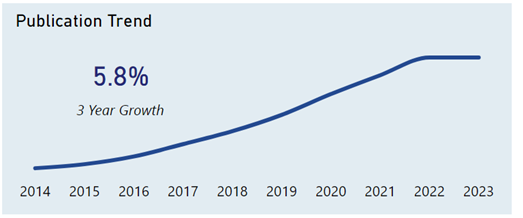
Based on data provided by the Harrity Analytics Patent Pulse™ Report on VR Hardware, the trend in VR hardware patent publications has experienced a consistent increase up to 2022, after which it levels off.  Over the past three years, there has been an annual growth of 5.8% in patent publications.  An increase in patent filings typically reflects a period of innovation, as companies seek to secure legal protection for their new inventions.  The data suggests progress in VR hardware development, pointing to the technology’s ongoing expansion and adoption.  

Analyzing the Growth of VR Hardware Patents: A Snapshot of Industry Leaders and Apple’s Position 
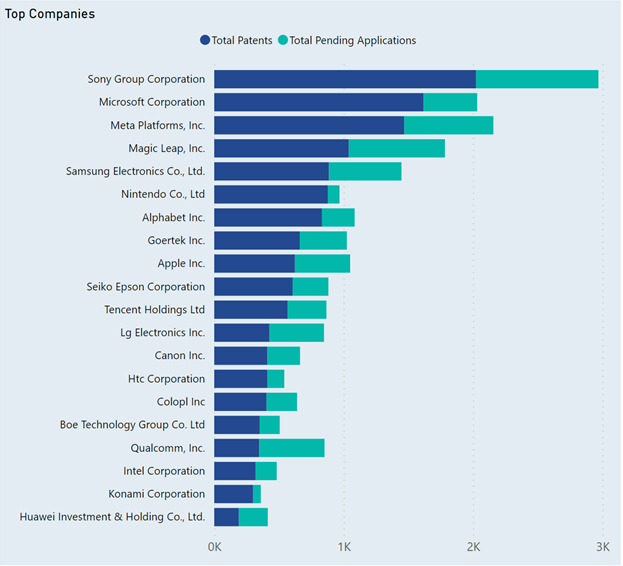
The chart presents data on the patent activities of leading corporations in the VR domain, specifically comparing the number of patents to the number pending applications.  This data provides a snapshot of VR technology patenting from technology giants. The following are highlights from this chart: 

  • Sony Group Corporation leads with the highest patent count. 
  • Microsoft, Meta Platforms, Magic Leap, Samsung, and Nintendo follow as top patent holders. 
  • These companies have many pending applications, showing active VR development. 
  • Apple Inc. ranks in the top 15, with fewer patents than the leaders. 

How Does Apple’s Growth in VR Patent Publications Compare to Industry Leaders? 
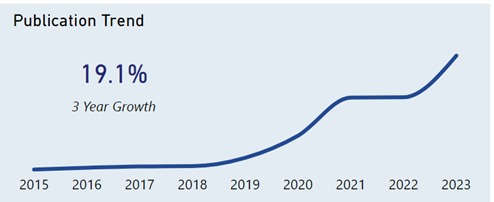
The following are the highlights from this chart about Apple’s publication trends: 

  • Apple’s publication growth in 3 years: 19.1%, more than triple the entire VR sector’s growth. 
  • Significant growth observed from 2019 to 2021, followed by a stable period. 
  • Growth resumed in the years 2022 to 2023. 

The Competitive Ecosystem 

As Apple’s Vision Pro joins the competitive landscape of virtual reality headsets, it stands amidst established players like Meta’s Quest series and Sony’s PlayStation VR.  Apple’s entry introduces its distinct blend of technologies and design philosophies, aiming to carve out its niche in a market that values innovation and user-centric experiences.  This environment, where companies not only compete on product capabilities but also on the intellectual property front, highlights a dynamic interplay of market strategies and technological advancements. 
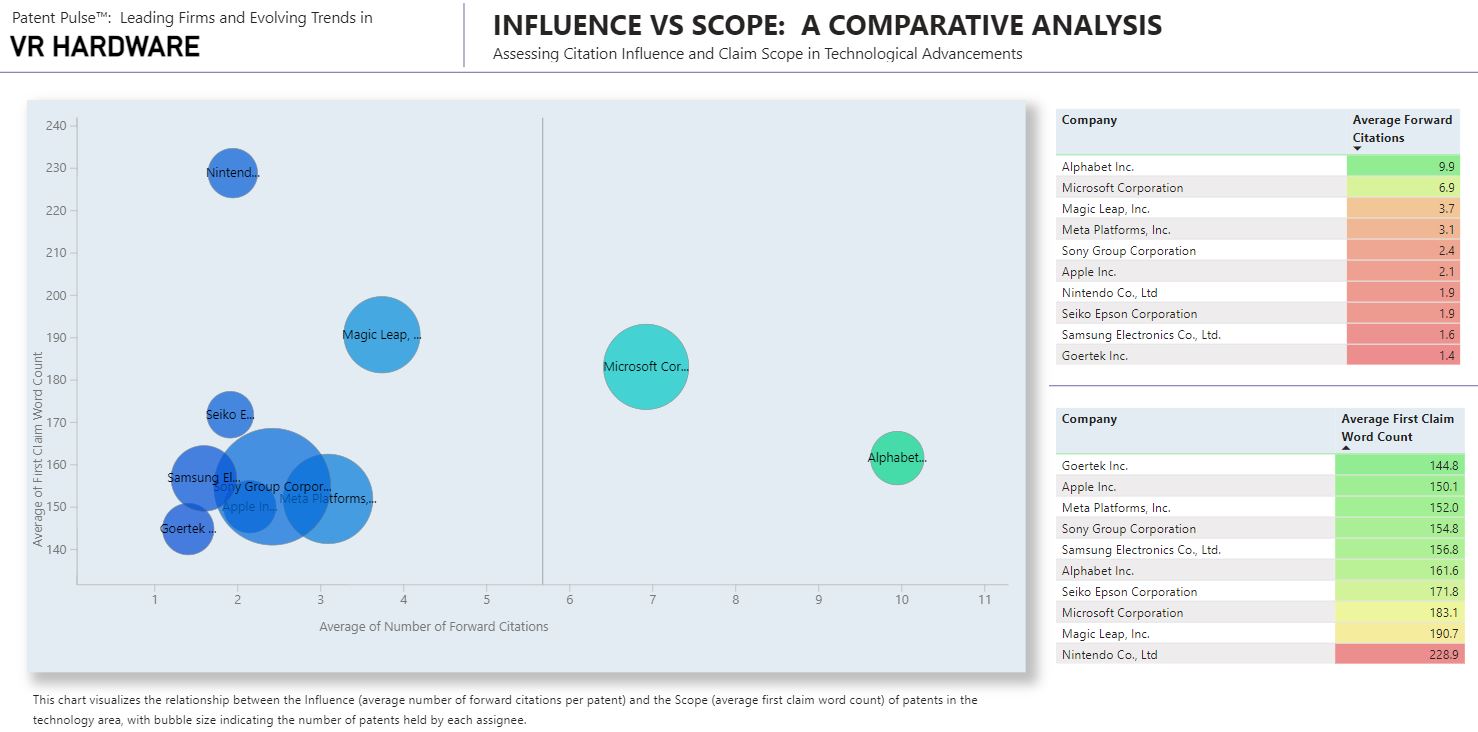
The chart provides a visual comparison of the influence and scope within the VR hardware patent landscape.  Influence is gauged by the average number of citations a company’s patents receive, indicating their significance to subsequent technological developments.  Scope is measured by the length of a patent’s first claim, which can reflect the breadth of the invention’s protection.  Larger bubbles represent a higher quantity of patents held by each entity.  The following are highlights from this chart: 

  • Microsoft and Alphabet have influential patents with shorter claim lengths. 
  • Goertek and Nintendo’s patents feature longer first claims. 
  • Apple’s patents have lower influence based on forward citations and have fewer words in the first claim. 

Analyzing the Impact and Breadth of VR Patent Portfolios 

Building on the understanding of patent activity as an indicator of technological development, further analysis can be conducted by examining the nuances of patent influence against the diversity of technology within the VR sector.  Review of such metrics provides insight into how companies balance the breadth of their technological advancements with the impact of their intellectual contributions.  This approach to patent analysis offers a unique perspective on how a company like Apple, with its moderate citation influence and longer first claims, positions itself among peers in terms of technological diversity and patent influence. 
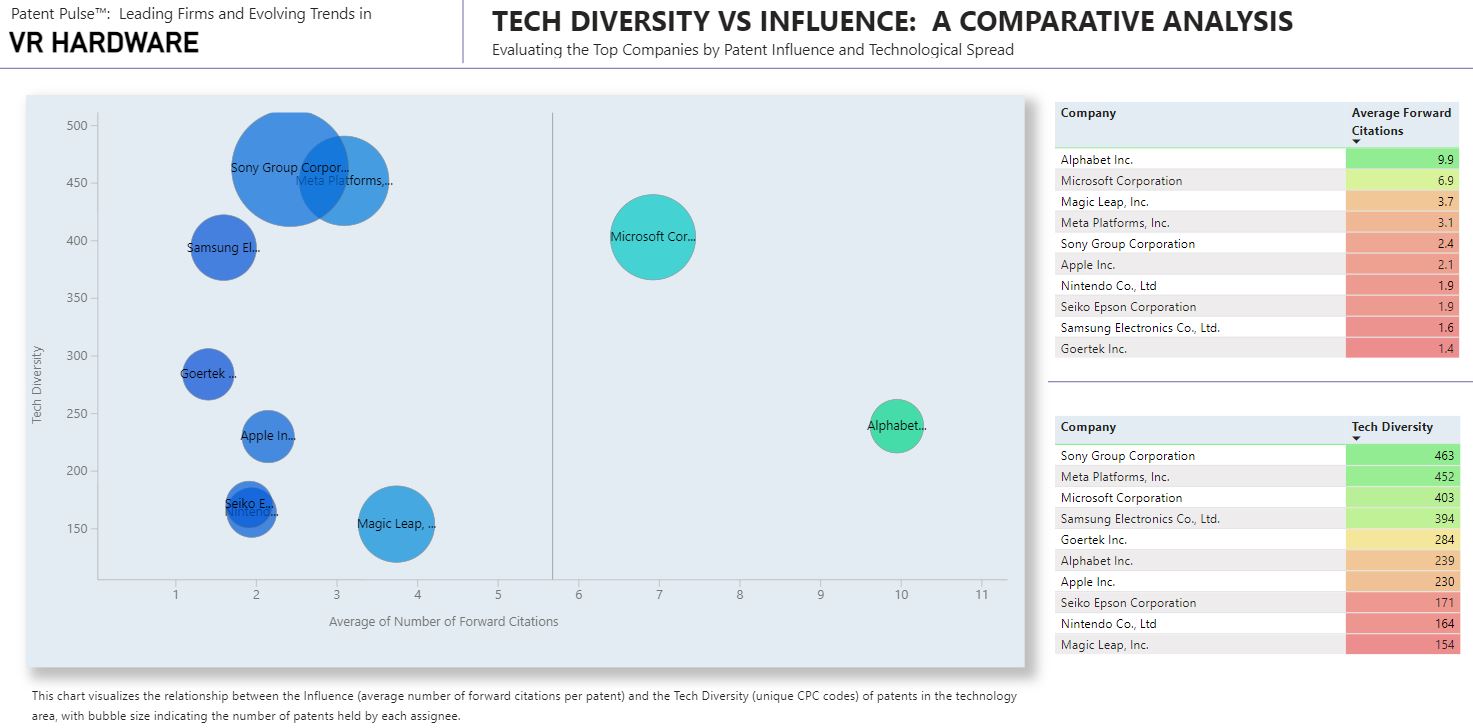
This chart offers a visual representation of the interplay between the number of forward citations—a marker of influence—and the technological diversity, as indicated by unique Cooperative Patent Classification (CPC) codes, for patents in the VR hardware domain.  The bubble sizes reflect the volume of patents each company holds.  The following are highlights from this chart: 

  • Microsoft and Alphabet have a high average of forward citations and multiple unique CPC codes. 
  • Sony and Meta Platforms demonstrate significant technological diversity. 
  • Apple holds moderate influence and technological diversity in this context. 

The Future is Now 

Apple’s Vision Pro is not the only VR headset to be introduced to the market in 2024.  The VR hardware landscape is set for potential other new releases from companies that include Valve Corporation and ByteDance.  Here is a summary of the most anticipated VR headsets: 

  1. Project Moohan: Samsung and Google are partnering to develop an advanced XR headset that leverages Samsung’s hardware capabilities and Google’s Android XR software.  This joint endeavor is positioned as a competitor to Apple’s Vision Pro, with an anticipated release in the summer of 2024. 
  2. PICO 4: Parent company Bytedance has apparently not yet launched PICO 4 in the US. 
  3. Valve VR Headset: Valve is currently working on the next iteration of its Valve Index VR headset, drawing upon its established VR expertise and extensive gaming catalogue. 
  4. Valve “Deckard”: This appears to be a new venture by Valve, which may be the successor to the Index VR system. 
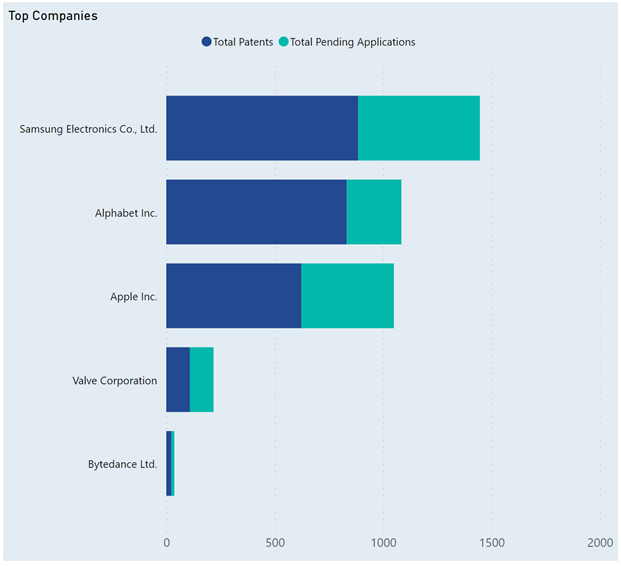
While not dominating the VR landscape, the companies shown in the above image, including Valve Corporation and ByteDance Ltd., own multiple VR patents and have several applications pending.  Their portfolios, though not as extensive as some competitors, reflect active participation in the VR sector. 

Applications of VR Technology Beyond Entertainment 

It should be noted that VR technology extends well beyond gaming into various sectors including the following:  

  • VR aids healthcare by enabling simulation of medical procedures and virtual patient rehabilitation. 
  • Education uses VR for immersive learning, allowing students to virtually visit historical locations or learn complex science. 
  • Real estate employs VR for remote property tours. 
  • Design and engineering benefit from VR’s ability to create 3D models, aiding visualization, and project iteration. 
  • The entertainment industry utilizes VR for immersive films and interactive storytelling experiences. 

Conclusion 

The launch of the Vision Pro signals Apple’s commitment to the VR segment.  With Apple holding a growing position in terms of patent activity and having moderate influence and technological variety within the VR domain, Vision Pro’s future contributions to this sector are anticipated with interest.

This data is sourced from the Harrity Analytics Patent Pulse™ Report on VR Hardware.  For more information about the Patent Pulse™ Report visit our website HERE, download a complimentary Patent Pulse Report HERE, or contact Harrity Analytics HERE. 

Sources: 

https://harrityllp.com/patent-pulse-report/ 

https://www.dexerto.com/tech/upcoming-vr-headsets-2156692/ 

https://deovr.com/blog/87-upcoming-vr-headsets 

https://www.tomsguide.com/news/oculus-quest-3-release-date-rumors-specs-news#:~:text=The%20Meta%20Quest%203%20is,to%20say%20about%20that%20soon) 

https://www.youtube.com/watch?v=dtp6b76pMak 

https://www.apple.com/apple-vision-pro/ 

https://www.apple.com/apple-vision-pro/guided-tour/  

https://www.apple.com/apple-vision-pro/specs/  

https://www.apple.com/newsroom/2023/01/apple-unveils-m2-pro-and-m2-max-next-generation-chips-for-next-level-workflows/  

https://forums.appleinsider.com/discussion/233273/hands-on-with-apple-vision-pro-in-the-wild  

https://www.makeuseof.com/what-is-apples-r1-chip-how-does-it-compare-m1-and-m2/  

https://www.hardwarezone.com.sg/tech-news-samsung-and-googles-xr-headset-expected-launch-2024  

https://www.theverge.com/2023/12/13/23999883/the-pico-5-headset-might-be-canceled-but-bytedance-isnt-done-with-vr  

Inspiring Inclusion in Patent Law: Celebrating International Women’s Day with Heart

As we approach International Women’s Day on March 8th, the theme of #inspireinclusion resonates profoundly within the patent law community, particularly among those with a background in mechanical engineering. The journey towards inclusion is a personal and collective endeavor, often marked by moments of feeling out of place. Yet, it’s through these experiences that the importance of fostering an inclusive environment becomes undeniably clear. This year, we are invited to embody the spirit of inclusion in a unique and heartwarming way, symbolizing our commitment to building a more welcoming and diverse field.

Holding a degree in mechanical engineering and navigating the intricate world of patent law, experiences of feeling excluded are not uncommon. These moments, though challenging, shine a light on the vital need for inclusivity within our professional spheres. As we gear up to celebrate International Women’s Day this Friday, March 8th, the patent law community is rallying around a powerful theme: #inspireinclusion. This initiative isn’t just a call to action; it’s a movement towards embracing diversity and fostering an environment where everyone feels valued and included.

This year’s International Women’s Day is more than a celebration; it’s a declaration of unity and understanding. The #inspireinclusion theme encourages us to adopt a stance that is as meaningful as it is symbolic—a heart. This gesture is far from arbitrary. It represents the core of where inclusion begins: our hearts. It’s a poignant reminder that at the heart of inclusion lies empathy, understanding, and the willingness to embrace diversity in all its forms.

The invitation to strike the #inspireinclusion pose this Friday is open to everyone, men included, highlighting that inclusion is not the responsibility of a single gender but a collective effort that requires the participation and support of all. The gesture of forming a heart is a powerful symbol of solidarity, unity, and the shared commitment to fostering an inclusive environment within the patent law community and beyond.

As we stand together, adopting the #inspireinclusion stance, we’re not just participating in a symbolic act. We’re pledging to make inclusivity a cornerstone of our professional and personal lives. This International Women’s Day, let’s inspire inclusion by showing the world that the patent law community stands united in its commitment to diversity, equity, and inclusion.

The call to inspire inclusion this International Women’s Day is more than a theme; it’s a reflection of our collective aspiration to create a more inclusive and equitable world. By participating in the #inspireinclusion pose, we are making a statement about the values we hold dear in the patent law community. This gesture, rooted in the simplicity and universality of a heart, serves as a powerful reminder of the impact of our actions and the importance of leading with empathy and understanding. Let’s embrace this opportunity to celebrate diversity and inclusion, not just on International Women’s Day but every day. Join us in striking the #inspireinclusion pose this Friday and be a part of a movement that champions equality, unity, and the power of inclusion.


Want more Driving Diversity? Check out other videos with Elaine Spector here!

Trends and Implications of Decreasing Average Office Actions Per Patent at the USPTO

By Rocky Berndsen, Head of Analytics

The United States Patent and Trademark Office (USPTO) has been observing a notable trend over the past six years that could have significant implications for patent applicants and the patenting process at large. Data from 2018 through 2023 shows that the average number of office actions per patent—a metric that indicates the average number of communications between the patent examiner and the applicant before a patent is either granted or the application is abandoned—has been consistently decreasing across various technology centers (TCs).

Analyzing the Numbers

In 2018, the USPTO’s overall average stood at 1.631 office actions per patent. As of 2023, this number has dipped to 1.371, marking a significant reduction. This decrease is not isolated to a specific sector but is across the board, including high-volume TCs such as 2100 (covering Computer Architecture, Software, and Information Security), which saw a drop from 2.088 to 1.580, and 3700 (covering Mechanical Engineering, Manufacturing, and Products), which went from 1.901 to 1.551.

Shorter Time to Obtain Patents

A primary implication of this trend is a likely acceleration in the patent granting process. With fewer office actions required, the back-and-forth between the USPTO and patent applicants is reduced, potentially leading to a more streamlined examination process. For inventors and companies, this means a faster path to securing patent rights, which can be crucial for maintaining competitive edges in fast-moving industries.

Lower Costs for Applicants

Each office action typically incurs additional costs for applicants, including attorney fees and potential amendment requirements. A reduction in the average number of office actions can thus translate into lower overall costs for obtaining a patent. This could be particularly beneficial for individual inventors and small businesses for whom cost is a major barrier to securing patent protection.

Implications for Patent Quality

However, while fewer office actions suggest a more efficient process, there could be concerns about the thoroughness of patent examinations and the potential impact on patent quality. The USPTO must balance the efficiency of the examination process with the need to maintain high standards for patentability, ensuring that only novel, non-obvious, and useful inventions are granted patent rights.

Impact on Patent Litigation

A decrease in office actions might also influence patent litigation. Patents that undergo fewer office actions could be perceived as less scrutinized, potentially affecting their defensibility in court. Conversely, this trend might result in patents that are more solid due to a more focused examination process, leading to less ambiguity and fewer grounds for litigation.

Enhanced Predictability for Planning

For businesses and investors, a predictable patent examination timeline facilitates better strategic planning and resource allocation. If the trend of decreasing office actions continues, it may enable more precise forecasting of patent portfolios and related business activities.

In conclusion, the downward trend in the average number of office actions per patent at the USPTO is a positive signal for applicants looking for a quicker and less costly patenting process. However, it’s imperative that this efficiency does not compromise the quality of granted patents—a balance the USPTO is undoubtedly striving to achieve. As we watch this trend continue, the patent ecosystem may need to adapt to the evolving dynamics of patent prosecution and enforcement.

Get in Touch for Insights on USPTO Data

If the information above has sparked your curiosity or if you have specific queries about USPTO data and trends, we invite you to reach out. Understanding the intricacies of patent data can provide valuable insights for your patent strategy and decision-making process. By filling out our contact form, you’ll connect with experts who can delve deeper into the data, provide personalized analysis, and help you gain insight from USPTO data.

Harrity Analytics - Contact Us
Step 1 of 2
Name

Enhancing Patent Prosecution Efficiency: A Strategic Approach to Examiner Interview Agendas

The path to securing a patent is intricate, with examiner interviews marking a critical juncture where direct dialogue can significantly influence the outcome. In this week’s The Precise Prosecutor, George Howarah leverages his extensive experience in patent law, unveiling a strategic method for preparing examiner interview agendas. This approach not only facilitates effective communication but also navigates the nuances of patent prosecution estoppel.


Crafting an Effective Agenda
The agenda for an examiner interview is more than a mere list; it’s a strategic tool that shapes the direction of the discussion. George emphasizes the importance of this document, which also becomes a part of the official record, potentially influencing future legal interpretations.


Key Elements of a Successful Agenda
George’s strategy for agenda preparation encompasses several critical steps:

Issue Prioritization: Identifying and ordering relevant issues and rejections according to their significance ensures comprehensive coverage without overwhelming the examiner.

Claim Amendments and Arguments: Proposing claim amendments and providing concise arguments or specification references in the agenda can preemptively address potential objections, setting the stage for a constructive conversation.

Flexibility in Discussion: The order of discussing issues might differ from their listing, allowing for tactical adjustments based on the complexity of issues and the time available.

Preparation of Backup Options: George advocates for the readiness of alternative amendments or arguments, offering flexibility in addressing examiner concerns and enhancing the likelihood of overcoming objections.

Clarity and Organization: A bullet-pointed, well-structured agenda respects the examiner’s limited preparation time, ensuring the discussion focuses on substantive issues rather than navigational confusion.


Leveraging the Agenda for Success
The preparation of an examiner interview agenda, as outlined by George, is a meticulous process that requires insight into the legal and procedural nuances of patent prosecution. By emphasizing clarity, strategic issue presentation, and the anticipation of potential objections, patent practitioners can engage more effectively with examiners. This approach not only addresses the immediate challenges of a particular patent application but also fosters a collaborative environment conducive to achieving a favorable resolution.


The strategic preparation of examiner interview agendas is pivotal in the patent prosecution process, offering a pathway to clearer communication and more efficient resolution of issues. George’s guidelines provide a blueprint for patent attorneys and agents striving to optimize their engagement with USPTO examiners, enhancing the prospects for patent grant success.

Want more Precise Prosecutor? Check out other videos with George Howarah here!

Stella Ennals: A Legacy of Innovation and Independence

As we commemorate the end of Black History Month, it is crucial to celebrate the stories that highlight the intersection of diversity, innovation, and resilience. Stella Ennals, a black female inventor, embodies this convergence through her journey to overcome personal and systemic barriers with her groundbreaking invention. This Driving Diversity blog post aims to shine a light on Stella’s invention, a device designed to empower individuals with disabilities, showcasing her perseverance and the impact of her work on fostering independence.

In Bethesda, Maryland, Stella Ennals embarked on a journey that would not only challenge her physical limitations but also the systemic obstacles that often hinder black female inventors. Her invention, a device enabling those with disabilities to transport their own trays, was born out of a necessity for independence after a personal physical injury left her desiring more autonomy.

Stella’s path to innovation was marked by a relentless pursuit of self-sufficiency and a desire to contribute a solution that would assist others facing similar challenges. Her invention is not just a testament to her engineering ingenuity but also to her deep understanding of the everyday hurdles faced by people with disabilities. By addressing a specific need, Stella’s device offers a broader message of empowerment and inclusion, underscoring the importance of accessibility in all aspects of life.

Reflecting on Stella’s journey, it’s evident that her fortitude and persistence were her greatest assets. Her ability to navigate the patent process and bring her invention to fruition is inspiring, particularly when considering the additional layers of challenge presented by systemic biases. Stella’s story is a powerful reminder of the impact one individual can have on improving the lives of many, driven by the simple yet profound goal of enhancing independence.

Stella Ennals stands as a beacon of innovation, resilience, and independence, her story resonating deeply as we celebrate Black History Month. Her invention transcends its practical application, symbolizing the broader struggles and triumphs of black female inventors against systemic barriers. Stella’s legacy encourages current and future generations to persevere in the face of adversity, innovate for the greater good, and strive for a more inclusive and accessible world for all.

Want more Driving Diversity? Check out other videos with Elaine Spector here!

The Art of Examiner Interviews: A Strategic Approach for Success

In the complex and nuanced world of patent prosecution, examiner interviews stand out as a crucial element in navigating the approval process efficiently. George Howarah shares his invaluable insights on how to leverage examiner interviews to their full potential. This blog post delves into the strategic preparation necessary for conducting successful examiner interviews, highlighting George’s expert perspective.

Understanding the Client’s Goals

The first step in preparing for an examiner interview involves a clear understanding of the client’s objectives. Whether the aim is to expedite claim approval within a reasonable scope or ensure the claims align with a specific product or standard, identifying these goals upfront is critical. This initial clarity guides the strategy throughout the interview process, ensuring that the direction pursued aligns with the client’s expectations.

Analyzing the Prosecution History

A thorough examination of the application’s prosecution history is essential. This involves distinguishing whether the application is original, a continuation, or a divisional. Understanding the nuances between the current claims and those in previous applications helps tailor the approach to the interview. Additionally, recognizing the stage of prosecution is key. An aggressive stance might be more suitable at the beginning, whereas a more conciliatory approach could be beneficial in later stages, aiming for a middle ground that maintains the claims’ integrity.

Evaluating the Examiner’s Position

Assessing the examiner’s posture towards the application and the specifics of any rejections is another critical step. This includes reviewing past interactions for any precedents of overcoming objections and scrutinizing the current office action for potential misunderstandings or oversights by the examiner. Such an evaluation helps in anticipating the examiner’s concerns and preparing a more effective response.

Assessing the Strength of the Rejection

Finally, George emphasizes the importance of analyzing the strength of the rejection. Whether dealing with a 102 (novelty) or a 103 (non-obviousness) rejection, it’s vital to give the examiner the benefit of the doubt while also firmly advocating for the patent’s validity. This may involve deciding on the necessity of claim amendments to navigate around the rejection.

The preparation for an examiner interview is a multifaceted process that requires a deep understanding of the client’s goals, the application’s history, the examiner’s perspective, and the nature of the rejection. George’s approach showcases the importance of meticulous preparation and strategic planning in achieving successful outcomes in patent prosecution. By adopting these strategies, patent practitioners can enhance their effectiveness in examiner interviews, leading to more favorable results for their clients.

Want more Precise Prosecutor? Check out other videos with George Howarah here!

Unlocking Genius: Empowering Black Innovators in the World of Patents

In the tapestry of American history, Black innovators have woven a rich legacy of ingenuity and resilience, yet their contributions often remain underrecognized in the annals of patent law. Dr. Charles Richard Drew, a surgeon and medical researcher renowned for pioneering blood plasma storage methods, exemplifies this legacy of innovation. As we delve into his story and the broader narrative of Black excellence, a pressing question emerges: How many potential Einsteins are we overlooking in our Black communities? During Black History Month, it’s imperative to confront the stark underrepresentation of Black professionals in the patent field—a reflection of a wider systemic disparity that limits the realization of Black potential in science, technology, engineering, and mathematics (STEM).

The story of Dr. Charles Richard Drew is not just one of historical significance but also a beacon of inspiration, highlighting the transformative impact that individuals from underrepresented backgrounds can have on society. Despite such monumental contributions, the patent field reveals a disheartening disparity: while 14% of Americans identify as Black, a mere 1% of patent holders are African American. This is in stark contrast to the 7% of STEM jobs held by African Americans, underscoring a significant gap between potential and realized opportunities for innovation.

This discrepancy not only dims the prospects of individual Black innovators but also deprives society of diverse perspectives and solutions. Addressing this gap requires a multifaceted approach, focusing on foundational issues such as access to education and resources. Enhancing STEM education, providing mentorship, and ensuring access to necessary resources are critical steps towards empowering Black individuals to invent, patent, and lead in the realm of technology and innovation.

Organizations like Invent Together are leading the charge by creating accessible educational resources, such as the Inventor’s Patent Academy, that aim to demystify the patenting process and make it more inclusive. By leveraging these resources and fostering a supportive community, we can start to bridge the gap for Black innovators.

The underrepresentation of Black professionals in patent law is a glaring issue that requires immediate and sustained action. By addressing systemic barriers and providing targeted support, we can pave the way for a new generation of Black inventors and innovators who will shape the future of technology and society. Let us commit to being part of this transformative journey, recognizing and uplifting the contributions of Black innovators not just during Black History Month, but all year round. As we reflect on the legacy of pioneers like Dr. Charles Richard Drew, let’s ask ourselves how we can contribute to creating a more inclusive and equitable patent field, where every potential Einstein has the opportunity to thrive.

Want more Driving Diversity? Check out other videos with Elaine Spector here!

Harrity Ascends to 27th on the Top Patent Firms List, Showcasing Unprecedented Growth

Washington, D.C.: Harrity & Harrity, LLP has marked a significant milestone in its journey towards excellence in patent law, securing the 27th spot on the esteemed Top Patent Firms List, an annual ranking of the leading firms obtaining US utility patents each year. This remarkable ascent is not only a testament to the firm’s unwavering dedication to innovation and quality but also highlights the exceptional growth trajectory it has maintained over the past five years in the highly competitive patent legal landscape.

From its 87th rank with 306 patents in 2018 to its current standing, Harrity & Harrity has not only advanced in rank year after year but has also more than quadrupled its patent output. In 2023 alone, the firm outperformed its previous year’s achievement by almost 60%, securing 1458 patents compared to 923 in 2022. This remarkable upward momentum is reflective of Harrity & Harrity’s robust strategic focus and the high-caliber proficiency of its team.

Harrity & Harrity’s progression in the rankings is particularly impressive given its focus on primarily domestic work in the electrical, mechanical, software, and business methods patent spaces— areas that exclude the life sciences spaces and the high volume of foreign-originated work that many of its competitors handle. In fact, when you consider strictly electrical, mechanical, software, and business methods patent work, Harrity jumps to the 19th spot on the Top Patent Firms List. Furthermore, Harrity achieved its 2023 number with a comparably small team of 40 professionals, while the majority of other firms in the Top 30 have well into the hundreds.

This data-driven success narrative exemplifies the firm’s “small firm, big impact” philosophy, illustrating how a concentrated team can deliver exceptional results that rival and even surpass those of much larger firms. Harrity & Harrity’s rise in the rankings is a testament to their strategic problem-solving approach, and a clear indicator that the firm is achieving the seemingly impossible through diligence, innovation, and a commitment to quality.

Harrity & Harrity’s unique story is one of a forward-thinking firm that thrives on real-world applications of advanced patent analytics and automation technologies, setting a new standard for what a specialized patent practice can accomplish.

For more insights into Harrity & Harrity’s remarkable growth and to explore their contributions to the patent field, please contact Samantha Sullivan and we would be happy to set up an interview with one of our partners.

About Harrity & Harrity:

Harrity & Harrity is a forward-thinking patent law firm in the Washington, D.C. area, specializing in electrical and mechanical technologies. Known for its innovative approach to patent law, the firm is committed to increasing diversity in the patent field and to giving back through its various charitable initiatives. For more information, please visit www.harrityllp.com.

The Underrated Key to Patent Prosecution Success: Examiner Interviews

In the realm of patent prosecution, there’s a tool that often goes underutilized, yet holds the potential to significantly streamline the patenting process, ensuring clarity, efficiency, and a stronger patent position. In this week’s Precise Prosecutor vlog, George Howarah brings to light the importance of examiner interviews, a strategy that can pivot the usual course of patent prosecution towards more favorable outcomes.

George points out a common pitfall in patent prosecution where practitioners might lean heavily on written responses to office actions. This method, while traditional, might not always capture the examiner’s perspective accurately, potentially leading to miscommunications, unaddressed rejections, or, in some cases, creating estoppel issues that could weaken the patent’s enforceability.

Examiner interviews stand out as a solution to these challenges. Engaging in a dialogue with the examiner post-office action not only clarifies the examiner’s stance but also opens the door for direct feedback on proposed arguments or amendments. This proactive approach can lead to more precise adjustments, avoiding the back-and-forth that often characterizes patent prosecution.

George advocates for scheduling an examiner interview after every office action, highlighting the benefits he has observed in his practice. These benefits include demonstrating a commitment to the patent application, reducing the time and cost associated with obtaining a patent, and minimizing the risk of prosecution estoppel.

George’s advice to fellow practitioners is clear: leverage examiner interviews as a standard step in your prosecution strategy to foster a more efficient, transparent, and successful patent prosecution process.

Want more Precise Prosecutor? Check out other videos with George Howarah here!

Bridging the Gap: Elevating Black Inventors in the Patent System

This February, as we observe Black History Month, we turn our focus to an often-overlooked arena where black excellence continues to fight for recognition and equity: the patent system. The underrepresentation of black inventors is not just a statistical oversight; it’s a reflection of systemic barriers that have persisted for far too long. These barriers not only hinder individual aspirations but also deprive our society of diverse innovations and contributions.

The systemic challenges faced by black inventors in navigating the patent system are multifaceted. From limited access to resources and networks to the financial burdens of patenting, the obstacles are significant. However, the tide is beginning to turn, thanks to the efforts of organizations committed to fostering diversity in innovation.

Invent Together stands out as a beacon of hope, offering free online programs designed to guide first-time patent applicants through the intricate process. By demystifying the patent application process, Invent Together is breaking down one of the significant barriers to entry for underrepresented inventors.

Moreover, educational institutions across the country are beginning to recognize the importance of supporting diversity in innovation. By adopting resources like those offered by Invent Together, universities, colleges, and institutes are laying the groundwork for what we hope will be a new era of inclusivity and diversity in the field of invention and innovation.

The path toward a more inclusive patent system is long and fraught with challenges, but it’s a journey worth embarking on. By supporting initiatives like Invent Together and encouraging educational institutions to play their part, we can begin to dismantle the systemic barriers that have sidelined black inventors for too long.

As we celebrate Black History Month, let’s commit to making a difference, not just this month but every month. The contributions of black inventors, both past and present, deserve recognition and support. By working together, we can ensure that the future of innovation is as diverse as the society it aims to serve.

Visit TIPA’s site to learn more and help us empower the next generation of inventors. Your support can change the course of history.

Want more Driving Diversity? Check out other videos with Elaine Spector here!

Elaine Spector Provides Data-Driven Perspective at 2024 AIPLA DEIA Colloquium

In an inspiring gathering at the 2024 AIPLA DEIA Colloquium in Puerto Rico, Elaine Spector, Partner at Harrity & Harrity, LLP, provided an enlightening presentation that underscored the crucial role of diversity, equity, inclusion, and accessibility (DEIA) in fostering innovation, entrepreneurship, and creativity within the intellectual property (IP) realm. This significant event, held in partnership with the Intellectual Property Institute of Canada (IPIC), ASIPI, and Invent Together, served as a platform for thought leaders to exchange insights and advance the conversation around DEIA in the IP field.

Elaine’s presentation delved into the current state of diversity in IP law, offering a comprehensive, data-driven analysis that illuminated both the progress made and the challenges that lie ahead. By leveraging empirical evidence, she highlighted the underrepresentation of diverse groups in the patent field and the untapped potential this presents for innovation. Elaine’s adept use of data not only provided a clear picture of the current landscape but also underscored the importance of strategic efforts to enhance diversity within the profession.

Elaine Spector on DEIA Panel

A standout moment of the colloquium for Elaine was meeting Aina Breen, a patent agent hired by Harrity out of our Patent Pathways™ program.  Patent Pathways™ is a groundbreaking 501(c)(3) organization that aims to bridge the diversity gap in the patent field by offering free training and mentorship to individuals interested in becoming patent professionals who are currently facing underrepresentation and socioeconomic barriers.

“The icing on the cake was meeting our extraordinary Patent Pathways™ (a 501(c)(3) organization) hire Aina Breen. Aina has a degree in mechanical engineering and rocked the patent bar exam on her first try! What an honor it is to know her and mentor her, and now, to meet her in person!” Elaine shared on LinkedIn.

Aina’s presence at the colloquium embodied the success of targeted efforts to foster inclusivity and support underrepresented talent in the IP sector.

Elaine Spector and Aina Breen

Elaine Spector’s participation in the 2024 AIPLA DEIA Colloquium not only reinforced Harrity & Harrity’s dedication to advancing DEIA in the IP field but also sparked meaningful discussions on how to continue this important work. Through a combination of data-driven insights and real-life success stories, the presentation highlighted the firm’s strategic approach to nurturing a more diverse, equitable, and inclusive environment for innovation.

As we reflect on the insights shared at the colloquium, it’s evident that while strides have been made, the journey toward full inclusivity and representation in the IP field continues. Harrity & Harrity remains at the forefront of this endeavor, committed to leveraging data and real-world outcomes to guide their efforts in making the patent world a more diverse, innovative, and accessible place.

For more information about Harrity & Harrity’s diversity initiatives and services, please visit harrityllp.com/diversity.

Harrity Wins ‘Patents Law Firm of the Year in Virginia – 2024′

Harrity & Harrity, LLP and John Harrity Awarded Patents Law Firm & Patents Lawyer of the Year in Virginia – 2024 by Corporate International

Harrity & Harrity, LLP is honored to announce that John Harrity has been named the ‘Patents Lawyer of the Year in Virginia – 2024,’ with the firm winning ‘Patents Law Firm of the Year in Virginia – 2024’ by Corporate International, a prestigious recognition as part of their 17th Global Awards. This award celebrates our commitment to excellence in the patent law field and underscores our dedication to innovation, quality, and diversity in our practices.

The Corporate International Global Awards mark a significant achievement in the legal industry, highlighting firms and individuals who have demonstrated outstanding merit and competence in their respective fields. The selection process is comprehensive, involving nominations from peers, evaluation of our work, consideration of our firm’s rankings, the expertise of our partners and directors, our previous awards and recognitions, network affiliations, reputation in the legal community, contributions to publications, and participation in speaking engagements.

This year’s awards were the most competitive to date, with a record number of nominations received. Being chosen as a winner from such a distinguished pool of nominees not only reflects the high caliber of our team’s expertise but also our consistent ability to exceed the expectations of our clients and peers.

This recognition is a testament to our firm’s unwavering commitment to fostering diversity, driving innovation, and delivering high-quality patent services. It is also a reflection of our dedication to supporting our clients in protecting their intellectual property in the computer, electrical, and mechanical fields.

We thank Corporate International for this honor, to our clients for their trust and collaboration, and to our dedicated team for their hard work and commitment to excellence. This award motivates us to continue our efforts in making significant contributions to the patent field, pushing the boundaries of what is possible, and maintaining our status as a leader in the legal community.

We look forward to continuing to serve our clients with the highest standards of quality and professionalism and to furthering our contributions to the legal field through our innovative practices and dedication to diversity and charity.

Harrity & Harrity, LLP remains committed to improving the patent field and creating a progressive, innovative workplace. We are proud of this recognition and excited about the opportunities it brings to further elevate our firm and the services we provide to our clients around the globe.

About Harrity & Harrity, LLP

Harrity & Harrity, LLP is a boutique patent law firm specializing in electrical, mechanical, and computer technologies. Based in the Washington, D.C. area, the firm is committed to fostering an innovative, progressive, and inclusive workplace. With a nationally dispersed remote team of skilled patent attorneys, patent agents, and support staff, Harrity & Harrity is at the forefront of providing high-quality, efficient, and automated patent services.


Maximizing Patent Value: A Strategic Approach to Claim Management

In the intricate world of patent filings, understanding how to leverage the structure of your patent application can significantly impact its value. One area that often goes underutilized is the strategic management of claims within an application. As Neil Kardos highlights in this week’s Practical Patents series, a nuanced approach to claim management can not only streamline the patent prosecution process but also ensure clients receive maximum value for their investments.

In the United States, the initial patent application filing fee covers the inclusion of up to 3 independent claims and a total of 20 claims. It’s a common misconception that the quantity of claims within a patent directly correlates with its strength or value. However, the strategic composition and management of these claims can significantly enhance a patent’s effectiveness and its potential to protect innovative technology comprehensively.

During the patent prosecution phase, it’s not uncommon to amend claims to align with the United States Patent and Trademark Office (USPTO) requirements for patentability. This often involves consolidating the concepts of multiple dependent claims into fewer, broader independent claims to facilitate application approval. Yet, this consolidation presents a unique opportunity for strategic claim management.

Neil emphasizes the importance of adding a new dependent claim for every claim that is canceled. This practice ensures that the final patent utilizes the full quota of claims that the filing fee entitles, thus maximizing the patent’s breadth and flexibility without incurring additional costs. It’s a practice that, surprisingly, not all patent practitioners follow, as evidenced by numerous patents issuing with fewer than the allotted 20 claims.

The implications of this strategy extend far beyond mere numerical optimization. Each claim in a patent application can be viewed as a unique tool for protecting different facets of the invention. By ensuring that each patent utilizes its full complement of claims, inventors can secure a more robust and nuanced protection. This not only enhances the patent’s defensive capabilities but also its value in potential licensing discussions or infringement disputes.

Furthermore, this approach demonstrates to clients a meticulous and value-driven management of their intellectual property. In a landscape where every detail counts, the strategic addition and adjustment of claims can significantly differentiate a patent’s quality and its potential for commercial success.

Neil’s insights into claim management offer a valuable perspective for anyone involved in the patent filing process. By understanding the strategic potential of claims adjustment and ensuring that patents utilize their full entitlement, practitioners can deliver enhanced value to their clients, reinforcing the importance of detail-oriented strategies in patent law.

Stay tuned for more insightful tips and tricks from Neil Kardos in our Practical Patents series! Until next time, happy patenting!

Note: This blog post is based on the opinions and observations of the author and should not be considered legal advice. Consult a qualified patent attorney for specific guidance on patent application drafting.

Want more tips? Check out other Practical Patents videos with Neil Kardos here!

Unveiling the Power of Bubble Charts in Competitive Intelligence: A Quantum Computing Perspective

By Rocky Berndsen, Head of Analytics

In the realm of competitive intelligence, especially within the patent field, traditional metrics such as patent counts have long been the standard for assessing a company’s patent portfolio strength.  However, this quantitative approach often overlooks the qualitative aspects of patents, which can provide deeper insights into a company’s technological prowess and strategic positioning.  Our recent Quantum Computing – Patent Pulse Report introduces an innovative approach to competitive benchmarking that utilizes bubble charts, offering a more nuanced view of the landscape.  To download the complimentary Quantum Computing Patent Pulse Report, CLICK HERE.

Beyond Counting Patents: The Need for Deeper Insights

While the number of patents a company holds is an important indicator of its activity in a particular technology area, it doesn’t tell the whole story.  Two crucial qualitative metrics often overlooked are the influence of a patent, measured by the number of forward citations it receives, and the scope of its claims, typically gauged by the word count of the first claim.  These metrics provide insights into the patent’s potential impact on future technologies and its breadth of coverage, respectively.

The Bubble Chart: A Visual Representation of Patent Quality and Quantity

The bubble chart featured in our Quantum Computing report illustrates how these qualitative metrics can be visualized alongside quantitative ones.  By plotting companies across two axes—average number of forward citations (influence) and average first claim word count (scope)—and using the bubble size to indicate the number of patents held, the chart provides a comprehensive view of each company’s patent portfolio in terms of both quality and quantity.

This visualization technique allows stakeholders to quickly identify leaders in the technology area, not just by the volume of their patents but by their potential impact and breadth.

Insights from the Quantum Computing Patent Landscape

The Quantum Computing – Patent Pulse Report reveals intriguing trends and strategic positions among key players in the quantum computing field.  For example, D-wave Systems Inc. stands out with patents that have the highest average first claim word count and the highest average forward citations.  To download the complimentary Quantum Computing Patent Pulse Report, CLICK HERE.

The Strategic Value of Bubble Charts in Competitive Benchmarking

The use of bubble charts for competitive benchmarking analyses offers several advantages:

  • Comprehensive Insights: It provides a holistic view of a company’s patent portfolio, combining quantity with qualitative metrics.
  • Strategic Decision-Making: Companies can identify not only their position but also their competitors’ strategic focuses, guiding R&D investments and patenting strategies.
  • Identifying Innovation Leaders: Stakeholders can pinpoint which companies are setting the pace in technological advancements, potentially guiding partnership or acquisition decisions.

Conclusion

As the patent landscape becomes increasingly complex, tools like bubble charts that offer multi-dimensional analyses become invaluable.  Our Quantum Computing – Patent Pulse Report is a testament to the power of such analytical tools in revealing the nuances of competitive positioning and technological leadership.  By moving beyond simple patent counts to a richer, more informative analysis, we can gain true insights into the dynamics of innovation across industries.

Elevating Patent Clarity: The Strategic Use of ‘Threshold’ in Patent Drafting

In this edition of the Practical Patents series, we delve into the nuanced use of the term ‘threshold’ in patent language, guided by Neil Kardos. This exploration highlights the importance of precision in patent drafting, a critical skill in the art of protecting intellectual property.

In the meticulous realm of patent drafting, every word counts. The term ‘threshold’ might appear straightforward, yet its application in patents is anything but. Neil explains this with two insightful examples.

1. Achieving Precision Over Vagueness

Clarity is the cornerstone of effective patent drafting. Generic terms like ‘high’ and ‘low’ are laden with ambiguity, often leading to Section 112 rejections. Neil’s advice is to opt for phrases such as ‘satisfies’ or ‘does not satisfy a threshold.’ This method enhances clarity and strengthens the enforceability of the patent.

2. Broadening Patent Scope Through ‘Threshold’

In instances where an inventor provides a specific number or range, the term ‘threshold’ can be used to expand the invention’s scope. By defining these figures as examples of satisfying a ‘threshold,’ a patent can encompass a broader range of applications, enhancing its protective coverage.

Neil emphasizes caution in using ‘threshold.’ He advises against framing claims based solely on a value being ‘greater than’ or ‘less than’ a threshold. Such language can inadvertently open doors for competitive workarounds.

Instead, Neil recommends a more comprehensive approach: asserting that a value ‘satisfies the threshold’ or ‘satisfies a condition.’ This strategy, when combined with a detailed specification, provides a stronger, more defensible patent.

As we conclude this discussion, we’re reminded of the critical role precise language plays in patent law. Neil’s insights into the use of ‘threshold’ underscore the importance of thoughtful and strategic patent drafting.

Stay tuned for more insightful tips and tricks from Neil in our Practical Patents series! Until next time, happy patenting!

Note: This blog post is based on the opinions and observations of the author and should not be considered legal advice. Consult a qualified patent attorney for specific guidance on patent application drafting.

Want more tips? Check out other Practical Patents videos with Neil Kardos here!

Harrity Named US News 2024 Best Companies to Work For: Law Firms

Harrity & Harrity, LLP Named a ‘Best Company to Work For: Law Firms’ by US News & World Report, Reflecting Excellence in Employee Satisfaction and Workplace Environment

Washington, D.C. – January 30, 2024

Harrity & Harrity, LLP is honored to announce its recognition as one of the Best Companies to Work For in 2024: Law Firms by US News & World Report. This prestigious distinction is based on a comprehensive evaluation method that highlights the firm’s commitment to creating an outstanding work environment.

The US News & World Report’s methodology for this ranking involves a detailed analysis of various factors that contribute to a positive workplace. These include quality pay and benefits, work/life balance, job stability, professional development opportunities, and overall employee well-being. This thorough assessment, leveraging data from Revelio Labs and Leopard Solutions, reflects the real-world experiences and perceptions of employees.

“Our inclusion in this list validates our efforts in providing a fulfilling and supportive workplace,” said Paul Harrity, Managing Partner. “At Harrity & Harrity, we strive not only for excellence in serving our clients but also in ensuring our team members have the resources and environment they need to thrive.”

The ranking process involved scaling and standardizing various metrics on a 1-5 scale, reflecting the firm’s outstanding performance in critical areas like compensation, job security, and employee satisfaction. This recognition underscores Harrity & Harrity’s dedication to fostering a culture of respect, inclusivity, and professional growth.

About Harrity & Harrity, LLP

Harrity & Harrity, LLP is a boutique patent law firm specializing in electrical, mechanical, and computer technologies. Based in the Washington, D.C. area, the firm is committed to fostering an innovative, progressive, and inclusive workplace. With a nationally dispersed remote team of skilled patent attorneys, patent agents, and support staff, Harrity & Harrity is at the forefront of providing high-quality, efficient, and automated patent services.


Maximizing Efficiency: A Case Study on Using the Patent 300® Report for Assessing Law Firm Performance

By Rocky Berndsen, Head of Analytics

In the ever-evolving realm of patent law, in-house attorneys face the critical task of assessing and optimizing the performance of their outside counsel. This blog post delves into a practical case study illustrating how an in-house attorney can leverage the insights from the Patent 300® Company Report to evaluate and enhance the effectiveness of their law firms in patent prosecution.

Step-by-Step Guide:

  1. Analyzing Key Metrics: The report provides comprehensive data, including total patents issued, average cost, office action frequency, and more. By comparing these metrics across different firms, an attorney can identify performance trends and cost-efficiency.
  2. Benchmarking Success Rates: Through examining specific metrics like interview success and extension of time requests, attorneys can benchmark their firms against industry standards, pinpointing areas for improvement.
  3. Cost-Effectiveness Evaluation: The average cost per patent metric is pivotal for assessing the financial aspect of the firm’s performance, helping in making budget-conscious decisions.
  4. Strategic Decision Making: With a detailed breakdown of each firm’s performance, an attorney can make informed decisions about continuing, modifying, or terminating relationships with specific outside counsel.
  5. Future Planning: The technology breakdowns and patent prosecution stats offer insights for future patent strategies, ensuring alignment with the company’s overall IP goals.

This case study exemplifies how an in-house attorney can transform raw data into actionable insights, leading to a more efficient and strategic approach in managing outside counsel for patent prosecution.

By embracing the detailed analysis offered by the Patent 300® Company Report, attorneys can not only assess but also significantly improve their firms’ performance, aligning it with the company’s broader intellectual property objectives.

Download a Complimentary Report on Your Company HERE

Review our Sample Report on Nvidia:

Nvidia - 2024 Patent 300® Company Report

Looking for more detailed analytics on your company or your competitors?

CONTACT US HERE

High Level Patent Portfolio Assessment Using Harrity’s Patent 300® Company Report

By Rocky Berndsen, Head of Analytics

Could a Glance at the Big Picture Reveal Secrets to Refining Your IP Strategy?

In the intricate world of intellectual property, IP counsel often find themselves deeply immersed in the minutiae of patents and portfolios. The challenge is real: staying afloat in a sea of detailed legal and technical complexities. But, what if the key to a breakthrough in patent strategy lies in a broader perspective? Could stepping back to observe high-level trends be the game-changer for assessing and enhancing your patent practice?

A Key to Unlock Patent Insights

Our Patent 300® Company Report is more than just a document; it’s a window to a world of strategic insights. With this report, IP counsel can transcend beyond the everyday details and gaze at the bigger picture. This high-level view offers a unique opportunity to understand the broader trends in patenting, helping you refine and realign your IP strategy effectively.

Exclusive Sample: NVIDIA Report

To give you a taste of what our report offers, we have attached a sample report for NVIDIA. This sample includes high-level patenting trends, detailed patent prosecution stats, insights into outside counsel costs, and a breakdown of technological focuses. It’s a glimpse into the kind of comprehensive analysis and strategic guidance that our full report offers.

Nvidia - 2024 Patent 300® Company Report

At Harrity, we believe in the power of perspective. It’s why we are excited to offer a unique tool that unlocks this very insight – the comprehensive portfolio report for companies on the distinguished Patent 300® List.

DOWNLOAD A COMPLIMENTARY COMPANY REPORT HERE

Your Guide to the Patent 300 Landscape

Are you curious to see who made it to this year’s Patent 300 List? We’ve got you covered. Visit HERE to discover the companies leading the charge in innovation and intellectual property.

Dive Deep into Patent Trends

The Patent 300® Company Report is not just about lists and numbers. It’s a deep dive into the world of patent trends, offering insights into patent prosecution statistics, technology breakdowns, and even metrics on outside counsel costs. This level of detail is invaluable in crafting a strategy that is not only responsive but also proactive in the face of evolving IP landscapes.

Download and Transform Your Approach

Ready to realign your IP strategy? Download your copy of the report HERE. Dive into the details, discover the trends, and start transforming your approach today. The insights you gain might just be the key to unlocking a more refined and effective IP strategy.

Patent Data Reveals Unique Continuation Practice Amongst Patent 300® Companies

By Rocky Berndsen, Head of Analytics

Continuation practice in US patent law refers to a procedure where an applicant files a subsequent application based on the disclosure of a prior non-provisional application, while the prior application is still pending.  This strategy can be used for various reasons, such as refining claims, pursuing different scopes of protection, or keeping a patent family alive as the business strategy or technology develops.  The Patent 300® data, focusing on the highest and lowest percentages of patents issued in 2023 that were continuations, provides fascinating insights into the innovation and patenting strategies of top companies.

Strategic Use of Continuation Practice Found in Numerous Industries

The chart above indicates that companies like Sonos, Edwards Life Sciences, and Ebay lead with the highest continuation percentages.  For example, the data shows that 88% of Sonos’ patents issuing in 2023 were continuation applications.  This approach suggests a targeted approach to innovation, where companies are keen on fortifying their market position by building robust patent portfolios around their core products and services.  Continuation practice allows these companies to create a thicket of patents, making it harder for competitors to navigate without infringing.  It also provides them the flexibility to adapt to technological advancements and market changes by updating or expanding their patent claims.

Moreover, continuation practice might be indicative of a strategic layering of patent protection that enables companies to keep certain innovations under initial protection while testing the market or developing further improvements.  For companies like Palantir and Dolby, whose products involve complex software or hardware, the ability to file continuations means they may have the ability to continually update their patent claims to cover the latest iterations of their technology.

Continuation applications can also serve as a legal strategy to keep competitors uncertain about the final form of the patent claims, which could deter potential infringement or at least make it more difficult for competitors to design around an applicant’s patent portfolio.

Why are some companies not filing many continuation applications at all?

The Patent 300® data also reveals a set of companies that utilize continuation practices minimally in their patenting efforts.  Notably, this list includes a significant number of automotive manufacturers, highlighted above, such as Subaru, Mazda, and Honda, all showing low continuation percentages.  This pattern could suggest a distinct approach to portfolio management within the automotive industry, where innovation is rapid and product development cycles are aligned with manufacturing and release schedules.

Another reason for the minimal use of continuation practice could be budgetary constraints.  Continuation applications incur additional costs, not just in filing fees but also in legal and administrative expenses over time.  For some companies, the cost of maintaining a high number of continuations may not justify the potential benefits.  Some companies may opt to instead focus on obtaining patents for newly developed technologies.

Additionally, the strategy behind claims could influence the use of continuation practice.  Companies may choose to file comprehensive initial patent applications with broad claims to cover their inventions fully from the outset.  This approach could reduce the need for subsequent continuation applications to refine or broaden the scope of the original claims.  Some companies may prioritize filing detailed applications that anticipate future product developments, thereby lessening the need for continuations.

Moreover, the breadth of patenting may reflect an applicant’s innovation strategy.  Companies with a wider range of products and services may prefer to obtain a broader spread of original patents rather than deepening the protection around a narrower technology area through continuations.  This approach can create a more extensive barrier to entry for competitors across a wider technology landscape.  Automotive companies, with their frequent iterations of vehicle models and technologies, might find more value in creating a broad patent portfolio that covers a range of innovations rather than focusing on continuing applications for specific technologies.

In sum, the Patent 300® data offers a revealing glimpse into the nuanced strategies behind continuation practices in patent law.  While certain companies leverage this mechanism to build a dense web of protection around key products, adapting to market and technological shifts, others in sectors like automotive opt for a broader innovation footprint, potentially driven by cost considerations, a preference for comprehensive initial filings, or the strategic spread of their patent efforts across a wider range of technologies.  These divergent approaches underscore the complexity of IP management, where each applicant crafts a strategy aligned with its business goals, market position, and the dynamic landscape of technological advancement.  The data not only reflects the tactical choices of individual companies but also illustrates broader industry trends in patenting, revealing the careful balance between depth and breadth in securing intellectual property rights.

Inside the European Patent Revolution: An Analysis of Emerging Unitary Patent Data

Inside the European Patent Revolution: An Analysis of Emerging Unitary Patent Data

By Ayana Marshall, Patent Data Analyst

Brief Introduction to the Unitary Patent System

Launched on June 1, 2023, the Unitary Patent System, managed by the European Patent Office (EPO), simplifies patent protection across participating European Union (EU) member states.  Replacing the need for separate validations in each state, it allows a single application and fee for protection in all participating countries.  Based on the European Patent Convention (EPC), the system enables patent holders to seek uniform protection post-grant in 17 initial EU member states.  The Unitary Patent is described as a “European patent with unitary effect”.  The system includes the Unified Patent Court (UPC), comprising judges from participating states, adjudicating on Unitary and European patent infringements and validity.  This system signifies a streamlined approach for patent protection in the EU.1-5

Trends in Unitary Patent Registrations

The European Patent Office (EPO) has compiled and shared data from the launch of the Unitary Patent System up to January 15, 2024.  This includes various statistics and insights into how the system has been utilized.  The following discussion will delve into the key elements and findings from this data set.

Requests for Unitary Effect

The data above reveals that the Unitary Patent System received 18,273 requests for unitary effect, with 17,733 successfully registered as patents.  Additionally, the uptake rate for the system in 2024 stands at 17.3%.  This statistic represents the proportion of total requests that resulted in registered patents within the specified timeframe.6

The chart above tracks unitary patent request trends from December 2022 to December 2023.  Monthly request volumes, shown via bars, are aligned with the left vertical axis.  The right axis and line graph represent the cumulative total of requests.

From December 2022 to June 2023, the chart shows a rise in monthly requests for unitary patents, starting below 1,000 and reaching around 2,000 by May with a peak of almost 3,000 in June 2023.  July 2023 through September 2023 saw a decline in requests for unitary effect followed by a slight increase of just over 2,000 in October 2023.  There was a subsequent decline to approximately 4,000 by December 2023.  This illustrates the evolving interest and engagement with the Unitary Patent system over the year.  The cumulative line shows a consistent and steady upward trajectory throughout the year, reflecting the addition of each month’s new requests to the total count.  Starting at almost zero in December 2022, the cumulative count surpasses 20,000 by December 2023.  This upward trend suggests growing interest in and engagement with the Unitary Patent system over the year.

Top 25 Companies (Proprietors)

The chart above displays the number of unitary patent requests filed by the top 25 companies.  The bars are color-coded to represent different regions: EPO states, the US, Japan, China, Korea, and Others.  Johnson & Johnson holds the top position in terms of requests with the highest tally, followed by Siemens AG trailing by a narrow margin.  Both corporations submitted requests in the mid-two-hundreds.  Similarly, Qualcomm, Inc.  and Samsung Group exhibit parallel levels of requests, showcasing comparable engagement in the unitary patent application process.  The chart demonstrates a diversity of companies across different regions, with several companies from EPO states and the US occupying the top spots, while companies from Japan, China, and Korea also feature prominently, although with fewer requests.

Origin of Proprietors

The map above illustrates the geographic distribution of patent proprietors, with Europe and North America exhibiting higher volumes of requests.  Europe is particularly prominent, with requests ranging between 3,000 to 4,000, while the United States shows a lower range of approximately 2,000 to 3,000 requests.

WIPO’s Technology Fields (IPC)

Medical technology and electrical machinery are the most represented technology fields, suggesting robust activity and interest in these areas.  The technology fields are classified by the International Patent Classification (IPC) system, detailing the distribution of unitary patent requests across various sectors.  The size of each block in the image corresponds to the number of requests in that technology field, with larger blocks indicating more requests.  The technology fields include Medical technology, Computer technology, Pharmaceuticals, Civil engineering, Transport, Measurement, ‘Machine tools, Handling, and Other special machines.

Each technology field in the image above is quantified with a count and percentage, indicating its share of unitary patent requests.  Medical technology leads with 2,135 requests, accounting for 11.7% of the total.  Civil engineering, Transport, and Other special machines,  also feature significantly with 1080 (5.9%), 1,000 (5.5%), and 971 (5.3%) requests respectively.  Other fields like Computer Technology and Handling show smaller proportions, with 792 (4.3%) and 756 (4.1%) requests.  The distribution of requests across these fields suggests a varied interest in unitary patent protection across different technology sectors.

Status of Registration

The status of registration represents the proportions of unitary patent applications in each stage of the registration process.  The chart above quantifies and categorizes unitary patents according to their registration status of registered, pending, and rejection.  Dominating the chart is the registered category with 17,733 cases, accounting for 97.0% of the total, while pending applications comprise 2.8% with 509 cases followed by the 23 (0.1%) cases that were withdrawn.  The rejected category, representing the smallest segment, includes only 8 cases, making up a 0.04% of the total.  This chart highlights the number of successful registrations in the unitary patent system.

Translation and Procedural Languages

Data on translation and procedural languages used reveals that English is commonly used for both, with German and French also being used.  English is used in 73.3% of procedural languages, a significant lead over German and French.  Spanish is the mostly commonly used translation language outpacing English by a narrow margin.

In summary, the consolidated data provides insight into the unitary patent system as it currently stands.  It appears to indicate active participation across various technological sectors, a high rate of patent registrations, and a wide geographic distribution of proprietors.  The diverse origins of the applicants appear to highlight the system’s potential global appeal, and the significant majority of finalized registrations appear to suggest its efficiency.  These details offer an understanding of how the system is being used, positioning it as a potentially key mechanism for safeguarding modern innovations.  The detailed breakdown of request origins, technology fields, and registration statuses offers stakeholders an understanding of the system’s current scope and functionality.

For those interested in accessing customized analytics, contact Harrity Analytics today!

Stay tuned for more insights and analyses from Harrity Analytics, as we continue to explore the ever-evolving world of patents and innovation.

  1. https://www.epo.org/en/applying/european/unitary/unitary-patent
  2. https://www.epo.org/en/legal/guide-up/2022/uppg_a_v.html#:~:text=32The%20primary%20aim%20of,obtaining%2C%20maintaining%20and%20managing%20them.
  3. https://www.unified-patent-court.org/en
  4. https://www.epo.org/en/legal/guide-up/2022/uppg_a_iii_1.html
  5. https://www.epo.org/en/applying/european/unitary
  6. https://www.epo.org/en/about-us/statistics/statistics-centre#/unitary-patent
  7. All images were obtained from https://www.epo.org/en/about-us/statistics/statistics-centre#/unitary-patent


Enhancing Patent Drafting: The Essential Role of Claim-Figure Mapping

Welcome back to another edition of the Practical Patents series. This week Neil Kardos brings his seasoned perspective to an often-overlooked yet pivotal aspect of drafting: the strategic alignment of claims with figures in patent applications.

Neil emphasizes the importance of creating a mapping between the figures and claims in a patent application. This step, often overlooked, is crucial in ensuring a coherent and comprehensive patent specification. By mapping each figure to the claims they support, patent drafters can establish a clear connection, laying the groundwork for a well-structured specification.

The beauty of this approach lies in its simplicity and efficacy. When you start working on your figures, Neil advises, make it a point to identify which claims each figure relates to. This mapping acts as a guide, ensuring every claim has a corresponding figure where it can be effectively described. If you find a claim that doesn’t neatly align with any of the figures, it’s a clear sign that you need to either introduce a new figure or revise an existing one.

This proactive strategy offers two significant benefits. Firstly, it eliminates the risk of ending up with unsupported claims in your patent application – a common pitfall that can lead to lengthy revisions or, worse, a weakened patent. Secondly, it serves as a remedy for writer’s block. Knowing exactly what to write for each figure can streamline the drafting process, making it more efficient and less daunting.

Neil warns of the pitfalls of neglecting this step. Without pre-mapping your claims to figures, you might find yourself with a draft specification and unsupported claims. At this juncture, the options are limited and unappealing: either retrofit your figures (and consequently, the specification) to accommodate the orphaned claims or force them into sections where they don’t quite belong. Both scenarios lead to a disjointed and potentially weaker patent application.

In summary, Neil’s advice is straightforward yet powerful: map your claims to your figures before diving into the specification. This method not only saves time but also ensures that each element of your patent application is well-supported and clearly articulated.

Stay tuned for more insightful tips and tricks from Neil in our Practical Patents series! Until next time, happy patenting!

Note: This blog post is based on the opinions and observations of the author and should not be considered legal advice. Consult a qualified patent attorney for specific guidance on patent application drafting.

Want more tips? Check out other Practical Patents videos with Neil Kardos here!

Analyzing Technology Trends from the 2024 Patent 300® List

Harrity Analytics is proud to announce the release of the 2024 Patent 300® List, an exclusive ranking of the top 300 companies, organizations, and universities obtaining US utility patents. This year’s list offers a comprehensive view of the intellectual property landscape and highlights the innovative strides made by leading technology firms.

The Top 15 Innovators of 2023 have showcased their commitment to innovation, collectively accounting for 16% of the 312,563 total utility patents issued. Despite a 3% drop from the previous year, these organizations have continued to push the boundaries of technology and innovation. Take a look at the top technology areas obtaining patents over the last 12 months.

Electronics and Semiconductors: The Front Runners
Samsung leads the pack with a staggering 9,036 patents, doubling the amount secured by the second-place LG. This indicates a strong focus on advancing consumer electronics, mobile communication technologies, and the underlying semiconductor technology. The emphasis on semiconductors is further highlighted by the presence of TSMC and Qualcomm in the top ranks, underlining the critical importance of these components in a multitude of devices.

Cloud, Software, and AI: The Digital Backbone
IBM, ranking third, along with Alphabet and Apple, emphasize the growing significance of cloud computing, artificial intelligence, and software innovation. These patents reflect not only their prowess in hardware but also their forward-thinking in the realms of software and services.

Optics, Imaging, and Automotive: Enhancing Vision and Mobility
Canon’s strong showing indicates a continued excellence in optics and imaging, a field that’s increasingly intersecting with automotive technologies, as seen with the presence of companies like Alphabet and Huawei. Such innovations are crucial for advancements in autonomous vehicles and connected mobility solutions.

Aerospace and Defense: Protecting and Exploring New Frontiers
Raytheon Technologies, known for its expertise in aerospace and defense, has maintained its position, signaling ongoing advancements in technologies critical for national security and exploration.

The Global Technology Landscape
The geographical diversity among the top 15 innovators, with companies from the United States, South Korea, Taiwan, and Japan, underscores the global nature of technological advancement and the interplay of different markets in driving innovation.

The 2024 Patent 300® List by Harrity Analytics not only celebrates the achievements of these innovators but also provides insights into the technology trends shaping our future. We invite industry professionals, analysts, and technology enthusiasts to delve deeper into our findings to understand the direction of innovation and its implications for the global market.

For a detailed exploration of the Patent 300® List and to gain more insights into these trends, visit our interactive Patent 300® Dashboard here.

For those interested in accessing customized analytics, contact Harrity Analytics today!

Stay tuned for more insights and analyses from Harrity Analytics, as we continue to explore the ever-evolving world of patents and innovation.


Elevating Patent Application Efficiency: The Case for a Claims-First Approach

Welcome to another installment of the Practical Patents series, where we delve into the art and science of patent drafting. Today, we’re exploring a provocative statement by Neil Kardos, an experienced patent attorney and advocate for strategic patenting: “If you’re not drafting claims, then figures, then the specification in that order, you’re doing it wrong.”

At first glance, this assertion seems to challenge conventional wisdom. Traditionally, many practitioners draft the figures and specifications first, leaving the claims for last. However, Neil’s approach, honed through experimentation and practice, suggests a radical departure from this norm.

Traditionally, the process begins with drafting detailed figures and a comprehensive specification. The rationale? It’s believed that having a clear visual and descriptive foundation paves the way for more precise claims. However, Neil’s experience tells a different story.

Neil discovered that this traditional method often necessitated significant rework. Terminology used in the specification might not align with the nuanced language of claim drafting. Questions arise: should it be “one or more” or “at least one”? “Multiple” or “a plurality”? Furthermore, naming conventions in the specification might not resonate with the intricate requirements of claim language, leading to a laborious cycle of revision and alignment between the claims, figures, and specification.

Advantages of a Claims-First Approach

  1. Clarity in Novelty and Non-Obviousness: Drafting claims first forces a focus on the invention’s novel aspects. It lays bare the innovative heart of the patent, guiding the subsequent detailing in figures and specifications.
  2. Efficiency in Drafting: By starting with claims, Neil found that subsequent steps became more streamlined. The figures and specification could be tailored to support the claims, reducing the need for iterative revisions.
  3. Strategic Focus: This approach ensures that the specification and figures emphasize the invention’s most crucial aspects, enhancing the patent’s overall strength.

Neil’s method turns traditional patent drafting on its head, emphasizing a strategic, claims-first approach. While it may not be a one-size-fits-all solution, it certainly provides food for thought for anyone involved in the patenting process.

Don’t forget to come back for more tips in the next installment of the Practical Patents Series. Until next time, happy patenting!

Note: This blog post is based on the opinions and observations of the author and should not be considered legal advice. Consult a qualified patent attorney for specific guidance on patent application drafting.

Want more tips? Check out other Practical Patents videos with Neil Kardos here!

Elevating the Craft of Inventor Interviews

Navigating inventor interviews without a robust disclosure document can be a daunting task for even the most experienced patent professionals. In this week’s Practical Patent series, Neil Kardos shares invaluable tips for transforming these challenges into opportunities for deeper understanding and more comprehensive patent applications.

Tip #1: Record the Call

Recording inventor interviews is a game-changer. It allows patent professionals to immerse themselves in the conversation, fully absorbing the inventor’s insights without the distraction of note-taking. This approach ensures no crucial detail is overlooked, capturing the essence of the invention in its entirety.

Tip #2: Use a Structured Question Checklist

Neil emphasizes the importance of a structured approach, beginning with high-level questions to grasp the overall concept before delving into the finer details. This technique not only clarifies the invention’s framework but also reveals its unique aspects and potential improvements.

The Kardos Questionnaire: Your Blueprint for Success

  1. Identifying the Problem: Understanding the specific issue the invention aims to solve sets the stage for assessing its significance and market relevance.
  2. Summarizing the Solution: This helps in evaluating the innovation’s practicality and its effectiveness in addressing the identified problem.
  3. Exploring Existing Solutions: Knowing what’s already out there highlights the invention’s unique selling points and potential competitive advantages.
  4. Comparing the Invention: This comparison sheds light on why and how the new invention stands out in the existing market landscape.
  5. Uncovering Additional Benefits: Often, inventions have secondary advantages that can broaden their appeal and marketability.
  6. Identifying Novelty: Pinpointing the novel aspects of an invention is crucial for determining its patentability.
  7. Assessing Business Value: Understanding which elements of the invention hold the most commercial potential can guide strategic patent drafting.

For process inventions, a step-by-step walkthrough reveals the intricacies of the method, while mechanical inventions benefit from a detailed analysis of component interrelations. Brainstorming sessions about enhancements and alternatives further refine the invention’s scope and applicability.

Neil’s approach culminates with an open-ended query, inviting any additional insights or overlooked aspects, ensuring a comprehensive understanding of the invention.

By adopting these strategies, patent professionals can adeptly navigate inventor interviews, laying a solid foundation for robust and defensible patent applications.

Don’t forget to come back for more tips in the next installment of the Practical Patents Series. Until next time, happy patenting!

Note: This blog post is based on the opinions and observations of the author and should not be considered legal advice. Consult a qualified patent attorney for specific guidance on patent application drafting.

Want more tips? Check out other Practical Patents videos with Neil Kardos here!

Harrity Recognized as an Inclusive Workplace by Best Companies Group

Harrity & Harrity, LLP Recognized as a Top Inclusive Workplace by Best Companies Group

January 4, 2024 – Harrity & Harrity, LLP, a leading patent law firm based out of Fairfax, VA, is honored to announce its recognition as a Top Inclusive Workplace by Best Companies Group and COLOR Magazine for 2023. This prestigious acknowledgment highlights Harrity & Harrity’s unwavering commitment to creating a diverse, inclusive, and welcoming work environment.

The Top Inclusive Workplace Program, initiated by Best Companies Group in partnership with COLOR Magazine, evaluates organizations on various aspects of workplace inclusivity, such as inclusion, belonging, psychological safety, community, and purpose. Harrity & Harrity’s approach to fostering an inclusive workplace aligns perfectly with these criteria, as the firm continuously implements initiatives and policies that encourage diversity and belonging.

“Our firm believes in the immense value of a diverse workforce and the positive impact it has on our services and innovation,” said Managing Partner Paul Harrity. “We are dedicated to creating an environment where every member of our team feels valued, heard, and empowered to contribute their unique perspectives.”

This recognition is not merely an accolade but a testament to Harrity & Harrity’s significant efforts in ensuring all employees, regardless of their background, feel included and engaged. This commitment has not only enhanced employee satisfaction and retention but has also contributed positively to the firm’s brand recognition and reputation within the patent law field.

The firm’s diverse and inclusive culture serves as a beacon in the industry, demonstrating the benefits of prioritizing belonging and inclusivity in the workplace. “We are proud to set an example in the legal industry and will continue to advocate for and implement practices that promote inclusivity,” Harrity added.

Harrity & Harrity looks forward to continuing its progress in fostering an inclusive work environment and is excited about the positive impacts this will have on both its team and clients. The firm will be celebrated alongside other recipients in the Winter 2024 Top Inclusive Workplaces digital publication by Best Companies Group and COLOR Magazine.

For more information about Harrity & Harrity’s diversity initiatives and services, please visit harrityllp.com/diversity.

**About Harrity & Harrity, LLP**

Harrity & Harrity, LLP is a boutique patent law firm specializing in electrical, mechanical, and computer technologies. Based in the Washington, D.C. area, the firm is committed to fostering an innovative, progressive, and inclusive workplace. With a nationally dispersed remote team of skilled patent attorneys, patent agents, and support staff, Harrity & Harrity is at the forefront of providing high-quality, efficient, and automated patent services.


AI Prompts Do Not Compromise Attorney Confidentiality Obligations

In a detailed article on IPWatchdog, Harrity attorney Alexander Zajac provides a nuanced analysis of how the use of large language models (LLMs) aligns with the confidentiality obligations of attorneys. Addressing the concerns of IP attorneys about the remote storage of LLM queries, he compares this to the routine use of web search engines and cloud storage, which also involve sharing queries with third-party servers.

Alex scrutinizes the data retention policies of Google and OpenAI, explaining how they collect and use data, and how users can opt for more privacy. He emphasizes that if standard digital tools like email and cloud storage are trusted for confidential information, then the robust security measures of Google and OpenAI should be equally reliable. He suggests that attorneys can adjust settings on these platforms to enhance privacy, rather than avoiding LLMs altogether.

This thoughtful exploration by Alex sheds light on the intersection of technology and legal ethics, urging the legal community to adapt to technological advancements while maintaining client confidentiality. To delve into the specifics of these policies and comprehensive perspectives on AI as a legal resource, read the full article on IPWatchdog HERE.

Decoding the Patent Puzzle: Key Tips to Crystal-Clear Patent Applications

In the intricate and often bewildering terrain of patent applications, achieving clarity is both an art and a science. This is particularly true for software or process-based inventions, where conveying complex ideas in a comprehensible manner is crucial. Neil Kardos offers his expert advice, sharing pivotal strategies to demystify these often perplexing documents. In this blog post, we’ll delve into two of Neil’s key tips, which promise to bring much-needed lucidity to your patent applications.

Tip #1: The Power of Descriptive Naming

Neil’s first tip revolves around the strategic use of descriptive names for devices in patent applications. This approach goes beyond mere labeling; it’s about creating an intuitive understanding of each device’s role. For example, naming a device that handles user verification as an “Authentication Device” instantly reveals its function. This practice ensures that every mention of the device within the document not only identifies it but also reminds the reader of its purpose, thus maintaining a clear focus on the invention’s core functionalities.

Tip #2: Artful Separation of Function and Form

In his second tip, Neil highlights the importance of distinguishing between what devices do and what they are. He recommends that the narrative in the “Invention Detail Figures” should concentrate on the devices’ roles in the invention’s process. For example, describing a user device transmitting credentials to an authentication device should be about this process, not about the possible physical forms of the user device. The comprehensive description of the devices’ physical forms and variations should be allocated to the “Device Environment Figure.” This methodical separation ensures the patent application remains streamlined and focused, facilitating a smoother reading experience.

By implementing these tips, inventors and patent drafters can significantly enhance the readability and clarity of their patent applications. Neil’s guidance is not just about simplifying content; it’s about structuring it in a way that guides the reader through the invention’s narrative with ease and understanding.

Don’t forget to come back for more tips in the next installment of the Practical Patents Series. Until next time, happy patenting!

Note: This blog post is based on the opinions and observations of the author and should not be considered legal advice. Consult a qualified patent attorney for specific guidance on patent application drafting.

Want more tips? Check out other Practical Patents videos with Neil Kardos here!

Mastering the Art of Clarity in Patent Applications

The world of patent applications is intricate and demanding. Among the numerous challenges faced by inventors and patent practitioners, one that stands paramount is the art of drafting a clear and engaging patent specification. Neil Kardos offers profound insights into enhancing the readability of patent applications.

The heart of Neil’s advice lies in the organization of the patent specification. The traditional approach of hopping between figures can be disorienting, leading to confusion. Neil advocates for a more linear, structured approach. This entails starting with an introductory paragraph for each figure, detailing its contents thoroughly, and concluding with a summary. Such an approach doesn’t just enhance readability; it builds a narrative, making the invention’s journey through its various stages more comprehensible and compelling.

Neil delves into two scenarios frequently encountered in patent drafting:

  1. Sequential Storytelling with Figures: Often, a series of figures (e.g., Figs. 1a to 1c) is used to unfold the invention step-by-step. Neil suggests employing a single introductory and concluding paragraph for the entire series. This technique ensures a seamless narrative flow, making the progression of the invention easier to follow and understand.
  2. Balancing Overview and Detail: When one figure presents an overarching view (e.g., Fig. 1) and another dives into granular details (e.g., Fig. 2), Neil recommends a delicate balancing act. Mention Fig. 2 while discussing Fig. 1, but save the in-depth discussion for later. This approach keeps the reader anchored in the broader context before delving into specifics, thereby maintaining engagement and understanding.

Neil’s methodology extends beyond mere structural organization. It embraces the art of storytelling within the technical confines of patent law. By treating each figure not just as a visual representation but as a chapter in the story of the invention, the drafter can create a more immersive and understandable narrative. This approach resonates with examiners and potential licensees, making the invention not just a list of technical features but a compelling innovation journey.

In the realm of patents, clarity is not just about compliance; it’s about captivating the reader, be it an examiner, a judge, or a potential investor. By adopting these strategies, patent practitioners can transform their applications from mere technical documents to engaging narratives that effectively communicate the essence of their inventions.

Don’t forget to come back for more tips in the next installment of the Practical Patents Series. Until next time, happy patenting!

Note: This blog post is based on the opinions and observations of the author and should not be considered legal advice. Consult a qualified patent attorney for specific guidance on patent application drafting.

Want more tips? Check out other Practical Patents videos with Neil Kardos here!

Crafting the Narrative in Patent Applications

In the realm of patent applications, the art of storytelling is often overshadowed by the complexity of technical details. However, Neil Kardos brings a refreshing approach to structuring patent applications, emphasizing not just the technicalities but the story of the invention itself. His method improves readability and enhances the experience for inventors and in-house counsel alike.

1. Setting the Stage with Background
Neil begins by advising the inclusion of a background section. This part introduces the technology behind the invention. Depending on the familiarity and complexity of the technology, this section can vary in length. For well-known concepts, a few sentences suffice, but for more intricate technologies, a detailed exposition might be necessary.

2. Identifying the Technical Problem
Following the background, Neil emphasizes the importance of clearly outlining the technical problem addressed by the invention. This step is crucial as it sets the stage for the solution and helps the reader understand the necessity of the invention.

3. Introducing the Technical Solution
Next, a high-level explanation of the technical solution is presented. This part showcases how the invention solves the identified problem. It’s a strategic move to keep this explanation at a high level, ensuring clarity and engagement.

4. Highlighting the Technical Benefits
Neil suggests elucidating the technical benefits of the invention. This section reinforces the value of the invention and its contribution to the field.

5. Diving into the Details
The fifth part of the structure delves into the specifics of the invention, including various options, alternatives, and detailed benefits. This comprehensive exploration allows for a deeper understanding of the invention’s potential.

6. Standardized Figures and Descriptions
Finally, standardized figures and descriptive language, particularly important for hardware supporting process-based inventions, are placed towards the end of the application. Neil’s rationale for this arrangement is to captivate the reader’s interest with the most significant elements upfront, avoiding boredom or confusion.

Neil’s recommended structure is not just about organizing content; it’s about crafting a narrative that makes patent applications more accessible and engaging. By following this structure, patent professionals can effectively communicate the essence of an invention, making the complex world of patents a bit more approachable and relatable.

Don’t forget to come back for more tips in the next installment of the Practical Patents Series. Until next time, happy patenting!

Note: This blog post is based on the opinions and observations of the author and should not be considered legal advice. Consult a qualified patent attorney for specific guidance on patent application drafting.

Want more tips? Check out other Practical Patents videos with Neil Kardos here!

1 2 3 6