Harrity Attorneys Honored by Best Lawyers®

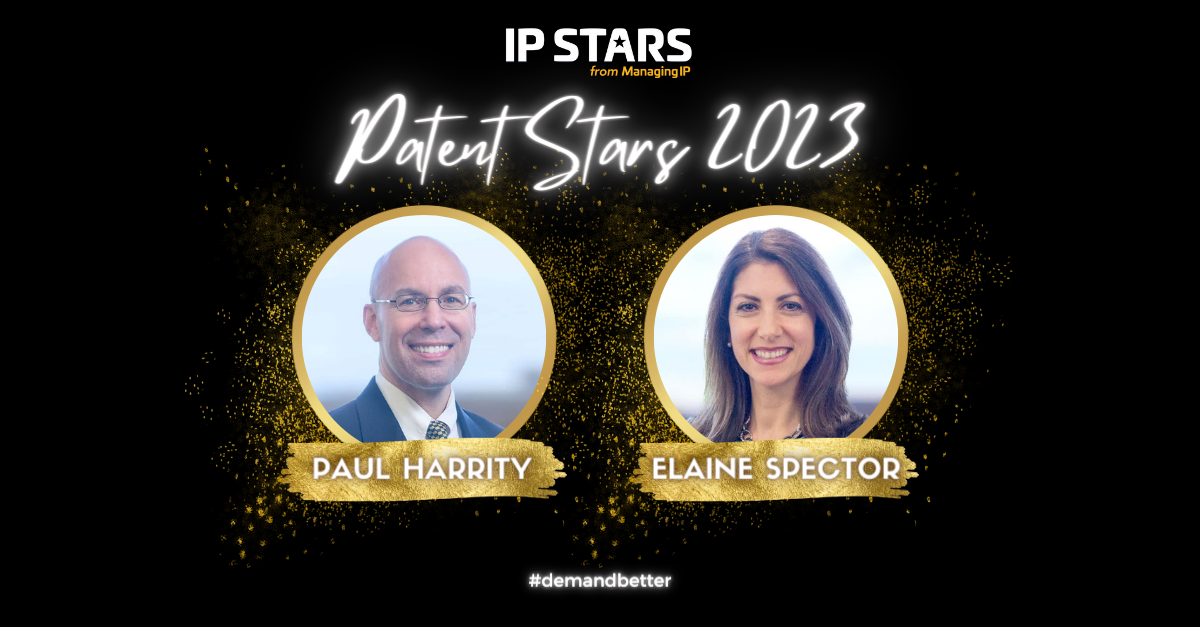
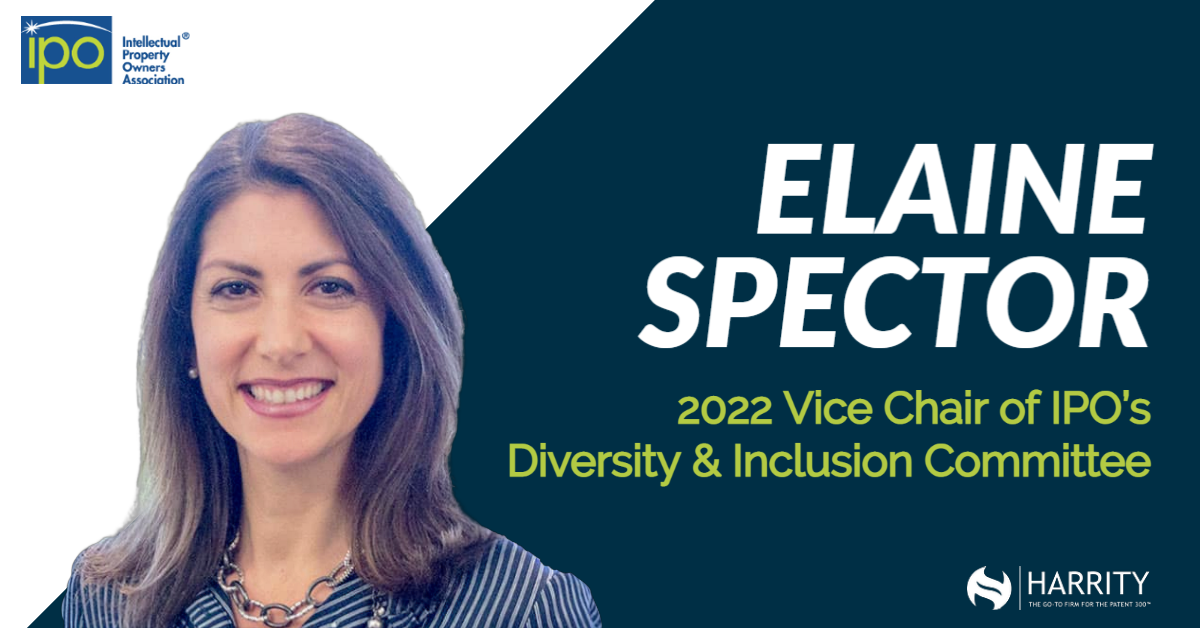
We are proud to share that three of Harrity & Harrity’s attorneys have been recognized in the prestigious Best Lawyers® awards for 2025, reflecting their dedication to excellence in patent law.

  • Derek Abeyta: Recognized in the Best Lawyers: Ones to Watch® in America category, which honors attorneys early in their careers for outstanding professional achievements.
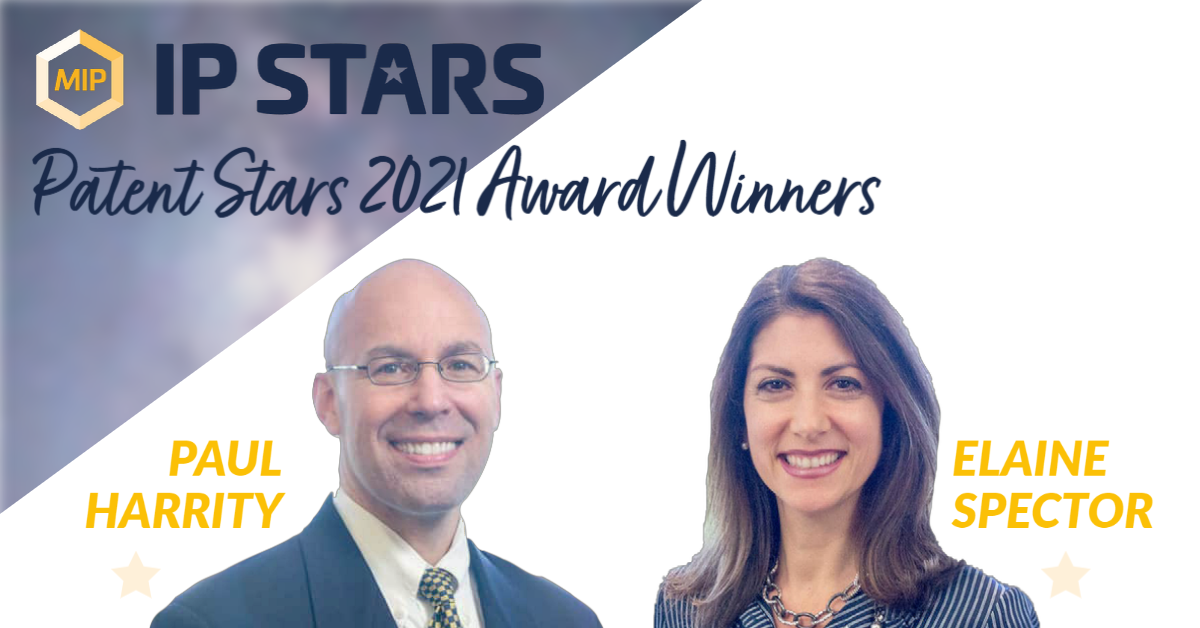
  • Paul Harrity and Elaine Spector: Both were included in The Best Lawyers in America®, a recognition that highlights lawyers for their professional accomplishments.

About the Recognition

Selections for Best Lawyers® are based entirely on peer review, highlighting the respect and admiration these attorneys have earned from their colleagues. This recognition underscores Harrity & Harrity’s commitment to quality, innovation, and teamwork in intellectual property law.

A Culture of Excellence

These honors reflect the collective efforts of our team and our focus on delivering exceptional client service while fostering a culture of diversity, collaboration, and efficiency. At Harrity, we take pride in the work we do to help protect innovations and support the needs of our clients.

Please join us in congratulating Derek, Paul, and Elaine on their recognition by Best Lawyers®! Their hard work exemplifies the values we strive for at Harrity & Harrity.

To learn more about our team and approach to patent law, visit www.harrityllp.com.

Tech Titans 2024: Top 25 Innovators in 3D Printing

Introduction

The field of 3D printing continues to revolutionize industries across the globe, from aerospace to healthcare, enabling the creation of complex, customized components with unprecedented precision. As the technology advances, so does the competitive landscape, with companies vying for leadership through innovation and patent portfolios. In this annual edition of “Tech Titans,” we spotlight the top 25 companies that are driving the future of 3D printing through their patents and pending applications. These innovators are not only shaping the present but also paving the way for tomorrow’s breakthroughs.

Top 25 Companies Patenting in 3D Printing Technology

Ranking Company Total Patents and Pending Applications Key Highlight
1 GE Aerospace 3,130 GE Aerospace maintains its dominance with an expansive portfolio, leading in additive manufacturing.
2 HP Inc. 2,831 HP Inc. is a major player in 3D printing, with a steady increase in patent filings over the past five years.
3 RTX Corporation 1,908 RTX Corporation makes significant strides in aerospace and defense sectors through 3D printing.
4 Stratasys Ltd. 1,588 Stratasys leads in polymer technologies, influencing industries from healthcare to automotive.
5 Xerox Corporation 1,477 Xerox focuses on industrial applications and materials innovation in 3D printing.
6 The Boeing Company 1,232 Boeing heavily invests in 3D printing for aerospace, focusing on reducing component weight.
7 Seiko Epson Corporation 1,004 Seiko Epson advances in precision engineering with high-resolution 3D printing technologies.
8 Safran SA 990 Safran focuses on using 3D printing in aerospace for component production and material performance.
9 3D Systems Corporation 934 3D Systems innovates in hardware and software, enabling new possibilities in manufacturing and healthcare.
10 Chinese Academy of Sciences 844 Chinese Academy of Sciences pushes boundaries in 3D printing technology across various scientific fields.
11 Siemens AG 760 Siemens optimizes manufacturing processes with 3D printing across multiple industries.
12 Mitsubishi Gas Chemical Company, Inc. 664 Mitsubishi Gas Chemical pioneers new materials for 3D printing, enhancing durability and versatility.
13 Xian Jiaotong University 602 Xian Jiaotong University leads in bioprinting and advanced materials research.
14 Ricoh Company Ltd. 654 Ricoh expands its portfolio in additive manufacturing, focusing on industrial applications.
15 EOS GmbH Electro Optical Systems 641 EOS GmbH is a leader in metal 3D printing, providing solutions for high-performance industrial applications.
16 Resonac Corporation 613 Resonac innovates in chemical engineering, using 3D printing for advanced material production.
17 Arkema SA 589 Arkema develops specialty materials for 3D printing, enhancing printed objects’ properties.
18 Canon Inc. 559 Canon leverages precision machinery expertise to advance 3D printing in optics and electronics.
19 Robert Bosch GmbH 542 Bosch integrates 3D printing into manufacturing to improve efficiency in automotive and industrial sectors.
20 BASF SE 530 BASF focuses on developing new materials that enhance the mechanical properties of 3D printed parts.
21 Applied Materials, Inc. 516 Applied Materials utilizes 3D printing for semiconductor manufacturing, driving electronics innovation.
22 Huazhong University of Science & Technology 516 Huazhong University advances 3D printing technologies for medical applications, particularly in bioprinting.
23 Nike, Inc. 491 Nike revolutionizes sportswear with 3D printing, particularly in footwear design and customization.
24 Siemens Energy AG 489 Siemens Energy uses 3D printing to enhance energy efficiency and sustainability in power generation.
25 Shenzen Creality 3D Technology 294 Creality drives consumer-grade 3D printing, making it more accessible to hobbyists and small businesses.


In-Depth Analysis

The 3D printing landscape is characterized by significant competition among both industrial giants and emerging innovators. Companies with a high “blocking patent index,” such as Stratasys Ltd. and 3D Systems Corporation, are using their portfolios to create competitive barriers, making it more challenging for others to enter the market. The high “average number of forward citations” seen in companies like Carbon Inc. and EOS GmbH suggests that these portfolios are influential in driving the direction of future innovations.

3d printing

Looking ahead, the continued evolution of materials science, coupled with advancements in precision manufacturing, will likely expand the applications of 3D printing across new industries. Companies that can effectively combine innovation with strategic patenting will remain at the forefront of this rapidly evolving field.

Patent Analytics On-Demand

Explore our Patent Analytics Services to gain insights into the latest trends, competitor activities, and strategic opportunities in your technology area. Our tools and expertise help you stay ahead of the curve in the rapidly evolving world of advanced robotics.  Learn more about our services HERE.

Conclusion

The top 25 innovators in 3D printing are not just leading the market—they are shaping the future of manufacturing and design. Stay tuned for our next installment of “Tech Titans,” where we will explore the cutting-edge developments in another transformative technology.

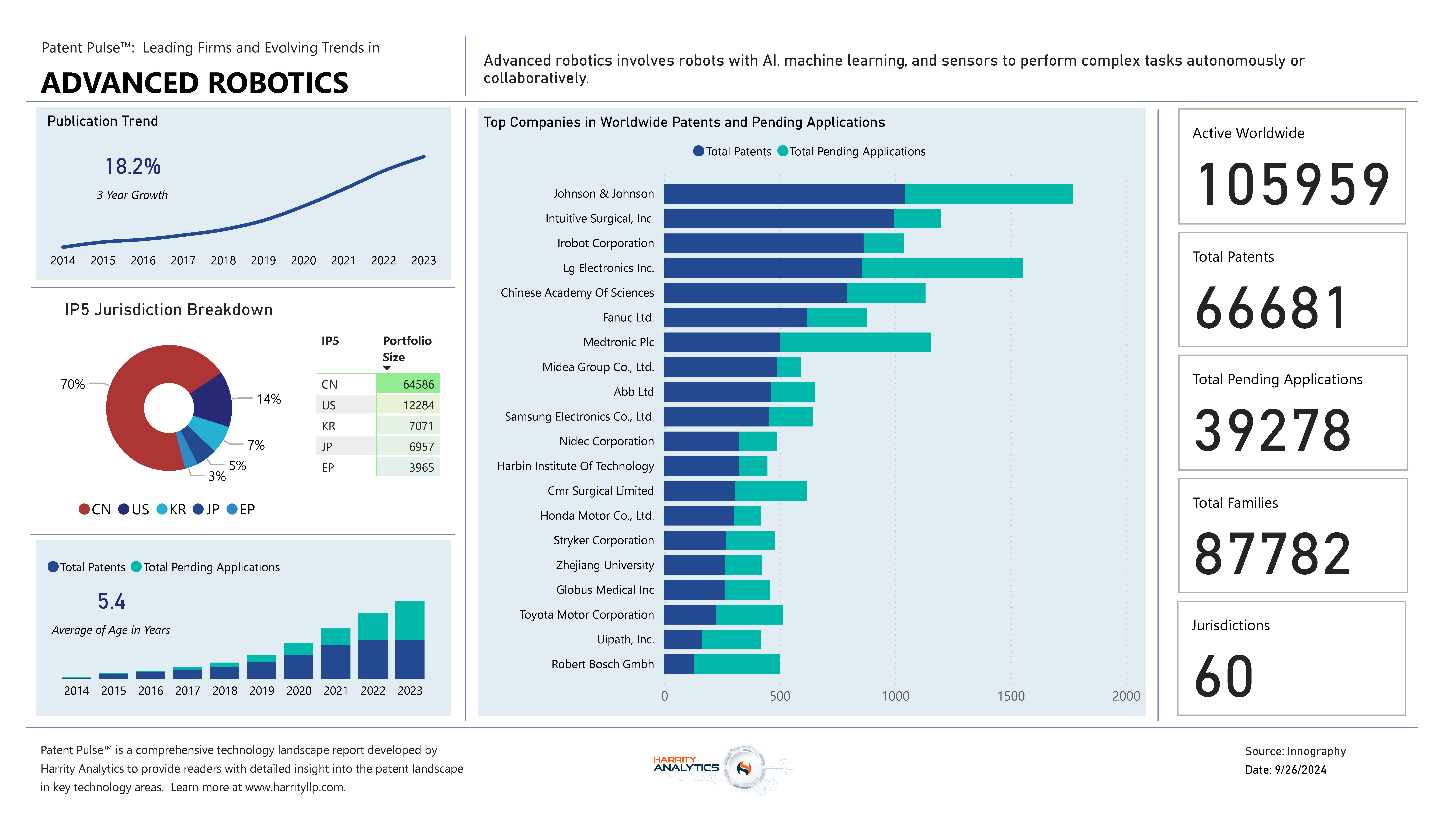
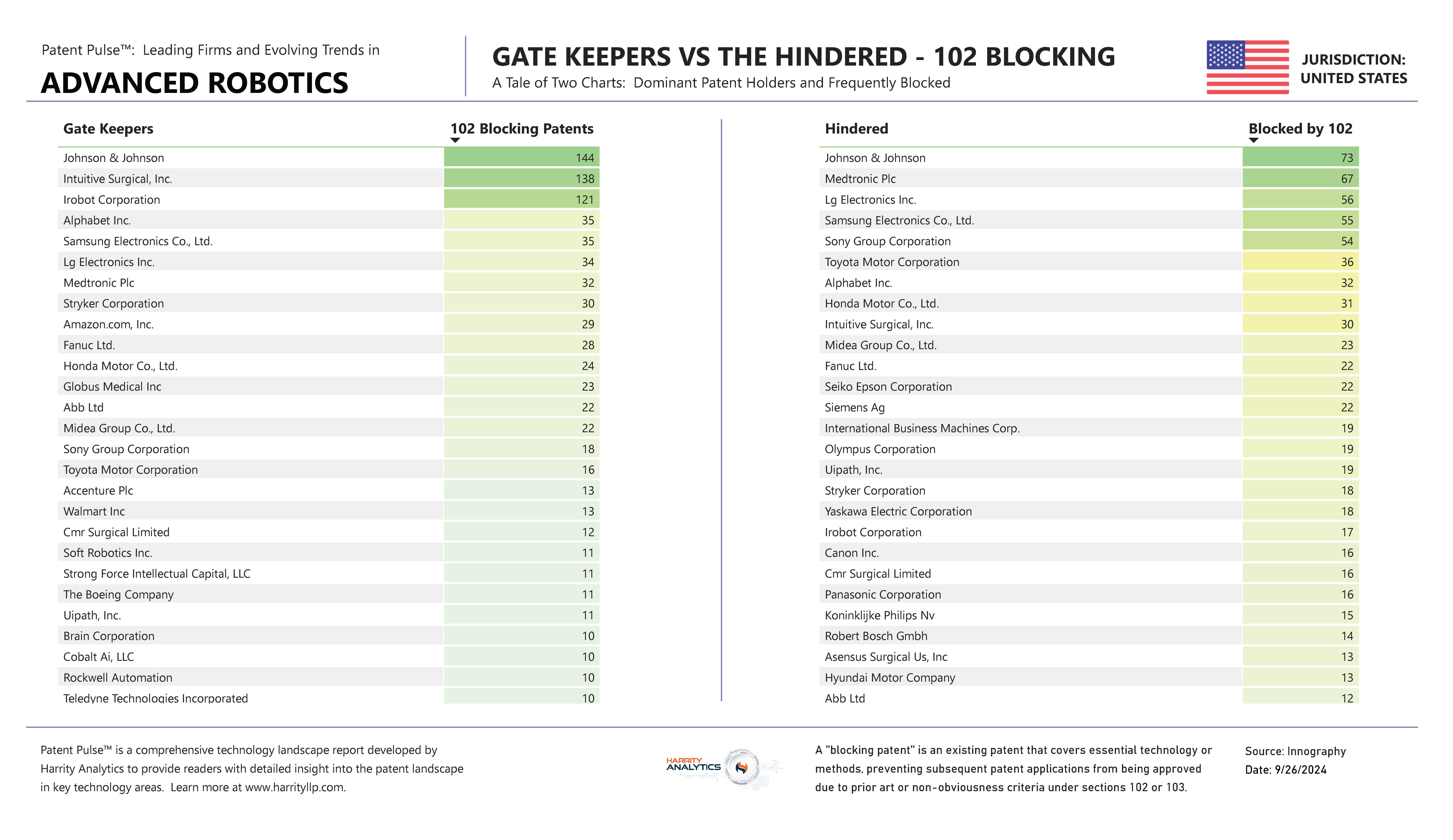
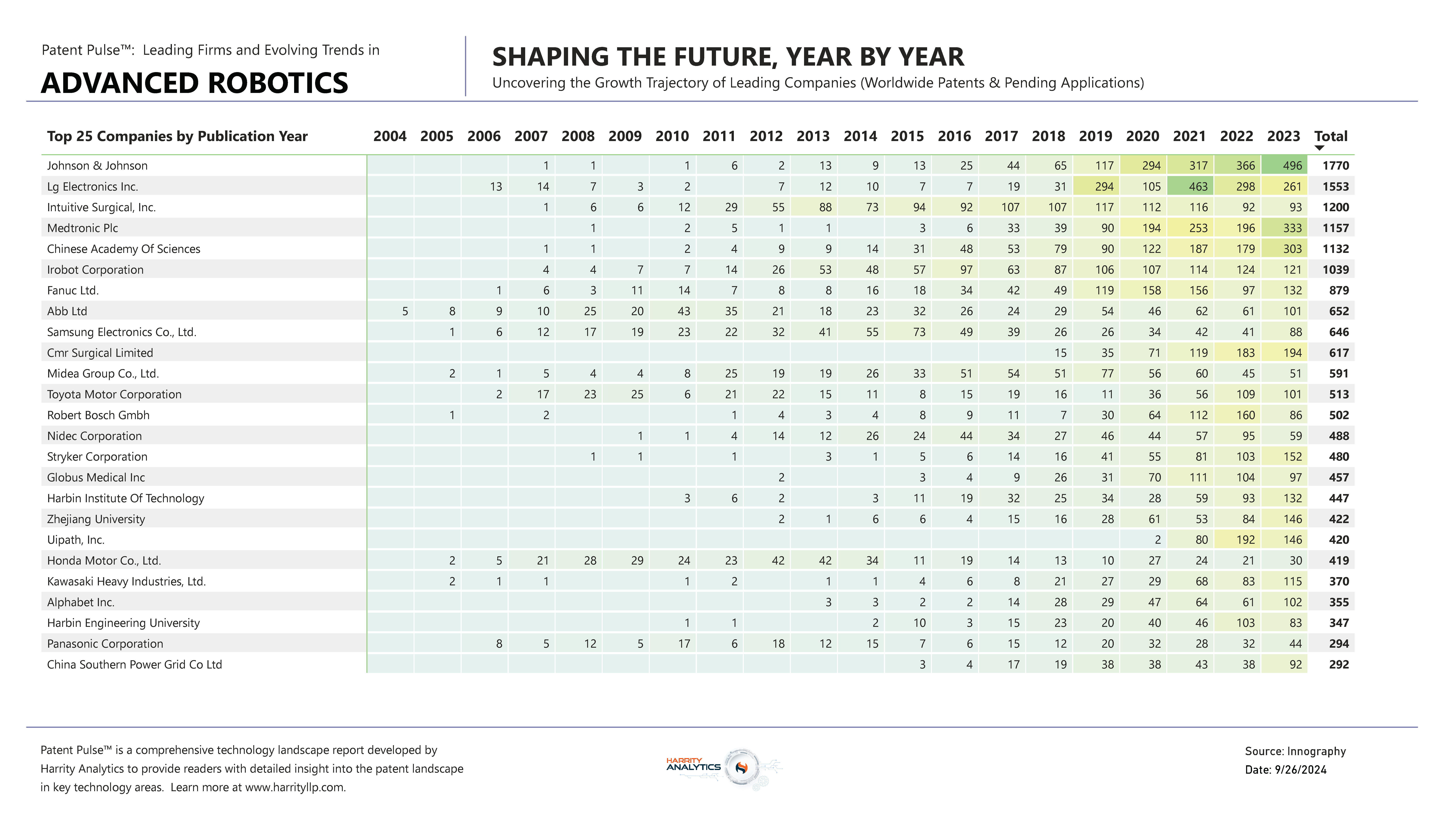
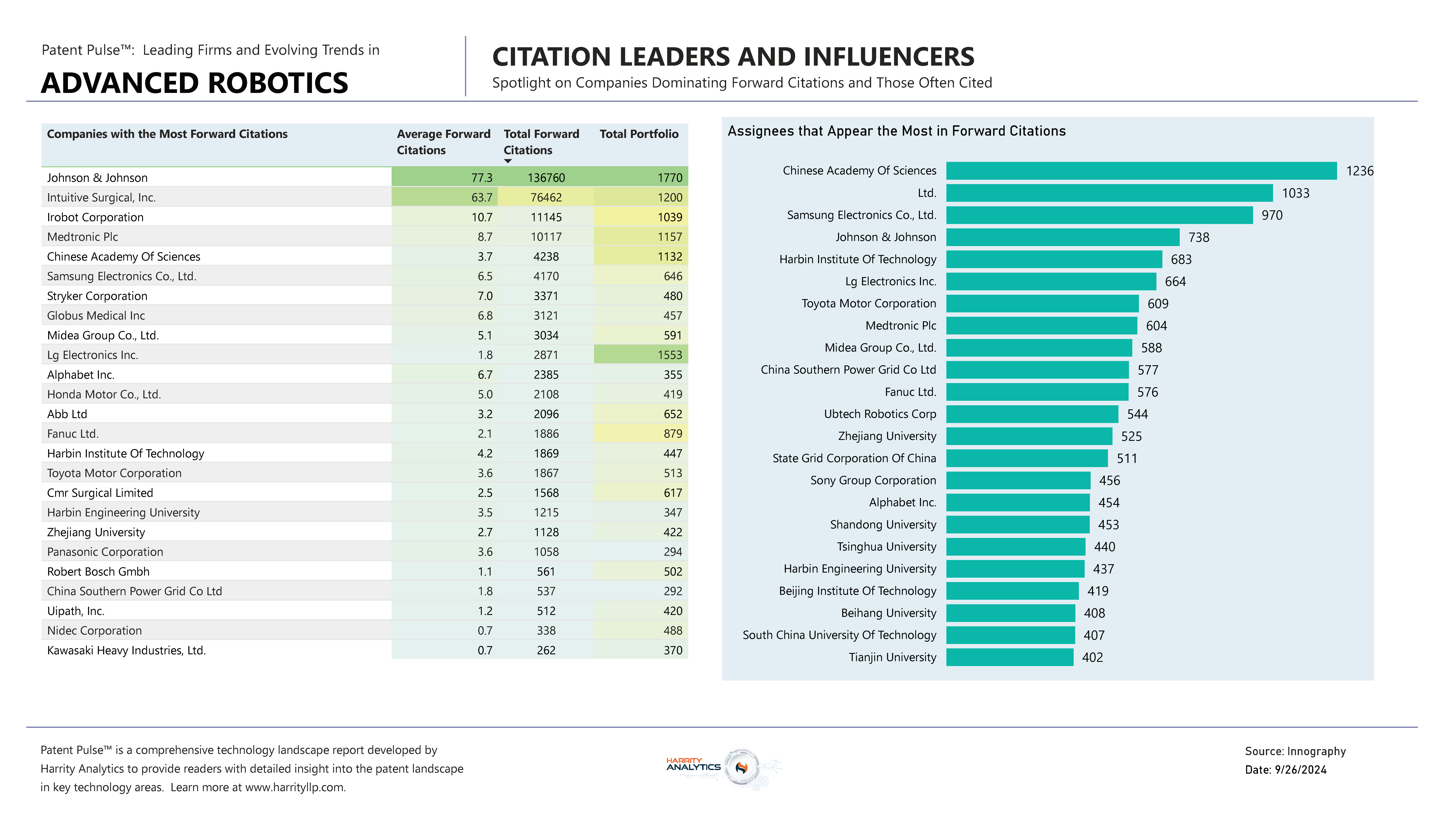
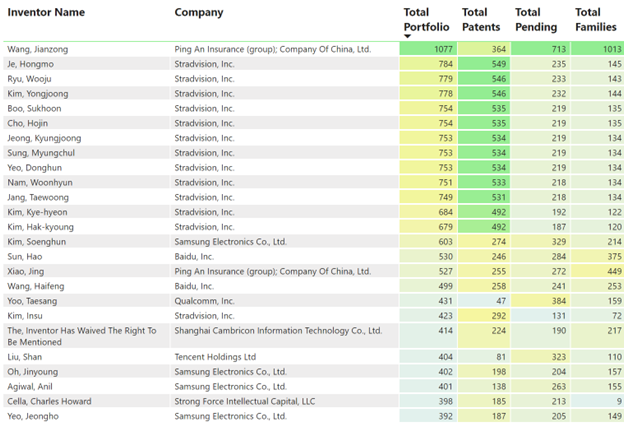
Tech Titans 2024: Top 25 Advanced Robotics Innovators

Introduction

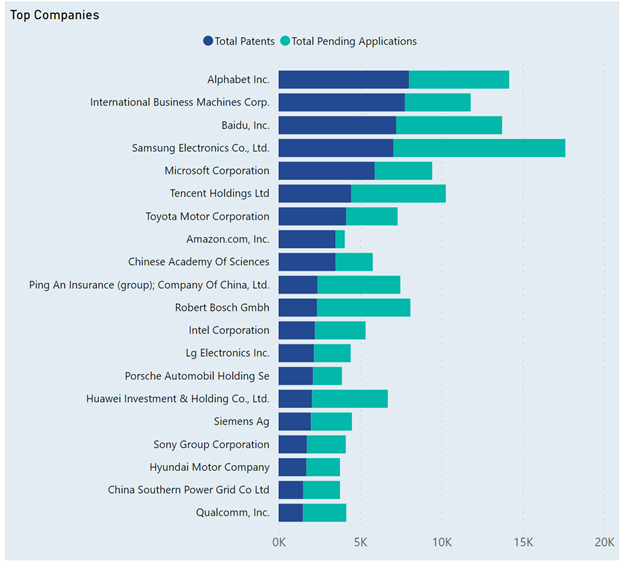
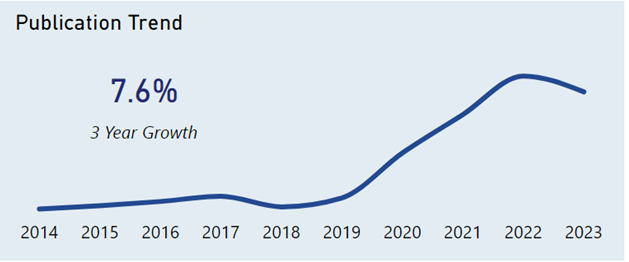
In the ever-evolving world of advanced robotics, innovation drives the industry forward, shaping the future of automation, artificial intelligence, and human-robot collaboration. This year’s “Tech Titans” post highlights the top 25 companies leading the charge in advanced robotics patents and pending applications. These companies are not only shaping the landscape today but also laying the groundwork for the technological advancements of tomorrow.

Trends and Competitive Landscape

The data in this year’s report highlights several key trends in the advanced robotics industry:

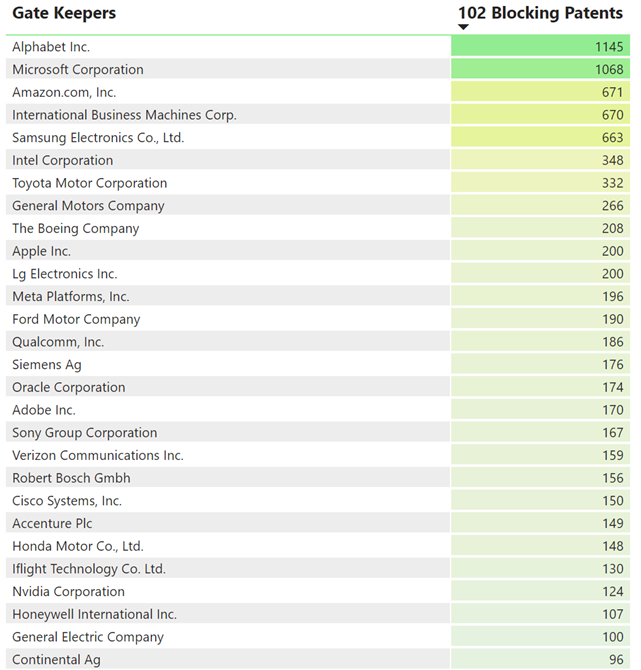
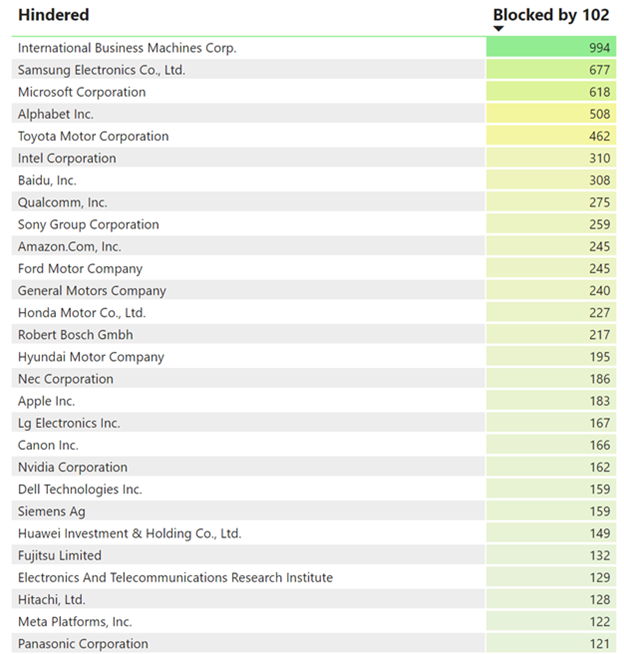
  1. Blocking Patent Index and Forward Citations: Companies with a high Blocking Patent Index and a significant number of forward citations, such as Johnson & Johnson and Intuitive Surgical, indicate strong and influential patent portfolios. These companies are effectively shaping the direction of technological advancements in robotics.
  2. Global Distribution of Patents: The top innovators are not limited to a single region; companies from the United States, China, and Japan dominate the list, reflecting the global nature of robotics innovation.
  3. Emerging Players: Companies like Cmr Surgical Limited and Globus Medical are rapidly expanding their patent portfolios, signaling their growing influence in the robotics sector.

Future Outlook

Looking ahead, the competition in advanced robotics is expected to intensify as companies continue to innovate and protect their technological advancements. The ongoing growth in AI and machine learning integration will likely drive further developments in autonomous and collaborative robotics.

Patent Analytics On-Demand

Explore our Patent Analytics Services to gain insights into the latest trends, competitor activities, and strategic opportunities in your technology area. Our tools and expertise help you stay ahead of the curve in the rapidly evolving world of advanced robotics.

Patent Analytics On-Demand

Conclusion

The “Tech Titans 2024” post showcases the leading innovators in advanced robotics, highlighting their significant contributions to the field. As these companies continue to shape the future of robotics, we look forward to exploring more advancements in the coming years. Stay tuned for our next post in this series, where we dive into another groundbreaking technology area.

Challenging the “Diversity Hire” Label: The Need for Equal Standards in the Workplace


In recent discussions about diversity and inclusion, one phrase continues to surface, often with detrimental effects: “diversity hire.” This term, far from being a compliment, often serves to undermine the hard work and achievements of women and individuals from diverse backgrounds. It’s a label that carries with it an assumption of inadequacy, which can be incredibly damaging in professional environments, particularly within the legal field. This blog delves into the double standards that persist in our industry and the importance of creating a workplace where every individual is judged by their abilities and contributions, not by outdated and biased perceptions.

Challenging the “Diversity Hire” Label

The term “diversity hire” is more than just a label—it’s a judgment that can have profound implications for those it’s applied to. When someone is referred to as a “diversity hire,” it diminishes their qualifications and suggests that their presence in the workplace is due more to a desire to meet diversity quotas than to their own merit and capabilities.

This label becomes even more insidious when we consider how mistakes are treated differently depending on who makes them. For example, when a man, particularly a white man, makes an error, it is often seen as a simple human mistake—an opportunity to learn and grow. However, when a woman or someone from a diverse background makes a similar mistake, it can quickly be attributed to their status as a “diversity hire.” This double standard not only undermines the confidence of these professionals but also perpetuates harmful stereotypes that they are less capable or deserving.

The Reality of Double Standards in the Workplace

At Harrity, we’re acutely aware of these double standards, especially through our Minority Firm Incubator program, which supports minority-owned law firms. Participants in this program have shared that the pressure they feel is immense—one mistake, and they fear they’re out. This “one and done” mentality seems to be applied disproportionately to minority professionals, raising a crucial question: is this the same standard applied to white men in our field?

The answer, as many have observed, appears to be no. This discrepancy reveals a deeper, systemic issue where the achievements of diverse professionals are often undervalued, and their missteps are disproportionately magnified. It’s a stark reminder that while we have made significant strides in promoting diversity, there is still much work to be done to ensure that all individuals are treated equitably and that their contributions are recognized fairly.

Toward a Workplace Free of Bias

It’s important to clarify that this issue isn’t about placing blame on any particular group. Rather, it’s about addressing the biases that still exist in many workplaces. These biases, whether conscious or unconscious, can distort perceptions and create an uneven playing field. The goal is to foster a professional environment where everyone is judged solely on their abilities, contributions, and potential—not on outdated and biased perceptions.

Achieving this will require ongoing effort and commitment from all of us. We must continue to challenge the stereotypes that undermine the achievements of women and individuals from diverse backgrounds and advocate for standards that are applied consistently and fairly across the board.

Words carry power, and the term “diversity hire” is one that we must challenge and reconsider. In our pursuit of a more inclusive and equitable workplace, it’s essential to recognize and dismantle the biases that contribute to unequal treatment. By holding all professionals to the same standard and valuing their contributions equally, we can build a legal profession that truly reflects the diversity of talent within our society. Let’s strive for a future where everyone, regardless of background, is given the respect and recognition they deserve—where no one is reduced to a label but is instead celebrated for their skills, dedication, and impact.

Want more Driving Diversity? Check out other videos with Elaine Spector here!

Strategic Growth: Navigating Self-Improvement in a Demanding Professional Landscape

Welcome back to our weekly conversation with #DearSandy, where we tackle the intricacies of professional development and offer guidance on overcoming some of the workplace’s toughest challenges.

In any career, especially in high-pressure environments, the pursuit of personal and professional growth is a constant endeavor. Whether you’re an experienced professional or just getting started, the desire to better oneself is a sign of ambition and a commitment to excellence. But with so many areas to potentially improve, it’s easy to feel overwhelmed about where to start.

This week’s “Dear Sandy” addresses a common dilemma: how to set and achieve self-improvement goals while managing the day-to-day demands of a busy work life.


Dear Sandy,

I’ve been with the firm for a couple of years and have truly enjoyed my work and the opportunities I’ve been given. However, as I look to the future, I want to ensure that I continue to grow both personally and professionally. I’m keen on making some self-improvements but feel overwhelmed by where to start. Could you provide some guidance on effective strategies for self-improvement within our professional setting? How can I set realistic goals and effectively work towards them while balancing my workload?

Sincerely,
Aspiring for Improvement


Dear Aspiring for Improvement,

Your desire to continue growing is commendable, and recognizing the need for self-improvement is the first critical step in your journey. Personal and professional growth is a continuous process, and with a strategic approach, you can make this journey both manageable and rewarding. Here’s how to get started:

1. Self-Assessment:
Start by evaluating your current skill set and responsibilities. Take a close look at areas where you excel and those where you believe there’s room for growth. Whether it’s honing technical skills, enhancing your communication abilities, or developing leadership qualities, understanding your starting point is essential for setting meaningful goals.

2. Set Specific, Measurable Goals:
Once you’ve identified the areas you want to improve, it’s time to set goals that are specific, measurable, achievable, relevant, and time-bound (SMART). For example, if you’re aiming to enhance your project management skills, you might set a goal to complete a relevant certification within the next six months. SMART goals provide structure, making it easier to track your progress and stay motivated.

3. Seek Constructive Feedback:
Feedback from colleagues, supervisors, and mentors is invaluable. Regularly ask for their input on your work to gain insights that might not be apparent through self-reflection alone. This external perspective can highlight strengths you might have overlooked and pinpoint areas needing further attention.

4. Utilize Available Resources:
Don’t overlook the professional development resources your firm offers, such as training sessions, mentorship programs, and access to educational courses. These tools are designed to support your growth, so make full use of them as you chart your self-improvement path.

5. Balance Work and Growth:
Achieving your self-improvement goals shouldn’t come at the expense of your well-being. Strive for a balance by setting realistic goals that align with your workload. Incorporate self-improvement activities into your routine without overloading yourself—this will help prevent burnout and ensure steady progress.

6. Reflect and Adapt:
As you work towards your goals, regularly reflect on your progress. Self-improvement is an evolving process, and it’s important to be flexible. Adjust your goals as needed to keep them aligned with your professional development and personal aspirations.


Remember, self-improvement is a journey, not a race. Celebrate your progress, no matter how small, and keep pushing forward with determination. Your commitment to personal growth is a powerful asset, and with the right approach, you’ll continue to thrive both personally and professionally.

Warm regards,
Sandy

Redefining Rainmaking: Empowering Women to Lead in Law

In a recent conversation, Elaine Spector explored the powerful yet often misunderstood concept of rainmaking in the legal profession. Her insights reveal the untapped potential among women, urging them to embrace their natural relationship-building abilities and redefine what it means to be a rainmaker.

Challenging Misconceptions About Rainmaking

Rainmaking has long been shrouded in misconceptions. According to Elaine, the traditional view of a rainmaker—a charismatic, outgoing individual who thrives in social settings—does not align with the true essence of this role. She emphasizes that rainmaking is not about being the life of the party or excelling in small talk; it’s about building genuine relationships and earning trust.

Women, she notes, are naturally adept at these skills. Yet, despite this, women are often underrepresented among rainmakers in law firms. The key to changing this dynamic lies in embracing rainmaking as a natural extension of who women are, rather than forcing themselves to fit into a mold that doesn’t reflect their strengths.

Why Rainmaking is Essential for Women

Elaine makes it clear that rainmaking is not just a skill; it’s a gateway to greater influence, career advancement, and financial reward. For women in law, stepping into the role of a rainmaker is about more than just personal growth—it’s about breaking barriers and ensuring that diverse voices are heard at the highest levels of decision-making.

The importance of rainmaking extends beyond individual careers; it’s about creating a more inclusive and balanced professional environment. By becoming rainmakers, women contribute to a culture where leadership reflects the diversity of the talent within the firm.

Practical Steps for Women to Start Rainmaking

So, how can women begin their journey toward becoming effective rainmakers? Elaine offers practical advice, encouraging women to take small, intentional steps. Whether it’s joining a professional organization, volunteering for a leadership role, attending industry conferences, or reconnecting with former colleagues, every effort helps build a network of relationships that can lead to meaningful professional opportunities.

In addition, Elaine shares exciting news about an upcoming workshop on relationship-building in the post-pandemic world. Hosted by John Harrity as part of the Patent Pathways Program, this free event on September 10th is open to everyone. It’s designed to provide women with the tools they need to transform everyday interactions into rainmaking opportunities. The workshop promises a hands-on approach, emphasizing authenticity and the power of genuine connections.

Rainmaking isn’t about transforming yourself into something you’re not; it’s about embracing your authentic self and leveraging the relationships you naturally build. For women in law, this means recognizing the power they already hold and stepping confidently into rainmaking roles. By doing so, they can advance their careers and contribute to a more diverse, inclusive legal profession. The upcoming workshop is an excellent starting point for anyone ready to take the first step toward unlocking their rainmaking potential. Don’t miss this opportunity to learn, connect, and grow.

Want more Driving Diversity? Check out other videos with Elaine Spector here!

Embracing Authenticity in the Professional Space: A Lesson in Diversity

In the ever-evolving landscape of the professional world, redefining what it means to be authentic in the workplace has become more crucial than ever. Elaine Spector recently shared a poignant reflection on this very topic. Her insights not only challenge the status quo but also celebrate the diverse ways women express their professional identities.

Elaine’s Personal Journey to Understanding

Elaine, who had grown comfortable with her femininity after years of being a tomboy, initially encouraged women to embrace their femininity in professional spaces without feeling pressured to conform to traditionally masculine behaviors. However, feedback from a dear friend highlighted the nuances and complexities surrounding this issue. The friend reminded her that professionalism has historically been defined by men, pointing out that traditional expectations, such as wearing a skirt in court, continue to persist in some areas.

Diverse Expressions of Womanhood

One woman’s experience further illuminated the diversity within womanhood. This woman, identifying as a lesbian with a masculine tomboy side, shared that makeup and fashion were not significant to her professional identity. She expressed frustration with the emphasis some professional women place on looks, emphasizing that these elements do not define “woman” for her. Instead, she finds her identity and professional distinction in her approach to people and problem-solving.

The Core of Professionalism

The core takeaway from these reflections is the importance of authenticity. For some, this might mean wearing makeup and dressing in a way that aligns with their sense of femininity. For others, it means rejecting these traditional markers and focusing on their skills and interactions. The key is that professionalism should be defined by one’s approach to work and relationships, not by adherence to outdated gender norms.

This enlightening discussion, underscores the necessity of recognizing and respecting the diverse ways women choose to present themselves professionally. Authenticity, rather than conformity, should be the cornerstone of professional identity. By embracing our unique approaches and perspectives, we contribute to a richer, more inclusive professional environment.

Want more Driving Diversity? Check out other videos with Elaine Spector here!

Mastering Precision in Patent Law: Strategies to Enhance Attention to Detail

Welcome back to our weekly dive into workplace wisdom with #DearSandy. Each week, we explore the complexities of office dynamics and discover practical advice for some of the most challenging situations.

In the professional world, especially in fields that demand high accuracy like patent law, maintaining attention to detail can be a formidable challenge. Ensuring every document is meticulously prepared and error-free is crucial. If you’re struggling to meet these exacting standards, don’t worry—many have been in your shoes. This week’s “Dear Sandy” delves into effective strategies to boost your attention to detail and excel in your role.

Dear Sandy,

I’ve recently joined a patent law firm and I’m having trouble maintaining the high level of attention to detail that this field demands. Despite my efforts, I occasionally miss small but crucial details in our documentation, which has led to some corrections from my supervisors. I really want to improve and ensure the quality of my work meets the firm’s standards. Do you have any advice on how I can enhance my attention to detail? Any strategies or tools that could help me would be greatly appreciated.

Sincerely,
Eager but Erring

Dear Eager but Erring,

It’s fantastic that you’re actively seeking to improve—this is the first and most crucial step toward growth. Attention to detail is critical in patent law, but it’s a skill that can be honed with practice and the right strategies. Here are some actionable tips to help you enhance your precision:

Break Tasks into Smaller Steps
Tackling an entire document at once can be overwhelming, leading to missed details. Break your work into smaller, more manageable sections. This allows you to focus intensely on each part without feeling overwhelmed.

Use Checklists
Create a detailed checklist for each type of document or task. This acts as a fail-safe to ensure all necessary aspects are covered. Over time, this process will become second nature and significantly reduce errors.

Limit Distractions
In a world full of constant notifications and interruptions, finding quiet time to concentrate can vastly improve your accuracy. Dedicate specific blocks of time to focus solely on tasks requiring high attention to detail.

Regular Reviews
Once a task is completed, take a break before reviewing your work. A fresh perspective can help you spot errors more effectively. Additionally, consider peer reviews—a colleague’s fresh set of eyes might catch something you missed.

Leverage Technology
There are numerous tools and software designed to minimize errors. Utilize software that checks for common mistakes or project management tools that track deadlines and requirements, supporting accuracy and efficiency.

Training and Continuous Learning
Engage in workshops or training sessions focused on precision and attention to detail. Continuous learning not only sharpens your skills but also keeps you updated on best practices in your field.

Remember, perfection isn’t about never making mistakes but about learning and improving from them. Your commitment to excellence is already a significant asset. Keep striving forward, and you’ll see your efforts pay off.

Warm regards,
Sandy

Redefining Networking: Embracing New Avenues for Professional Connections

In today’s fast-paced professional world, networking and building relationships have dramatically evolved. Gone are the days when business connections were forged exclusively on the golf course or over formal meetings. Women professionals are now redefining networking by embracing activities that promote well-being, creativity, and genuine connections. This shift not only enhances professional relationships but also contributes to personal growth and a sense of community.

Elaine Spector recently shared an inspiring example that underscores this shift. Elaine came across a LinkedIn post about a group of women practicing yoga together, highlighting an innovative approach to networking. This simple yet powerful activity has sparked a broader discussion about incorporating wellness into professional networking routines. Combining yoga with networking represents a refreshing departure from traditional methods, showcasing how women are finding new and meaningful ways to connect.

Networking through yoga is just one example of the creative avenues available today. Whether through lunch dates, shopping sprees, or running groups, the possibilities are endless. These activities not only offer professional connection opportunities but also promote a healthier, more balanced lifestyle.

Reflecting on the past, Elaine recounted how she once took golf lessons over 25 years ago to fit into the then-popular networking activity. Despite becoming quite skilled, her experience underscored the limited options available at that time for building professional relationships.

Today, professionals are fortunate to have a wide array of choices that allow them to tailor their networking efforts to their personal interests and lifestyles. This shift empowers individuals to form deeper, more meaningful connections based on shared experiences and passions.

Elaine encourages others to share their favorite unconventional networking activities. The excitement of discovering new ways to connect and build relationships is palpable. Whether it’s a shared hobby, a wellness activity, or something entirely unique, finding what resonates and strengthens professional bonds is key. Embracing and celebrating the diverse ways to support each other professionally and personally is crucial.

Networking has evolved from rigid, traditional activities to more dynamic and personalized experiences. By embracing activities like yoga, running, and other interest-based gatherings, women are not only building stronger professional networks but also fostering a sense of community and well-being. As new ways to connect are explored, it’s important to celebrate the diversity of networking approaches and the enriched relationships they bring. Sharing favorite networking activities can inspire others to think outside the box in their professional journeys.

We encourage all professionals to embrace these innovative networking methods. By coming together, we can drive meaningful change and foster a more inclusive and connected professional environment.

Want more Driving Diversity? Check out other videos with Elaine Spector here!

How to Address Broken Promises at Work: A Constructive Approach

Welcome back to our weekly dive into workplace wisdom with #DearSandy. Each week, we explore the complexities of office dynamics and discover practical advice for some of the most challenging situations.

In the professional world, it’s not uncommon to encounter challenges that test our patience and resilience. One such challenge is dealing with unfulfilled promises from your boss. These unmet expectations can erode trust and dampen motivation, making it crucial to address the issue constructively. In this week’s “Dear Sandy,” we tackle the delicate matter of handling broken promises at work to foster a stronger, more cohesive team environment.

Dear Sandy,

I’m facing a challenging situation at work and I hope you can provide me some advice. My boss has repeatedly made promises to me regarding various aspects of my job, like project opportunities. However, these promises have not been fulfilled, and it’s starting to impact my motivation and trust in my leadership. I truly want to address this issue constructively because I believe in our team’s potential and want us to succeed together. How can I approach my boss about these broken promises in a way that is professional and conducive to building a stronger team?

Frustrated Team Player


Dear Frustrated Team Player,

It sounds like you’re in a difficult position, but your desire to resolve this constructively is the right approach to fostering a better working environment.

Firstly, it’s important to prepare for this conversation by gathering specific instances where project opportunities were discussed but did not materialize. This isn’t to keep score, but to clearly illustrate your concerns. When you speak to your boss, request a private meeting at a time when neither of you are rushed or stressed.

Begin the conversation with appreciation and positive intentions. For example, you might start with, “I really value your leadership and our team’s goals, and I want to discuss something important to ensure we can continue to work effectively together.” This sets a collaborative tone.

Present your observations factually and express how the situation makes you feel, without sounding accusatory. Use “I” statements, such as, “I feel concerned when I see discussions about project opportunities that don’t materialize, as it affects my ability to contribute effectively.”

It’s crucial to be open to hearing your boss’s side of the story. There may be factors you’re unaware of that have influenced these decisions. This conversation is as much about listening as it is about being heard.

Finally, propose a solution or ask for suggestions on how future disappointments can be minimized. Perhaps a more transparent way of communicating decisions or a regular check-in could be helpful.

Remember, the goal is to build trust and open lines of communication. It’s possible that your boss is unaware of the impact of these unmet promises, and your initiative to address it respectfully can set the stage for more reliable and supportive teamwork.

Sincerely,

Sandy

Finding Your Place: Thriving in a New Work Environment

Welcome back to our weekly dive into workplace wisdom with #DearSandy. Each week, we explore the complexities of office dynamics and discover practical advice for some of the most challenging situations.

The excitement of starting a new job can quickly turn into uncertainty if you feel out of sync with your team or the company culture. This situation is particularly challenging in specialized fields like patent law, where both the work and the environment can feel unfamiliar. If you’re questioning whether you belong at your new firm, you’re not alone. Let’s explore how to navigate this transitional period and find your footing.

Dear Sandy,

I’ve been with the firm for a few months now, and I’m starting to feel like I might not be the best fit here. While I appreciate the opportunity and find the work in patent law intriguing, I’m struggling to connect with my team and often feel out of step with the firm’s culture. I’m not sure if it’s just the initial adjustment period or if this is a sign that I should consider other options. I don’t want to make a hasty decision, but I also don’t want to stay somewhere I don’t belong. Any advice on how to navigate this situation?

Feeling Out of Place


Dear Feeling Out of Place,

Feeling like you’re not fitting in at a new job can be quite challenging, but it’s not uncommon, especially in a field as specialized and demanding as patent law. Before making any decisions, it’s important to give yourself some time to adjust; sometimes, the initial months at a new firm can be the hardest due to the steep learning curve and settling into a new environment.

Seek Feedback and Guidance: Talk to your supervisor or a mentor within the firm about how you’re feeling. They can provide you with constructive feedback on your work and help you understand more about the firm’s culture and expectations. This can also open up opportunities for you to engage in different kinds of projects or work with new teams.

Connect More with Colleagues: Sometimes, feeling out of place can stem from not having formed strong connections with colleagues. Try to engage more with your team and other peers. Attend social events, participate in firm-wide activities, or simply start by having lunch with different groups. Building relationships can often help in feeling more integrated.

Evaluate Your Expectations and Fit: Consider what aspects of the firm’s culture feel misaligned with your expectations or values. Is it the work style, communication, or perhaps the social aspect of the workplace? Identifying these can help you discuss with HR or your mentor about possible adjustments or even lead you to reflect on what you truly seek in your professional environment.

Professional Development: If the work itself feels overwhelming, consider asking for more training or resources to help you improve your skills. Sometimes, feeling more competent in our roles can significantly improve how we perceive our fit in a place.

Give It Time: Lastly, allow yourself a bit more time to adapt. Often, initial perceptions change as we grow more accustomed to new environments and roles.

If, after taking these steps, you still feel that your values and needs are not met, it might be worth considering other options. Remember, the right fit is important not only for the firm but also for your own professional satisfaction and growth.

Wishing you all the best as you navigate this period of transition. Remember, every challenge is also an opportunity for growth.

Warm regards,

Sandy

Confronting AI Bias and Enhancing Diversity

In the dynamic landscape of technology, diversity and inclusion have never been more essential. As the Intellectual Property Owners (IPO) Annual Meeting in Chicago approaches this September, these themes will be a central focus. Harrity & Harrity is proud to present a special program titled “Making Room for Diversity,” which will explore pressing issues in artificial intelligence (AI), including the significant impact of biased training data on AI models.

Elaine Spector recently shared a personal experience that highlights the importance of this issue. Her daughter, inspired by Elaine, is pursuing a career in engineering and took an online AI class over the summer. The course concluded with group presentations, which Elaine and other parents were invited to attend. Elaine was particularly impressed by her daughter’s presentation, which, unsurprisingly, was outstanding.

One presentation that caught Elaine’s attention focused on the analysis of how biased training data can affect AI models. The students emphasized a crucial point: biased data leads to biased outcomes. This problem is especially concerning in the context of face recognition software, where such biases can result in significant inaccuracies and unfair treatment of specific groups.

Addressing AI bias is not merely an academic challenge but a real-world issue with far-reaching implications. Ensuring fairness and equity in AI systems is vital. This is why Harrity & Harrity is bringing this critical discussion to the IPO Annual Meeting. The “Making Room for Diversity” program will feature a networking lunch and workshop dedicated to addressing these challenging issues within our profession.

Scheduled for Sunday, just before the afternoon committee meetings, this event is designed to be both informative and engaging. It will provide a unique opportunity for attendees to connect with peers and discuss strategies for enhancing diversity and inclusion in the field of technology and intellectual property.

We encourage all attendees of the IPO Annual Meeting to participate in this important event. By coming together, we can drive meaningful change and foster a more inclusive technological future.

Link to registration for the IPO Annual Meeting can be found here: IPO Annual Meeting Registration.

We look forward to seeing you in September!

Want more Driving Diversity? Check out other videos with Elaine Spector here!

Rediscovering Your Work Passion: Overcoming the Mid-Career Slump

Welcome back to our weekly dive into workplace wisdom with #DearSandy. Each week, we explore the complexities of office dynamics and discover practical advice for some of the most challenging situations.

Starting a new job often comes with a burst of excitement and ambition. However, as time passes, it’s not uncommon to find yourself feeling unmotivated and stuck in a routine. If this sounds familiar, you’re certainly not alone. The good news is that it’s entirely possible to reignite that initial passion and make your work life feel fulfilling once again. Let’s dive into a recent reader’s question about feeling stuck in their job and explore some actionable advice on how to get back on track.

Dear Sandy,

I’ve been with the firm for a couple of years now, and initially, I was very excited about my role and the impact I could have. Lately, however, I’ve been feeling increasingly unmotivated. Every day feels the same, and I’m struggling to find the passion I once had for my work. I still want to contribute meaningfully, but I’m not sure how to shake this slump. What advice can you give to someone feeling stuck in their job?

Dear Stuck in a Slump,

Firstly, it’s important to recognize that what you’re experiencing is quite common, and it’s okay to feel this way. Motivation can ebb and flow, and it’s natural for enthusiasm to wane after the initial excitement wears off. Here are a few steps you can take to reignite your passion:

Seek New Challenges
Sometimes, a lack of motivation stems from feeling unchallenged or routine-bound. Talk to your supervisor about taking on a new project or learning a new skill that aligns with your interests. This can bring a fresh sense of purpose to your role.

Set Personal Goals
Personal development goals can significantly enhance your professional life. Whether it’s improving a skill, learning a new area in your field, or aiming for a promotion, having clear objectives can give you something to strive towards.

Connect with Your Colleagues
Often, a sense of community at work can enhance your job satisfaction. Participate in firm activities, or simply spend more time connecting with colleagues. Sharing ideas and challenges can provide new perspectives and rekindle your enthusiasm.

Reflect on Your Impact
Remind yourself of the reasons you chose this career path. Consider the impact your work has on others, including how it supports the broader goals of your organization. Recognizing the value of your work can renew your sense of purpose.

Consider Professional Help
If your lack of motivation is deep and persistent, it might help to talk to a professional counselor. They can provide strategies to manage your feelings more effectively.

Remember, it’s perfectly normal to seek change and growth. Use this time to explore what truly motivates you and how you can align those drivers with your career at the firm. You’re not alone in this journey, and there are many resources within our firm to support you.

Wishing you the best,

Sandy

Rainmaking for Introverted Lawyers: Harnessing Your Strengths for Success

Rainmaking, or the art of generating business, is essential for career progression in law firms. However, for many introverted lawyers, traditional networking can be daunting. In the latest ‘Driving Diversity’ episode, Elaine Spector shares her personal strategies on how introverts can successfully navigate rainmaking by leveraging their strengths and building trust through meaningful engagement in professional organizations.

Rethinking Traditional Networking

Elaine opens by acknowledging the vital role rainmaking plays in career advancement within law firms. She empathizes with introverts who find traditional networking challenging but reassures that there are subtler and equally effective methods to achieve success. The focus is on finding approaches that align with an introvert’s natural tendencies, making the process more comfortable and effective.

Effective Strategies for Introverts

A powerful strategy Elaine recommends is joining and actively participating in professional organizations. This involvement allows introverted lawyers to contribute without the pressure of traditional networking settings. Volunteering for committees, collaborating on projects, or helping organize events are excellent ways to build connections.

Although these activities require time and effort, they are immensely beneficial. They provide a platform to showcase dedication and expertise, gradually building trust and forming strong professional relationships. Over time, these connections often lead to business opportunities as colleagues and peers recognize the individual’s reliability and commitment.

Building Trust Through Consistency

Elaine shares personal anecdotes to highlight how her volunteer work within organizations has led to significant business opportunities. The relationships she formed were rooted in trust and mutual respect, essential components for successful rainmaking. This trust is built over time through consistent and reliable performance.

By consistently delivering results and maintaining a high level of professionalism, introverted lawyers can demonstrate their value to potential clients and colleagues. This approach not only aids in business development but also fosters a supportive professional network for ongoing career growth.

Rainmaking doesn’t have to be synonymous with extroversion. For introverted lawyers, finding alternative methods to build relationships and generate business is crucial. By engaging in organizational activities and consistently proving their capabilities, introverts can successfully navigate the rainmaking process without stepping too far out of their comfort zone. The key lies in dedication, trust-building, and leveraging one’s strengths. Do you have any rainmaking tips for introverts? Share your thoughts and continue the conversation on making rain in the legal profession.

Want more Driving Diversity? Check out other videos with Elaine Spector here!

Mastering the Art of Deep Work: Essential Reads to Elevate Your Focus

Welcome back to our weekly dive into workplace wisdom with #DearSandy. Each week, we explore the complexities of office dynamics and discover practical advice for some of the most challenging situations.

In our fast-paced, distraction-laden world, the ability to concentrate deeply and produce high-quality work is becoming a rare and valuable skill. Whether you’re looking to enhance your productivity, achieve your goals, or simply make the most out of every day, embracing the concept of “deep work” can be transformative. Today, we explore some essential reads that can guide you on your journey to mastering this powerful skill.


Dear Sandy,

I’ve been trying to improve my focus and depth, aiming to make the most out of every day. I’ve heard a lot about “deep work” and its benefits, and I’d like to dive deeper into this concept. Could you recommend some books that would help me become more proficient in deep work?

Eager to Focus


Dear Eager to Focus,

It’s wonderful to hear that you’re keen on enhancing your ability to focus deeply! Deep work is indeed a powerful skill. Here are a few books that can guide you on your journey to mastering deep work:

  1. “Deep Work: Rules for Focused Success in a Distracted World” by Cal Newport This book is a cornerstone when it comes to understanding and implementing deep work. Newport defines deep work as the ability to focus without distraction on a cognitively demanding task. The book provides actionable advice on how to integrate deep work into your daily routine, making it a must-read for anyone serious about improving their focus.
  2. “Flow: The Psychology of Optimal Experience” by Mihaly Csikszentmihalyi Although not exclusively about deep work, this book explores the state of ‘Flow,’ which is closely related. It describes how people can achieve great satisfaction and productivity by engaging in activities that challenge their skills and concentration. Understanding flow can help you create conditions for deep work in your life.
  3. “The War of Art: Break Through the Blocks and Win Your Inner Creative Battles” by Steven Pressfield Suitable for creative professionals and anyone facing regular resistance in their tasks, this book addresses the challenges of procrastination and resistance. It’s very useful for learning to sit down and focus on deep work, offering inspiration and practical advice to overcome obstacles.
  4. “Make Time: How to Focus on What Matters Every Day” by Jake Knapp and John Zeratsky This practical guide offers strategies to create a more focused environment and beat distractions. It provides insights on how to redesign your day to prioritize important tasks that require deep work. With its user-friendly approach, “Make Time” can help you make consistent progress on your most significant goals.
  5. “Mindfulness for Beginners: Reclaiming the Present Moment—and Your Life” by Jon Kabat-Zinn While not directly related to deep work, mastering mindfulness can greatly enhance your ability to concentrate deeply. This book is a great start for anyone looking to be more present and less distracted, laying a solid foundation for deep work practices.

By delving into these books, you’ll gain insights and techniques that can not only boost your productivity but also your satisfaction with your work. Remember, the ability to do deep work is not just about managing time but also about managing your attention.

Keep focusing,

Sandy

Unleashing Potential: Harnessing AI for Personal and Professional Growth

Welcome back to our weekly dive into workplace wisdom with #DearSandy. Each week, we explore the complexities of office dynamics and discover practical advice for some of the most challenging situations.

In today’s fast-paced digital landscape, artificial intelligence (AI) stands at the forefront of technological innovation, promising to transform our professional capabilities and personal productivity. As businesses increasingly integrate AI into their operations, individuals are also exploring how this powerful tool can elevate their own skill sets and efficiency. This week, we address a compelling question from a reader eager to embark on their AI journey. Join us as we delve into practical strategies for leveraging AI to unlock your full potential.


Dear Sandy,

I’m intrigued by the potential of artificial intelligence and how it might enhance my skills and productivity. I’m eager to start using AI tools for personal development but am unsure how to begin. What’s the best way to approach this personal learning journey?

Eagerly Awaiting Advice


Dear Eagerly Awaiting Advice,

Your enthusiasm for artificial intelligence is inspiring. AI indeed offers remarkable opportunities for personal and professional enhancement. To help you embark on your AI journey, here are some structured steps to guide you:

1. Educate Yourself

Start with the Basics: Begin by building a strong foundation in AI. Focus on areas that spark your interest or hold the most relevance to your career. Online resources such as Coursera, edX, and LinkedIn Learning provide excellent introductory courses that can help you get started.

2. Define Personal Goals

Set Clear Objectives: Determine what you aim to achieve with AI. Whether it’s automating routine tasks, enhancing your analytical skills, or improving overall efficiency, having clear goals will help you stay focused and motivated on your learning path.

3. Experiment with Tools

Hands-On Experience: Experiment with various AI tools and software that align with your goals. Platforms like TensorFlow, H2O.ai, and IBM Watson offer free trials or open-source versions, enabling you to gain practical experience without financial constraints.

4. Join Communities

Engage with Enthusiasts: Participate in online communities and forums where AI professionals and enthusiasts gather. Websites like Reddit’s r/MachineLearning, Stack Overflow, and LinkedIn groups provide valuable support, answer questions, and share insights that can enhance your learning experience.

5. Apply Your Knowledge

Start Small: Apply AI solutions to specific tasks to gain hands-on experience. This practical approach will help you understand the real-world implications of AI and how it can improve your daily activities. Whether it’s using AI for data analysis, automating responses, or optimizing workflows, practical application is crucial.

6. Stay Updated

Continuous Learning: The AI field is constantly evolving. Stay informed about the latest developments by following industry leaders on social media, subscribing to newsletters like AI Weekly, and attending relevant webinars and conferences. Keeping up-to-date ensures your skills remain relevant and cutting-edge.

By following these steps, you’ll be well-equipped to integrate AI into your personal and professional toolkit, enhancing your skills and productivity. Embrace this exciting journey with curiosity and confidence, and you’ll find yourself on the path to significant growth and achievement.

Best wishes,

Sandy

Transforming Setbacks into Stepping Stones: Handling Workplace Mistakes with Confidence

Welcome back to our weekly dive into workplace wisdom with #DearSandy. Each week, we explore the complexities of office dynamics and discover practical advice for some of the most challenging situations.

In the legal profession, precision is paramount, and errors can feel like the end of the world—especially for those just starting out. This week, we’re exploring the experience of a junior attorney facing a significant mistake and how to navigate the aftermath with poise and professionalism. This isn’t just about damage control; it’s about turning a misstep into a major learning opportunity.


Dear Sandy,

I’m a junior attorney at a law firm and I’ve just realized that I made a significant error in one of my cases. I inadvertently missed a filing deadline, and this might be costly to the firm. I’m terrified of the repercussions and am unsure how to approach this with my supervisors. How should I communicate this mistake?

Worried in Washington


Dear Worried in Washington,

First and foremost, it’s important to address the issue promptly and directly. Here’s how you can handle it:

1. Get the Facts Straight

Collect all the details about the mistake: what happened, why it happened, and the potential fallout. Think about some possible solutions to minimize the impact.

2. Request a Private Meeting

Speak to your supervisor as soon as possible and ask for a private meeting. Discussing this face-to-face shows maturity and a willingness to confront the issue head-on.

3. Be Transparent

In your meeting, be completely honest about the mistake. Explain clearly what went wrong and the implications. Taking ownership of the error is crucial—avoid making excuses.

4. Offer Solutions

After explaining the situation, present the solutions you’ve prepared. Demonstrating a proactive approach to fixing the problem shows initiative and responsibility.

5. Ask for Advice

Seek guidance on how to prevent similar errors in the future. Showing that you want to learn and improve from this experience can help rebuild trust.

6. Follow Up Professionally

After your meeting, send a follow-up email summarizing the discussion and the agreed-upon steps. This not only reinforces your professionalism but also ensures clarity on the next actions.

Remember, everyone makes mistakes, but how you handle them can define your career. By addressing the issue responsibly, you can earn respect and trust even in difficult situations.


Embracing Growth Through Challenges

Mistakes are part of the journey, but they don’t have to derail your career. Handling errors with integrity and a proactive mindset not only mitigates the immediate problem but also positions you as a professional who is dedicated to growth and excellence.

Stay strong, learn from the experience, and turn this moment into a stepping stone for future success.

Stay committed and resilient,

Sandy

Maximizing Productivity and Earnings for Attorneys: Essential Strategies

Welcome back to our weekly dive into workplace wisdom with #DearSandy. Each week, we explore the complexities of office dynamics and discover practical advice for some of the most challenging situations.

In the fast-paced legal world, efficiency is a key driver of success. For attorneys, mastering time management and leveraging the right tools can significantly enhance both productivity and earning potential. Whether you’re handling case files, staying updated on legal developments, or maintaining timely communication with clients, there’s always room for improvement. This week we’re exploring some strategies and tools that can help attorneys streamline their workflows and boost their income.


Dear Sandy,

As an attorney at our firm, I’m always looking for ways to enhance my performance and increase my earnings. Managing case files, keeping up with legal developments, and maintaining timely communication with clients are all areas where I feel I could improve my efficiency. I’d love to know what tools or methods you recommend for someone looking to maximize their productivity and ultimately, their earning potential.

Eager for Efficiency


Dear Eager for Efficiency,

You’re not alone in aiming to boost efficiency and earnings; many attorneys seek ways to enhance their financial success through better time management. Here are a few strategies and tools that can help you streamline your workflow and potentially increase your income:

  1. Leverage Technology:
    • Utilize Automation Tools Developed by the Firm: Embrace the automation tools that our firm has developed. These tools are tailored to our operations and can significantly reduce the time you spend on routine tasks, allowing you to handle more cases or complex matters that might lead to higher earnings.
  2. Interview and Collaborate:
    • Learn from Efficient Colleagues: Interview and work with the firm’s attorneys and agents who are known for their efficiency. Understand their processes and techniques, and consider how you can apply similar strategies in your own practice.
  3. Prioritize and Plan:
    • Task Management Systems: Using software like Trello, Asana, or Monday.com can help keep your tasks organized and prioritized. These platforms allow you to visualize your workload and deadlines, making it easier to manage time effectively and focus on high-value tasks.
    • The Pomodoro Technique: Employing this time management method, which involves working in focused sprints followed by short breaks, can improve your concentration and stamina, helping you accomplish more in less time.
  4. Delegate When Possible:
    • Delegate lower-level tasks to support staff or juniors. This will free up your time to focus on more complex and lucrative legal work.
  5. Regular Review:
    • Regularly evaluate your workflow and identify any inefficiencies. Make adjustments to your tools and processes to continue improving your efficiency and enhancing your earning potential.

By integrating these tools and techniques into your daily routine, you can manage your time more effectively, increase your productivity, and potentially see an increase in your earnings without compromising the quality of your work.

Stay efficient,
Sandy

Don’t forget to check back next week for more practical advice from Sandy on how to thrive in the legal profession.

Mastering the Art of Gaining Trust: How to Navigate Limited Delegation at Work

Welcome back to our weekly dive into workplace wisdom with #DearSandy. Each week, we explore the complexities of office dynamics and discover practical advice for some of the most challenging situations. This week’s ‘Dear Sandy’ tackles a common workplace dilemma, offering sage advice for those looking to expand their roles and increase their impact within their teams.

In the fast-paced world of professional careers, feeling stuck due to limited delegation by your manager can be particularly disheartening. Many employees find themselves eager to take on more responsibilities, only to be hemmed in by a manager who holds the reins too tightly. This not only stifles personal growth but can dampen morale and productivity.

Dear Sandy,

I’m caught in a frustrating situation at work where I feel underutilized. My manager appears reluctant to delegate significant tasks, preferring instead to manage the most important responsibilities themselves. This approach leaves me feeling undervalued and stifled in my professional growth. I’m eager to prove my capabilities and take on more, but I want to do so without overstepping boundaries or offending. How can I encourage my manager to trust me with more substantial responsibilities?

Eager for More

Sandy’s Response:

Dear Eager for More,

Feeling undervalued because a manager won’t delegate significant tasks is a challenge, but it’s one that can be navigated with thoughtful strategy and communication. Here’s how you can approach this delicate situation to both prove your capabilities and enhance your role within your team.

Step 1: Initiate a Constructive Conversation

Schedule a one-on-one meeting with your manager to discuss your role and aspirations. When you speak, focus on your enthusiasm for your job and your desire to contribute more significantly to team objectives. Frame your conversation positively, showing your eagerness to grow, rather than as criticism of their management style. For example, you might say, “I’ve really been enjoying my role and am looking to increase my contributions. Are there opportunities for me to take on more responsibility in upcoming projects?”

Step 2: Demonstrate Your Reliability

Before and after your conversation, make sure to excel in your current responsibilities. Consistency in delivering high-quality work on time builds trust and establishes a track record of reliability, showing your manager that you’re ready for more.

Step 3: Suggest a Trial Period

Propose a trial period where you can handle more complex tasks or oversee a portion of a project. This can be framed as a low-risk way for you to demonstrate your capability to manage larger responsibilities while also easing your manager’s workload.

Step 4: Request Regular Feedback

Regularly seek feedback on your performance. This shows your commitment to continual improvement and success, while also giving you insight into your manager’s expectations and any hesitations they may have about increasing your responsibilities.

Adopting a strategic approach to communication and demonstrating your capabilities can significantly alter your career trajectory. Remember, the goal is to not only secure more significant tasks but also to foster an environment where growth and trust are paramount. If you’ve found this advice helpful, or if you have your own experiences and tips to share, join the conversation on our LinkedIn. Let’s discuss how we can all work towards a more empowering and productive workplace. Here’s to your continued success and growth!

Thriving at the Intersection of Motherhood and Law: A Journey of Empowerment

Mother’s Day serves as a poignant reminder of the unique challenges faced by working mothers, especially those in demanding professions like law. As we celebrate the dedication and resilience of mothers everywhere, Elaine Spector’s story offers a beacon of hope and a testament to what is possible when workplaces evolve to meet the needs of their employees.

The journey of a working mother often entails a delicate balancing act between professional obligations and family responsibilities. For Elaine, the struggle was all too familiar until a pivotal career move in 2017 changed everything. After joining Harrity & Harrity, a law firm that breaks away from traditional molds, she found a supportive environment that truly values work-life balance. Harrity offered flexible work options, including the ability to work remotely before it became a necessity during the pandemic, and even provided a clear path to partnership on a reduced-hour schedule.

The support Elaine received from Harrity & Harrity proved to be a game-changer, enabling her to flourish in her dual roles as a lawyer and a mother. Now in her 29th year of practice, she celebrates the fact that she is not just surviving in her career; she is thriving. The transition to a home office has become her preferred setup, enhancing her productivity and satisfaction. Harrity’s progressive stance, further cements her contentment with her work arrangement.

Elaine’s story is a powerful reminder of the importance of workplace flexibility and support for working mothers. It reflects a growing acknowledgment that supporting motherhood in the workplace is not just about providing flexibility but also about fostering an environment where women can advance in their careers without sacrificing their family life.

As we reflect on the stories shared this Mother’s Day, it’s clear that the path to supporting working mothers is not just about individual resilience but also about institutional change. Firms like Harrity & Harrity are leading the way in creating environments where mothers do not have to choose between their careers and their families. Let’s take inspiration from these success stories to advocate for more family-friendly policies across all sectors. To all the hardworking mothers out there, your strength inspires change, and your achievements pave the way for future generations of working women.

Want more Driving Diversity? Check out other videos with Elaine Spector here!

Pioneering Balance: Elaine Spector’s Path to Equity Partnership and Beyond

Last week, we explored Elaine Spector’s strategic move from the high-pressure world of patent litigation to a role that prioritized intellectual collaboration and family proximity at Johns Hopkins Tech Ventures. Her journey underscored the necessity for a role that could accommodate her as a professional and a parent. Despite achieving proximity, the role lacked the flexibility she required, setting the stage for her next career leap.

Finding Flexibility and Making History

Upon joining Harrity & Harrity, Elaine found the elusive balance she had been seeking. The firm offered remote positions with adaptable working hours, a radical shift that allowed her more time with her family without compromising her career ambitions. This was not merely a job change but a complete transformation of her professional identity.

At Harrity, Elaine championed flexibility and innovation in her work arrangement. Her journey to becoming the firm’s first female equity partner is a testament to Harrity & Harrity’s commitment to diversity and work-life balance. This achievement marks a significant milestone not only for Elaine but also for the firm, highlighting its progressive stance in a traditionally rigid field.

Elaine’s Top Five Recommendations for Career Advancement

In her current role, Elaine generously shares her insights, offering five key recommendations to aid other legal professionals, particularly working mothers, in their career trajectories:

  1. Embrace Flexibility: Seek roles that offer flexible hours and remote work possibilities.
  2. Carve Out Time for Business Development: Use accessible tools like LinkedIn to build and maintain client relationships from home.
  3. Advocate for Yourself: Don’t shy away from negotiating for what you need, whether it’s a reduced schedule or extended leave.
  4. Cultivate Your Network: Build a supportive network of mentors and colleagues who understand and support your dual aspirations of family and work.
  5. Hold on to Your Aspirations: Maintain your professional goals alongside your personal responsibilities; it is possible to excel at both.

Elaine Spector’s journey from a high-stakes litigation environment to becoming a pioneering female equity partner illustrates a broader narrative within the legal landscape. Her story provides practical strategies and hope, proving that legal professionals—especially working mothers—can sculpt a successful career that harmonizes professional growth with personal life. As we continue to explore practical tips for navigating patent law with familial responsibilities, Elaine’s principles offer a roadmap for those seeking to achieve similar success.

Want more Driving Diversity? Check out other videos with Elaine Spector here!

Pioneering Balance: Elaine Spector’s Journey from Litigation to Leadership

In the ongoing “Navigating New Horizons” series of the Driving Diversity Blog, we delve deeper into Elaine Spector’s transformative journey through the realms of patent law. Following last week’s gripping narrative, “Navigating the High Stakes: A Patent Litigator’s Journey from Trials to Tech Transfer,” we now explore how Elaine’s intense experiences in a high-stakes trial environment catalyzed her transition to a more balanced role at Johns Hopkins Tech Ventures, and eventually to Harrity & Harrity, where she achieved a groundbreaking flexible work arrangement.

Transition to Tech Transfer and Beyond

Elaine’s intense involvement in a grueling month-long patent litigation trial in the Eastern District of Texas was a pivotal moment, testing her limits and shaping her career trajectory. The demanding nature of the trial, characterized by long hours and high pressure, illuminated the stark realities of balancing professional obligations with personal life—particularly as a mother. The professional isolation she felt during this time, exacerbated by a poignant moment of connecting with her children via Skype, underscored her need for change.

Realizing the necessity for a shift, Elaine transitioned to an in-house role at Johns Hopkins Tech Ventures. Here, she sought a part-time position but accepted full-time work, prioritizing proximity to family over her preferred work arrangement. This role, while closer to home and filled with intellectual collaboration, still lacked the flexibility Elaine needed as her children grew older.

Finding Flexibility and Making History

Elaine’s pursuit of a better work-life balance led her here, to Harrity & Harrity, where she found the flexibility she had long sought in a remote position with adaptable work hours. This move was not just about changing jobs; it was about reshaping her professional identity. At Harrity, she not only embraced a reduced hours schedule but also ascended to become the first female partner, a testament to the firm’s progressive stance on work-life balance and diversity.

Elaine’s journey from the intensity of the war room to achieving partnership at Harrity & Harrity encapsulates a broader narrative prevalent in today’s legal landscape. Her story offers hope and actionable insights for legal professionals, especially working mothers, demonstrating that it is indeed possible to craft a fulfilling career that accommodates both professional aspirations and personal responsibilities. As we anticipate next week’s discussion on practical tips for working mothers in law, Elaine’s experiences continue to inspire and guide those navigating the patent law field towards more inclusive and adaptable career paths.

Want more Driving Diversity? Check out other videos with Elaine Spector here!

Mastering Difficult Client Relationships: Essential Tips for Patent Attorneys

Handling challenging clients is part and parcel of any service-oriented profession, especially in the intricate world of patent law. In this week’s Dear Sandy, our esteemed Controller, Sandy Maxey, responds to an attorney at a mid-sized firm who shares a common yet taxing dilemma: managing a new client whose communication style is not only challenging but sometimes downright disrespectful. From disregarding advice to setting unrealistic deadlines and maintaining a condescending tone, this scenario puts professional skills and patience to the test.

Dear Sandy,

I am a patent attorney at a mid-sized firm, and I have recently been tasked with managing the portfolio of a new client. While I am excited about the opportunities this assignment presents, I am finding the client’s communication style to be particularly challenging and at times, disrespectful. They frequently disregard my professional advice, impose unrealistic deadlines, and their overall tone can be quite condescending. I am committed to maintaining professionalism and ensuring the quality of my work remains unaffected, but I am struggling. How can I effectively manage this situation without causing friction or appearing uncooperative?

Troubled by the Tone

Sandy’s Response:

Navigating a professional relationship with a challenging client can indeed be difficult, but it also presents an opportunity to hone your communication and boundary-setting skills.

  1. Keep a Detailed Record: Documenting all communications is essential. This record can be invaluable in resolving disputes or misunderstandings regarding what has been communicated.
  2. Establish Clear Boundaries: Organizing a meeting to set clear expectations and timelines can be instrumental. It’s an opportunity to assert the reasoning behind your professional decisions and to establish yourself as an authority.
  3. Confront Disrespect Directly: If the client’s disrespect persists, it should be addressed directly, yet diplomatically. Articulate the need for respectful communication to maintain a productive working relationship.
  4. Leverage Firm Support: Should the problem continue, involve a supervisor or partner. They can offer additional support, mediate the situation, or potentially reassign the client to another attorney better suited to handle the dynamic.
  5. Value Your Professional Well-being: It’s crucial to remember that while clients are important, they should not undermine your professional integrity or well-being. If necessary, seek adjustments within your firm to protect these.

Why This Is Important

Dealing with difficult clients not only tests professional mettle but also provides an opportunity to strengthen communication and negotiation skills. Sandy’s advice underscores the need for strategic thinking and personal resilience in these situations. Whether printed in a newspaper or shared online, these insights can help any attorney navigate the complexities of client relationships in the legal field.

This guide serves as a roadmap for patent attorneys and other professionals who may find themselves in similar situations, offering both strategic advice and reassurance that they are not alone in facing these challenges. By maintaining professionalism and setting clear boundaries, attorneys can manage difficult client relationships effectively, ensuring that their careers remain on a positive trajectory.

We Want to Hear from You

Do you have experiences with challenging clients? How have you managed these relationships without sacrificing your professional standards? Share your stories and strategies with us on LinkedIn to continue the conversation.

Navigating the High Stakes: A Patent Litigator’s Journey from Trials to Tech Transfer

In the latest entry of the “Navigating New Horizons” series and the Driving Diversity Blog, we continue to follow Elaine Spector’s riveting journey. This installment transitions from a hopeful equilibrium of work-life balance to an intense legal battle that tested her commitments and catalyzed a significant career shift. Elaine’s experiences illuminate the challenges faced by patent attorneys striving to align professional aspirations with personal responsibilities.

Elaine’s innovative work arrangement was an exemplar of work-life balance, blending remote work with time at home and at the office. However, her well-structured life was upended by an urgent summons to a high-stakes patent litigation case. Drawn into the vortex of a month-long trial in the Eastern District of Texas, Elaine found herself in the throes of a legal battle that demanded her presence far beyond the typical professional commitment.

The war room, a rented hotel space devoid of its original furnishings and repurposed with desks and strategic planning areas, became the epicenter of the trial’s operations. Here, Elaine and her colleagues engaged in intense collaborative sessions, sometimes stretching up to 20 hours a day. This environment, while energizing for some, was a crucible of stress for Elaine, who had to manage her professional duties while grappling with the emotional strain of being separated from her young children. The physical setup of the war room facilitated a high level of collaboration, but it also underscored the relentless pressure and isolation from normal life, including a poignant moment when she used Skype to connect with her children, briefly bridging the gap between her two worlds.

The climax of Elaine’s trial experience came when she was unexpectedly excluded from the trial table. Initially hopeful when her boss had to leave due to a family emergency, Elaine anticipated taking his place at the table. Yet, this expectation was abruptly dashed by a pile of books and an uncomfortable conversation with the lead associate who insisted the space be kept open for the jurors. This incident was not just a professional setback but a deeply humiliating moment, highlighting the opaque and perhaps biased decision-making processes within her team.

Elaine Spector’s story from the war room to the trial table captures more than just the challenges of a patent litigation trial; it encapsulates the emotional and professional trials faced by many in high-stakes legal environments. Her subsequent decision to leave big law for a tech transfer role at Johns Hopkins University was driven by the need for a career that accommodated her professional skills and personal life. Elaine’s experiences offer a raw, unfiltered look into the conflicts that can arise when professional demands collide with personal needs, serving as a powerful narrative for those navigating similar paths in demanding fields.

Want more Driving Diversity? Check out other videos with Elaine Spector here!

The Strategic Dilemma: Overcoming Double Patenting with Terminal Disclaimers

Navigating the labyrinthine world of patent law can be as complex as the innovations it protects. Among the myriad challenges faced by patent practitioners, double patenting rejections and the judicious use of terminal disclaimers stand out. These issues require not only legal acumen but also strategic foresight. This detailed exploration sheds light on the intricate dance between securing robust patent protection and maximizing the commercial lifespan of your intellectual assets.

Deciphering Double Patenting

Double patenting involves the risk of granting several patents for the same invention, potentially extending monopoly rights beyond the intended term. This scenario is particularly problematic as it can lead to a thicket of overlapping rights that are difficult to navigate for both the patent holder and potential competitors. Understanding the nuances of double patenting is essential for anyone looking to navigate the patent landscape successfully.

Terminal Disclaimers: A Strategic Tool

Filing a terminal disclaimer is a common tactic to overcome double patenting objections. This maneuver effectively synchronizes the expiry of the involved patents, thus aligning them within the legally permissible patent term. However, this resolution is not without its trade-offs:

  1. Integration of Patent Lifecycles: Terminal disclaimers bind the destinies of multiple patents, potentially complicating future adjustments to a portfolio.
  2. Reduction in Patent Term: They may unintentionally shorten the effective patent term, potentially undercutting the commercial advantage they provide.

Strategic Considerations for Managing Patent Portfolios

When facing a double patenting dilemma, thoughtful consideration is paramount:

  1. Evaluating Business Impact: Consider the broader business implications of linking patents. How might this influence your company’s strategy in terms of market presence or competitive edge?
  2. Analyzing Patent Family Relationships: Determine the relationship between the patent families involved and assess the potential long-term impacts of tying these families together through a terminal disclaimer.
  3. Exploring Claim Adjustments: Before resorting to a terminal disclaimer, exhaust all options to differentiate the claims of the current application from those of the related patent. Amending claims or arguing distinctiveness can sometimes circumvent the need for a disclaimer.
  4. Optimal Timing of Filing: Delay the decision to file a terminal disclaimer until it is absolutely necessary, which allows for a complete assessment of the prosecution landscape and might reveal alternative strategies.

The decision to file a terminal disclaimer in response to a double patenting rejection intertwines legal strategy with business foresight. A well-considered approach can not only navigate through the immediate legal hurdles but also set the stage for long-term innovation management and commercial success.

Want more Precise Prosecutor? Check out other videos with George Howarah here!

Navigating New Horizons: Elaine’s Journey Through High-Stakes Litigation to Family-Centric Career Choices

In our latest installment of the Driving Diversity “Navigating New Horizons” series, we continue to explore Elaine Spector’s dynamic journey as a patent attorney caught between the rigorous demands of her career and the personal commitment to her family. This chapter picks up after Elaine has seemingly found the perfect work-life arrangement, only to have it upended by an intense legal battle that challenges her priorities and career trajectory.

Elaine’s innovative work schedule was a pioneering model before remote work gained traction. It allowed her a balanced division between her professional responsibilities and her family life, with two days in the office, one from home, and two days off to be with her three young children. This arrangement seemed ideal until she was drawn into a complex patent litigation case in the Eastern District of Texas.

The case was far from straightforward; it was a high-stakes, unyielding trial that refused to settle and demanded her presence for an extended period, significantly more than her usual commitment. Elaine found herself in Texas for a whole month, a stark contrast to the family-centric routine she had cultivated. This shift not only placed a strain on her familial relationships but also on her mental and emotional well-being, as she grappled with the professional demands of being a key player in a relentless legal struggle.

During this trial, Elaine’s dedication to her craft was evident, but the personal cost of such dedication became increasingly clear. The separation from her young children during critical developmental years caused her to deeply question whether her career in private practice was sustainable in the long term. Her internal conflict and the toll of the trial became a catalyst for reevaluating her career path.

Post-trial, Elaine sought a position that could offer both professional fulfillment and proximity to her family. She transitioned to a role in technology transfer at Johns Hopkins University. This role, while full-time, promised a significant reduction in travel and more regular hours, factors that were crucial in her decision. The move was strategic, aligning her professional skills with her personal need to be available for her children.

Elaine’s story is a powerful narrative about the challenges of maintaining work-life balance in the high-pressure world of patent law. It illustrates the tough decisions many legal professionals face when personal priorities clash with professional opportunities. Elaine’s shift from a high-stakes litigation environment to an in-house role at a major research institution symbolizes a broader conversation about the evolving demands and expectations of work in the legal sector.

As we anticipate further developments in Elaine’s career, her experiences serve as a valuable case study for other professionals navigating similar paths. Her journey underscores the importance of aligning career choices with personal values and the continuous search for balance in a demanding professional landscape.

Want more Driving Diversity? Check out other videos with Elaine Spector here!

Unlocking the Potential of AFCP 2.0: A Game-Changer in Patent Prosecution

In the intricate dance of patent prosecution, making the right moves after receiving a Final Office Action (FOA) from the USPTO is paramount. In this week’s The Precise  George Howarah sheds light on a strategic tool that is transforming the landscape for applicants and attorneys: the After Final Consideration Pilot 2.0 (AFCP 2.0).

The Turning Point: Beyond Traditional Responses

Traditionally, the response to an FOA often leads down the path of filing a Request for Continued Examination (RCE). However, this route can be both time-consuming and costly, potentially slowing down the journey to patent issuance. George introduces AFCP 2.0 as a compelling alternative, aiming to streamline the prosecution process with a more nuanced approach.

Delving Into AFCP 2.0

AFCP 2.0 emerges as a beacon of efficiency, offering a pathway to advance prosecution without the need for an RCE. The program allows for the consideration of a response to an FOA that includes a non-broadening amendment to at least one independent claim. This key provision paves the way for a more dynamic interaction between applicants and the USPTO.

The USPTO allocates additional time under AFCP 2.0 for examiners to review applications, creating an environment conducive to thorough evaluation and discussion. The goal? To reach an allowance or to facilitate a productive dialogue through an interview with the applicant, addressing any hurdles that stand in the way.

Why AFCP 2.0 Matters

George emphasizes several advantages of AFCP 2.0 that make it an invaluable tool in the patent prosecution toolkit:

  1. Speed: By potentially bypassing the RCE cycle, AFCP 2.0 can significantly reduce the time to patent issuance.
  2. Cost Effectiveness: The program is free to use, offering a budget-friendly option for advancing prosecution.
  3. Enhanced Engagement: The opportunity for an examiner interview under AFCP 2.0 is a strategic advantage, allowing for direct negotiation and clarification, thereby enhancing the prospects of allowance.

Strategic Application of AFCP 2.0

Despite its benefits, George notes the importance of meeting AFCP 2.0’s specific criteria to qualify for the program. Examiners have sole discretion in this regard, making it essential for applicants to craft their responses carefully.

In practice, George recommends always exploring the possibility of AFCP 2.0 when crafting a response to an FOA, especially when it involves a non-broadening amendment to an independent claim. This approach not only leverages the program’s benefits but also offers a proactive stance in navigating the prosecution process.

A Paradigm Shift in Prosecution Strategy

George’s insight into AFCP 2.0 heralds a shift towards a more efficient, cost-effective, and interactive patent prosecution process. As the legal landscape continues to evolve, embracing such innovative programs will be key to navigating the complexities of securing patent rights successfully.

In a world where time is of the essence, and every detail matters, AFCP 2.0 stands out as a pivotal tool, reshaping the strategy behind patent prosecution. George’s advocacy for its use underscores its potential to significantly impact how we approach the final stages of patent application.

Want more Precise Prosecutor? Check out other videos with George Howarah here!

Unveiling the Brains Behind AI Patenting: Leading Inventors Transforming Technology

By Ayana Marshall, Patent Data Analyst

Artificial intelligence (AI) has come a long way thanks to its top inventors.  Their groundbreaking work has not only pushed AI technology forward but also made it a vital part of different industries.  These innovators have transformed AI from ideas into impactful tools.  This article spotlights these leading inventors, celebrating the individuals whose creativity and foresight have made AI innovations indispensable. 

Leading Inventors in AI: A Perspective Based on Global Patents and Pending Applications 

The table above presents a summary of the contributions of leading AI inventors, ranking them by their patent portfolio size.  This table details a list of inventors with their associated patent portfolios, highlighting their active global patents and pending applications.  The following are the highlights: 

  • Global Patent Leader: Jianzong Wang from Ping An Insurance (Group) tops the list with 1,077 total patents and applications. 
  • Granted Patents: Wang currently holds 364 granted patents. 
  • Pending Applications: A considerable number of 713 applications are pending, indicating active innovation. 
  • Patent Families: Wang’s patents are part of a large family of 1,013, suggesting broad and varied technological advancements. 
  • Company Spotlight: Stradvision, Inc. features prominently, with several inventors on the list having a high volume of pending patents, highlighting the company’s intensive R&D focus. 

The gradient coloring starting from green across the table visually emphasizes the inventors with the most extensive patent activities, with darker greens denoting inventors with larger volumes.  This table, therefore, not only highlights individual achievement but also subtly points out the competitive landscape of AI development among leading tech companies. 

Leading Inventors in AI: A Perspective Based on US Patents and Pending Applications 

This image details a list of inventors with their associated patent portfolios, highlighting their active US patents and pending applications.  

  • U.S. Patent Front-Runner: Sarbajit K. Rakshit from IBM leads with 356 patents and pending applications in the U.S. 
  • Notable Inventors: Kenneth Neumann of Kpn Innovations, LLC and inventors from Capital One Financial Corporation are also highlighted for their substantial contributions. 
  • Close Contender: Austin Walters of Capital One Financial Corporation has a portfolio close behind with 303 patents and pending applications. 
  • Patents vs. Pending Applications: The table distinguishes between granted patents and pending applications, highlighting active areas of innovation with Neumann leading in pending applications. 
  • Cross-Industry Innovation: Inventors from various companies like Cisco Systems, Adobe, and Samsung demonstrate AI’s wide-ranging impact across different sectors. 

Beyond the Numbers 

In summary, the data from both images offers a look at the AI industry’s inventors and their contributions on a global scale, as well as within the United States.  The inventors listed highlight a robust commitment to innovation, with extensive patent portfolios that include both granted patents and those awaiting approval.  

Notably, the inventors affiliated with companies like Stradvision, Inc., Capital One Financial Corporation, and Ping An Insurance Group demonstrate strides in AI technology globally, as evidenced by their patent counts.  The number of pending applications further suggests that the field is poised for growth with potential new AI solutions on the horizon.  These inventors, therefore, represent the driving force behind the AI sector’s evolution, embodying the industry’s commitment to advancing technology and securing its future development through patent protection. 

This data is sourced from the Harrity Analytics Patent Pulse™ Report on Artificial Intelligence.  For more information about the Patent Pulse™ Report visit our website HERE, download a complimentary Patent Pulse Report HERE, or contact Harrity Analytics HERE. 


Who’s Conquering the AI Globe?  The Patent Showdown Between Reach & Influence

By Ayana Marshall, Patent Data Analyst

The scope of Artificial Intelligence (AI) patents is a key indicator of innovation and global reach in the field.  The chart in the image arranges the companies by two metrics: the influence of their patents, indicated by average forward citations, and the international expanse of their patent holdings, revealing a strategic dimension to how AI advancements are being staked worldwide. 

Tech Titans in the Spotlight: Microsoft and Alphabet Inc. Lead the Charge 

The bubble chart was used here to assess the breadth of jurisdiction and citation impact of AI patents. Geographic coverage is plotted on the x-axis and average forward citations are plotted on the y-axis.  The following are the highlights from the chart: 

  • Microsoft & Alphabet Inc. Lead: Both companies secure top positions in AI patent rankings, highlighting extensive patent counts and wide international presence. 
  • Citation Impact: Alphabet Inc. has the highest average forward citations with Microsoft closely following. 
  • Other Notable Companies: Toyota Motor Corporation, Samsung Electronics, Huawei, and Robert Bosch. also feature with significant geographic coverage and citation impacts. 
  • Citation Prominence: Baidu, Tencent, and Ping An Insurance are notable because of their citation counts. 

Unveiling the Global AI Innovation Map: A Closer Look at Tech Titans 

The positioning of companies across the chart illuminates the reach of their AI endeavors.  This visual guide offers a look into the scale and influence of each technology titan’s AI patent portfolios.  This data is sourced from the Harrity Analytics Patent Pulse™ Report on Artificial Intelligence.

For more information about the Patent Pulse™ Report visit our website HERE, download a complimentary Patent Pulse Report HERE, or contact Harrity Analytics HERE. 

Navigating New Horizons: Elaine’s Quest for Work-Life Harmony in IP Law Continues


Last week, we embarked on an insightful exploration into Elaine’s transformative journey within the Intellectual Property (IP) law landscape—a narrative that resonated deeply with many in our community. As we continue with the second installment of “Navigating New Horizons,” Elaine’s quest for work-life harmony in the demanding world of IP law gains new depth and dimension.

Elaine’s transformation from a full-time associate to a part-time employee in the wake of motherhood marked the beginning of her unique journey through the world of IP law—a journey characterized by its challenges, learning curves, and triumphs. Her bold request for additional leave, following the birth of her second child, was met with refusal, highlighting the rigidities still present within some corners of the legal profession. This pivotal moment spurred Elaine to seek out opportunities that aligned more closely with her values and vision for a balanced life.

The serendipitous offer from a larger general practice firm, ready to embrace her on terms that respected her need for flexibility, represented a turning point. Here was a chance to engage in patent preparation, prosecution, and opinion work while also being present for her family—a blend of professional and personal fulfillment that had previously seemed elusive.

Yet, as Elaine settled into this new chapter, the unforeseen complexities of litigation emerged, threatening the delicate balance she had worked so hard to achieve. Faced with potentially career-altering decisions, Elaine’s narrative encapsulates the ongoing struggle for work-life harmony that many legal professionals, especially parents, confront.

As we continue to follow Elaine’s journey, her story encourages a reflection on the broader implications for the legal industry. It serves as a reminder of the critical importance of fostering workplaces that are truly inclusive and adaptable, capable of supporting diverse talents and life circumstances.

Elaine’s narrative is more than just a personal story; it’s a call to action for the legal profession to prioritize diversity, inclusion, and flexibility. As she navigates the complexities of IP law and motherhood, her experiences illuminate the path toward a more equitable and supportive industry. By championing professionals like Elaine, who seek to balance the scales of career and family, the legal community can take meaningful steps towards creating environments where every lawyer has the opportunity to thrive, irrespective of their personal responsibilities.

Want more Driving Diversity? Check out other videos with Elaine Spector here!

Decoding the Signature: The Influence of Patent Examiner Authority on Patent Outcomes

Navigating the patent application process can feel like a complex chess game, where understanding the moves of patent examiners plays a critical role in strategy. In this week’s ‘The Precise Prosecutor’, George Howarah provides a deep dive into a less discussed but highly impactful aspect of the patent examination process: the significance of a patent examiner’s ability to sign their own office actions and what it means for applicants.

The Significance of Examiner Levels

At the heart of the patent examination process is the General Schedule (GS) pay scale, which ranges from GS-5 for junior examiners to GS-15 for the most senior. This scale is not just a measure of experience but also a reflection of authority within the United States Patent and Trademark Office (USPTO).

A key transition occurs when examiners reach the GS-13 level, granting them partial signatory authority. This allows them to independently sign all non-final office actions, a significant marker of trust and responsibility within the USPTO. The journey from a junior GS-5 examiner to a GS-13 with this level of autonomy involves a rigorous evaluation of job performance, emphasizing the quality of work.

From Junior to Primary: The Path to Full Authority

Achieving primary examiner status, where one can sign all types of office actions including final ones, requires even more. Examiners must successfully complete a specialized program designed to evaluate their readiness for this level of independence. This designation as a primary examiner signifies a level of expertise and authority that directly impacts the patent application process.

Why It Matters to Patent Applicants

For patent applicants, the distinction between junior and primary examiners is crucial. An office action signed by a junior examiner who lacks the authority to issue final decisions might not have undergone the same level of scrutiny as those reviewed by a primary examiner. This is especially critical in complex technological areas or in nuanced legal scenarios, where experienced oversight is paramount.

George emphasizes the practical step of examining the examiner’s signature on office actions. This isn’t about undermining the capability of junior examiners but rather about understanding the depth of review and expertise your patent application is receiving. A signature from a primary examiner indicates a thorough vetting process, reflecting a higher degree of reliability and authority.

The level of authority a patent examiner holds can significantly influence the patent examination process. By understanding the implications of examiner signatures, applicants can gain insights into the level of scrutiny their application has undergone, informing their responses and strategies. George’s expert insights offer a critical lens through which applicants can navigate the patent process more effectively, especially in fields where the complexity of technology and law intersect.

Want more Precise Prosecutor? Check out other videos with George Howarah here!

Navigating New Horizons: The Journey of a Lawyer Mom in the World of IP Law

April brings not just the promise of spring but also stories of resilience and determination that inspire and empower. In this week’s #DrivingDiversity, Elaine Spector opens up about her odyssey in the legal field—a journey punctuated by trials and tribulations but also by immense growth and learning.

Starting in 1996 at a small firm in Bethesda, Elaine plunged into the vast ocean of IP law, where she had the fortune of exploring every facet of the discipline. This initial foray was not just a job; it was a crucible that honed her skills and shaped her into a formidable associate.

The leap from a small firm to a larger IP boutique marked a significant phase in Elaine’s career. Here, she became the go-to associate for those unpredictable Friday 4 PM calls, a testament to her reliability and dedication. Her days, stretching from 7 AM to 7 PM, including weekends, epitomized the commitment required in the high-stakes world of IP law.

However, the arrival of Elaine’s first child marked a pivotal moment, compelling her to confront the reality many women in law face—the daunting challenge of balancing a demanding career with motherhood. The decision to reduce her hours from 1800 to 1200 annually was a bold step towards seeking balance, yet it was met with a compromise that barely skimmed the surface of her needs. The agreement to work from home on Fridays, while maintaining this arrangement under wraps —presented its own set of challenges, highlighting the complexities of navigating career and family life in silence.

This untenable situation eventually led Elaine to a crossroads, prompting her to leave the firm in search of a more accommodating work-life balance. Her story leaves us on the edge of our seats, wondering if the utopia of balance exists within the legal profession.

Elaine’s journey underscores a broader dialogue on the need for structural changes within the legal industry to support women. It’s a call to action for firms to not only accommodate but embrace flexible working arrangements, fostering an environment where talent thrives alongside parenthood. As we await the next chapter in Elaine’s story, her experiences serve as a catalyst for conversation and action, inspiring both individuals and organizations to advocate for policies and cultures that empower women in law to thrive in all aspects of their lives.

Want more Driving Diversity? Check out other videos with Elaine Spector here!

Unveiling the USPTO’s Examiner Production System: Strategic Insights for Patent Prosecutors

Navigating the patent examination process at the United States Patent and Trademark Office (USPTO) requires more than just a deep understanding of law and technology—it demands insight into the operational metrics that drive examiner behaviors, notably the production system.

Understanding the Examiner Production System

At the core of the USPTO’s operational efficiency is a metric system known as “counts,” a performance evaluation tool that transcends traditional hour-based assessments. Examiners are evaluated based on their ability to meet specific count quotas within each bi-weekly period. These quotas are influenced by several factors: the examiner’s seniority, the technological complexity of the art unit assigned, and the total examining hours available in the pay period.

This system necessitates that senior examiners, due to their experience, are expected to meet higher count quotas. Meanwhile, examiners handling applications in technologically advanced or complex art units are allotted fewer counts, acknowledging the intricate nature of their examination tasks.

How Counts Are Earned

The allocation of counts is strategically set to ensure efficiency and productivity:

  • A first Office Action on the merits awards an examiner 1.25 counts.
  • Completing a final Office Action earns 0.5 counts.
  • If an application is abandoned or an RCE (Request for Continued Examination) is filed, the examiner receives 0.5 counts.
  • After an RCE is submitted, any subsequent Office Action, typically non-final, yields one count, with an additional 0.5 counts for a final Office Action, another RCE, or abandonment.

It’s critical to understand that the earning of counts is not directly correlated with the time spent on each Office Action, underscoring the USPTO’s emphasis on results over time spent.

Strategic Considerations for Patent Prosecutors

The examiner production system significantly impacts patent prosecution strategies. Examiners are under a structured time constraint to review applications, especially during final Office Actions. This makes it imperative for attorneys to submit clear, concise, and strategically focused amendments and arguments. Ensuring that your submissions are easily understandable can facilitate the examiner’s review process, potentially speeding up the examination process and improving the chances of patent grant.

A thorough comprehension of the USPTO’s examiner production system is invaluable for patent prosecutors. By aligning submission strategies with the nuances of the system, attorneys can navigate the patent application process more effectively, improving outcomes for their clients. Understanding how examiners are motivated and measured can transform a potentially opaque process into a more predictable and navigable path to patent approval.

Want more Precise Prosecutor? Check out other videos with George Howarah here!

Bridging the Gap: Empowering Women in STEM to Explore Careers in Patent Law

In a world where career paths are as diverse as the individuals pursuing them, the journey of discovering one’s true calling can be filled with unexpected turns and revelations. This holds particularly true in the intersecting realms of STEM and law, where the unique profession of patent law resides—a field that marries the precision of science and engineering with the intricacies of legal expertise. As we reflect on Women’s History Month, it’s essential to spotlight the opportunities that exist for women in STEM to venture into the lesser-known territories of patent law, embodying the potential to innovate, protect, and advocate for groundbreaking inventions.

The inspiration to bridge the divide between STEM and patent law often starts with a personal narrative—a story of discovery, influence, and ambition. Take, for instance, the journey of a child fascinated by mathematics, whose early inclinations were nurtured by a mechanical engineer father. This innate curiosity to solve and fix, combined with an unexpected prowess in debate, laid the groundwork for an unforeseen career prospect: becoming a patent attorney.

The revelation that a career in patent law does not require one to choose between a love for science and a passion for law, but rather, celebrates the combination of both, is a turning point. It’s the story of realizing that with a background in hard sciences, such as mechanical engineering, one could embark on a legal career specialized in protecting intellectual property.

Yet, this realization brings to light a significant challenge: the lack of awareness among many students about the viability of patent law as a career path. This gap in knowledge is especially pronounced among women in STEM, who, despite their growing numbers in technical fields, remain underrepresented in patent law. The importance of role models, mentors, and informative networks cannot be overstated in bridging this gap, highlighting the need for initiatives that introduce women to the profession.

As we close Women’s History Month, the call to action becomes clear: to spread the word about the opportunities within patent law for women with STEM backgrounds. The upcoming “Harrity for Parity: Women’s Patent Workshop” is more than an event; it’s a stepping stone for undergraduate women in STEM to explore a career that not only needs their expertise but desperately seeks their perspective and innovation.

The journey from a child’s curiosity in math and science to a professional career in patent law exemplifies the importance of information, guidance, and encouragement in navigating one’s career path. It underscores the critical role that awareness plays in opening doors to diverse career opportunities for women in STEM. By becoming the bridge for others, we can ensure that more women not only become aware of careers in patent law but are also empowered to pursue them. Let us all be part of this movement to diversify the field of patent law, ensuring it benefits from the brilliant minds of women in STEM. Join the conversation, spread the word, and let’s pave the way for future generations of women patent attorneys.

Want more Driving Diversity? Check out other videos with Elaine Spector here!

Navigating Allowable Subject Matter in Patent Applications: Strategies for Success

Navigating the patent process is a nuanced journey, especially when responding to first office actions that indicate allowable subject matter alongside dependent claims. In this week’s #ThePreciseProsecutor, George Howarah provides a strategic blueprint to approach this scenario, ensuring that patent applicants can make informed decisions that enhance the value of their applications.

The Foundation of Analysis
Upon receiving a first office action that identifies allowable subject matter, it’s critical not to rush into incorporating these suggestions or, conversely, dismissing them out of hand. George advocates for a deliberate approach that scrutinizes the office action with fresh eyes.

1. Unbiased Analysis: The First Step
Begin your evaluation as though the office action did not specify allowable subject matter. This involves a deep dive into the inventive concept of your application and its encapsulation within the claims, ensuring you fully grasp the innovation at hand without any preconceptions.

2. Assessing the Strategic Scope
How does the allowable subject matter’s scope compare to related applications or patents? A close similarity, especially with the independent claims of a parent application, might diminish its strategic value, suggesting that the new allowable matter may not substantially enhance your patent portfolio.

3. Business Value: A Key Consideration
The commercial impact of the allowable subject matter is paramount. If it fails to encompass a critical standard or product feature your business targets, its utility may be limited. This assessment helps prioritize modifications that align with your strategic business objectives.

4. Balancing Scope and Substance
Evaluate whether the allowable subject matter presents a reasonable scope and if it’s merely ancillary to your application’s core invention. Sometimes, what’s allowed is too narrow to warrant incorporation in its initial form. Instead, look for opportunities to negotiate or amend claims for a broader, more impactful scope.

Beyond the Initial Action: A Proactive Stance
Exploring broader subject matter than what is initially indicated as allowable can be a wise strategy. Engaging in a dialogue with the patent office or preparing amendments can often lead to securing more comprehensive protection, potentially at a more opportune time.

Addressing a first office action with a strategic mindset can transform a routine step in the patent process into a pivotal opportunity for enhancing your intellectual property portfolio. By adopting George Hawara’s methodical approach, applicants can not only navigate the complexities of office actions but also position their inventions for maximum impact and protection.

Navigating through the patent application process, particularly in responding to office actions, demands a strategic outlook that evaluates the invention’s core, its market relevance, and the tactical deployment of allowable subject matter. Following George’s strategic framework provides a pathway not just to patentability but to securing valuable, enforceable patent rights.

Want more Precise Prosecutor? Check out other videos with George Howarah here!

Navigating the Legal Landscape: The Supreme Court and the Future of Diversity in Education

Amidst the turbulence stirred by last year’s landmark affirmative action decision and subsequent legal challenges, the Supreme Court’s recent inaction regarding a high-profile lawsuit has cast a ray of hope across the landscape of educational diversity. This moment serves as a critical juncture for proponents of diversity in the legal field, where the balance between meritocracy and inclusivity stands in stark relief. The refusal to review the lawsuit against the Thomas Jefferson High School for Science and Technology (TJ) in Northern Virginia offers not just clarity but also an affirmation of innovative approaches to admissions policies. This week’s #DrivingDiversity blog post ventures into this pivotal development, unraveling its significance for the evolution of diversity in educational admissions and the broader implications for equitable access to education.

From Concern to Clarity

The legal challenges mounted by the American Alliance for Equal Rights against several notable law firms had cast a shadow of apprehension over diversity efforts within the legal community. At the heart of this anxiety was the fear of a domino effect that might erode admissions policies designed to uplift economically disadvantaged applicants. The backdrop of this unease was a landscape fraught with uncertainty about the sustainability of diversity initiatives.

A Turning Point

Yet, as the dust settles, the Supreme Court’s decision to sidestep the lawsuit against TJ marks a watershed moment. In revising its admissions policies in 2021 to align with a merit-based approach pioneered in Texas in 1997, TJ has not only preserved but enhanced its commitment to diversity. By selecting the top 1.5% of students from each public middle school in the area, the school dramatically broadened its demographic and socioeconomic diversity, steering clear of explicit racial criteria. This strategy represents a significant victory for advocates of inclusivity, illustrating a viable pathway to enriching educational diversity through merit-based practices.

The Path Forward

The case of TJ serves as a compelling example of how educational institutions can navigate the challenging waters of admissions policies in a post-affirmative action era. It underscores the potential for creating environments that are both diverse and inclusive, without sacrificing the principles of merit and excellence. The Supreme Court’s stance offers a glimmer of hope and a blueprint for the future, highlighting that progress towards equitable education is both possible and necessary.

While we celebrate these victories, we also acknowledge the long road ahead. The dream of universal access to quality education remains just that—a dream for many. However, the advancements at TJ remind us of the power of resilience, innovation, and the collective pursuit of a more inclusive future.

The journey towards diversity and inclusion in the legal and educational sectors is fraught with challenges, yet it is imbued with the potential for profound societal impact. The Supreme Court’s recent actions serve not only as a testament to the resilience of diversity initiatives but also as a guiding light for the future. As we continue to navigate this complex landscape, let us draw inspiration from the successes and remain steadfast in our commitment to ensuring that all children, irrespective of their background, have access to the quality education they rightfully deserve. Together, we can make this vision a reality, one step at a time.

Want more Driving Diversity? Check out other videos with Elaine Spector here!

Streamlining Patent Prosecution: A Proven Strategy for Navigating Office Actions

The journey toward patent approval is often complex, marked by the critical juncture of responding to an office action. George Howarah offers a strategic blueprint for addressing these challenges, providing a systematic approach to enhance the efficiency and effectiveness of patent prosecution efforts.

Step One: Claim Analysis

The journey begins with a comprehensive analysis of the claims, particularly focusing on the independent claims. George underscores the importance of grasping the full scope of these claims as they encapsulate the essence of the inventive concept. This step is foundational, setting the stage for a targeted and informed response.

Step Two: Office Action Review

The next phase involves a meticulous review of the office action, paying close attention to the nature of the rejections and the specifics of the cited prior art. George points out the potential to challenge the relevance of prior art based on its date or ownership. This critical evaluation is pivotal for developing a strategic plan of attack.

Step Three: Specification Examination

Central to George’s approach is a thorough examination of the patent’s specification. This in-depth review ensures a profound understanding of how the invention is described and claimed, facilitating a more accurate alignment between the invention and the claims. This deep comprehension is vital for identifying the strongest possible position in response to the office action.

Step Four: Developing the Response Strategy

Finally, George focuses on crafting a tailored response strategy. This involves identifying the core inventive concept within the independent claims and evaluating the examiner’s cited references for their applicability and interpretation. Depending on the examiner’s rationale, George suggests either proposing strategic amendments to the claims or preparing cogent arguments to underscore the invention’s novelty and non-obviousness.

George’s structured approach demystifies the process of responding to office actions, offering patent practitioners a clear, step-by-step guide to navigating these waters. By adopting this methodical strategy, inventors and attorneys alike can improve their chances of advancing through the patent prosecution process successfully, ensuring their innovations receive the protection they deserve.

Want more Precise Prosecutor? Check out other videos with George Howarah here!

Beyond the Marker: Equal Pay Day and the Legal Sector’s Call for Action

In the landscape of modern justice, the battle for equal pay remains a glaring contradiction. Equal Pay Day, observed on March 12th, underscores a reality we can no longer ignore – the persistent wage gap between genders. It’s a day that forces us to reckon with the fact that women have to work significantly longer into the next year to earn what men did in the previous one. This revelation comes not from the fringes of our society but straight from the legal sector, a realm dedicated to upholding fairness and justice.

The irony is not lost on us. The legal profession, built on the principles of equity and justice, finds itself at the heart of this ongoing struggle for wage parity. The call for action is clear and unequivocal: it’s time to disrupt the status quo. The message is a rallying cry for everyone, urging them to amplify their voices using #equalpay, share personal stories, and engage in conversations that matter. The goal is to create a groundswell of support that cannot be ignored, pushing for systemic changes that ensure equal pay is not just an ideal but a reality.

Moreover, the emphasis on male allies participating in this movement is crucial. Equal pay is not solely a women’s issue; it’s a societal one that affects us all. When women are paid fairly, the benefits ripple through families, communities, and economies. Thus, the call to action extends beyond gender lines, inviting everyone to play a part in rectifying this injustice.

As we reflect on Equal Pay Day, let’s recognize it not just as a marker of how far we’ve come, but more importantly, how far we still have to go. The fight for equal pay in the legal profession and beyond is a testament to the broader struggle for gender equality and justice. It’s a call to action for all of us to engage, advocate, and push for change. The path to equality requires relentless effort, solidarity, and a commitment to justice for all. Let’s make equal pay a reality, not just for the sake of fairness, but for the future we all share.

Want more Driving Diversity? Check out other videos with Elaine Spector here!

AI Titans: Who’s Dominating the Patent Universe

By Ayana Marshall, Patent Data Analyst

In the rapidly advancing field of technology, Artificial Intelligence (AI) is a notable area of focus.  This field, where machines are designed to simulate human intelligence, is a center of both innovation and patent competition.  Key players in this arena are major companies that are not only involved in developing AI but also in securing their developments through patents.  These leading companies are actively engaging in AI research and development, and through their patent filings, they are protecting their innovations.  This activity plays a significant role in the ongoing evolution of AI technology and its integration into various industries. 

Global Players: Patent Powerhouses Shaping the Future 

The Top Companies bar chart above illustrates the total patents and total pending applications in AI held by various global corporations.  The following are some highlights: 

  • Leading Patent Holder: Alphabet Inc. holds the highest number of total patents, indicating significant investment in AI. 
  • IBM & Baidu Presence: International Business Machines Corp. (IBM) and Baidu, Inc. follow closely in patent counts, highlighting their roles as major players in AI development. 
  • Samsung’s Pending Applications: Samsung Electronics Co., Ltd. has a notably higher number of pending applications than granted patents. 
  • Varied Company Involvement: Microsoft Corporation, Tencent Holdings Ltd, Toyota Motor Corporation, and Amazon.com, Inc. are also key contenders with substantial patent portfolios. 
  • Ping An Insurance’s AI Focus: Ping An Insurance (Group) Company of China, Ltd. is recognized for its considerable AI patent portfolio. 
  • Manufacturing Companies + AI: Robert Bosch GmbH and Siemens AG, known for manufacturing, have significant AI patent activities, underlining AI’s cross-sector impact. 
  • Technology & Automotive Dominance: The chart emphasizes the strong involvement of technology and automotive companies in AI patent holdings. 

Tracing the Trajectory of AI Patent Publications 

Expanding on the context of patent holdings, the line graph above spans from 2014 to 2023.  The following are the highlights: 

  • Upward Trend:  The Publication Trend shows a fluctuating but overall increasing trend in AI patent publications from 2014 to 2023. 
  • Growth in Publications:  There’s a 7.6% annual increase in AI patent publications in the three years up to 2023. 
  • 2019 as a Milestone Year:  The year 2019 is highlighted as a significant year, marking the start of a noticeable rise in the number of AI patent publications. 

This overview introduces the major industry players and the publication trajectory in AI innovation, offering insights for understanding AI development and patenting.  This data is sourced from the Harrity Analytics Patent Pulse™ Report on Artificial Intelligence. 

For more information about the Patent Pulse™ Report visit our website HERE, download a complimentary Patent Pulse Report HERE, or contact Harrity Analytics HERE.

102 Blocking Patents as an Indication of High-Quality AI Patent Portfolios

By Ayana Marshall, Patent Data Analyst

The hottest area for patenting globally is in Artificial Intelligence (AI) innovation, and one indicator of the quality of patent portfolios in the AI space is the number of 102 blocking patents.  102 blocking patents are patents cited by an examiner as a 102 reference in an office action at the USPTO (United States Patent and Trademark Office).  These Gate Keepers are building high quality patent portfolios that protect their innovation and keep other competitors from patenting similar inventions in AI. 

The table above shows a list of major technology companies, referred to here as “Gate Keepers,” that have obtained the most blocking patents related to Artificial Intelligence (AI).  The following are the highlights from this table: 

  • Alphabet Inc. holds the highest number of blocking patents, totaling 1,145. 
  • Microsoft Corporation follows with 1,068 blocking patents. 
  • Amazon.com, Inc. has 671 blocking patents. 
  • The list includes a mix of technology, automotive, and industrial companies. 
  • Notable entries include Samsung Electronics with 663 patents and IBM with 670 patents. 
  • Companies such as Meta Platforms, Inc. and Ford Motor Company also feature on the list with 200 and 190 patents, respectively. 

Now that we know which companies have the most blocking patents, we can now look at who is being hindered the most by 102 blocking patents.  The table below shows the list of major technology companies, referred to here as the “Hindered,” that have had the most AI patents cited against them in a 102 rejection. 

The following are the highlights from this list of companies: 

  • IBM at the Forefront: International Business Machines Corp. (IBM) leads with 994 patents impacted by 102 blockages. 
  • Samsung & Microsoft Affected: Samsung Electronics Co., Ltd. and Microsoft Corporation also faced significant numbers of blocked patents, with 677 and 618, respectively. 
  • Notable Tech Giants: Alphabet Inc. and Toyota Motor Corporation are among other technology giants, with 508 and 462 blocked AI patents, hinting at the competitive landscape they navigate. 
  • Intellectual Property Challenges: Companies like Intel Corporation and Baidu, Inc. also experienced several patent blockages. 
  • Broad Industry Impact: The list includes a diverse range of companies from different industries, showing that patent blockages in AI are a common challenge across the technology sector. 

This data highlights that the AI technology landscape includes companies that, while pushing the boundaries of AI, encounter significant hurdles in the form of 102 blocked patents.  The challenges faced by these companies underscore the importance of strategic patent management and the potential for collaboration or negotiation in advancing the field of AI.  Despite these obstacles, the continued efforts and resilience of these companies fuel the progress and expansion of AI technologies globally. 

This data is sourced from the Harrity Analytics Patent Pulse™ Report on Artificial Intelligence. For more information about the Patent Pulse™ Report visit our website HERE, download a complimentary Patent Pulse Report HERE, or contact Harrity Analytics HERE.

Transforming Examiner Interviews into Opportunities: A Practical Guide

Navigating the patent prosecution landscape requires more than just legal expertise; it demands a nuanced understanding of the human elements that influence the process. Examiner interviews are a pivotal aspect of this journey, offering unique opportunities to directly influence the outcome of a patent application. George Howarah shares his refined approach to these interviews, combining technical acumen with strategic interpersonal engagement.

The Importance of Personal Connection

George begins by emphasizing the importance of establishing a personal connection with the examiner. Before diving into the technicalities, he spends a few minutes asking about the examiner’s wellbeing and any updates from the patent office. This approach is not just about pleasantries; it’s a strategic move to make the interview less contentious and foster a collaborative atmosphere. Such a rapport encourages the examiner to be more open to discussion, laying the groundwork for a productive conversation.

Presenting the Invention and Claims

Another crucial part of George’s strategy is how he presents the invention and the claims. He carefully selects drawings that directly support his arguments and articulates the essence of the invention in his own words, steering clear of the complex language often found in claims. This approach not only aids in mutual understanding but also allows the examiner to view the invention from the attorney’s perspective, facilitating a more meaningful discussion about the application’s merits.

The Path to Agreement

The goal of any examiner interview is to reach some form of agreement that advances the patent application towards allowance. George shares his structured method for negotiating claim amendments, starting with the ideal outcome and gradually addressing more specific concerns. This step-by-step negotiation is designed to find common ground, however small, which can be crucial for prosecution estoppel and avoiding future legal hurdles.

George’s approach to examiner interviews is a testament to the power of preparation, personal connection, and precise argumentation. By adopting these strategies, patent attorneys can enhance their chances of success, transforming a daunting process into a manageable and even rewarding experience.

So, How Do You Conduct Examiner Interviews?

George’s methods are a blend of art and science, offering a proven framework for engaging with patent examiners effectively. But the field is wide open for discussion: How do you approach examiner interviews?

Want more Precise Prosecutor? Check out other videos with George Howarah here!

Apple Vision Pro: A Patent Look at the New Entrant in Virtual Reality

By Ayana Marshall, Patent Data Analyst

Introduction 

Virtual Reality (VR) has evolved from a futuristic concept to an everyday reality, and with Apple’s launch of the Vision Pro headset, the technology giant is now staking its claim in this innovative field.  This article takes a closer look at the Vision Pro, examining how it fits into an already dynamic market and patenting landscape, and what its arrival signifies for the future of VR. 

Overview of Apple’s Vision Pro 

The Apple Vision Pro is designed for seamless integration across the Apple ecosystem, enhancing the user experience on all Apple devices. 

Computational Power, Latency, and Memory Bandwidth 

Powered by the M2 chip, the Vision Pro balances high-speed processing with energy efficiency, further enhanced by a 10-core GPU and a 16-core Neural Engine.  With 16GB of unified memory, it supports efficient data processing and multitasking.  The introduction of the R1 chip reduces photon-to-photon latency to 12 milliseconds, enhancing immersion and minimizing motion sickness, while a 256GB/s memory bandwidth ensures responsive VR interactions. 

Display Technology, Audio Technology, and Media Playback 

Its display employs micro-OLED technology with 23 million pixels, delivering visuals supported by a wide color spectrum and variable refresh rates for smooth motion.  An array of advanced sensors and cameras enables environmental mapping and motion tracking, complemented by passthrough technology that blends virtual and physical spaces for enhanced user awareness.  The Vision Pro’s immersive audio experience, enriched by Spatial Audio with dynamic head tracking, personalized audio ray tracing, a six-mic array with directional beamforming, and ultra-low-latency connections with AirPods Pro (2nd generation).  Additionally, extensive support for audio and video formats ensures high-fidelity content consumption. 

Operating System, Battery Life and Charging 

visionOS, Apple’s platform for spatial computing, is the operating system for the Vision Pro.  This operating system enhances the VR experience by leveraging the device’s advanced hardware for seamless navigation and immersive applications, integrating tightly with the Apple ecosystem.  It supports eye and hand controls and is compatible with physical keyboards, trackpads, and game controllers.  The Vision Pro’s optimized battery life supports extended use, and advanced connectivity options with Wi-Fi 6 (802.11ax) and Bluetooth 5.3 provide reliable streaming and device pairing. 

Input Methods, Ergonomics and Physical Design 

Input versatility includes interactions through hands, eyes, voice, and supported accessories like keyboards, trackpads, and game controllers, broadening usability.  Items can be chosen simply by gazing at them and tapping fingers together, while pinching, dragging, zooming, and rotating objects can be accomplished using specific hand gestures.  The adjustable Interpupillary Distance (IPD) and the device’s lightweight design provide visual comfort and ease of use. 

Security and Accessibility Features 

Security is a priority, with Optic ID offering iris-based biometric authentication, encrypting data securely to protect user privacy.  A key aspect of the Vision Pro is its comprehensive accessibility features, designed to empower individuals with disabilities to fully engage with their device. 

Exploring the VR Market Dynamics 

The Vision Pro enters a market with well-known products like the Sony PlayStation VR, HTC Vive, and Meta’s Quest 3.  These systems have already established their places in the VR market, creating a competitive environment for the introduction of the Apple Vision Pro. 

Patents as Innovation Indicators 

Based on data provided by the Harrity Analytics Patent Pulse™ Report on VR Hardware, the trend in VR hardware patent publications has experienced a consistent increase up to 2022, after which it levels off.  Over the past three years, there has been an annual growth of 5.8% in patent publications.  An increase in patent filings typically reflects a period of innovation, as companies seek to secure legal protection for their new inventions.  The data suggests progress in VR hardware development, pointing to the technology’s ongoing expansion and adoption.  

Analyzing the Growth of VR Hardware Patents: A Snapshot of Industry Leaders and Apple’s Position 

The chart presents data on the patent activities of leading corporations in the VR domain, specifically comparing the number of patents to the number pending applications.  This data provides a snapshot of VR technology patenting from technology giants. The following are highlights from this chart: 

  • Sony Group Corporation leads with the highest patent count. 
  • Microsoft, Meta Platforms, Magic Leap, Samsung, and Nintendo follow as top patent holders. 
  • These companies have many pending applications, showing active VR development. 
  • Apple Inc. ranks in the top 15, with fewer patents than the leaders. 

How Does Apple’s Growth in VR Patent Publications Compare to Industry Leaders? 

The following are the highlights from this chart about Apple’s publication trends: 

  • Apple’s publication growth in 3 years: 19.1%, more than triple the entire VR sector’s growth. 
  • Significant growth observed from 2019 to 2021, followed by a stable period. 
  • Growth resumed in the years 2022 to 2023. 

The Competitive Ecosystem 

As Apple’s Vision Pro joins the competitive landscape of virtual reality headsets, it stands amidst established players like Meta’s Quest series and Sony’s PlayStation VR.  Apple’s entry introduces its distinct blend of technologies and design philosophies, aiming to carve out its niche in a market that values innovation and user-centric experiences.  This environment, where companies not only compete on product capabilities but also on the intellectual property front, highlights a dynamic interplay of market strategies and technological advancements. 

The chart provides a visual comparison of the influence and scope within the VR hardware patent landscape.  Influence is gauged by the average number of citations a company’s patents receive, indicating their significance to subsequent technological developments.  Scope is measured by the length of a patent’s first claim, which can reflect the breadth of the invention’s protection.  Larger bubbles represent a higher quantity of patents held by each entity.  The following are highlights from this chart: 

  • Microsoft and Alphabet have influential patents with shorter claim lengths. 
  • Goertek and Nintendo’s patents feature longer first claims. 
  • Apple’s patents have lower influence based on forward citations and have fewer words in the first claim. 

Analyzing the Impact and Breadth of VR Patent Portfolios 

Building on the understanding of patent activity as an indicator of technological development, further analysis can be conducted by examining the nuances of patent influence against the diversity of technology within the VR sector.  Review of such metrics provides insight into how companies balance the breadth of their technological advancements with the impact of their intellectual contributions.  This approach to patent analysis offers a unique perspective on how a company like Apple, with its moderate citation influence and longer first claims, positions itself among peers in terms of technological diversity and patent influence. 

This chart offers a visual representation of the interplay between the number of forward citations—a marker of influence—and the technological diversity, as indicated by unique Cooperative Patent Classification (CPC) codes, for patents in the VR hardware domain.  The bubble sizes reflect the volume of patents each company holds.  The following are highlights from this chart: 

  • Microsoft and Alphabet have a high average of forward citations and multiple unique CPC codes. 
  • Sony and Meta Platforms demonstrate significant technological diversity. 
  • Apple holds moderate influence and technological diversity in this context. 

The Future is Now 

Apple’s Vision Pro is not the only VR headset to be introduced to the market in 2024.  The VR hardware landscape is set for potential other new releases from companies that include Valve Corporation and ByteDance.  Here is a summary of the most anticipated VR headsets: 

  1. Project Moohan: Samsung and Google are partnering to develop an advanced XR headset that leverages Samsung’s hardware capabilities and Google’s Android XR software.  This joint endeavor is positioned as a competitor to Apple’s Vision Pro, with an anticipated release in the summer of 2024. 
  2. PICO 4: Parent company Bytedance has apparently not yet launched PICO 4 in the US. 
  3. Valve VR Headset: Valve is currently working on the next iteration of its Valve Index VR headset, drawing upon its established VR expertise and extensive gaming catalogue. 
  4. Valve “Deckard”: This appears to be a new venture by Valve, which may be the successor to the Index VR system. 

While not dominating the VR landscape, the companies shown in the above image, including Valve Corporation and ByteDance Ltd., own multiple VR patents and have several applications pending.  Their portfolios, though not as extensive as some competitors, reflect active participation in the VR sector. 

Applications of VR Technology Beyond Entertainment 

It should be noted that VR technology extends well beyond gaming into various sectors including the following:  

  • VR aids healthcare by enabling simulation of medical procedures and virtual patient rehabilitation. 
  • Education uses VR for immersive learning, allowing students to virtually visit historical locations or learn complex science. 
  • Real estate employs VR for remote property tours. 
  • Design and engineering benefit from VR’s ability to create 3D models, aiding visualization, and project iteration. 
  • The entertainment industry utilizes VR for immersive films and interactive storytelling experiences. 

Conclusion 

The launch of the Vision Pro signals Apple’s commitment to the VR segment.  With Apple holding a growing position in terms of patent activity and having moderate influence and technological variety within the VR domain, Vision Pro’s future contributions to this sector are anticipated with interest.

This data is sourced from the Harrity Analytics Patent Pulse™ Report on VR Hardware.  For more information about the Patent Pulse™ Report visit our website HERE, download a complimentary Patent Pulse Report HERE, or contact Harrity Analytics HERE. 

Sources: 

https://harrityllp.com/patent-pulse-report/ 

https://www.dexerto.com/tech/upcoming-vr-headsets-2156692/ 

https://deovr.com/blog/87-upcoming-vr-headsets 

https://www.tomsguide.com/news/oculus-quest-3-release-date-rumors-specs-news#:~:text=The%20Meta%20Quest%203%20is,to%20say%20about%20that%20soon) 

https://www.youtube.com/watch?v=dtp6b76pMak 

https://www.apple.com/apple-vision-pro/ 

https://www.apple.com/apple-vision-pro/guided-tour/  

https://www.apple.com/apple-vision-pro/specs/  

https://www.apple.com/newsroom/2023/01/apple-unveils-m2-pro-and-m2-max-next-generation-chips-for-next-level-workflows/  

https://forums.appleinsider.com/discussion/233273/hands-on-with-apple-vision-pro-in-the-wild  

https://www.makeuseof.com/what-is-apples-r1-chip-how-does-it-compare-m1-and-m2/  

https://www.hardwarezone.com.sg/tech-news-samsung-and-googles-xr-headset-expected-launch-2024  

https://www.theverge.com/2023/12/13/23999883/the-pico-5-headset-might-be-canceled-but-bytedance-isnt-done-with-vr  

Inspiring Inclusion in Patent Law: Celebrating International Women’s Day with Heart

As we approach International Women’s Day on March 8th, the theme of #inspireinclusion resonates profoundly within the patent law community, particularly among those with a background in mechanical engineering. The journey towards inclusion is a personal and collective endeavor, often marked by moments of feeling out of place. Yet, it’s through these experiences that the importance of fostering an inclusive environment becomes undeniably clear. This year, we are invited to embody the spirit of inclusion in a unique and heartwarming way, symbolizing our commitment to building a more welcoming and diverse field.

Holding a degree in mechanical engineering and navigating the intricate world of patent law, experiences of feeling excluded are not uncommon. These moments, though challenging, shine a light on the vital need for inclusivity within our professional spheres. As we gear up to celebrate International Women’s Day this Friday, March 8th, the patent law community is rallying around a powerful theme: #inspireinclusion. This initiative isn’t just a call to action; it’s a movement towards embracing diversity and fostering an environment where everyone feels valued and included.

This year’s International Women’s Day is more than a celebration; it’s a declaration of unity and understanding. The #inspireinclusion theme encourages us to adopt a stance that is as meaningful as it is symbolic—a heart. This gesture is far from arbitrary. It represents the core of where inclusion begins: our hearts. It’s a poignant reminder that at the heart of inclusion lies empathy, understanding, and the willingness to embrace diversity in all its forms.

The invitation to strike the #inspireinclusion pose this Friday is open to everyone, men included, highlighting that inclusion is not the responsibility of a single gender but a collective effort that requires the participation and support of all. The gesture of forming a heart is a powerful symbol of solidarity, unity, and the shared commitment to fostering an inclusive environment within the patent law community and beyond.

As we stand together, adopting the #inspireinclusion stance, we’re not just participating in a symbolic act. We’re pledging to make inclusivity a cornerstone of our professional and personal lives. This International Women’s Day, let’s inspire inclusion by showing the world that the patent law community stands united in its commitment to diversity, equity, and inclusion.

The call to inspire inclusion this International Women’s Day is more than a theme; it’s a reflection of our collective aspiration to create a more inclusive and equitable world. By participating in the #inspireinclusion pose, we are making a statement about the values we hold dear in the patent law community. This gesture, rooted in the simplicity and universality of a heart, serves as a powerful reminder of the impact of our actions and the importance of leading with empathy and understanding. Let’s embrace this opportunity to celebrate diversity and inclusion, not just on International Women’s Day but every day. Join us in striking the #inspireinclusion pose this Friday and be a part of a movement that champions equality, unity, and the power of inclusion.


Want more Driving Diversity? Check out other videos with Elaine Spector here!

Trends and Implications of Decreasing Average Office Actions Per Patent at the USPTO

By Rocky Berndsen, Head of Analytics

The United States Patent and Trademark Office (USPTO) has been observing a notable trend over the past six years that could have significant implications for patent applicants and the patenting process at large. Data from 2018 through 2023 shows that the average number of office actions per patent—a metric that indicates the average number of communications between the patent examiner and the applicant before a patent is either granted or the application is abandoned—has been consistently decreasing across various technology centers (TCs).

Analyzing the Numbers

In 2018, the USPTO’s overall average stood at 1.631 office actions per patent. As of 2023, this number has dipped to 1.371, marking a significant reduction. This decrease is not isolated to a specific sector but is across the board, including high-volume TCs such as 2100 (covering Computer Architecture, Software, and Information Security), which saw a drop from 2.088 to 1.580, and 3700 (covering Mechanical Engineering, Manufacturing, and Products), which went from 1.901 to 1.551.

Shorter Time to Obtain Patents

A primary implication of this trend is a likely acceleration in the patent granting process. With fewer office actions required, the back-and-forth between the USPTO and patent applicants is reduced, potentially leading to a more streamlined examination process. For inventors and companies, this means a faster path to securing patent rights, which can be crucial for maintaining competitive edges in fast-moving industries.

Lower Costs for Applicants

Each office action typically incurs additional costs for applicants, including attorney fees and potential amendment requirements. A reduction in the average number of office actions can thus translate into lower overall costs for obtaining a patent. This could be particularly beneficial for individual inventors and small businesses for whom cost is a major barrier to securing patent protection.

Implications for Patent Quality

However, while fewer office actions suggest a more efficient process, there could be concerns about the thoroughness of patent examinations and the potential impact on patent quality. The USPTO must balance the efficiency of the examination process with the need to maintain high standards for patentability, ensuring that only novel, non-obvious, and useful inventions are granted patent rights.

Impact on Patent Litigation

A decrease in office actions might also influence patent litigation. Patents that undergo fewer office actions could be perceived as less scrutinized, potentially affecting their defensibility in court. Conversely, this trend might result in patents that are more solid due to a more focused examination process, leading to less ambiguity and fewer grounds for litigation.

Enhanced Predictability for Planning

For businesses and investors, a predictable patent examination timeline facilitates better strategic planning and resource allocation. If the trend of decreasing office actions continues, it may enable more precise forecasting of patent portfolios and related business activities.

In conclusion, the downward trend in the average number of office actions per patent at the USPTO is a positive signal for applicants looking for a quicker and less costly patenting process. However, it’s imperative that this efficiency does not compromise the quality of granted patents—a balance the USPTO is undoubtedly striving to achieve. As we watch this trend continue, the patent ecosystem may need to adapt to the evolving dynamics of patent prosecution and enforcement.

Get in Touch for Insights on USPTO Data

If the information above has sparked your curiosity or if you have specific queries about USPTO data and trends, we invite you to reach out. Understanding the intricacies of patent data can provide valuable insights for your patent strategy and decision-making process. By filling out our contact form, you’ll connect with experts who can delve deeper into the data, provide personalized analysis, and help you gain insight from USPTO data.

Harrity Analytics - Contact Us
Name
Business Email
Reason(s) for Interest our Tools & Services.
Acknowledgement of Request for Contact

Enhancing Patent Prosecution Efficiency: A Strategic Approach to Examiner Interview Agendas

The path to securing a patent is intricate, with examiner interviews marking a critical juncture where direct dialogue can significantly influence the outcome. In this week’s The Precise Prosecutor, George Howarah leverages his extensive experience in patent law, unveiling a strategic method for preparing examiner interview agendas. This approach not only facilitates effective communication but also navigates the nuances of patent prosecution estoppel.


Crafting an Effective Agenda
The agenda for an examiner interview is more than a mere list; it’s a strategic tool that shapes the direction of the discussion. George emphasizes the importance of this document, which also becomes a part of the official record, potentially influencing future legal interpretations.


Key Elements of a Successful Agenda
George’s strategy for agenda preparation encompasses several critical steps:

Issue Prioritization: Identifying and ordering relevant issues and rejections according to their significance ensures comprehensive coverage without overwhelming the examiner.

Claim Amendments and Arguments: Proposing claim amendments and providing concise arguments or specification references in the agenda can preemptively address potential objections, setting the stage for a constructive conversation.

Flexibility in Discussion: The order of discussing issues might differ from their listing, allowing for tactical adjustments based on the complexity of issues and the time available.

Preparation of Backup Options: George advocates for the readiness of alternative amendments or arguments, offering flexibility in addressing examiner concerns and enhancing the likelihood of overcoming objections.

Clarity and Organization: A bullet-pointed, well-structured agenda respects the examiner’s limited preparation time, ensuring the discussion focuses on substantive issues rather than navigational confusion.


Leveraging the Agenda for Success
The preparation of an examiner interview agenda, as outlined by George, is a meticulous process that requires insight into the legal and procedural nuances of patent prosecution. By emphasizing clarity, strategic issue presentation, and the anticipation of potential objections, patent practitioners can engage more effectively with examiners. This approach not only addresses the immediate challenges of a particular patent application but also fosters a collaborative environment conducive to achieving a favorable resolution.


The strategic preparation of examiner interview agendas is pivotal in the patent prosecution process, offering a pathway to clearer communication and more efficient resolution of issues. George’s guidelines provide a blueprint for patent attorneys and agents striving to optimize their engagement with USPTO examiners, enhancing the prospects for patent grant success.

Want more Precise Prosecutor? Check out other videos with George Howarah here!

Stella Ennals: A Legacy of Innovation and Independence

As we commemorate the end of Black History Month, it is crucial to celebrate the stories that highlight the intersection of diversity, innovation, and resilience. Stella Ennals, a black female inventor, embodies this convergence through her journey to overcome personal and systemic barriers with her groundbreaking invention. This Driving Diversity blog post aims to shine a light on Stella’s invention, a device designed to empower individuals with disabilities, showcasing her perseverance and the impact of her work on fostering independence.

In Bethesda, Maryland, Stella Ennals embarked on a journey that would not only challenge her physical limitations but also the systemic obstacles that often hinder black female inventors. Her invention, a device enabling those with disabilities to transport their own trays, was born out of a necessity for independence after a personal physical injury left her desiring more autonomy.

Stella’s path to innovation was marked by a relentless pursuit of self-sufficiency and a desire to contribute a solution that would assist others facing similar challenges. Her invention is not just a testament to her engineering ingenuity but also to her deep understanding of the everyday hurdles faced by people with disabilities. By addressing a specific need, Stella’s device offers a broader message of empowerment and inclusion, underscoring the importance of accessibility in all aspects of life.

Reflecting on Stella’s journey, it’s evident that her fortitude and persistence were her greatest assets. Her ability to navigate the patent process and bring her invention to fruition is inspiring, particularly when considering the additional layers of challenge presented by systemic biases. Stella’s story is a powerful reminder of the impact one individual can have on improving the lives of many, driven by the simple yet profound goal of enhancing independence.

Stella Ennals stands as a beacon of innovation, resilience, and independence, her story resonating deeply as we celebrate Black History Month. Her invention transcends its practical application, symbolizing the broader struggles and triumphs of black female inventors against systemic barriers. Stella’s legacy encourages current and future generations to persevere in the face of adversity, innovate for the greater good, and strive for a more inclusive and accessible world for all.

Want more Driving Diversity? Check out other videos with Elaine Spector here!

The Art of Examiner Interviews: A Strategic Approach for Success

In the complex and nuanced world of patent prosecution, examiner interviews stand out as a crucial element in navigating the approval process efficiently. George Howarah shares his invaluable insights on how to leverage examiner interviews to their full potential. This blog post delves into the strategic preparation necessary for conducting successful examiner interviews, highlighting George’s expert perspective.

Understanding the Client’s Goals

The first step in preparing for an examiner interview involves a clear understanding of the client’s objectives. Whether the aim is to expedite claim approval within a reasonable scope or ensure the claims align with a specific product or standard, identifying these goals upfront is critical. This initial clarity guides the strategy throughout the interview process, ensuring that the direction pursued aligns with the client’s expectations.

Analyzing the Prosecution History

A thorough examination of the application’s prosecution history is essential. This involves distinguishing whether the application is original, a continuation, or a divisional. Understanding the nuances between the current claims and those in previous applications helps tailor the approach to the interview. Additionally, recognizing the stage of prosecution is key. An aggressive stance might be more suitable at the beginning, whereas a more conciliatory approach could be beneficial in later stages, aiming for a middle ground that maintains the claims’ integrity.

Evaluating the Examiner’s Position

Assessing the examiner’s posture towards the application and the specifics of any rejections is another critical step. This includes reviewing past interactions for any precedents of overcoming objections and scrutinizing the current office action for potential misunderstandings or oversights by the examiner. Such an evaluation helps in anticipating the examiner’s concerns and preparing a more effective response.

Assessing the Strength of the Rejection

Finally, George emphasizes the importance of analyzing the strength of the rejection. Whether dealing with a 102 (novelty) or a 103 (non-obviousness) rejection, it’s vital to give the examiner the benefit of the doubt while also firmly advocating for the patent’s validity. This may involve deciding on the necessity of claim amendments to navigate around the rejection.

The preparation for an examiner interview is a multifaceted process that requires a deep understanding of the client’s goals, the application’s history, the examiner’s perspective, and the nature of the rejection. George’s approach showcases the importance of meticulous preparation and strategic planning in achieving successful outcomes in patent prosecution. By adopting these strategies, patent practitioners can enhance their effectiveness in examiner interviews, leading to more favorable results for their clients.

Want more Precise Prosecutor? Check out other videos with George Howarah here!

Unlocking Genius: Empowering Black Innovators in the World of Patents

In the tapestry of American history, Black innovators have woven a rich legacy of ingenuity and resilience, yet their contributions often remain underrecognized in the annals of patent law. Dr. Charles Richard Drew, a surgeon and medical researcher renowned for pioneering blood plasma storage methods, exemplifies this legacy of innovation. As we delve into his story and the broader narrative of Black excellence, a pressing question emerges: How many potential Einsteins are we overlooking in our Black communities? During Black History Month, it’s imperative to confront the stark underrepresentation of Black professionals in the patent field—a reflection of a wider systemic disparity that limits the realization of Black potential in science, technology, engineering, and mathematics (STEM).

The story of Dr. Charles Richard Drew is not just one of historical significance but also a beacon of inspiration, highlighting the transformative impact that individuals from underrepresented backgrounds can have on society. Despite such monumental contributions, the patent field reveals a disheartening disparity: while 14% of Americans identify as Black, a mere 1% of patent holders are African American. This is in stark contrast to the 7% of STEM jobs held by African Americans, underscoring a significant gap between potential and realized opportunities for innovation.

This discrepancy not only dims the prospects of individual Black innovators but also deprives society of diverse perspectives and solutions. Addressing this gap requires a multifaceted approach, focusing on foundational issues such as access to education and resources. Enhancing STEM education, providing mentorship, and ensuring access to necessary resources are critical steps towards empowering Black individuals to invent, patent, and lead in the realm of technology and innovation.

Organizations like Invent Together are leading the charge by creating accessible educational resources, such as the Inventor’s Patent Academy, that aim to demystify the patenting process and make it more inclusive. By leveraging these resources and fostering a supportive community, we can start to bridge the gap for Black innovators.

The underrepresentation of Black professionals in patent law is a glaring issue that requires immediate and sustained action. By addressing systemic barriers and providing targeted support, we can pave the way for a new generation of Black inventors and innovators who will shape the future of technology and society. Let us commit to being part of this transformative journey, recognizing and uplifting the contributions of Black innovators not just during Black History Month, but all year round. As we reflect on the legacy of pioneers like Dr. Charles Richard Drew, let’s ask ourselves how we can contribute to creating a more inclusive and equitable patent field, where every potential Einstein has the opportunity to thrive.

Want more Driving Diversity? Check out other videos with Elaine Spector here!

The Underrated Key to Patent Prosecution Success: Examiner Interviews

In the realm of patent prosecution, there’s a tool that often goes underutilized, yet holds the potential to significantly streamline the patenting process, ensuring clarity, efficiency, and a stronger patent position. In this week’s Precise Prosecutor vlog, George Howarah brings to light the importance of examiner interviews, a strategy that can pivot the usual course of patent prosecution towards more favorable outcomes.

George points out a common pitfall in patent prosecution where practitioners might lean heavily on written responses to office actions. This method, while traditional, might not always capture the examiner’s perspective accurately, potentially leading to miscommunications, unaddressed rejections, or, in some cases, creating estoppel issues that could weaken the patent’s enforceability.

Examiner interviews stand out as a solution to these challenges. Engaging in a dialogue with the examiner post-office action not only clarifies the examiner’s stance but also opens the door for direct feedback on proposed arguments or amendments. This proactive approach can lead to more precise adjustments, avoiding the back-and-forth that often characterizes patent prosecution.

George advocates for scheduling an examiner interview after every office action, highlighting the benefits he has observed in his practice. These benefits include demonstrating a commitment to the patent application, reducing the time and cost associated with obtaining a patent, and minimizing the risk of prosecution estoppel.

George’s advice to fellow practitioners is clear: leverage examiner interviews as a standard step in your prosecution strategy to foster a more efficient, transparent, and successful patent prosecution process.

Want more Precise Prosecutor? Check out other videos with George Howarah here!

Bridging the Gap: Elevating Black Inventors in the Patent System

This February, as we observe Black History Month, we turn our focus to an often-overlooked arena where black excellence continues to fight for recognition and equity: the patent system. The underrepresentation of black inventors is not just a statistical oversight; it’s a reflection of systemic barriers that have persisted for far too long. These barriers not only hinder individual aspirations but also deprive our society of diverse innovations and contributions.

The systemic challenges faced by black inventors in navigating the patent system are multifaceted. From limited access to resources and networks to the financial burdens of patenting, the obstacles are significant. However, the tide is beginning to turn, thanks to the efforts of organizations committed to fostering diversity in innovation.

Invent Together stands out as a beacon of hope, offering free online programs designed to guide first-time patent applicants through the intricate process. By demystifying the patent application process, Invent Together is breaking down one of the significant barriers to entry for underrepresented inventors.

Moreover, educational institutions across the country are beginning to recognize the importance of supporting diversity in innovation. By adopting resources like those offered by Invent Together, universities, colleges, and institutes are laying the groundwork for what we hope will be a new era of inclusivity and diversity in the field of invention and innovation.

The path toward a more inclusive patent system is long and fraught with challenges, but it’s a journey worth embarking on. By supporting initiatives like Invent Together and encouraging educational institutions to play their part, we can begin to dismantle the systemic barriers that have sidelined black inventors for too long.

As we celebrate Black History Month, let’s commit to making a difference, not just this month but every month. The contributions of black inventors, both past and present, deserve recognition and support. By working together, we can ensure that the future of innovation is as diverse as the society it aims to serve.

Visit TIPA’s site to learn more and help us empower the next generation of inventors. Your support can change the course of history.

Want more Driving Diversity? Check out other videos with Elaine Spector here!

Maximizing Patent Value: A Strategic Approach to Claim Management

In the intricate world of patent filings, understanding how to leverage the structure of your patent application can significantly impact its value. One area that often goes underutilized is the strategic management of claims within an application. As Neil Kardos highlights in this week’s Practical Patents series, a nuanced approach to claim management can not only streamline the patent prosecution process but also ensure clients receive maximum value for their investments.

In the United States, the initial patent application filing fee covers the inclusion of up to 3 independent claims and a total of 20 claims. It’s a common misconception that the quantity of claims within a patent directly correlates with its strength or value. However, the strategic composition and management of these claims can significantly enhance a patent’s effectiveness and its potential to protect innovative technology comprehensively.

During the patent prosecution phase, it’s not uncommon to amend claims to align with the United States Patent and Trademark Office (USPTO) requirements for patentability. This often involves consolidating the concepts of multiple dependent claims into fewer, broader independent claims to facilitate application approval. Yet, this consolidation presents a unique opportunity for strategic claim management.

Neil emphasizes the importance of adding a new dependent claim for every claim that is canceled. This practice ensures that the final patent utilizes the full quota of claims that the filing fee entitles, thus maximizing the patent’s breadth and flexibility without incurring additional costs. It’s a practice that, surprisingly, not all patent practitioners follow, as evidenced by numerous patents issuing with fewer than the allotted 20 claims.

The implications of this strategy extend far beyond mere numerical optimization. Each claim in a patent application can be viewed as a unique tool for protecting different facets of the invention. By ensuring that each patent utilizes its full complement of claims, inventors can secure a more robust and nuanced protection. This not only enhances the patent’s defensive capabilities but also its value in potential licensing discussions or infringement disputes.

Furthermore, this approach demonstrates to clients a meticulous and value-driven management of their intellectual property. In a landscape where every detail counts, the strategic addition and adjustment of claims can significantly differentiate a patent’s quality and its potential for commercial success.

Neil’s insights into claim management offer a valuable perspective for anyone involved in the patent filing process. By understanding the strategic potential of claims adjustment and ensuring that patents utilize their full entitlement, practitioners can deliver enhanced value to their clients, reinforcing the importance of detail-oriented strategies in patent law.

Stay tuned for more insightful tips and tricks from Neil Kardos in our Practical Patents series! Until next time, happy patenting!

Note: This blog post is based on the opinions and observations of the author and should not be considered legal advice. Consult a qualified patent attorney for specific guidance on patent application drafting.

Want more tips? Check out other Practical Patents videos with Neil Kardos here!

Unveiling the Power of Bubble Charts in Competitive Intelligence: A Quantum Computing Perspective

By Rocky Berndsen, Head of Analytics

In the realm of competitive intelligence, especially within the patent field, traditional metrics such as patent counts have long been the standard for assessing a company’s patent portfolio strength.  However, this quantitative approach often overlooks the qualitative aspects of patents, which can provide deeper insights into a company’s technological prowess and strategic positioning.  Our recent Quantum Computing – Patent Pulse Report introduces an innovative approach to competitive benchmarking that utilizes bubble charts, offering a more nuanced view of the landscape.  To download the complimentary Quantum Computing Patent Pulse Report, CLICK HERE.

Beyond Counting Patents: The Need for Deeper Insights

While the number of patents a company holds is an important indicator of its activity in a particular technology area, it doesn’t tell the whole story.  Two crucial qualitative metrics often overlooked are the influence of a patent, measured by the number of forward citations it receives, and the scope of its claims, typically gauged by the word count of the first claim.  These metrics provide insights into the patent’s potential impact on future technologies and its breadth of coverage, respectively.

The Bubble Chart: A Visual Representation of Patent Quality and Quantity

The bubble chart featured in our Quantum Computing report illustrates how these qualitative metrics can be visualized alongside quantitative ones.  By plotting companies across two axes—average number of forward citations (influence) and average first claim word count (scope)—and using the bubble size to indicate the number of patents held, the chart provides a comprehensive view of each company’s patent portfolio in terms of both quality and quantity.

This visualization technique allows stakeholders to quickly identify leaders in the technology area, not just by the volume of their patents but by their potential impact and breadth.

Insights from the Quantum Computing Patent Landscape

The Quantum Computing – Patent Pulse Report reveals intriguing trends and strategic positions among key players in the quantum computing field.  For example, D-wave Systems Inc. stands out with patents that have the highest average first claim word count and the highest average forward citations.  To download the complimentary Quantum Computing Patent Pulse Report, CLICK HERE.

The Strategic Value of Bubble Charts in Competitive Benchmarking

The use of bubble charts for competitive benchmarking analyses offers several advantages:

  • Comprehensive Insights: It provides a holistic view of a company’s patent portfolio, combining quantity with qualitative metrics.
  • Strategic Decision-Making: Companies can identify not only their position but also their competitors’ strategic focuses, guiding R&D investments and patenting strategies.
  • Identifying Innovation Leaders: Stakeholders can pinpoint which companies are setting the pace in technological advancements, potentially guiding partnership or acquisition decisions.

Conclusion

As the patent landscape becomes increasingly complex, tools like bubble charts that offer multi-dimensional analyses become invaluable.  Our Quantum Computing – Patent Pulse Report is a testament to the power of such analytical tools in revealing the nuances of competitive positioning and technological leadership.  By moving beyond simple patent counts to a richer, more informative analysis, we can gain true insights into the dynamics of innovation across industries.

Maximizing Efficiency: A Case Study on Using the Patent 300® Report for Assessing Law Firm Performance

By Rocky Berndsen, Head of Analytics

In the ever-evolving realm of patent law, in-house attorneys face the critical task of assessing and optimizing the performance of their outside counsel. This blog post delves into a practical case study illustrating how an in-house attorney can leverage the insights from the Patent 300® Company Report to evaluate and enhance the effectiveness of their law firms in patent prosecution.

Step-by-Step Guide:

  1. Analyzing Key Metrics: The report provides comprehensive data, including total patents issued, average cost, office action frequency, and more. By comparing these metrics across different firms, an attorney can identify performance trends and cost-efficiency.
  2. Benchmarking Success Rates: Through examining specific metrics like interview success and extension of time requests, attorneys can benchmark their firms against industry standards, pinpointing areas for improvement.
  3. Cost-Effectiveness Evaluation: The average cost per patent metric is pivotal for assessing the financial aspect of the firm’s performance, helping in making budget-conscious decisions.
  4. Strategic Decision Making: With a detailed breakdown of each firm’s performance, an attorney can make informed decisions about continuing, modifying, or terminating relationships with specific outside counsel.
  5. Future Planning: The technology breakdowns and patent prosecution stats offer insights for future patent strategies, ensuring alignment with the company’s overall IP goals.

This case study exemplifies how an in-house attorney can transform raw data into actionable insights, leading to a more efficient and strategic approach in managing outside counsel for patent prosecution.

By embracing the detailed analysis offered by the Patent 300® Company Report, attorneys can not only assess but also significantly improve their firms’ performance, aligning it with the company’s broader intellectual property objectives.

Download a Complimentary Report on Your Company HERE

Review our Sample Report on Nvidia:

Nvidia - 2024 Patent 300® Company Report

Looking for more detailed analytics on your company or your competitors?

CONTACT US HERE

High Level Patent Portfolio Assessment Using Harrity’s Patent 300® Company Report

By Rocky Berndsen, Head of Analytics

Could a Glance at the Big Picture Reveal Secrets to Refining Your IP Strategy?

In the intricate world of intellectual property, IP counsel often find themselves deeply immersed in the minutiae of patents and portfolios. The challenge is real: staying afloat in a sea of detailed legal and technical complexities. But, what if the key to a breakthrough in patent strategy lies in a broader perspective? Could stepping back to observe high-level trends be the game-changer for assessing and enhancing your patent practice?

A Key to Unlock Patent Insights

Our Patent 300® Company Report is more than just a document; it’s a window to a world of strategic insights. With this report, IP counsel can transcend beyond the everyday details and gaze at the bigger picture. This high-level view offers a unique opportunity to understand the broader trends in patenting, helping you refine and realign your IP strategy effectively.

Exclusive Sample: NVIDIA Report

To give you a taste of what our report offers, we have attached a sample report for NVIDIA. This sample includes high-level patenting trends, detailed patent prosecution stats, insights into outside counsel costs, and a breakdown of technological focuses. It’s a glimpse into the kind of comprehensive analysis and strategic guidance that our full report offers.

Nvidia - 2024 Patent 300® Company Report

At Harrity, we believe in the power of perspective. It’s why we are excited to offer a unique tool that unlocks this very insight – the comprehensive portfolio report for companies on the distinguished Patent 300® List.

DOWNLOAD A COMPLIMENTARY COMPANY REPORT HERE

Your Guide to the Patent 300 Landscape

Are you curious to see who made it to this year’s Patent 300 List? We’ve got you covered. Visit HERE to discover the companies leading the charge in innovation and intellectual property.

Dive Deep into Patent Trends

The Patent 300® Company Report is not just about lists and numbers. It’s a deep dive into the world of patent trends, offering insights into patent prosecution statistics, technology breakdowns, and even metrics on outside counsel costs. This level of detail is invaluable in crafting a strategy that is not only responsive but also proactive in the face of evolving IP landscapes.

Download and Transform Your Approach

Ready to realign your IP strategy? Download your copy of the report HERE. Dive into the details, discover the trends, and start transforming your approach today. The insights you gain might just be the key to unlocking a more refined and effective IP strategy.

Patent Data Reveals Unique Continuation Practice Amongst Patent 300® Companies

By Rocky Berndsen, Head of Analytics

Continuation practice in US patent law refers to a procedure where an applicant files a subsequent application based on the disclosure of a prior non-provisional application, while the prior application is still pending.  This strategy can be used for various reasons, such as refining claims, pursuing different scopes of protection, or keeping a patent family alive as the business strategy or technology develops.  The Patent 300® data, focusing on the highest and lowest percentages of patents issued in 2023 that were continuations, provides fascinating insights into the innovation and patenting strategies of top companies.

Strategic Use of Continuation Practice Found in Numerous Industries

The chart above indicates that companies like Sonos, Edwards Life Sciences, and Ebay lead with the highest continuation percentages.  For example, the data shows that 88% of Sonos’ patents issuing in 2023 were continuation applications.  This approach suggests a targeted approach to innovation, where companies are keen on fortifying their market position by building robust patent portfolios around their core products and services.  Continuation practice allows these companies to create a thicket of patents, making it harder for competitors to navigate without infringing.  It also provides them the flexibility to adapt to technological advancements and market changes by updating or expanding their patent claims.

Moreover, continuation practice might be indicative of a strategic layering of patent protection that enables companies to keep certain innovations under initial protection while testing the market or developing further improvements.  For companies like Palantir and Dolby, whose products involve complex software or hardware, the ability to file continuations means they may have the ability to continually update their patent claims to cover the latest iterations of their technology.

Continuation applications can also serve as a legal strategy to keep competitors uncertain about the final form of the patent claims, which could deter potential infringement or at least make it more difficult for competitors to design around an applicant’s patent portfolio.

Why are some companies not filing many continuation applications at all?

The Patent 300® data also reveals a set of companies that utilize continuation practices minimally in their patenting efforts.  Notably, this list includes a significant number of automotive manufacturers, highlighted above, such as Subaru, Mazda, and Honda, all showing low continuation percentages.  This pattern could suggest a distinct approach to portfolio management within the automotive industry, where innovation is rapid and product development cycles are aligned with manufacturing and release schedules.

Another reason for the minimal use of continuation practice could be budgetary constraints.  Continuation applications incur additional costs, not just in filing fees but also in legal and administrative expenses over time.  For some companies, the cost of maintaining a high number of continuations may not justify the potential benefits.  Some companies may opt to instead focus on obtaining patents for newly developed technologies.

Additionally, the strategy behind claims could influence the use of continuation practice.  Companies may choose to file comprehensive initial patent applications with broad claims to cover their inventions fully from the outset.  This approach could reduce the need for subsequent continuation applications to refine or broaden the scope of the original claims.  Some companies may prioritize filing detailed applications that anticipate future product developments, thereby lessening the need for continuations.

Moreover, the breadth of patenting may reflect an applicant’s innovation strategy.  Companies with a wider range of products and services may prefer to obtain a broader spread of original patents rather than deepening the protection around a narrower technology area through continuations.  This approach can create a more extensive barrier to entry for competitors across a wider technology landscape.  Automotive companies, with their frequent iterations of vehicle models and technologies, might find more value in creating a broad patent portfolio that covers a range of innovations rather than focusing on continuing applications for specific technologies.

In sum, the Patent 300® data offers a revealing glimpse into the nuanced strategies behind continuation practices in patent law.  While certain companies leverage this mechanism to build a dense web of protection around key products, adapting to market and technological shifts, others in sectors like automotive opt for a broader innovation footprint, potentially driven by cost considerations, a preference for comprehensive initial filings, or the strategic spread of their patent efforts across a wider range of technologies.  These divergent approaches underscore the complexity of IP management, where each applicant crafts a strategy aligned with its business goals, market position, and the dynamic landscape of technological advancement.  The data not only reflects the tactical choices of individual companies but also illustrates broader industry trends in patenting, revealing the careful balance between depth and breadth in securing intellectual property rights.

2023 Harrity Holiday Gift Guide

Are you doing some last minute holiday shopping? Stumped on what to get that one person on your list who seems to have everything? Don’t worry- Team Harrity has got you covered!
 
We have put together our official holiday gift guide for all the tech lovers, remote workers, self care queens, and fitness fanatics in your life. These carefully curated gifts have been hand-selected by our team members and include things that we all use in our everyday lives!


TECH


Ray-Ban Meta Wayfarer Smart Glasses


Listen to music, take photos and videos, and livestream on social media all from your Ray Bans! This is tech that our team is so excited about!

You can buy it here


Wireless Charging Stand


Charge all your devices wirelessly with this neat tabletop gadget!

You can buy the Belkin charging stand here.


Apple AirTag


We’ve all been there… you’re running out the door but the keys are nowhere to be found. Lost keys no more! The Apple Airtag is a versatile item that helps keep your valuables organized.

You can find it here.


LIFX Lightstrip


Upgrade virtually any space in your home with these smart lights! Choose any color via an app on your phone to take your desk, kitchen, bedroom, or game room into an oasis.

You can find it here.


Hatch Restore 2 Sunrise Alarm Clock


A favorite amongst the parents at our firm, the Hatch sunrise alarm makes waking up, dare we say it, peaceful! The alarm/white noise combo makes for the best night of sleep ever.

You can find it here.


Pura 4 Smart Diffuser


The Pura smart diffuser brings customized luxurious, clean scents to your home at the touch of a button (on an app!) The coolest thing is the adaptive diffusion and the smart scheduling functions.

You can find it here.


Polaroid Hi-Print Bluetooth Printer


Send your favorite photos straight to this pocket sized printer and instantly get beautiful, high quality business card sized prints!

You can find it here.


BOOKS


These books are all Harrity favorites, and are reads that we recommend again and again!

Start with Why: How Great Leaders Inspire Everyone to Take Action by Simon Sinek

Find the leadership book we recommended to the Minority Firm Incubator firms here.


The Four Agreements: A Practical Guide to Personal Freedom (A Toltec Wisdom Book) by Don Miguel Ruiz

Find this must read book that we send our newly hired attorneys here.


Atomic Habits: An Easy & Proven Way to Build Good Habits & Break Bad Ones by James Clear

Find this practical self help book that our Marketing Director, Samantha Sullivan, recommends here.


The Happiness Advantage: How a Positive Brain Fuels Success in Work and Life by Shawn Achor

Find this “life-changing” guide to happiness that our Firm Controller, Sandra Maxey, recommends here.


Audible Subscription

Listen to these books we recommend plus so much more with a subscription to Audiobook.


WORK FROM HOME ESSENTIALS


Being a fully remote firm, Team Harrity has definitely come across some must have items for those who work from home.

Standing Desk


If you haven’t bought into the hype of a standing desk yet, now is the time! Being able to stand and stretch and move around during meetings is a gam changer for productivity. Pair this with the under desk treadmill we recommend in this guide to get your heart pumping, or with this ergonomic mat to take the pressure off your feet and ankles.

You can find that we recommend here.


Phone Tripod Stand with Bluetooth Remote

For someone who is creating content (videos, taking photos, etc.), this phone tripod is awesome. We really love it because it has a bluetooth remote so you can start and stop the video without having to do the awkward “press record and step back quickly” move.

You can find it here.


Desktop Ring Light

Have you seen Elaine Spector‘s Driving Diversity videos? Her secret to looking professional and polished in those videos and in meetings? A ring light!

You can find the one that we recommend here.


Coffee Mug Warmer

Sometimes when you get focused on work, you can forget about you wonderful caffeinated drink. And nobody likes cold coffee. This is the perfect gift for the coffee lover in your life!

You can get the one that we recommend here.


Mini Fridge


Anyone who works from home knows that the worst thing ever is having to interrupt your flow to get a drink or a snack. This mini fridge is perfect to keep in a home office so you can just reach over and get what you need!

Find this one here.


Eye Massager


After a long day of looking at a screen, this eye massager with heat is a gam changer for avoiding eye strain and headaches.

You can find the one that we love here.


ErgoFoam Under Desk Foot Rest


If you are sitting at your desk for long periods of time, this foot rest really makes a difference in how comfortable your feet and legs are!

You can find this one here.


Wearable Blanket Hoodie


It’s oversized, it’s warm, it’s cozy… Need we say more?

This one specifically makes an appearance on our support staff meetings every now and then. Find it here.


WELLNESS FINDS


2 in 1 Under Desk Treadmill


This under desk treadmill is the perfect way to get your steps in and close your rings while working. Pair it with the standing desk converter for the perfect office set up!

You can find the one we recommend here.


Hoka Bondi 8


These are worth the hype! Not only are they stylish, but they are really like walking on clouds!

Wear these on your next walking meeting by purchasing them here.


Peloton Guide


This super cool device turns your TV into an AI-powered personal trainer to give you a great workout at home!

You can find it here.


Massage Gun


If you are have a fitness fanatic in your life, this gift will basically be like giving them gold. This deep tissue massage gun provides quick pain relief for those overworked muscles.

You can get the one our team recommends here.


STANLEY QUENCHER H2.0 FLOWSTATE™ TUMBLER | 64 OZ

 

Staying hydrated is so important, and it’s actually pretty easy when you’re using a cute water bottle! We love this Stanley because at 64 oz, you’ll spend less time refilling at the fridge.

You can get it here.


Ninja CREAMi Ice Cream Maker

This viral healthy ice cream maker is a favorite of our Co-Founding Partner, John Harrity.

You can get it here.


Bentgo Prep 100-Piece Meal Prep Starter Kit


This meal prep kit comes from a highly recommended brand and is a great price!

You can get it here.


HARRITY FAVES


Swag from our Harrity 4 Charity Online Shop!

Shameless plug, but our Harrity 4 Charity swag is really pretty awesome! There is never a shortage of Harrity sweatshirts or Patent Pathways™ tees on our firmwide meetings. The best part? 100% of net proceeds go to our partner charities!

You can shop our essential & holiday collection here.


Sugarwish


This super cool gifting site lets you pick the category and size of a gift for your loved one, and then allows them to choose the exact gift that they want. So, no more guessing games with holiday gifts!

You can shop here.


Lootcrate Tees


This shirt subscription box is sure to be a big hit for the t-shirt loving individuals in your life. Shirts tend to run small and shrink, though, so we would recommend sizing up when ordering.

You can shop here.


Artificial Flower Bouquet


A bouquet that will never wilt or need to be thrown out? Yes please!

Shop faux holiday arrangements from the site we love here.


A Donation to One of Our Partner Charities!

Now through the end of the year, we will be matching gifts made to our Harrity 4 Charity partners: Patent Pathways ($50,000 match), Inova Children’s Hospital ($100,000 match), Change the Conversation ($50,000 match) and ZERO—The End of Prostate Cancer ($100,000 match), and starting 12/1, the American Heart Association ($25,000 match). Please consider making a donation in your friend’s or family member’s name by the end of the year to have your impact doubled!

Donate here.


Revolutionizing the Patent Landscape: The ‘Driving Diversity’ ADAPT Webinar Unpacks the Future of Diversity in Patent Law

Today, we’re diving into a subject that’s close to our hearts: the advancement of diversity in the patent law field. If you’re as passionate about this issue as we are, you’ll want to know all about the Diversity Dialogue: ADAPT Webinar that recently took place. This event brought together some of the brightest minds in the industry to discuss diversity, equity, and inclusion (DEI) in patent law.

In a world where innovation drives progress, it’s important for the teams behind the patents to reflect the diversity of the world they serve. This isn’t just an ethical imperative; it’s a business necessity. Diverse teams bring fresh perspectives that can catalyze groundbreaking ideas. And that’s where the ADAPT initiative comes in, as a collaborative effort aimed at making tangible changes in the industry.

Harrity’s Elaine Spector was joined by panelists Gail Su (Google), Mike Binns (Meta) and Judy Yee (Microsoft) as this collective wisdom came together to delve into the ADAPT initiative, each contributing their unique perspectives and expertise.

How ADAPT Came to Be

Elaine Spector kicked off the discussion by recounting the founding story of ADAPT. The goal? To transition from mere talk to meaningful action. The thought that collective action from power players like Google, Meta, and Microsoft was the key to making waves in the patent law ecosystem. So they formed a DEI collective and gave it a name worth remembering: ADAPT.

Why DEI Isn’t Just a Buzzword

DEI isn’t a corporate fad—it’s a corporate strategy. Gail Su hit the nail on the head, reminding us that diverse teams don’t just check boxes; they break new ground. Also, Mike Binns pushed us to think broader about what diversity means. It’s not just about color or gender; it’s about varied educational backgrounds, experiences, and even diverse ways of thinking.

The Progress So Far

ADAPT is more than just a collective on paper; it’s making real moves. From mentorship programs to data analytics for tracking DEI metrics, this initiative isn’t playing small. ADAPT isn’t here for the short game, but is looking to build sustainable diversity.

As we look to the future, the objectives for ADAPT extend well beyond the present moment. The panelists articulated a strategic vision aimed at institutionalizing DEI practices within the patent law ecosystem. Elaine Spector emphasized Harrity & Harrity’s unwavering commitment to not only supporting but also actively contributing to these pioneering initiatives. The ambition is to elevate DEI practices to the level of an industry standard, setting a precedent for excellence and inclusivity that other firms in the patent law field will aspire to meet.

Questions to Spark Your Imagination

  1. How can your firm adopt a data-driven approach to keep DEI at the forefront?
  2. What unorthodox strategies could you utilize to attract and retain diverse talent?
  3. Could DEI be the secret sauce for your organization’s long-term success?

If this post has piqued your interest, don’t miss the chance to watch the entire ADAPT Diversity Dialogue Webinar here. Until we meet again, let’s continue to challenge the status quo and reshape the future landscape of patent law.

Watch the full webinar here:

Want to get involved? Check out the useful link below!

ADAPT.LEGAL


Want more? Watch Elaine Spector’s Driving Diversity series HERE. Elaine shares tips and sparks conversations to drive diversity in the legal field in this weekly short-video series.

Paul Harrity and Elaine Spector Named 2023 Patent Stars in MIP’s IP Stars Rankings

Harrity & Harrity is pleased to announce that Paul Harrity & Elaine Spector were recently selected by Managing IP, the leading specialist guide to IP law firms and practitioners worldwide, as 2023 Patent Stars.

The annual “IP Stars” list recognizes leading lawyers and law firms for intellectual property work in more than 125 jurisdictions.

Paul is Harrity’s Managing Partner. He focuses on preparing and prosecuting patent applications. He began his career in 1991 as a patent agent at the United States Patent and Trade Office. Since leaving the USPTO, Paul has prepared hundreds of patent applications and thousands of Patent Office responses.

Elaine is a Partner at Harrity and has over 20 years of experience in intellectual property law. Her current practice consists primarily of prosecuting patent applications with a focus on electromechanical technologies. Prior to joining Harrity & Harrity, Elaine worked in private practice for over 15 years handling various intellectual property matters, including patent application drafting and prosecution, trademark prosecution and enforcement, as well as litigating complex patent cases in federal courts. Elaine’s extensive litigation experience provides her with a unique perspective in prosecuting patent applications.


Sandra Maxey Featured on World of Marketing Podcast

Harrity’s Firm Controller, Sandra Maxey, was featured on Foster Web Marketing’s World of Marketing Podcast! Along with host, Tom Foster, Sandy discusses her snowbird lifestyle, her proudest moments, meditation, and why she regrets jumping out of an airplane!

You can listen to the full interview here!

An infographic image depicting the top 15 companies that obtained patents in 2022

Infographic of the Top 15 Companies Obtaining Patents in 2022

Each year, Harrity Analytics releases the annual Patent 300® List, a ranking of the top 300 companies, organizations, and universities obtaining US utility patents.  Patents reflect a company’s investment in innovation and their commitment to protecting their intellectual property.

This ranking is based on a count of the total number of US utility patent obtained in 2022.

The Top 15 Companies represent 15% of the 323,018 total utility patents issued in 2022.  The total patents issued in 2022 dropped 1% from the prior year.

Click HERE for a larger version of the infographic.


Celebrating Women’s History Month – MFI 2.0 Spotlight – Shawna Lemon

To celebrate Women’s History Month, and what is to come for women in our field, Harrity is highlighting Shawna Lemon, a graduate of our Minority Firm Incubator 2.0 Program and Co-managing Shareholder of Stanek Lemon, a majority female-owned IP law firm!

During this interview, Shawna candidly discusses what she is most proud of in her position as a firm leader, her advice to others, and how the MFI 2.0 program took her business to the next level.

Watch the full video:

The Minority Firm Incubator 2.0 program is a new & improved 42-week program that provides the training and tools needed to propel female and minority-owned patent law firms, existing or yet to be launched, to the next level of success. This program includes free training & strategy classes, concluding with a pitch session with a panel of in-house IP attorneys. The MFI 2.0 is an integral part of Harrity’s ongoing diversity initiative to recruit, retain, and advance attorneys who will contribute to the diversity of the patent field.

We are currently accepting applicants for the 2024 program. You can learn more and apply now HERE.

Celebrating Black History Month – MFI 2.0 Spotlight – Ted Wood

To celebrate Black History Month, Harrity is highlighting the black-owned law firms that participated in the 2022 Minority Firm Incubator 2.0 program!

This week, we sat down with Ted Wood, Managing Partner of Wood IP, a black-owned, service-disabled veteran-owned patent law firm. 

Ted candidly discusses his time in the military, how he faces others’ expectations as a black patent attorney, and his advice to those looking to enter into the patent field.

Watch his entire interview here:


ABOUT MFI 2.0:

The Minority Firm Incubator 2.0 Program is Harrity’s 42-week program that provides the training and tools needed to propel female and minority-owned patent law firms, existing or yet to be launched, to the next level of success. The program includes free training & strategy classes, concluding with a pitch session with a panel of in-house IP attorneys. The MFI 2.0 is an integral part of Harrity’s ongoing diversity initiative to recruit, retain, and advance attorneys who will contribute to the diversity of the patent field.

In November 2022, 7 minority-owned law firms graduated from the first iteration of this program after intensive law firm operations trainings from Harrity partners and pitches to a panel of in-house attorneys. You can learn more and apply to the 2024 program here.


Celebrating Black History Month – MFI 2.0 Spotlight – James Bennin

To celebrate Black History Month, Harrity is highlighting the black-owned law firms that participated in the inaugural Minority Firm Incubator program and the 2022 Minority Firm Incubator 2.0 program!

This week, we sat down with James Bennin, Founder & Owner of Onyx IP Group, a black-owned patent law firm. 

James got candid about his accomplishments as a new firm owner, the driving force behind Onyx IP Group, and his advice to those wanting to join the #patent field.

Watch his entire interview here:


ABOUT MFI 2.0:

The Minority Firm Incubator 2.0 Program is Harrity’s 42-week program that provides the training and tools needed to propel female and minority-owned patent law firms, existing or yet to be launched, to the next level of success. The program includes free training & strategy classes, concluding with a pitch session with a panel of in-house IP attorneys. The MFI 2.0 is an integral part of Harrity’s ongoing diversity initiative to recruit, retain, and advance attorneys who will contribute to the diversity of the patent field.

In November 2022, 7 minority-owned law firms graduated from the first iteration of this program after intensive law firm operations trainings from Harrity partners and pitches to a panel of in-house attorneys. You can learn more and apply to the 2024 program here.


Celebrating Black History Month – MFI 2.0 Spotlight – Arlene Neal

To celebrate Black History Month, Harrity is highlighting the black-owned law firms that participated in the 2022 Minority Firm Incubator 2.0 program!

This week, we sat down with Arlene Neal, Founder & Managing Attorney at Neal Blibo, a black-owned, woman-owned law firm. 

When asked about being a black-owned, woman-owned law firm, Arlene said, “I see a lot of black-owned firms and I see a lot of women-owned firms, but I don’t see a lot of the combination- black and woman-owned. And I’m thinking to myself, “Well, I gotta be proud!”

Watch her entire interview here:


ABOUT MFI 2.0:

The Minority Firm Incubator 2.0 Program is Harrity’s 42-week program that provides the training and tools needed to propel female and minority-owned patent law firms, existing or yet to be launched, to the next level of success. The program includes free training & strategy classes, concluding with a pitch session with a panel of in-house IP attorneys. The MFI 2.0 is an integral part of Harrity’s ongoing diversity initiative to recruit, retain, and advance attorneys who will contribute to the diversity of the patent field.

When speaking on this program, Arlene says, “As a Managing Attorney, I am always seeking out the best practices in running my firm. The MFI program exposed me to new processes for managing my firm and also helped me to refine current processes.”

In November 2022, 7 minority-owned law firms graduated from the first iteration of this program after intensive law firm operations trainings from Harrity partners and pitches to a panel of in-house attorneys. You can learn more and apply to the 2024 program here.


Harrity Welcomed Seven Exceptional Attorneys in 2022

Harrity & Harrity, LLP is excited to report that we have added 7 exceptional patent professionals to the team this year! Over the last 12 months, Harrity has welcomed Allison Howard, Derek Abeyta, Ryan Heavener, Nathan Gundlach, Nicholas A. Mihalic, Stephen Kontos, and Spencer Peterson to the firm. With six decades of combined experience amongst them across a variety of complex technologies, each hire is a valuable addition to the team. “Through our meticulous hiring process, we have added 7 outstanding patent superstars to our team! To say that we are excited to have them join us is an understatement.”, Managing Partner Paul Harrity says of the firm’s recent growth. Adding these individuals has increased our total percentage of diverse patent professionals to 41%. 


Allison Howard | Boulder, CO (Joined 5/31/2022) 

Allison Howard is a patent agent specializing in patent preparation and prosecution before the United States Patent and Trademark Office. She utilizes her intellectual property experience to aid clients in obtaining protection of their intellectual property. Prior to joining Harrity & Harrity, Allison worked in private practice specializing in patent preparation and prosecution for a variety of technologies. Over the past years, Allison has volunteered as a math and science tutor for the I Have a Dream Foundation of Boulder County, assisting with English as a Second Language students. 

Learn more about Allison here. 


Derek Abeyta | Peoria, AZ (Joined 5/31/2022) 

Derek Abeyta is a patent attorney with considerable experience in preparing and prosecuting patent applications for clients, both in the United States and in foreign countries. Such patent applications relate to a variety of mechanical, electrical, and electromechanical fields, including telecommunications, extended reality systems, camera processing, power electronics, and more. His law practice has focused on patent preparation and prosecution, as well as patent infringement and validity counseling. Derek currently resides in Peoria, Arizona with his wife and kids and enjoys playing softball, exploring the outdoors, and listening to music.  

Learn more about Derek here. 


Ryan Heavener | Chester Springs, PA (Joined 8/15/2022) 

Ryan Heavener specializes in the preparation and the procurement of patent assets. He leverages his expertise to build formidable patent portfolios that are optimized with the unique business objectives of his clients. Ryan focuses on electrical, electromechanical, and mechanical arts. For over 3 years, Ryan worked in Germany as patent counsel for one of the world’s leading semiconductor companies. During his tenure, Ryan managed the procurement, development, and maintenance of the company’s vast patent portfolio through frequent interaction with engineers and outside counsel, while remaining budget conscious.  

Learn more about Ryan here. 


Nathan Gundlach | Clearfield, UT (Joined 8/15/2022) 

Nathan Gundlach is a registered patent agent with experience drafting and prosecuting patent applications related to memory technologies, wireless communications, home automation and security, encryption/decryption, machine learning, neural networks, and database management. Prior to joining Harrity & Harrity, Nathan worked for another firm where he handled preparation and prosecution matters for various clients and technologies, and as a graduate research assistant at the University of Utah. In his spare time, Nathan enjoys volunteering with the Utah Food Bank and other charity initiatives in his local community. 

Learn more about Nathan here. 


Nicholas Mihalic | Madison, OH (Joined 8/29/2022) 

Nick Mihalic is a patent attorney with considerable experience in client counseling and patent preparation and prosecution. With an advanced degree in electrical engineering, he excels at quickly comprehending complex inventions and converting them into high-quality patent applications. His practice focuses primarily on electrical, electromechanical, and computer technologies. Prior to joining Harrity, Nick worked for mid-size and small Intellectual Property boutique firms. He also served as general counsel for a Nevada-based corporation where he gained invaluable experience. 

Learn more about Nick here. 


Stephen Kontos | Royal Oak, MI (Joined 9/8/2022) 

Stephen Kontos is a patent attorney with experience drafting and prosecuting patent applications for a variety of technologies. Leveraging his electrical engineering background and experience as outside intellectual property counsel to some of the largest companies in the world, Stephen helps in-house IP teams strategically patent innovative technology. Stephen supports diversity, equity, and inclusion in the legal industry, particularly with respect to the LGBTQ+ community. His services help in-house legal departments meet their supplier diversity goals. 

Learn more about Stephen here. 


Spencer Peterson | Boise, ID (Joined 9/30/2022) 

Spencer Peterson is a registered patent agent with experience drafting and prosecuting patent applications in both the U.S. and in foreign jurisdictions. He has drafted and prosecuted patents in the fields of volatile and non-volatile memory cell technologies, memory device processes and communications, wireless telecommunications, and semiconductor fabrication and design. In his spare time, Spencer enjoys spending time with his wife and kids (preferably outdoors), playing sports, reading, and watching documentaries. He also volunteers as a leader of a local youth group.  

Learn more about Spencer here. 


Elaine Spector Featured in Brink News Article, “Why Is There a Chronic Lack of Diversity in the Legal Profession?”

Harrity Partner & Diversity Co-chair, Elaine Spector, was recently featured in an interview with Brink News, where she shared her thoughts on the lack of diversity in the legal field and her ideas on how to improve diversity and equity in law.

You can read the entire article on Brink’s website.

You can learn more about our Diversity Initiatives here and join our Diversity Mentor Network here.

2022 Harrity Holiday Gift Guide

Are you doing some last minute holiday shopping? Stumped on what to get that one person on your list that seems to have everything? Don’t worry, Team Harrity has got you covered!

We have put together our official holiday gift guide for all the tech lovers, remote workers, bookworms, and fitness fanatics in your life. These carefully curated gifts have been hand selected by our team members and include things that we all use in our everyday life!


TECH


Meta Quest 2 – All in One VR Headset

The Quest 2 is a team favorite here at Harrity! This one is perfect for a seasoned techie as well as someone who is new to the VR game.


You can buy it here


Bluetooth Wireless Headphones

Whether it is to listen to music while working on an app, tuning in to a meeting while on a daily walk, or catching up on your show during your lunch break, wireless headphones are a great gift for all!


You can buy the 3rd generation AirPods here.

If AirPods aren’t for you, we also love the Beats Fit Pro. You can buy those here.


Fujifilm Instax Mini 7+

This little polaroid is a fun gift for the person in your life who is always snapping photos! This bundle comes with extra film, so there are plenty of opportunities for fun pics!


You can find it on sale here.


BOOKS


These books are all Harrity favorites, and are reads that we recommend again and again!

Start with Why: How Great Leaders Inspire Everyone to Take Action by Simon Sinek

Find the leadership book we recommended to the Minority Firm Incubator 2.0 firms here.


The Four Agreements: A Practical Guide to Personal Freedom (A Toltec Wisdom Book) by Don Miguel Ruiz

Find this must read book that we send our newly hired attorneys here.


Atomic Habits: An Easy & Proven Way to Build Good Habits & Break Bad Ones by James Clear

Find this practical self help book that our Marketing Director, Samantha Sullivan, recommends here.


The Happiness Advantage: How a Positive Brain Fuels Success in Work and Life by Shawn Achor

Find this “life-changing” guide to happiness that our Firm Controller, Sandra Maxey, recommends here.


Audible Subscription

Listen to these books we recommend plus so much more with a subscription to Audiobook.


WORK FROM HOME ESSENTIALS


Being a fully remote firm, Team Harrity has definitely come across some must have items for those who work from home.

Logitech C920x HD Pro Webcam

A good webcam that shows your face clearly is a must for a remote team.


You can find the one that we use here.


Phone Tripod Stand with Bluetooth Remote

For someone who is creating content (videos, taking photos, etc.), this phone tripod is awesome. We really love it because it has a bluetooth remote so you can start and stop the video without having to do the awkward “press record and step back quickly” move.


You can find it here.


Desktop Ring Light

Have you seen Elaine Spector‘s Driving Diversity videos? Her secret to looking professional and polished in those videos and in meetings? A ring light!


You can find the one that we recommend here.


Height Adjustable Standing Desk Converter

Sitting all day can get tiresome, so we always recommend a standing desk or a more affordable option- a standing desk converter.


You can find the one that Partner, Neil Kardos, recommends here.

He also recommends this supportive floor mat to go along with it.


Glass Desktop Computer Pad Whiteboard

This desktop whiteboard is a great way to take notes and save space on a smaller desk. We love this one because of they hidden pull-out storage it has!


You can find it here.


Coffee Mug Warmer

Sometimes when you get focused on work, you can forget about you wonderful caffeinated drink. And nobody likes cold coffee. This is the perfect gift for the coffee lover in your life!


You can find the one that our Patent Prosecution Specialist, Clarissa Brandt, recommends here.


Mini Fridge

Anyone who works from home knows that the worst thing ever is having to interrupt your flow to get a drink or a snack. This mini fridge is perfect to keep in a home office so you can just reach over and get what you need!


Find this one on sale here.


NovelKeys Deskpad

A deskpad is like a supersized mouse pad that goes under your mouse and keyboard. It protects your desk from scratches and provides a nice aesthetic accent to any work from home (or office) setup.


You can find the one that Partner, Ryan Thelen, loves here.


Swag from our Harrity 4 Charity Online Shop!

Shameless plug, but our Harrity 4 Charity swag is really pretty awesome! There is never a shortage of Harrity sweatshirts or Patent Pathways™ tees on our firmwide meetings. The best part? 100% of net proceeds go to our partner charities!


You can shop our essential & holiday collection here.


FITNESS FINDS


2 in 1 Under Desk Treadmill


This under desk treadmill is the perfect way to get your steps in and close your rings while working. Pair it with the standing desk converter for the perfect office set up!


You can find the one we recommend here.


On Cloud Cloud 5 Shoes

We think these are worth the hype! Not only are they stylish, but they are really like walking on air. We love the Cloud 5 shoes for their versatility and breathable material.


Wear these on your next walking meeting by purchasing them here.


Fitbit Charge 5

A crowd favorite for a reason, the Fitbit is a great fitness tool to pair with any device you have. We love this one for it’s stress tracking feature and it’s slim profile, making it perfect to wear with long sleeves.


You can find it here.


Jump N Rope

This innovative jump rope was designed by jump rope expert and inventor, Molly Metz, to help athletes perform. Molly will be featured on the upcoming season of the Clause 8 Podcast, hosted by Eli Mazour!


Check out the revolutionary jump rope perfect for the CrossFit lover in your life and read Molly’s story here.


HARRITY FAVES

Here are some of our tried and true gifts that our team loves!


Eye Massager Mask

After a long day of looking at the computer screen, this eye massager is a great tension reliever. Just pop it on, turn some music on through the bluetooth speaker function, and relax ????‍♀️????‍♂️


Find the one that we love here.


Soft Slide Sandals


These trendy pillow slides are perfect to wear indoors or outdoors. We love them for their soft soles and rubber material, which makes them super easy to clean!


Find the highly rated pair we love here.


Bionic Wrench

You may recall hearing Eli Mazour’s season 3 episode of Clause 8 where he interviews Professor Dan Brown and Dan Brown Jr., the father and son duo behind Loggerhead Tools. This tool is kind of a big deal in the patent world, and there’s a good reason why!


You can listen to the in-depth conversation on with Dan Brown and Dan Brown Jr. here.

You can find the Bionic Wrench, the perfect tool for the DIYers in your life, here.


Bluetooth LED Strip Lights

These lights are such a good addition to any room. We love them because they are app and remote operated and can sync up to any song you have on your playlist!


Find them here.


Meat Chopper

This meat chopper is absolute must-have for our New Apps team (no really… they all have one!). The chef in your life will love how easy this makes meal times!


Find the one that New Applications Manager, Sara Dodge, recommends here.


A Donation to One of Our Partner Charities!

Now through the end of the year, we will be matching gifts made to our Harrity 4 Charity partners: Inova Children’s Hospital ($100,000 match), No More Stolen Childhoods ($100,000 match) and ZERO—The End of Prostate Cancer ($100,000 match), and starting 12/1, the American Heart Association ($50,000 match). Please consider making a donation in your friend’s or family member’s name by the end of the year to have your impact doubled!


Donate here.


Clause 8 Season 3, Episode 2: Ryan Abbott on Why Patent Law Should Recognize AI Inventors

Eli Mazour‘s Clause 8 Podcast, The Voice of IP, has returned for Season 3, featuring all new exclusive interviews with the intellectual property community’s biggest names.

LISTEN TO EPISODE 2 HERE!


Good lawyers effectively deal with the present. Very few have what it takes to create the future. Professor Ryan Abbott is doing just that.

He leads the DABUS project: the first time ever an AI machine has been named as an inventor on a patent application. Most thought that the project was an interesting academic exercise that was unlikely to go anywhere. Some – uncharitably – dismissed it as “a publicity stunt.”

Yet, the DABUS project did get a patent in South Africa. And, an Australian judge ruled that AI machine can be recognized as an inventor. Even more significantly, the DABUS project successfully raised awareness about the issue of AI inventorship among policy makers all over the world.

But what does it mean for an AI system to be named as an inventor in the real world?

In this episode, Abbott makes his case for the skeptics: Identifying AI as the inventor on patents is morally and commercially important. He also explains how to judge whether the human pushing the buttons is as much an inventor as the AI they’re programming.

On this episode, Eli and Prof. Abbott talk about the Artificial Inventor Project, whether everything will be “obvious” in the future, and Prof. Abbott’s fascinating new book “The Reasonable Robot: Artificial Intelligence and the Law.”


You can subscribe and listen to the full episode on your favorite podcasting app and learn more at voiceofIP.com. New episodes will drop every Tuesday!


Clause 8 Season 3, Episode 1: Professor Dan Brown and Dan Brown Jr.’s Patent Battle Against a Retail Giant

Eli Mazour‘s Clause 8 Podcast, The Voice of IP, has returned for Season 3, featuring all new exclusive interviews with the intellectual property community’s biggest names.

LISTEN TO EPISODE 1 HERE!


Professor Dan Brown and his son, Dan Brown Jr., are straight out of central casting.  Prof. Brown, the father, grew up in a working-class Irish family on Chicago’s South Side before eventually becoming a professor of engineering at Northwestern University. Dan Jr. is a moppy-haired marketing genius who is now President of LoggerHead Tools.

As a result of a father-son argument, Prof. Brown invented an award-winning tool called the Bionic Wrench and pursued the audacious idea of manufacturing it in entirely in America. Sears positioned itself to become their exclusive retailer when the initial order of 300,000 units sold out between Black Friday and Christmas. Unfortunately, not long after, Sears started pressuring them to manufacture it in China to lower the price of the bionic wrench.

“It was pure greed. And we said no,” Prof. Brown said.

When Prof. Brown refused, Sears got another company, Apex, to make a knockoff of the bionic wrench in China. So, LoggerHead Tools, represented by Skiermont Derby, took them to court. They were on their way to being vindicated when the death of the original federal judge, assigned to the case, put that into doubt.

Today, they continue to tell the story of their “David and Goliath” battle in hopes that the patent law can be improved to support America’s innovators.


You can subscribe and listen to the full episode on your favorite podcasting app and learn more at voiceofIP.com. New episodes will drop every Tuesday!


Top Medical Device Companies in 2021 US Patents

Top Medical Device Companies in 2021 US Patents

By Rocky Berndsen, Head of Harrity Analytics

Medical devices are a $432 billion dollar global industry and here are the top 20 companies patenting in the US. Overall, these companies obtained 8% fewer patents in 2021 compared to 2020. Most of these companies are filing first in the US, with Philips as an exception.

Over 40% of the patents issued are continuations, Considering that the average number of continuations in 2021 was 23%, this shows the strategic continuation patenting in the medical device space.

Of note is the variability in the average office actions per patent and RCEs per patent statistics in the medical device space. The highest office actions per patent is 2.4 and the lowest is 1.3. The highest RCEs per patent is 0.8 and the lowest is 0.3.

Kudos to Johnson & Johnson, Medtronic, Philips, Boston Scientific, Stryker, Abbott, BD, SHIMADZU CORPORATION, Intuitive, and Baxter International Inc. for making the top 10!

Learn more about our patent analytics capabilities by visiting the Harrity Analytics site HERE.

Harrity Names Ryan Thelen as Newest Partner

Congratulations to Harrity’s newest Partner, Ryan Thelen!

(WASHINGTON, DC)  Harrity & Harrity, LLP, a leading patent law firm based in Fairfax, VA, is pleased to announce the promotion of Ryan Thelen to the position of Partner with the firm. Harrity & Harrity operates nationwide, with 37 total patent attorneys and agents across 26 states. Ryan is Harrity’s 8th Partner and first promotion of 2022.

Ryan has been with Harrity since 2018. His practice focuses on the preparation and prosecution of patent applications in various fields, such as telecommunications, networking, software, semiconductors, cloud computing, automation, data analytics, and security. He has been instrumental in landing, onboarding, and managing one of the firm’s largest clients and is regularly involved in firm innovation and best practice implementation. Ryan is an active member of the Intellectual Property Owners Association (IPO) and PTAB Bar Association.

“It is an honor to be a part of the leadership of such an amazing firm with such a bright future. I could tell right away when I first joined Harrity that this firm was going to be very different from other firms because how amazing the support staff is and the level of training that was provided. Everyone here really cares about the success of others and the firm as a whole. I am really grateful to be given the opportunity to pay it forward and to help the firm continue to grow,” said Ryan of his new position.

Prior to joining Harrity & Harrity, Ryan practiced in-house at Panduit Corp. and Hewlett Packard Enterprise. While in-house, Ryan gained extensive experience in patent portfolio management, product clearance, invention disclosure mining, infringement analysis, and post-grant proceedings before the Patent Trial & Appeal Board. Prior to his work in-house, Ryan worked at Finnegan, Henderson, Farabow, Garrett, & Dunner as well as Arent Fox while attending law school in the evenings.

Ryan received his Juris Doctor with honors from The George Washington University Law School (2016) and earned a Bachelor of Science degree in Electrical Engineering from Kettering University (2008).  Prior to starting his legal career, Ryan was a project engineer for United Technologies in the UTC Aerospace Systems business unit, where he led teams of engineers in the development of commercial and military aircraft engines.

Ryan works remotely out of Flushing, MI, where he lives with his wife and three young daughters.


About Harrity & Harrity, LLP

Harrity & Harrity is a leading patent preparation and prosecution firm specializing in the electrical and mechanical technology areas, with a focus on giving back through its Harrity 4 Charity program and many diversity initiatives. Harrity is considered a Go-To Firm for the Patent 300™ and their clients trust in their high-quality work, experienced people, industry leading innovation, and outstanding service.

For more information on Harrity’s analytics, automation, and patent services, firm culture, and current openings, please visit harrityllp.com.

Comparing Auto Manufacturer’s Patent Data to Sales, Revenues, and R&D

By Rocky Berndsen, Head of Harrity Patent Analytics


One of my favorite ways to look at patent data is by comparing the data to sales, revenues, and R&D. Here are the top Auto Manufacturers that obtained patents in the US. I’ve included data from our patent database, and from www.goodcarbadcar.com.

This stat is interesting – Cars Sold to Patents. There could be a couple of insights drawn from this stat.

Here are some of my thoughts:
1. How much does a company value patenting – a higher ratio may indicate that the company places less value on patenting.
2. How much are patents playing in driving sales – a lower ratio may indicate that patents play a bigger role in driving sales
3. Which companies are innovating the most in the space relative to market size – using cars sold to normalize the quantity of patents provides a more direct benchmark.

Connect with me on Linkedin and let me know your thoughts on this statistic and what other kinds of stats you’d find interesting.

You can find more patent data on the top companies by viewing our Patent 300® List HERE.


About Harrity Patent Analytics

Harrity Patent Analytics, an analytical team within the boutique IP law firm of Harrity & Harrity, LLP, uses cutting-edge capabilities to analyze patent data and extract insights for clients to use when making strategic decisions regarding patent portfolios. Patent 300® companies rely on Harrity Patent Analytics services to understand their patent portfolios, the patent portfolios of their competitors, and patent office trends around the world. For more information, visit harrityllp.com/services/patent-analytics/.


Elaine Spector appointed as 2022 Vice Chair of IPO’s Diversity & Inclusion Committee

We are proud to announce that Harrity Partner, Elaine Spector, has been appointed to serve as Vice Chair of IPO’s Diversity & Inclusion Committee for 2022!
On her role, Elaine said, “I am honored to continue my role as Vice-Chair of the Intellectual Property Owner Association (IPO)’s Diversity & Inclusion Committee for 2022. We have an amazing team of leaders on this committee, and I am excited for the year ahead and all that we will accomplish. There is still so much work to be done in this space.”
To learn more about IPO’s D&I Committee, visit their website here!


Harrity 4 Charity Announces 2021 Matching Campaigns

We have a lot of matching dollars to give! Please consider making a donation to one of our #Harrity4Charity partners, & we will DOUBLE your impact! We are currently matching donations to Inova Children’s Hospital and No More Stolen Childhoods. On December 1st, we will begin matching donations to the American Heart Association, and on December 21st, we will match donations made to ZERO!

Harrity 4 Charity, the giving-back initiative of Harrity LLP, is leading the way in Giving Tuesday efforts and challenging others to join.

Harrity 4 Charity will match up to $200,000 of donations gifted between now and Dec. 31st to the American Heart Association ($50,000 match), INOVA Children’s Hospital ($75,000 match), No More Stolen Childhoods ($50,000 match) and ZERO—The End of Prostate Cancer ($25,000 match).

American Heart Association

Starting December 1st, Harrity 4 Charity is matching up to $50,000 of donations made to the American Heart Association, the largest non-profit organization dedicated to fighting heart disease, through the upcoming Lawyers Have Heart event. Click here to donate and to register for the 2021 LHH 5K, 10K and Fun Walk, virtually or in-person. You can also make a donation by simply texting ‘RUNLHH’ to 41444.

No More Stolen Childhoods

In an effort to put an end to childhood sexual abuse and help survivors with recovery, we are matching $50,000 of donations made to NMSC by December 31st. Please click here to contribute.

INOVA Children’s Hospital

Harrity 4 Charity will double $75,000 of donations made to INOVA from now until 11/30. All donations will go directly towards purchasing toys and books, and providing support for children undergoing treatment and surgery at INOVA Children’s Hospital during the holidays for Poppy’s Toy Drive — an initiative started by eight-year old cancer survivor, Poppy, who spent 160 days at Inova in 2018. Click here to donate to Poppy’s Toy Express.

ZERO: The End of Prostate Cancer

On December 21, Harrity is matching $25,000 of donations made to ZERO- The End of Prostate Cancer! You can join the fight against prostate cancer and support prostate cancer education, testing, patient support, research and advocacy by donating here.


About Harrity 4 Charity

Harrity 4 Charity represents a partnering of law firm Harrity & Harrity, LLP, with charities that are near and dear to our hearts. Harrity pledges to give five percent of profits to partner charities and all Harrity employees pledge to donate a portion of their paychecks. Harrity & Harrity is a patent preparation and prosecution firm specializing in the electrical and mechanical technology areas and is considered a Go-To Firm for the Patent 300 ™. Our clients have come to trust in our high-quality work, experienced people, industry leading innovation, and outstanding service. For more information, visit harrityllp.com.

Harrity & Harrity, LLP Ranked #1 on the Corporate Philanthropy – Small Companies by Giving in Greater D.C. List by The Washington Business Journal

We are humbled to announce that we have been ranked #1 on the Corporate Philanthropy – Small Companies by Giving in Greater D.C. by the Washington Business Journal! With $448,165 donated in 2020, we are proud of Team Harrity for their commitment to giving back!

If you’d like to see the full list, visit The Washington Business Journal.

Harrity Welcomes Four Outstanding Patent Professionals

Harrity & Harrity, LLP, a leading patent preparation and prosecution firm in the electrical and mechanical space, is excited to announce the addition of four experienced patent professionals. Over the last six months, Harrity has welcomed Jim Nuxoll, Thomas Hartin, Christopher Wen, and Christopher Dawson to the firm. With over five decades of combined experience across a variety of complex technologies, including semiconductors and 5G networks, each hire is a valuable addition to the team. “At Harrity, we handpick every single individual to join our firm. To say that we are excited to have these four superstars on our team is an understatement,” Managing Partner Paul Harrity says of the firm’s recent growth. 

Learn more about the new Harrity team members below.  


Jim Nuxoll | Working remotely from Idaho (Joined June 7, 2021) 

Jim Nuxoll is a registered patent agent has over twenty-five years of experience in the semiconductor industry, including having served on Micron Technology’s patent committee. He is a listed inventor on nine U.S. patents and has extensive experience in drafting and preparing patent applications covering various aspects in the field of semiconductors, as well as prosecuting patent applications in the U.S. as well as non-U.S. jurisdictions.   

Learn more about Jim Nuxoll here. 


Thomas Hartin | Working remotely from New York (Joined August 9, 2021) 

Thomas Hartin is a registered patent attorney and a member of the firm’s patent prosecution team with a focus on helping large technology companies build valuable, high-quality patent portfolios in an efficient manner. In this role, he develops and implements best practices for managing workflow and innovative, data-driven patent prosecution strategies for reaching favorable results at the USPTO. Thomas has 7 years of experience in the patent field, with experience in patent litigation, as well as preparing and prosecuting hundreds of patent applications related to telecommunications, computer software, consumer cable products and technologies, networking devices, data privacy, and the Internet of Things. 

Learn more about Thomas Hartin here. 


Christopher Wen | Working remotely from Michigan (Joined September 27, 2021) 

Chris Wen is a registered patent attorney with nearly a decade of experience whose practice includes assisting clients obtain patent rights in the U.S. and abroad.  His experience covers a variety of technologies, including various types of mechanical and electro-mechanical devices, among others. Prior to joining Harrity & Harrity, Chris was a partner at an intellectual property boutique firm in the metro-Detroit area where he worked on a wide array of patent and other intellectual property matters. 

Learn more about Chris Wen here. 


Christopher Dawson | Working remotely from Kansas (Joined October 11, 2021) 

Chris Dawson is a registered patent attorney with over a decade of experience in patent preparation and prosecution, intellectual property litigation, and technology transactions. He has extensive experience drafting patent applications directed to computer software, telecommunications, power generation and alternative energy, aerospace, LED and lighting, consumer electronics, and many other technologies. 

Prior to joining Harrity & Harrity, Chris was a partner in a Midwest-based intellectual property boutique firm, where he represented clients through all phases of intellectual property procurement and enforcement. 

Learn more about Chris Dawson here. 


Rocky Berndsen Named part of the World’s Leading IP Strategists in IAM Strategy 300 List

Harrity & Harrity is pleased to announce that Head of Patent Analytics, Rocky Berndsen, was selected by IAM as a World Leading IP Strategist. This award identifies the individuals who are leading the way in the development and implementation of strategies that maximize the value of IP portfolios.

Rocky Berndsen is the head of the patent analytics group at Harrity & Harrity. The group’s practice specializes in providing corporate clients with data analytics that focus on gaining insight and intelligence relating to their patent portfolio, their competitors, their outside counsel, and the patent field in general.


Titans of Technology Blockchain

Titans of Technology: Blockchain / The Top Companies in Blockchain Patents 2021

By Rocky Berndsen

Blockchain patenting has been exploding since 2016 and with Bitcoin and Ethereum hitting new all-time highs this year, Harrity Analytics decided to refresh their 2019 analysis of the blockchain patent space, in order to find out which companies are now patenting heavily in blockchain technology and in which countries patents are being obtained.


TITANS OF TECHNOLOGY: BLOCKCHAIN DASHBOARD (Powered by Power BI)

Harrity Analytics has created a nine page interactive dashboard that gives users the ability to view the blockchain technology landscape by 1) countries, 2) worldwide companies, 3) US patents by company, 4) Chinese patents by company, 5) Korean patents by company, 6) EPO patents by company, 7) Competitive Analysis / Gap Analysis, 8) filing trends, 9) patent trends.  Try the dashboard below.


The top ten countries or jurisdictions in the blockchain patent space are China, the United States, Korea, EPO, PCT, Japan, Taiwan, Singapore, Canada, and Australia.  China currently leads the number of active blockchain patents and pending applications with 34,562, a vast majority of those, 28,476, are pending applications. The United States is second in patenting with 8,759 active patents and pending applications. Korea is third with 4,035 active patents and pending applications in blockchain technology. Below is a chart showing totals for the top ten countries in the blockchain patent space.


Top Countries in Blockchain Patents 2021

Country/JurisdictionPatentPending ApplicationGrand Total
China60862847634562
United States321855418759
Korea191121244035
Europe (EPO)32919592288
WIPO (PCT)020182018
Japan56210871649
Taiwan6406041244
Singapore0789789
Canada97628725
Australia287398685


The top companies in the blockchain patent space vary based on the country or jurisdiction where the patenting is occurring. A worldwide view shows that most of the top companies in blockchain patenting are Chinese companies. With Alibaba, Ping An, Advanced New Technologies, and Tencent rounding out the top 4. Below is a chart of the top companies in the blockchain patent space worldwide.


Top Companies in Worldwide Blockchain Patents & Pending Applications - 2021

CompanyActive Worldwide Patents and Pending Applications
Alibaba Group Holding Ltd2588
Ping An Insurance (group); Company Of China, Ltd.2075
Advanced New Technologies Co., Ltd.1914
Tencent Holdings Ltd1703
Nchain Holdings Limited1196
Alipay.com Co., Ltd1094
International Business Machines Corp.962
Shenzhen Oneconnect Technology Co., Ltd.587
China United Network Communications Group Company Limited516
Baidu, Inc.429
Hangzhou Fuzamei Technology Co., Ltd.378
Mastercard Incorporated361
Bizmodeline Co Ltd320
China Pingan Property Insurance Stock Co., Ltd.288
Coinplug,inc260
Shenzhen Onething Technology Co., Ltd.257
Siemens Ag248
Shenzhen Qianhai Webank Co., Ltd.244
Shandong Aichengshiwang Information Technology Co., Ltd.222
Beijing Aimoruice Science And Technology Co., Ltd.222
Accenture Plc208
Bank Of China, Ltd.199
Visa Inc.192
Jiangsu Rongye Technology Company Limited187
Shenzhen Launch Tech Company Limited186
Microsoft Corporation185
Sony Corporation182
Huawei Investment & Holding Co., Ltd.180
Bank Of America Corporation169
Hangzhou Qulian Technology Ltd.155
Fujitsu Limited154
Taikang Life Insurance Co., Ltd.145
Samsung Electronics Co., Ltd.145
Intel Corporation145
Iallchain Co., Ltd.145
Hangzhou Qulian Technology Co.,ltd.145
Beijing Jingdong Shangke Information Technology Co., Ltd.143
Industrial & Commercial Bank Of China Ltd.142
Beijing Aimo Ruice Technology Co., Ltd.140
Zhongan Information Technology Services Co., Ltd.132
Capital One Financial Corp.132
Panasonic Corporation129
Guangdong University Of Technology123
Dell Technologies Inc.123
Nec Corporation122
Pingan Ind Co Ltd121
Xidian University107
Jpmorgan Chase & Co.107
Hitachi, Ltd.100
Shanghai Dianrong Information Technology Co., Ltd.98
Toronto-dominion Bank97
Nokia Corporation97
University Of Electronic Science And Technology Of China94
Hangzhou Yunphant Network Technology Co., Ltd.94
Black Gold Coin, Inc.90
Robert Bosch Gmbh89
One Connect Smart Technology Co., Ltd. (shenzhen)89
Lenovo Group Limited88
Shandong Icity Network Information Technology Co., Ltd.86
Nanjing University Of Posts And Telecommunications85
Toyota Motor Corporation82
Beijing Rui Zhuo Xi Tou Technology Development Co., Ltd.82
Salesforce.com, Inc.81
State Grid Corporation Of China80
Chongqing University80
Telefonaktiebolaget Lm Ericsson78
Hewlett Packard Enterprise Company76
Wal-mart Stores, Inc.75
China Unionpay Co., Ltd.75
Beijing Hai Yi Tong Zhan Information Technology Co., Ltd.74
Oracle Corporation73
Beijing University Of Posts And Telecommunications73
China Southern Power Grid Co Ltd72
Chinese Academy Of Sciences71
Beijing University Of Technology71
Bubi (beijing) Network Technology Co., Ltd.70
Ford Motor Company69
Webank Spa68
Nippon Telegraph & Telephone Corp.68
Qihoo 360 Technology Co., Ltd.67
Turkcell Iletisim Hizmetleri A.s.66
Beijing Ruice Technology Co., Ltd.66
Strong Force Tx Portfolio 2018, LLC65
The Government Of Germany63
Tsinghua University63
Paypal Holdings, Inc.63
Hangzhou Rivtower Technology Co., Ltd.63
Cloudminds (shenzhen) Holdings Co., Ltd.63
Shandong Inspur Qualink Technology Co., Ltd.62
Electronics And Telecommunications Research Institute62
Sap Se61
Beihang University61
Wuhan University60
Deutsche Telekom Ag60
Aisino Co., Ltd60
General Electric Company59
Kt Corporation58
Cisco Systems, Inc.57
Netmarble Corporation56
Shaanxi Medicine Chain Block Chain Group Co., Ltd.55
Ygsoft Inc.54
China Mobile Communications Corporation54
Aowei Information Technology (jiangsu) Co., Ltd.54
AT&T Inc.53
Sinochem Corporation52
State Farm Mutual Automobile Insurance Company51
Gold Exchange51
Sinochain Tech Co Ltd49
Metaps Plus Inc.49
Zhejiang University48
China Construction Bank48
Bt Group Plc48
Keb Hana Bank47
Zhongshan University46
Hunan University45
American Express Company44
Netease, Inc.43
Innogy Se43
Instinct Block Chain Technology Co Ltd43
Kangjian Information Technology (shenzhen) Co., Ltd.42
Jinan University42
The Boeing Company41
Honeywell International Inc.41
Americorp Investments LLC41
Tzero Ip, LLC40
Zhongchao Credit Card Industry Development Co., Ltd.40
Tencent Cloud Computing (beijing) Co., Ltd.40
Nippon Soda Co., Ltd.40
Myomega Systems Gmbh40
Fudan University40
Coinbase, Inc.40
Anhui Gaoshan Pharmaceutical Co., Ltd.40
Shanghai Vechain Information Technology Co., Ltd.39
Infobank Corp.39
Tenpay Payment Science And Technology Co., Ltd.38
Shenzhen Ansike Electronic Tech Co Ltd38
Shanghai Jiaotong University38
Merck Kgaa38
Huazhong University Of Science & Technology38
Ebay Inc.38
Beijing Octa Innovations Information Technology Co., Ltd.38
Nasdaq, Inc.37
Jiangsu Hengbao Intelligent System Technology Co., Ltd.37
Beijing Peersafe Technology Co., Ltd.37
Beijing Oracle Chain Technology Co., Ltd.37
Micron Technology, Inc.36
Jinan Inspur Hi-tech Investment Development Co., Ltd.36
Institute Of Information Engineering Cas36
Wells Fargo & Company35
Tianjin University35
Trueseen Ltd.35
Hangzhou Cryptape Technology Co., Ltd.35
Zall Research Institute Of Smart Commerce (wuhan) Co., Ltd.34
Lizhan34
Digital Asset (switzerland) Gmbh34
China Zheshang Bank Co Ltd34
Beijing Lan Kong Ke Chuang Technology Co. Ltd34
Atos Se34
United Services Automobile Association33
Thales Sa33
Sony Group Corporation33
Liannong (shenzhen) Information Technology Co., Ltd.33
Chengdu Stacs Technology Co., Ltd.33
Shenzhen Zhishuilian Technology Co., Ltd.32
Shenzhen University32
Shanghai Wanxiang Blockchain Inc.32
Swirlds, Inc.31
Royal Bank Of Canada31
Inveniam Capital Partners, Inc.31
Hepu Technology Development (beijing) Co., Ltd.31
Fisher Rosemount Systems Inc31
Beijing Wodong Tianjun Information Technology Co., Ltd.31
Beijing Kingsoft Internet Security Software Co. Ltd.31
Beijing Institute Of Technology31
Beijing Hai Tong Technology Co Ltd Emori31
Zhong Information Technology Service Co., Ltd.30
Verizon Communications Inc.30
Lbxc Co., Ltd.30
Inspur Group Co., Ltd.30
China Citic Bank Co Ltd30
Lapsechain Sa C/o Leax Avocats29
Hefei Dappworks Technology Co., Ltd.29
Daimler Ag29
Beijing Kingsoft Cloud Network Technology Co., Ltd.29
Algorand Inc.29
Winklevoss Ip, LLC28
Sogang University Research & Business Development Foundation28
Strong Force Intellectual Capital, LLC28
Porsche Automobil Holding Se28
Eygs Llp28
Guangzhou University28
Foshan Yisu Jusen Technology Co., Ltd.28
East China Normal University28
Avaya Inc28
Blockchain Asics, Inc.28
Zhejiang Gongshang University27
Workday, Inc.27
Shimadzu Corporation27
Sichuan Homwee Technology Co Ltd27
Shanghai Gonglian Information Technology Co., Ltd.27
Nhn Corporation27
Neusoft Corporation27
Modernity Financial Holdings, Ltd.27
Chung-ang University27
Abmax Biotechnology Co Ltd27
Union Mobile Pay Ltd26
Shenzhen Golo Chelian Data Technology Co., Ltd.26
Shenzhen Leiling Guangtong Technology Research And Development Co., Ltd.26
Northern Trust Corporation26
Hangzhou Gandao Technology Co., Ltd.26
Southeast University25
Shenzhen Jiupin Air Purification Technology Co., Ltd.25
Shaanxi Medical Chain Blockchain Group Co., Ltd.25
R3 Ltd.25
Shanghai Youyang Xinmei Information Technology Co., Ltd.25
Shanghai Distributed Technologies Co., Ltd.25
Ping'an Consumer Finance Co., Ltd.25
Peking University25
Peking University Shenzhen Graduate School25
Institute Of Computing Technology Of The Chinese Academy Of Sciences25
Foshan University25
Gree Group Co., Ltd.25
Beijing Tiandihexing Technology Co., Ltd.25
Beijing Haiying Institute Of Science And Technology Information25
Vechain Global Technology S.ar.l.24
Zte Corporation24
Thomson Reuters Corporation24
Sichuan Changhong Electric Co., Ltd.24
Softbank Corp.24
Jindie Software (china) Co., Ltd.24
Juzix Technology (shenzhen) Co., Ltd.24
Innovative And Advance Technology Co., Ltd.24
Fubon Financial Holding Co Ltd.24
General Motors Company24
Dcun Corporation24
Cme Group Inc.24
Bitflyer Blockchain, Inc.24
Beijing Insight Chain Technology Co., Ltd.24
Amazon.com, Inc.24
Sichuan University23
South China University Of Technology23
Shenzhen City Naishidi Technology Development Co. Ltd.23
Shanghai Insurance Exchange Co., Ltd.23
National University Of Defense Technology Of The Chinese People's Liberation Army23
Putian City Zhuhuo Information Technology Co., Ltd.23
Nantworks, LLC23
Launch Tech Company Limited23
Fujian University Of Technology23
Denso Corporation23
Cryptape Inc.23
Boe Technology Group Co. Ltd23
Wuxi Jingtum Network Technology Co., Ltd.22
Sicpa Holding Sa22
Tianjin University Of Technology22
Shanghai Vonechain Information Technology Co., Ltd.22
Northeastern University22
Migu Culture Technology Co., Ltd.22
Hunan Tian He Guo Yun Technology Co., Ltd.22
Honda Motor Co., Ltd.22
Jiangsu University22
Hangzhou Dianzi University22
Hangzhou Yulan Technology Co., Ltd.22
Asahi Kasei Corporation22
Beijing Jingdong Zhenshi Information Technology Co., Ltd.22
Beijing Blockchain Cloud Technology Co., Ltd.22
State Grid Electronic Commerce Co., Ltd.21
Tbcasoft, Inc.21
Toshiba Corporation21
Nomura Research Institute, Ltd.21
Motorola Solutions Inc21
Nanjing University Of Science And Technology21
Kddi Corporation21
Hunan Smart Government Block Chain Technology Co., Ltd.21
Hp Inc.21
Beijing Jd Finance Technology Holding Co., Ltd.21
Anhui Lingtuyi Intelligent Technology Co., Ltd.21
Zhejiang Shuqin Technology Co., Ltd.20
Wuhan Douyu Network Technology Co., Ltd.20
Shenzhen Zhongke Zhicheng Technology Co., Ltd.20
Ruban Quantum Technology Co., Ltd.20
Shenzhen Beiyoutong New Energy Technology Development Co., Ltd.20
Nanjing Jinninghui Technology Co., Ltd.20
North China Electric Power University20
Hefei University Of Technology20
Hangzhou Hyperchain Technologies Co., Ltd.20
Guangzhou Youpu Electric Power Technology Co., Ltd.20
Financial And Risk Organisation Limited20
Cooperation Foundation Inje University Industry-academic20
Commissariat ? L'?nergie Atomique Et Aux ?nergies Alternatives20
Chongqing Huayi Kangdao Technology Co., Ltd.20
China Telecom Corporation Limited20
Xian Zhigui Internet Technology Co., Ltd.19
Zhongsi Boan Technology (beijing) Co., Ltd.19
Xiaomi Inc.19
Shenzhen Turing Singularity Intelligent Technology Co., Ltd.19
Shenzhen Saiante Technology Service Co., Ltd.19
Raytheon Technologies Corporation19
Ping Identity Corporation19
Mitsubishi Heavy Industries, Ltd.19
Macrogen Inc19
Nanjing Zhongcheng Block Chain Research Institute Co., Ltd.19
Fidelity Investments19
Giesecke & Devrient Gmbh19
Golo Iov Data Technology Co., Ltd.19
Dongguk University Industry Academic Cooperation Foundation19
Dalian University Of Technology19
Akamai Technologies, Inc.19
Beijing Arxan Fintech Co., Ltd.19
Bitflyer Inc.19
Acronis International Gmbh19
Beijing Bixing Technology Co., Ltd.19
Sk Telecom Co., Ltd.18
Tal Education Group18
Madisetti, Vijay18
Mcafee, LLC18
Hyundai Motor Company18
J2 Global, Inc.18
Innoplexus Ag18
Intuit Inc.18
Hon Hai Precision Industry Co., Ltd.18
Institute For Information Industry18
Jingdong Digital Technology Holdings Co., Ltd.18
China University Of Geoscience18
China Internet Network Information Center18
Dareway Software Co., Ltd.18
Civic Technologies18
Wangsu Science & Technology Co., Ltd.17
Xage Security, Inc.17
Shigengjian Data Technology (shanghai) Co., Ltd.17
Seagate Technology Plc17
Shanghai Heshu Software Co., Ltd.17
Shandong University17
Shanghai Ceying Network Technology Co., Ltd.17
Shenzhen Polytechnic17
Moneybreak LLC17
Mobile Innovations17
Mr. Ray, Inc.17
Kunming University Of Science And Technology17
Hefei Weitian Yuntong Information Science And Technology Co., Ltd.17
Kepco Kdn Co Ltd17
Guangdong Hongying Technology Co., Ltd.17
Endress+hauser (international) Holding Ag17
Fulian17
Hainan Univ17
Chengdu Sefon Software Co., Ltd.17
Comcast Corporation17
All It Top Co., Ltd.17
Baas17
Bank Of Taiwan17
Beijing Aimo Reechain Science And Technology Co., Ltd.17
Vivo Communication Technology Co. Ltd.16
Siemens Energy Ag16
Strike Protocols Inc.16
Simpsx Technologies LLC16
Star Mesh LLC16
Shenzhen Xiaokong Communication Technology Co., Ltd.16
Shenzhen Dianlian Technology Co., Ltd.16
Pingan Trust Co., Ltd.16
No. 30 Institute Of China Electronic Technology Group Corporation16
Kasa Ltd.16
Chengdu High-tech Information Technology Research Institute16
China Merchants Group Ltd16
Cable Television Laboratories Inc16
Beijing Technology & Business Univ.16
3m Company16
Wenzhou Tusheng Science And Technology Co., Ltd.15
Xian University Of Posts And Telecommunications15
Tata Sons Ltd15
Smartmd15
T0.com, Inc.15
Tongji University15
Shenzhen Great China Blockchain Technology Co., Ltd.15
Nanjing Ruixi Information Technology Co., Ltd.15
Mitsubishi Electric Corporation15
Nanjing Trusted Blockchain And Algorithm Economic Research Institute Co., Ltd.15
Netspective Communications LLC Maryland15
Pingan International Finance Lease Co., Ltd.15
Nike, Inc.15
Jiangsu Pay Egis Technology Co., Ltd.15
Korea Advanced Institute Of Science And Technology15
Johnson Controls International Plc15
Hangzhou Shichuang Electronic Technology Co., Ltd.15
Foundation Of Soongsil University-industry Cooperation15
Guilin University Of Electronic Technology15
Dish Network Corp.15
Dongguan Monda Plastic-chemical Technology Co., Ltd.15
Chunghwa Telecom Co., Ltd.15
Beijing Haopukang Technology Co., Ltd.15
Ant Blockchain Technology (shanghai) Co., Ltd15
Adp, LLC15
Anchor Labs15
Wealedger Network Technologies Co., Ltd.14
Voice Life, Inc.14
Zhihuigu (xiamen) Iot Technology Co., Ltd.14
Xian Jiaotong Univ14
Tcl Corporation14
Shenzhen Technology Co Ltd Blue To Di14
Suzhou Dajiaying Information Technology Co., Ltd.14
Shenzhen Ars(advanced River System) Technology Co., Ltd.14
Shenzhen Blockcontinent Technology Co., Ltd.14
Puhua Yunchuang Technology (beijing) Co., Ltd.14
Obook Inc14
Infineon Technologies Ag14
Fujifilm Holdings Corp14
Cognitive Scale, Inc.14
Central South University14
Bundesrepublik Deutschland14
Commonwealth Scientific & Industrial Research Organisation14
Changsha University Of Science And Technology14
Beijing Feitian Technologies14
Ali Group S.r.l.14
A.l.i. Technologies Inc14
Beijing Wuzi University14
Beatdapp Software Inc.14
Yinqing Technology (beijing) Co., Ltd.13
Zhejiang Normal Univ.13
Ylz Information Technology Co., Ltd.13
Xiamen Shunshi Gongshi Information Technology Co., Ltd.13
United Parcel Service, Inc.13
Xiangtan University13
University Of Science And Technology Of China13
Soonchunhyang University13
Suzhou City Xingji Yuntong Blockchain Technology Co., Ltd.13
Suzhou Tongji Blockchain Research Institute Co., Ltd.13
Suzhou Inspur Intelligent Software Co., Ltd.13
The Walt Disney Company13
Skuchain, Inc.13
Qilu University Of Technology13
Rad Group13
Shaanxi Medicine Chain Group Co., Ltd.13
Schneider Electric Sa13
Securrency, Inc13
Shenzhen Lvyuan Huizhi Technology Co., Ltd.13
Moog Inc.13
Pinganfu Technology Service Co., Ltd.13
Monticello Enterprises LLC13
Neural Technologies Ltd13
Nanjing Reborn Quantum Technology Co., Ltd.13
Harbin Engineering University13
Jilin University13
Iconloop Inc.13
Harbin Institute Of Technology13
Itext Group Nv13
Indexmine. Inc.13
Leadpoint13
Jiangsu Tongfudun Information Technology Co., Ltd.13
Hanyang University13
International Trust Machines Corporation13
Hangzhou Wopu Iot Technology Co., Ltd.13
Guangdong Hongxin E-commerce Technology Co., Ltd.13
Facebook, Inc.13
Gsc Secrypt, LLC13
Chengdu University Of Technology13
China Electronic Technology Cyber Security Co., Ltd.13
Chongqing Jinvovo Network Technology Co., Ltd.13
Chongqing University Of Science And Technology13
Beijing Huitong Jincai Information Technology Co., Ltd.13
Acer Incorporated13
Beijing Guorenbao Technology Co., Ltd.13
Abb Ltd13
Zhejiang University Of Technology12
Wipro Limited12
Uni-ledger Technology (beijing) Co., Ltd.12
Yantai University12
Way2bit Co. Ltd.12
Xerox Corporation12
Wistron Corporation12
University Of Science And Technology Beijing12
Yonsei University12
Tmrw Foundation Ip And Holding Sarl12
Shenzhen Qianhai Wealedger Network Technology Co., Ltd.12
Seiko Epson Corporation12
Shanghai Development Center Of Computer Software Technology12
Shandong Inspur Cloud Service Information Technology Co., Ltd.12
Security Matters Ltd.12
Shanghai Qiyin Information Technology Co Ltd12
Quliantong Network Co., Ltd.12
Refinitiv Us Organization LLC12
National Computer Network And Information Security Management Center12
Markany Inc12
Mocana Corp.12
Orange Sa12
Mythical, Inc.12
Ncr Corporation12
Pingan Yiqianbao E-commerce Co., Ltd.12
Nanjing University12
Loyyal Corporation12
Medibloc Co., Ltd.12
International Game Technology Plc12
Lg Electronics Inc.12
Korea University12
Information And Telecommunication Branch Of State Grid Anhui Electric Power Company12
Kyocera Corporation12
Jiangxi University Of Science And Technology12
Korea Minting Security Printing & Id Card Operating Corp12
Guangzhou Zhihong Electronic Technology Co., Ltd.12
Guangzhou Yuejian Sanhe Software Co.,ltd.12
Goldman Sachs Group, Inc.12
Guangdong Hongxin Enterprise Service Co., Ltd.12
Guangxi University12
Ebaonet Healthcare Information Technology (beijing) Co., Ltd.12
Digital Asset Holdings, LLC12
China Academy Of Information And Communications Technology12
Chronicled, Inc.12
Advent International Corporation12
Adobe Inc.12
Beijing Yuanlangchao Technology Co., Ltd.12
Anhui University Of Science & Technology12
Bayerische Motoren Werke Ag12
Beijing Thinkey Technologies Co., Ltd.12
Zhengzhou University11
Zhengzhou Normal Univ11
Xiamen Keruisheng Technology Co., Ltd.11
Smartsky Networks LLC11
Silictec (shenzhen) Electronic Technology Co., Ltd.11
The Carlyle Group, L.p.11
Shimano Inc.11
Shenzhen Qianhai Huanrong Lianyi Information Technology Service Co., Ltd.11
State Grid Block Chain Technology (beijing) Company11
Stringon Technology (beijing) Co., Ltd.11
Renmin University Of China11
Shanxi Texin Huanyu Information Technology Co., Ltd.11
Shandong Daige Information Technology Co., Ltd.11
Qufu Normal University11
Sensoriant, Inc.11
Quantum Gate Inc.11
Shandong Inspur Co Ltd11
Linkeychain Intelligent Technology (shanghai) Co., Ltd.11
Liquineq Ag11
Line Plus Corporation11
Hangzhou Zhikuai Network Technology Co., Ltd.11
Korea Information Security Management Institute11
Hasan, Syed11
Kunming Dabangke Technology Co., Ltd.11
Industrial Technology Research Institute11
Guangzhou Yibite Blockchain Technology Co., Ltd.11
Gk8 Ltd.11
Gulbrandsen, Magnus11
Guangxi Normal University11
Dongyuan (beijing) Digital Technology Co., Ltd.11
Edvanst Nyu Teknolodzhiz Ko., Ltd.11
Core Scientific, Inc.11
Cssc Systems Engineering Research Institute11
Chongqing Huihui Information Technology Co., Ltd.11
Beijing Zhibangbang Technology Co., Ltd.11
Blockchain Inc.11
Biovoice Information Technology Co., Ltd.11
Blockchain Asics LLC11
Block Chain Security Corp.11
Ai Biomaterial Healthtech Ltd.11
Agricultural Bank Of China11
Tzero Group, Inc.10
Uvue Ltd10
Yangzhou University10
Zamna Technologies Limited10
Yocto Technologies, S.l.10
Vechain Foundation Limited10
Shenzhen Zhonghui Zhiti Technology Co., Ltd.10
Southern University Of Science And Technology10
The Industry & Academic Cooperation In Chungnam National University Iac10
Telefonica S.a.10
Tianyi Electronic Commerce Co., Ltd.10
Shenzhen Yilian Information System Co., Ltd.10
Terminus Technologies, Inc.10
Shanghai Wurong Intelligent Technology Co., Ltd.10
Shanghai Mohe Network Technology Co., Ltd.10
Quark Chain Technology (shenzhen) Co., Ltd.10
Shenzhen Fanxi Electronics Co., Ltd.10
Ruiya Blockchain Technology (shenzhen) Co., Ltd.10
Shenzhen Fubei Technology Co., Ltd.10
Shanghai Yuanlu Jiajia Information Science And Technology Co., Ltd.10
Servicenow, Inc.10
Shenzhen Buyun Technology Co., Ltd.10
Shanghai Jianshi Network Technology Co., Ltd.10
Sf Tech Co., Ltd.10
Meilai Network Technology (shanghai) Co., Ltd.10
Linius (aust) Pty Ltd10
Northwestern University10
Nok Nok Labs, Inc.10
Nantong University10
Platon Sa10
Nanjing Institute Of Technology10
Mobilitie, LLC10
Nexon Co., Ltd.10
Ningbo Fuwan Information Technology Co., Ltd.10
Jiangsu Peerfintech Technology Co., Ltd.10
Jiangsu Hengwei Information Technology Co., Ltd.10
Hohai Univ.10
Jiangsu Worldallwell Holdings Co., Ltd.10
Koch Industries10
Lapsechain Sa10
Leverage Rock LLC10
Jiangsu Aowei Holdings Co., Ltd.10
Infrared5 Inc.10
Lianqi Technology (beijing) Co., Ltd.10
Eluvio, Inc.10
Farmobile, LLC10
Fuzhou University10
Guangzhou Block Zero Chain Technology Co., Ltd.10
Eight Plus Ventures, LLC10
Dongguan Dayi Industry Chain Service Co., Ltd.10
Domos, LLC10
Chengdu Lingguang Quantum Technology Co Ltd10
China University Of Petroleum10
Digitalzone Co., Ltd.10
Chengdu Shangtongshidai Digital Technology Co., Ltd.10
Cambridge Blockchain, Inc.10
Ccb Fintech Co., Ltd.10
Chongqing Xiaoyudian Small Loan Co., Ltd.10
Cheju National University Industry-academic Cooperation Foundation10
Beijing Tianyi Science Trade Co10
Beijing Jiaotong University10
Beijing Tus Data Asset Technology Development Co., Ltd.10
Barclays Execution Services Limited10
Axell Corporation10
Balanced Media Technology, LLC10
Ajou University10


When you look at the top companies in the blockchain space that are patenting in the United States a different picture takes shape. IBM and Advanced New Technologies dominate the blockchain space in the United States. Of particular note in the United States is the number of banks and financial services companies patenting heavily in blockchain technology including Bank of America, MasterCard, Capital One, Visa, and TD Bank.  Below is a chart showing the top players in the blockchain patent space in the United States.


Top Companies in US Blockchain Patents & Pending Applications - 2021

CompanyUS PatentsUS Pending ApplicationsGrand Total
International Business Machines Corp.341435776
Advanced New Technologies Co., Ltd.453310763
Bank Of America Corporation8979168
Nchain Holdings Limited3150153
Mastercard Incorporated45104149
Dell Technologies Inc.5753110
Capital One Financial Corp.5451105
Accenture Plc494089
Microsoft Corporation335487
Intel Corporation265379
Visa Inc.175269
Toyota Motor Corporation125567
Salesforce.com, Inc.125163
Toronto-dominion Bank263157
Tencent Holdings Ltd55257
Sony Corporation154156
Hewlett Packard Enterprise Company74855
Strong Force Tx Portfolio 2018, LLC15253
AT&T Inc.262753
State Farm Mutual Automobile Insurance Company361551
Jpmorgan Chase & Co.84351
Sap Se143347
Siemens Ag34447
Nec Corporation93645
Coinplug,inc311445
Cisco Systems, Inc.301545
Wal-mart Stores, Inc.162642
Samsung Electronics Co., Ltd.103242
Panasonic Corporation93039
Alipay.com Co., Ltd142539
Paypal Holdings, Inc.112738
Fujitsu Limited72734
United Services Automobile Association33033
Nokia Corporation52732
Deutsche Telekom Ag161632
Wells Fargo & Company30131
Oracle Corporation102131
Inveniam Capital Partners, Inc.92231
Coinbase, Inc.131831
American Express Company72431
Verizon Communications Inc.141630
Alibaba Group Holding Ltd82129
Baidu, Inc.22729
Winklevoss Ip, LLC26228
Ebay Inc.52227
General Electric Company101626
Telefonaktiebolaget Lm Ericsson22325
Hitachi, Ltd.81725
Workday, Inc.101424
Huawei Investment & Holding Co., Ltd.22224
Ford Motor Company61723
Americorp Investments LLC13821
Honeywell International Inc.41620
Tzero Ip, LLC51419
R3 Ltd.61319
Amazon.com, Inc.12719
Strong Force Intellectual Capital, LLC21618
Micron Technology, Inc.51318
Madisetti, Vijay14418
Cme Group Inc.9918
Bt Group Plc71118
Robert Bosch Gmbh21517
Ping Identity Corporation13417
Myomega Systems Gmbh61117
Mobile Innovations16117
Eygs Llp31417
Acronis International Gmbh10717
Strike Protocols Inc.11516
Seagate Technology Plc41216
Simpsx Technologies LLC11516
Nantworks, LLC7916
Innoplexus Ag61016
Fidelity Investments7916
Xage Security, Inc.13215
Netspective Communications LLC Maryland7815
Innogy Se8715
Electronics And Telecommunications Research Institute31215
Blockchain Asics, Inc.14115
The Boeing Company31114
Raytheon Technologies Corporation10414
Nasdaq, Inc.8614
Cognitive Scale, Inc.8614
Royal Bank Of Canada31013
Johnson Controls International Plc9413
Akamai Technologies, Inc.4913
Mythical, Inc.9312
Refinitiv Us Organization LLC6612
Ncr Corporation21012
Gsc Secrypt, LLC12012
Dish Network Corp.4812
Cable Television Laboratories Inc11112
Civic Technologies8412
Avaya Inc5712
Adobe Inc.5712
Black Gold Coin, Inc.9312
The Carlyle Group, L.p.10111
Digital Asset (switzerland) Gmbh3811
Sensoriant, Inc.4610
Nike, Inc.2810
Nippon Telegraph & Telephone Corp.2810
Mcafee, LLC5510
Launch Tech Company Limited01010
Eight Plus Ventures, LLC9110
Facebook, Inc.2810
Comcast Corporation1910
Cloudminds (shenzhen) Holdings Co., Ltd.4610
Adp, LLC3710


When you look at the top companies in the blockchain space that are patenting in China it stands out that a significant proportion of the applications in China are pending applications and have not yet patented. This may indicate that most of the patenting in China is very recently filed applications. Ping An, Tencent, and Alibaba round out the top 3 companies patenting in the blockchain space in China.  Below is a chart of the top companies in the blockchain patent space in China.


Top Companies in Chinese Blockchain Patents & Pending Applications - 2021

CompanyChinese PatentsChinese Pending ApplicationsGrand Total
Ping An Insurance (group); Company Of China, Ltd.10717681875
Tencent Holdings Ltd42511451570
Alibaba Group Holding Ltd310684994
Alipay.com Co., Ltd267557824
Shenzhen Oneconnect Technology Co., Ltd.14558572
China United Network Communications Group Company Limited109407516
Hangzhou Fuzamei Technology Co., Ltd.87282369
Baidu, Inc.79268347
China Pingan Property Insurance Stock Co., Ltd.1287288
Shenzhen Qianhai Webank Co., Ltd.33209242
Shenzhen Onething Technology Co., Ltd.19204223
Shandong Aichengshiwang Information Technology Co., Ltd.0222222
Beijing Aimoruice Science And Technology Co., Ltd.24195219
Bank Of China, Ltd.10189199
Jiangsu Rongye Technology Company Limited9178187
Shenzhen Launch Tech Company Limited7179186
Nchain Holdings Limited1174175
Hangzhou Qulian Technology Ltd.32121153
Taikang Life Insurance Co., Ltd.17128145
Iallchain Co., Ltd.38107145
Industrial & Commercial Bank Of China Ltd.8134142
Beijing Aimo Ruice Technology Co., Ltd.8132140
Hangzhou Qulian Technology Co.,ltd.4135139
Beijing Jingdong Shangke Information Technology Co., Ltd.31108139
Pingan Ind Co Ltd0121121
Guangdong University Of Technology16105121
Zhongan Information Technology Services Co., Ltd.2197118
Xidian University3273105
Huawei Investment & Holding Co., Ltd.2181102
International Business Machines Corp.19697
Hangzhou Yunphant Network Technology Co., Ltd.217394
University Of Electronic Science And Technology Of China355893
Shanghai Dianrong Information Technology Co., Ltd.286189
Shandong Icity Network Information Technology Co., Ltd.08686
Nanjing University Of Posts And Telecommunications117384
Beijing Rui Zhuo Xi Tou Technology Development Co., Ltd.325082
Chongqing University107080
State Grid Corporation Of China136477
Beijing University Of Posts And Telecommunications274673
China Southern Power Grid Co Ltd96372
Bubi (beijing) Network Technology Co., Ltd.284270
Chinese Academy Of Sciences254570
Advanced New Technologies Co., Ltd.581270
Beijing University Of Technology96069
Qihoo 360 Technology Co., Ltd.184967
Lenovo Group Limited95867
Beijing Ruice Technology Co., Ltd.36366
Hangzhou Rivtower Technology Co., Ltd.06363
Shandong Inspur Qualink Technology Co., Ltd.06262
Beihang University204161
Wuhan University134760
Aisino Co., Ltd25860
Beijing Hai Yi Tong Zhan Information Technology Co., Ltd.35760
Tsinghua University263359
Shaanxi Medicine Chain Block Chain Group Co., Ltd.35255
Ygsoft Inc.45054
Mastercard Incorporated74653
China Unionpay Co., Ltd.134053
Sinochem Corporation183452
China Mobile Communications Corporation143650
Sinochain Tech Co Ltd44549
Siemens Ag24749
China Construction Bank04848
Zhejiang University123547
Zhongshan University93746
Hunan University44145
Cloudminds (shenzhen) Holdings Co., Ltd.123244
Instinct Block Chain Technology Co Ltd53843
Kangjian Information Technology (shenzhen) Co., Ltd.04242
Sony Corporation04141
Netease, Inc.122941
Zhongchao Credit Card Industry Development Co., Ltd.93140
Tencent Cloud Computing (beijing) Co., Ltd.04040
Jinan University103040
Fudan University53540
Anhui Gaoshan Pharmaceutical Co., Ltd.04040
Shanghai Vechain Information Technology Co., Ltd.73239
Tenpay Payment Science And Technology Co., Ltd.73138
Shenzhen Ansike Electronic Tech Co Ltd43438
Huazhong University Of Science & Technology152338
Beijing Octa Innovations Information Technology Co., Ltd.43438
Shanghai Jiaotong University82937
Jiangsu Hengbao Intelligent System Technology Co., Ltd.82937
Beijing Oracle Chain Technology Co., Ltd.152237
Beijing Peersafe Technology Co., Ltd.172037
Institute Of Information Engineering Cas162036
Jinan Inspur Hi-tech Investment Development Co., Ltd.63036
Trueseen Ltd.03535
Hangzhou Cryptape Technology Co., Ltd.122335
Zall Research Institute Of Smart Commerce (wuhan) Co., Ltd.102434
Lizhan72734
China Zheshang Bank Co Ltd72734
Aowei Information Technology (jiangsu) Co., Ltd.43034
Tianjin University03333
Liannong (shenzhen) Information Technology Co., Ltd.23133
Chengdu Stacs Technology Co., Ltd.33033
Shenzhen Zhishuilian Technology Co., Ltd.72532
Shanghai Wanxiang Blockchain Inc.03232
Visa Inc.03131
Beijing Institute Of Technology102131
Beijing Hai Tong Technology Co Ltd Emori151631
Zhong Information Technology Service Co., Ltd.92130
Shenzhen University62430
China Citic Bank Co Ltd03030
Beijing Wodong Tianjun Information Technology Co., Ltd.03030
Accenture Plc22830
Inspur Group Co., Ltd.02929
Fujitsu Limited22628
East China Normal University151328
Foshan Yisu Jusen Technology Co., Ltd.12728
Beijing Kingsoft Cloud Network Technology Co., Ltd.02828
Zhejiang Gongshang University42327
Sichuan Homwee Technology Co Ltd62127
Shanghai Gonglian Information Technology Co., Ltd.42327
Neusoft Corporation52227
Abmax Biotechnology Co Ltd91827
Beijing Kingsoft Internet Security Software Co. Ltd.72027
Union Mobile Pay Ltd141226
Shenzhen Golo Chelian Data Technology Co., Ltd.52126
Shenzhen Leiling Guangtong Technology Research And Development Co., Ltd.42226
Hangzhou Gandao Technology Co., Ltd.22426
Shenzhen Jiupin Air Purification Technology Co., Ltd.32225
Shanghai Distributed Technologies Co., Ltd.121325
Shanghai Youyang Xinmei Information Technology Co., Ltd.02525
Ping'an Consumer Finance Co., Ltd.02525
Shaanxi Medical Chain Blockchain Group Co., Ltd.32225
Institute Of Computing Technology Of The Chinese Academy Of Sciences52025
Guangzhou University42125
Foshan University81725
Beijing Haiying Institute Of Science And Technology Information32225
Beijing Tiandihexing Technology Co., Ltd.81725
Sichuan Changhong Electric Co., Ltd.61824
Panasonic Corporation02424
Jindie Software (china) Co., Ltd.32124
Innovative And Advance Technology Co., Ltd.02424
Juzix Technology (shenzhen) Co., Ltd.71724
Gree Group Co., Ltd.91524
Beijing Insight Chain Technology Co., Ltd.51924
Zte Corporation41923
Sichuan University111223
Southeast University41923
South China University Of Technology71623
Shenzhen City Naishidi Technology Development Co. Ltd.22123
Shanghai Insurance Exchange Co., Ltd.32023
Putian City Zhuhuo Information Technology Co., Ltd.71623
Peking University71623
National University Of Defense Technology Of The Chinese People's Liberation Army41923
Hefei Dappworks Technology Co., Ltd.41923
Intel Corporation22123
Fujian University Of Technology61723
Cryptape Inc.51823
Wuxi Jingtum Network Technology Co., Ltd.31922
Shanghai Vonechain Information Technology Co., Ltd.22022
Peking University Shenzhen Graduate School91322
Migu Culture Technology Co., Ltd.51722
Northeastern University101222
Hepu Technology Development (beijing) Co., Ltd.51722
Jiangsu University22022
Hangzhou Yulan Technology Co., Ltd.12122
Hangzhou Dianzi University51722
Ford Motor Company02222
Beijing Blockchain Cloud Technology Co., Ltd.12122
State Grid Electronic Commerce Co., Ltd.61521
Hunan Tian He Guo Yun Technology Co., Ltd.02121
Hunan Smart Government Block Chain Technology Co., Ltd.21921
Anhui Lingtuyi Intelligent Technology Co., Ltd.02121
Beijing Jd Finance Technology Holding Co., Ltd.111021
Wuhan Douyu Network Technology Co., Ltd.71320
Zhejiang Shuqin Technology Co., Ltd.51520
Shenzhen Zhongke Zhicheng Technology Co., Ltd.11920
Tianjin University Of Technology31720
Shenzhen Beiyoutong New Energy Technology Development Co., Ltd.41620
North China Electric Power University61420
Ruban Quantum Technology Co., Ltd.31720
Nanjing Jinninghui Technology Co., Ltd.51520
Hefei University Of Technology71320
Hangzhou Hyperchain Technologies Co., Ltd.71320
Guangzhou Youpu Electric Power Technology Co., Ltd.14620
China Telecom Corporation Limited11920
Chongqing Huayi Kangdao Technology Co., Ltd.41620
Xian Zhigui Internet Technology Co., Ltd.21719
Xiaomi Inc.81119
Zhongsi Boan Technology (beijing) Co., Ltd.11819
Shenzhen Turing Singularity Intelligent Technology Co., Ltd.91019
Shenzhen Saiante Technology Service Co., Ltd.01919
Robert Bosch Gmbh01919
Golo Iov Data Technology Co., Ltd.61319
Dalian University Of Technology81119
Beijing Bixing Technology Co., Ltd.21719
Beijing Arxan Fintech Co., Ltd.41519
Boe Technology Group Co. Ltd21719
Beijing Jingdong Zhenshi Information Technology Co., Ltd.01919
Tal Education Group61218
Nanjing University Of Science And Technology31518
Dareway Software Co., Ltd.21618
China University Of Geoscience71118
Shigengjian Data Technology (shanghai) Co., Ltd.41317
Shanghai Ceying Network Technology Co., Ltd.71017
Shanghai Heshu Software Co., Ltd.41317
Shandong University71017
Mr. Ray, Inc.01717
Nokia Corporation01717
Hefei Weitian Yuntong Information Science And Technology Co., Ltd.11617
Kunming University Of Science And Technology01717
Fulian21517
Guangdong Hongying Technology Co., Ltd.01717
Hainan Univ11617
Chengdu Sefon Software Co., Ltd.51217
China Internet Network Information Center51217
Beijing Aimo Reechain Science And Technology Co., Ltd.31417
Shenzhen Xiaokong Communication Technology Co., Ltd.11516
Vivo Communication Technology Co. Ltd.31316
Pingan Trust Co., Ltd.01616
No. 30 Institute Of China Electronic Technology Group Corporation51116
Chengdu High-tech Information Technology Research Institute01616
Beijing Technology & Business Univ.01616
Wenzhou Tusheng Science And Technology Co., Ltd.41115
Xian University Of Posts And Telecommunications11415
Tongji University31215
Shenzhen Great China Blockchain Technology Co., Ltd.01515
Nanjing Zhongcheng Block Chain Research Institute Co., Ltd.41115
Pingan International Finance Lease Co., Ltd.01515
Nanjing Trusted Blockchain And Algorithm Economic Research Institute Co., Ltd.51015
Jingdong Digital Technology Holdings Co., Ltd.51015
Jiangsu Pay Egis Technology Co., Ltd.10515
Hangzhou Shichuang Electronic Technology Co., Ltd.21315
Guilin University Of Electronic Technology41115
Dongguan Monda Plastic-chemical Technology Co., Ltd.31215
Beijing Haopukang Technology Co., Ltd.11415
Xian Jiaotong Univ41014
Zhihuigu (xiamen) Iot Technology Co., Ltd.5914
Tcl Corporation21214
Suzhou Dajiaying Information Technology Co., Ltd.7714
Shenzhen Blockcontinent Technology Co., Ltd.11314
Shenzhen Ars(advanced River System) Technology Co., Ltd.01414
Puhua Yunchuang Technology (beijing) Co., Ltd.01414
Samsung Electronics Co., Ltd.11314
Oracle Corporation01414
Coinplug,inc11314
Central South University41014
Changsha University Of Science And Technology11314
Beijing Feitian Technologies9514
Beijing Wuzi University7714
Xiangtan University31013
Wealedger Network Technologies Co., Ltd.21113
Zhejiang Normal Univ.5813
Xiamen Shunshi Gongshi Information Technology Co., Ltd.01313
Yinqing Technology (beijing) Co., Ltd.11213
Ylz Information Technology Co., Ltd.11213
Suzhou City Xingji Yuntong Blockchain Technology Co., Ltd.01313
University Of Science And Technology Of China01313
Suzhou Tongji Blockchain Research Institute Co., Ltd.31013
Shenzhen Lvyuan Huizhi Technology Co., Ltd.4913
Shenzhen Dianlian Technology Co., Ltd.01313
Shenzhen Technology Co Ltd Blue To Di11213
Nanjing Reborn Quantum Technology Co., Ltd.21113
Microsoft Corporation21113
Qilu University Of Technology01313
Shaanxi Medicine Chain Group Co., Ltd.01313
Pinganfu Technology Service Co., Ltd.01313
Harbin Engineering University7613
Jilin University31013
Jiangsu Tongfudun Information Technology Co., Ltd.11213
Hangzhou Wopu Iot Technology Co., Ltd.31013
Guangdong Hongxin E-commerce Technology Co., Ltd.01313
Chengdu University Of Technology6713
China Merchants Group Ltd7613
China Electronic Technology Cyber Security Co., Ltd.01313
Chongqing University Of Science And Technology01313
Beijing Guorenbao Technology Co., Ltd.21113
Beijing Huitong Jincai Information Technology Co., Ltd.6713
Zhejiang University Of Technology21012
Yantai University11112
Suzhou Inspur Intelligent Software Co., Ltd.01212
Uni-ledger Technology (beijing) Co., Ltd.21012
University Of Science And Technology Beijing3912
Shanghai Development Center Of Computer Software Technology01212
Shanghai Qiyin Information Technology Co Ltd01212
Shenzhen Qianhai Wealedger Network Technology Co., Ltd.11112
Nanjing University01212
National Computer Network And Information Security Management Center4812
Shandong Inspur Cloud Service Information Technology Co., Ltd.01212
Pingan Yiqianbao E-commerce Co., Ltd.01212
Quliantong Network Co., Ltd.21012
Jiangxi University Of Science And Technology4812
Harbin Institute Of Technology11112
Information And Telecommunication Branch Of State Grid Anhui Electric Power Company5712
Guangzhou Yuejian Sanhe Software Co.,ltd.11112
Guangdong Hongxin Enterprise Service Co., Ltd.01212
Guangxi University3912
Guangzhou Zhihong Electronic Technology Co., Ltd.4812
Ebaonet Healthcare Information Technology (beijing) Co., Ltd.6612
China Academy Of Information And Communications Technology11112
Anhui University Of Science & Technology3912
Beijing Thinkey Technologies Co., Ltd.01212
Beijing Yuanlangchao Technology Co., Ltd.11112
Xiamen Keruisheng Technology Co., Ltd.01111
Zhengzhou Normal Univ11011
Wangsu Science & Technology Co., Ltd.5611
Zhengzhou University2911
Shimano Inc.4711
Silictec (shenzhen) Electronic Technology Co., Ltd.3811
Stringon Technology (beijing) Co., Ltd.01111
Shenzhen Qianhai Huanrong Lianyi Information Technology Service Co., Ltd.01111
Shanxi Texin Huanyu Information Technology Co., Ltd.01111
Qufu Normal University3811
Shandong Daige Information Technology Co., Ltd.01111
Shandong Inspur Co Ltd01111
Linkeychain Intelligent Technology (shanghai) Co., Ltd.01111
Kunming Dabangke Technology Co., Ltd.01111
Guangzhou Yibite Blockchain Technology Co., Ltd.11011
Guangxi Normal University5611
Hangzhou Zhikuai Network Technology Co., Ltd.6511
Cssc Systems Engineering Research Institute01111
Dongyuan (beijing) Digital Technology Co., Ltd.01111
Chongqing Huihui Information Technology Co., Ltd.01111
Beijing Zhibangbang Technology Co., Ltd.11011
Agricultural Bank Of China2911
Biovoice Information Technology Co., Ltd.2911
Yangzhou University3710
Tianyi Electronic Commerce Co., Ltd.01010
Terminus Technologies, Inc.2810
Shenzhen Yilian Information System Co., Ltd.01010
Shenzhen Zhonghui Zhiti Technology Co., Ltd.5510
State Grid Block Chain Technology (beijing) Company3710
Southern University Of Science And Technology1910
Telefonaktiebolaget Lm Ericsson3710
Shenzhen Fubei Technology Co., Ltd.01010
Shenzhen Buyun Technology Co., Ltd.1910
Shanghai Yuanlu Jiajia Information Science And Technology Co., Ltd.01010
Shanghai Jianshi Network Technology Co., Ltd.3710
Shenzhen Fanxi Electronics Co., Ltd.4610
Shanghai Mohe Network Technology Co., Ltd.01010
Shanghai Wurong Intelligent Technology Co., Ltd.3710
Shenzhen Polytechnic3710
Meilai Network Technology (shanghai) Co., Ltd.3710
Nanjing Institute Of Technology01010
Ningbo Fuwan Information Technology Co., Ltd.1910
Nantong University01010
Ruiya Blockchain Technology (shenzhen) Co., Ltd.01010
Quark Chain Technology (shenzhen) Co., Ltd.2810
Sf Tech Co., Ltd.1910
Renmin University Of China01010
Jiangsu Hengwei Information Technology Co., Ltd.01010
Hohai Univ.2810
Hewlett Packard Enterprise Company01010
Jiangsu Peerfintech Technology Co., Ltd.01010
Lianqi Technology (beijing) Co., Ltd.4610
Jiangsu Worldallwell Holdings Co., Ltd.1910
Guangzhou Block Zero Chain Technology Co., Ltd.01010
Fuzhou University3710
Chengdu Shangtongshidai Digital Technology Co., Ltd.01010
Ccb Fintech Co., Ltd.1910
Chongqing Xiaoyudian Small Loan Co., Ltd.4610
Dongguan Dayi Industry Chain Service Co., Ltd.2810
Chengdu Lingguang Quantum Technology Co Ltd01010
Chongqing Jinvovo Network Technology Co., Ltd.1910
Dell Technologies Inc.01010
China University Of Petroleum3710
Beijing Jiaotong University3710
Beijing Tus Data Asset Technology Development Co., Ltd.1910
Beijing Tianyi Science Trade Co3710


In Korea the top five companies patenting in the blockchain space include Bizmodeline, Alibaba, Coinplug, Nchain, and Samsung.  Though Bizmodeline has the most blockchain patent applications in Korea, 100% of their applications are still pending, whereas for Alibaba and Coinplug more than half of their applications have already patented.  Below is a chart of the top companies in the blockchain patent space in Korea.


Top Companies in Korean Blockchain Patents & Pending Applications - 2021

CompanyKorean PatentsKorean Pending ApplicationsGrand Total
Bizmodeline Co Ltd0320320
Alibaba Group Holding Ltd10984193
Coinplug,inc10341144
Nchain Holdings Limited49599
Samsung Electronics Co., Ltd.25759
Kt Corporation114758
Netmarble Corporation322456
Gold Exchange05050
Keb Hana Bank04747
Electronics And Telecommunications Research Institute64046
Metaps Plus Inc.44044
Infobank Corp.03838
Chung-ang University42327
Sogang University Research & Business Development Foundation131225
Lbxc Co., Ltd.02525
Tencent Holdings Ltd22224
Dcun Corporation02424
Dongguk University Industry Academic Cooperation Foundation13619
Sk Telecom Co., Ltd.61117
Kepco Kdn Co Ltd15217
Moneybreak LLC9817
Baas11617
Cooperation Foundation Inje University Industry-academic13417
All It Top Co., Ltd.14317
Hyundai Motor Company7916
Nhn Corporation11415
Smartmd9514
Korea Advanced Institute Of Science And Technology10414
Baidu, Inc.11314
Leadpoint01313
Indexmine. Inc.01313
Foundation Of Soongsil University-industry Cooperation10313
Iconloop Inc.9312
Korea Minting Security Printing & Id Card Operating Corp9312
Yonsei University7411
Sony Corporation2911
Korea University7411
Korea Information Security Management Institute11011
Hanyang University6511
Soonchunhyang University7310
Way2bit Co. Ltd.459
The Industry & Academic Cooperation In Chungnam National University Iac549
Quantum Gate Inc.459
Medibloc Co., Ltd.459
Ajou University459
Alphabrothers Co., Ltd.909
Buzz Beyond Co., Ltd.099
Ubivelox Inc.808
Postech Research And Business Development Foundati538
Sbenc Co., Ltd.808
Lsware Inc358
Misotree Co., Ltd.808
Kyung Hee University628
Digitalzone Co., Ltd.628
Ewha University-industry Collaboration Foundation718
Certon Systems Gmbh268
Cheju National University Industry-academic Cooperation Foundation628
Sangmyung University Council For Industry Academic Cooperation527
Sogang University Corp.707
Swempire617
Siemens Ag257
Kasa Ltd.527
Kit Co., Ltd.347
Korea University Research And Business Foundation, Sejong Campus527
Koreamapilgeoraeso Co., Ltd.437
Markany Inc617
Hancom With Inc.437
Enterlaw Corporation527
Blockchain Inc.437
Alipay.com Co., Ltd167
Blockchain Asics, Inc.077
Eduhash Global Partners Co., Ltd.167
Peoplecarsharing Co., Ltd.156
Vtw Co., Ltd.336
Team Blackbird Co., Ltd.606
Omnicom Group Inc.516
Gwangju Institute Of Science And Technology246
Hoyun516
Mofas Co., Ltd.606
Kumoh National Institute Of Technology426
Nexon Co., Ltd.066
Lg Electronics Inc.336
Ksign Co., Ltd.516
Korea Federation Of Savings Banks336
Dunamu Inc.066
Cubesystem Co., Ltd.156
Green It606
Shinhwa Co505
Visa Inc.055
Unihublab Corp.145
Nuri Telecom Co., Ltd.145
Quber Co., Ltd.235
Sf Blockchain Co., Ltd.325
University-industry Cooperation Group Of Kyung Hee235
Korea Electric Power Corporation325
Konkuk University325
Guhada Co., Ltd.325
Hansung University Industry University Cooperation Foundation325
Kakao Corporation415
Industry-university Cooperation Foundation Hankuk325
Hfr, Inc.505
Korea Institute Of Science And Technology415
Korea Electronics Technology Institute325
Dna505
General Electric Company055
Dongseo Technology Headquters325
Anifan Co., Ltd.325
Comin Information System Inc.325


At the EPO in Europe, the top five companies patenting in the blockchain space include Advanced New Technologies, Nchain, Siemens, Accenture, and Nokia.  Below is a chart of the top companies in the blockchain patent space at the EPO.


Top Companies in European (EPO) Blockchain Patents & Pending Applications - 2021

CompanyEPO PatentsEPO Pending ApplicationsGrand Total
Advanced New Technologies Co., Ltd.79294373
Nchain Holdings Limited27153180
Siemens Ag2379102
Accenture Plc162945
Nokia Corporation103343
Alipay.com Co., Ltd04040
Visa Inc.43539
Telefonaktiebolaget Lm Ericsson32730
Mastercard Incorporated72330
Nec Corporation52328
Sony Group Corporation12627
The Government Of Germany91827
Microsoft Corporation32225
Huawei Investment & Holding Co., Ltd.12324
Fujitsu Limited41822
Innogy Se91019
Panasonic Corporation21517
Deutsche Telekom Ag61117
Bt Group Plc51217
Samsung Electronics Co., Ltd.01313
Tzero Ip, LLC01313
Baidu, Inc.01313
International Business Machines Corp.01313
Tencent Holdings Ltd01212
Sony Corporation01212
Intel Corporation11112
Coinplug,inc21012
Jpmorgan Chase & Co.01212
Oracle Corporation11011
Honeywell International Inc.01111
Thales Sa3710
Cisco Systems, Inc.2810
General Electric Company01010
Siemens Energy Ag099
Myomega Systems Gmbh099
Atos Se279
The Boeing Company268
Merck Kgaa178
Sap Se268
Hewlett Packard Enterprise Company178
Bitflyer Blockchain, Inc.088
Robert Bosch Gmbh077
Nippon Telegraph & Telephone Corp.257
Digital Asset (switzerland) Gmbh167
Commissariat ? L'?nergie Atomique Et Aux ?nergies Alternatives347
Launch Tech Company Limited066
Motorola Solutions Inc066
Northern Trust Corporation246
Tata Sons Ltd066
Porsche Automobil Holding Se246
Hitachi, Ltd.066
Blockchain Asics, Inc.066
Cme Group Inc.156
Itext Group Nv426
Shimadzu Corporation415
Swirlds, Inc.235
Vechain Global Technology S.ar.l.055
Telefonica S.a.145
Salesforce.com, Inc.055
Royal Bank Of Canada145
Abb Ltd055
Cloudminds (shenzhen) Holdings Co., Ltd.235
3m Company055
Barclays Execution Services Limited055
Financial And Risk Organisation Limited055


In this analysis, Harrity Analytics has also included the ability to view company portfolios side-by-side and visualize the overlap in their CPC classifications. This may give some insight into the industries in which companies are choosing to patent blockchain technology.  As an example, the chart below shows a comparison of the top classifications for IBM and Advanced New Technologies.  There is overlap between the two portfolios, but you can also see that IBM has patents in inventory / stock management technology, whereas Advanced New Technologies does not seem to be patenting in that area.  Interestingly, Advanced New Technologies is patenting very heavily in the exchange (e.g., stocks, commodities, derivatives) area, whereas, IBM has not been patenting as heavily on a comparative basis.


IBM vs. Advanced New Technologies - Blockchain Competitive Analysis / Gap Analysis - 2021

Blockchain by CPC Technology ClassificationIBMAdvanced New Technologies
H04L9/3239 - Involving Non-Keyed Hash Functions, E.G. Modification Detection Codes [Mdcs], Md5, Sha Or Ripemd6995
G06F21/64 - Protecting Data Integrity, E.G. Using Checksums, Certificates Or Signatures68153
G06F21/602 - Providing Cryptographic Facilities Or Services3684
G06F21/6218 - To A System Of Files Or Objects, E.G. Local Or Distributed File System Or Database3523
G06Q20/02 - Involving A Neutral Party, E.G. Certification Authority, Notary Or Trusted Third Party [Ttp]2728
G06Q20/065 - Using E-Cash2646
G06F16/27 - Replication, Distribution Or Synchronisation Of Data Between Databases Or Within A Distributed Database System; Distributed Database System Architectures Therefor1727
G06F21/6245 - Protecting Personal Data, E.G. For Financial Or Medical Purposes1629
G06Q10/087 - Inventory Or Stock Management, E.G. Order Filling, Procurement, Balancing Against Orders130
G06Q40/04 - Exchange, E.G. Stocks, Commodities, Derivatives Or Currency Exchange13142
G06F16/9024 - Graphs; Linked Lists124
G06F21/32 - Using Biometric Data, E.G. Fingerprints, Iris Scans Or Voiceprints1111
G06F21/10 - Protecting Distributed Programs Or Content, E.G. Vending Or Licensing Of Copyrighted Material1024
G06F21/33 - Using Certificates90
G06F21/6227 - Where Protection Concerns The Structure Of Data, E.G. Records, Types, Queries99
G06Q10/10 - Office Automation, E.G. Computer Aided Management Of Electronic Mail Or Groupware811
G06F21/645 - Using A Third Party810
G06Q2220/00 - Business Processing Using Cryptography76
G06F16/2365 - Ensuring Data Consistency And Integrity74
G06N5/022 - Knowledge Engineering; Knowledge Acquisition70


CONCLUSION

The Blockchain Technology Titans 2021 Report shows that there has been significant growth in patenting blockchain technology all over the world. The growth in blockchain technology patenting points to the significant investment that is being made by companies and institutions in research and development (R&D) of this emerging technology area.  It will be exciting to see what happens in the blockchain space over the coming years.

To learn more about how Harrity Patent Analytics can help you find insights into the patent world, contact us via email HERE.

IPO Diversity & Inclusion Committee Honored with the 2021 Outstanding Committee of the Year Award

Congratulations are in order for the IPO Diversity & Inclusion Committee for being awarded the 2021 Outstanding Committee of the Year Award!

Harrity Partner and Committee Vice Chair, Elaine Spector, says: “It is such a pleasure to work with such a committed group in furthering diversity of the legal profession, which is in dire need of improvement. I am excited to see how this committee can make a direct impact on diversity of the IP profession, as well as the legal profession.”

From IPO:

“In recognition of exceptional service, IPO will present its 2021 Outstanding Committee of the Year Award to the Diversity & Inclusion Committee during the 2021 IPO LIVE + Virtual Annual Meeting. The Diversity & Inclusion Committee is chaired by SHRUTI COSTALES (Dell Technologies). Its co-vice chairs are CARYLN BURTON (Osha Bergman Watanabe & Burton LLP), SERENA I. FARQUHARSON-TORRES (Bristol-Myers Squibb Co.), and ELAINE SPECTOR (Harrity & Harrity, LLP). The secretary is CLAUDIA W. STANGLE (Leydig, Voit & Mayer, Ltd.) and Board Liaison is DARRYL FRICKEY (Dow Chemical Co.).

The committee has gone above and beyond this year by preparing the Practical Guide on Diversity & Inclusion in the Legal Profession and several webinars supporting it, as well as creating a new D&I resource group for IP Professionals with Disabilities and Advocates. The committee continues to be forward-thinking in creating content and materials for those inside and outside the IPO membership. Congratulations to the committee and all its members!”


Driving Diversity with Elaine Spector | Episode 31

Join Harrity’s Elaine Spector as she shares tips and sparks conversations to drive diversity in the legal field in her weekly vlog, ‘Driving Diversity.’

EPISODE THIRTY ONE | BLACK WOMEN IN LAW

To learn more about Harrity’s diversity efforts, visit harrityllp.com/diversity. For more diversity resources, including all Driving Diversity episodes, check out The Diversity Channel.


Driving Diversity with Elaine Spector | Episode 30

Join Harrity’s Elaine Spector as she shares tips and sparks conversations to drive diversity in the legal field in her weekly vlog, ‘Driving Diversity.’

EPISODE THIRTY | WOMEN’S EQUALITY DAY

To learn more about Harrity’s diversity efforts, visit harrityllp.com/diversity. For more diversity resources, including all Driving Diversity episodes, check out The Diversity Channel.


Driving Diversity with Elaine Spector | Episode 29

Join Harrity’s Elaine Spector as she shares tips and sparks conversations to drive diversity in the legal field in her weekly vlog, ‘Driving Diversity.’

EPISODE TWENTY NINE | WORK/LIFE BALANCE FOR PARENTS

To learn more about Harrity’s diversity efforts, visit harrityllp.com/diversity. For more diversity resources, including all Driving Diversity episodes, check out The Diversity Channel.


John Harrity featured in The MPF Webinar Series – “Building a Truly Exceptional Law Firm Culture”

The “secret sauce” for creating an exceptional firm culture? Hiring the right people who align with the culture that you want to create.

At the Managing Partner Forum Webinar, “Building a Truly Exceptional Law Firm Culture”, Harrity Co-Founding Partner John Harrity and Jimerson Birr Managing Partner Charles Jimerson shared how they built a firm culture that attracts and retains both clients and legal superstars.

Watch the full webinar:

Special thanks to John Remsen, Jr. and Uri Gutfreund from Managing Partner Forum for hosting this incredibly insightful webinar!


Driving Diversity with Elaine Spector | Episode 28

Join Harrity’s Elaine Spector as she shares tips and sparks conversations to drive diversity in the legal field in her weekly vlog, ‘Driving Diversity.’

EPISODE TWENTY EIGHT | BLACK WOMAN’S EQUAL PAY DAY

To learn more about Harrity’s diversity efforts, visit harrityllp.com/diversity. For more diversity resources, including all Driving Diversity episodes, check out The Diversity Channel.


Driving Diversity with Elaine Spector | Episode 27

Join Harrity’s Elaine Spector as she shares tips and sparks conversations to drive diversity in the legal field in her weekly vlog, ‘Driving Diversity.’

EPISODE TWENTY SEVEN| LAWYERS WITH DISABILITIES

To learn more about Harrity’s diversity efforts, visit harrityllp.com/diversity. For more diversity resources, including all Driving Diversity episodes, check out The Diversity Channel.


Paul Harrity and Elaine Spector Named 2021 Patent Star in MIP’s IP Stars Rankings

Harrity & Harrity is pleased to announce that Paul Harrity & Elaine Spector were recently selected by Managing Intellectual Property, the leading specialist guide to IP law firms and practitioners worldwide, as a 2021 Patent Star.

This is Paul’s 4th consecutive year on the list and Elaine’s inaugural year. The annual “IP Stars” list recognizes leading lawyers and law firms for intellectual property work in more than 125 jurisdictions.

Paul is Harrity’s Managing Partner. He focuses on preparing and prosecuting patent applications. He began his career in 1991 as a patent agent at the United States Patent and Trade Office. Since leaving the USPTO, Paul has prepared hundreds of patent applications and thousands of Patent Office responses.

Elaine is a Partner at Harrity and has over 20 years of experience in intellectual property law. Her current practice consists primarily of prosecuting patent applications with a focus on electromechanical technologies. Prior to joining Harrity & Harrity, Elaine worked in private practice for over 15 years handling various intellectual property matters, including patent application drafting and prosecution, trademark prosecution and enforcement, as well as litigating complex patent cases in federal courts. Elaine’s extensive litigation experience provides her with a unique perspective in prosecuting patent applications.


Driving Diversity with Elaine Spector | Episode 26

Join Harrity’s Elaine Spector as she shares tips and sparks conversations to drive diversity in the legal field in her weekly vlog, ‘Driving Diversity.’

EPISODE TWENTY SIX| ARE WINEB LAWYERS PAYING ENOUGH ATTENTION TO UPWARD MOBILITY

To learn more about Harrity’s diversity efforts, visit harrityllp.com/diversity. For more diversity resources, including all Driving Diversity episodes, check out The Diversity Channel.


New Clause 8 Episode: Josh Landau – On Lobbying for Weaker Patent Rights and ‘Making a PB&J Sandwich’

Eli Mazour‘s Clause 8 Podcast, The Voice of IP, has returned for Season 2, featuring all new exclusive interviews with the intellectual property community’s biggest names.


The first episode of this season of Clause 8 featured the most recent USPTO Director – Andrei Iancu – discussing his efforts to strengthen America’s patent system over the last three years. One of the most publicly vocal opponents of those efforts was Josh Landau, patent counsel at the Computer and Communications Industry Association (CCIA). Now that those views are in ascendancy in the Biden administration and Congress, it made sense to finish this season by talking to Josh.

This is an incredibly insightful episode exploring first hand how the patent process helps innovative individuals and small companies bring their ideas to fruition. Listen here!


On today’s podcast:

  • The role of the CCIA in the patent debate
  • The failure of Section 101 legislation in the last Congress
  • The “patent quality” problem
  • How the Patent Trial and Appeal Board (PTAB) operates
  • Patent policy advocacy on Capitol Hill
  • Patent policy in Trump v Biden administration
  • Is the patent system unfair to patent owners in any way?
  • Why do different patent attorneys have such different views of the patent system?
  • US inventors
  • The “peanut butter and jelly sandwich” patent


You can subscribe and listen to the full episode on your favorite podcasting app and learn more at voiceofIP.com. All Season 2 episodes are available now!


Driving Diversity with Elaine Spector | Episode 22

Join Harrity’s Elaine Spector as she shares tips and sparks conversations to drive diversity in the legal field in her weekly vlog, ‘Driving Diversity.’

EPISODE TWENTY TWO | PRIDE MONTH

To learn more about Harrity’s diversity efforts, visit harrityllp.com/diversity. For more diversity resources, including all Driving Diversity episodes, check out The Diversity Channel.


New Clause 8 Episode – Mark Han: Applying Lessons from Intellectual Ventures to Helping Innovative Doctors

Eli Mazour‘s Clause 8 Podcast, The Voice of IP, has returned for Season 2, featuring all new exclusive interviews with the intellectual property community’s biggest names.


Don’t miss this latest episode of Clause 8 with President and Chief Legal Officer of IntuitiveX, Mark Han, about the new business model IntuitiveX created to help innovators in the medical field.

Mark cut his teeth working for the largest and most notorious “patent troll” Intellectual Ventures (IV).  During the episode, Mark talks about what he learned from that experience and why he’s now excited to be in the business of bringing new products to market and building  new companies at IntuitiveX.

This is an incredibly insightful episode exploring first hand how the patent process helps innovative individuals and small companies bring their ideas to fruition. Listen here!


On today’s podcast:

  • Intellectual Ventures
  • How to identify and acquire valuable portfolios
  • The “patent troll” narrative
  • How IntuitiveX is advancing medical innovations
  • What IntuitiveX looks for in innovators and their inventions
  • Taking Amplify Surgical from idea to market


You can subscribe and listen to the full episode on your favorite podcasting app and learn more at voiceofIP.com. New episodes drop every Tuesday!


New Clause 8 Episode: AIPF’s President Chris Agrawal on Growing $1 Billion Portfolio & Succeeding in IP Field

Eli Mazour‘s Clause 8 Podcast, The Voice of IP, has returned for Season 2, featuring all new exclusive interviews with the intellectual property community’s biggest names.


Chris Agrawal is President of the Association of Intellectual Property Firms. He’s also the reason Eli got into patent law in the first place. If you’re a startup founder worrying you’re already behind on building a portfolio of patents, or you’re wondering how to scale your patent program, listen here!


You can subscribe and listen to the full episode on your favorite podcasting app and learn more at voiceofIP.com. New episodes drop every Tuesday!


Driving Diversity with Elaine Spector | Episode 21

Join Harrity’s Elaine Spector as she shares tips and sparks conversations to drive diversity in the legal field in her weekly vlog, ‘Driving Diversity.’

EPISODE TWENTY ONE | FLORIDA CLE REGULATIONS CONTINUED


To learn more about Harrity’s diversity efforts, visit harrityllp.com/diversity. For more diversity resources, including all Driving Diversity episodes, check out The Diversity Channel.


Driving Diversity with Elaine Spector | Episode 20

Join Harrity’s Elaine Spector as she shares tips and sparks conversations to drive diversity in the legal field in her weekly vlog, ‘Driving Diversity.’

EPISODE TWENTY | THE IDEA ACT


To learn more about Harrity’s diversity efforts, visit harrityllp.com/diversity. For more diversity resources, including all Driving Diversity episodes, check out The Diversity Channel.


Driving Diversity with Elaine Spector | Episode 19

Join Harrity’s Elaine Spector as she shares tips and sparks conversations to drive diversity in the legal field in her weekly vlog, ‘Driving Diversity.’

EPISODE NINETEEN | ARE CLE PROGRAMS DISCRIMINATORY? 

To learn more about Harrity’s diversity efforts, visit harrityllp.com/diversity. For more diversity resources, including all Driving Diversity episodes, check out The Diversity Channel.


New Clause 8 Episode: Judge Alan Albright On Becoming the Go-To Judge for Patent Cases

Eli Mazour‘s Clause 8 Podcast, The Voice of IP, has returned for Season 2, featuring all new exclusive interviews with the intellectual property community’s biggest names.


If you’ve ever wondered how and why Judge Alan D Albright of the U.S. District Court for the Western District of Texas became America’s go-to judge for patent cases, you don’t want to miss this episode of Clause 8.

LISTEN HERE

Judge Albright is as transparent in this episode as he is in the courtroom. So if you’re wondering how to make your case more efficient, how you can clerk for him, or why it’s easier to predict where to be struck by lightning than how to become a district court judge, don’t miss him on this week’s Clause 8.

On this podcast:

  • Judge Albright’s love for patent cases & why it’s not really work for him
  • Plan to handle growing docket of patent cases
  • Getting into patent law as the youngest magistrate judge in history
  • Why many district court judges aren’t interested in handling patent cases and how it impacts their resolution
  • Example set by Judge John Ward and Eastern District of Texas
  • Why patent owners deserve a jury trial
  • Picking effective patent litigation counsel
  • Discovery disputes
  • Approach to attorneys filing transfer motions
  • Advice to trial attorneys for preparing and being effective
  • Navigating Federal Circuit decisions and focusing on being a good trial judge
  • Following press coverage & commitment to transparency
  • Clerking for Judge Alan Albright
  • Why you shouldn’t – or possibly should – wear python boots to the courthouse

You can subscribe and listen to the full episode on your favorite podcasting app and learn more at voiceofIP.com. New episodes will drop every Tuesday!


John Harrity Shares Survival Story to Raise CPR Awareness

Virginia Lawyer Saved by CPR Shares Story to Raise Awareness

By Diane Bernard

FAIRFAX, Va. – A lawyer in Fairfax had a sudden heart attack and was saved by a friend’s knowledge of cardiopulmonary resuscitation (CPR). Next week is National CPR and Automatic External Defibrillator (AED) Awareness Week, and now he’s challenging folks to join a fundraiser to support research for these life-saving procedures.

In 2016, John Harrity was a healthy, 49-year-old athlete who followed a strict diet and had no family history of heart disease. Playing in a weekly basketball game, he felt like he couldn’t breathe and suddenly fainted. Harrity had what he described as one of the worst types of cardiac arrest – a so-called “widow-maker.”

“Luckily, that night my friend called 911 immediately, and within seconds of me hitting the ground, they were performing CPR – and that saved my life,” he said. “I mean, it is the reason that I am here today.”

Harrity encouraged people to watch the American Heart Association’s Hands-Only CPR video to learn how to help in a heart-attack emergency. Another way is to participate in the upcoming Washington, D.C., “Lawyers Have Heart” 10-K race. The free event is open to everyone and will be held online the weekend of June 11. More information is online at lawyershaveheartdc.org.

Federal data show heart disease remains the number one killer in the nation and the second-leading cause of death in Virginia. Harrity pointed to his own experience as evidence the chances of survival are double or triple if CPR is performed immediately after cardiac arrest. He noted the urgency behind learning the life-saving technique.

“Seventy percent of out-of-the-hospital cardiac arrests happen in the home,” he said, “and only about 46% of people who experience an out-of-the-hospital cardiac arrest receive that immediate help that’s needed, including that CPR.”

More than 350,000 Americans have a cardiac arrest outside of a hospital setting each year, and about 90% of those are fatal, according to the American Heart Association.

Click HERE to listen to the newscast on Public News Service.

Join us for the 31st Annual Lawyers Have Heart free virtual event in support of the American Heart Association, the largest organization dedicated to educating the community on heart disease & CPR. Register here.

New Clause 8 Episode: Professor Stephen Yelderman – A Personal View of How the Supreme Court Approaches IP

Eli Mazour‘s Clause 8 Podcast, The Voice of IP, has returned for Season 2, featuring all new exclusive interviews with the intellectual property community’s biggest names.


In today’s incredibly candid episode, Prof. Stephen Yelderman shares stories about his journey into patent law, why he chose to become a patent agent, meeting Justice Amy Coney Barrett, clerking at the Supreme Court, and the creative ways companies try to influence the Supreme Court. Listen here!

Prof. Yelderman insights are not to be missed by anyone who is interested in having a better understanding of how the Supreme Court approaches IP issues, how the patent system truly works, and how to succeed in the legal field.

“A piece of advice I have is when an opportunity comes, say yes to it because you oftentimes don’t have good visibility to all the doors that will open down the road.”

On the episode:

  • From engineering at Stanford to patent law to clerking at the Supreme Court
  • Perspective about the patent examination process from working as a patent agent in Silicon Valley
  • Academic consensus that leans into an anti-patent direction
  • Misguided thinking about “patent quality”
  • Different approaches to anticipation and obviousness during USPTO examination, PTAB proceedings, and district court litigation
  • Meeting and working with ACB before she joined the Supreme Court
  • The one patent case ACB decided before joining the Supreme Court that cited one of Prof. Yelderman’s articles
  • How and why the Supreme Court approaches IP cases differently from other case
  • Impact of Breyer and Kennedy
  • Gorsuch’s correct approach to patent cases & the one case he got wrong
  • Why Gorsuch’s concerns regarding the PTAB are likely to be the future consensus
  • Efforts to influence Supreme Court & impact of atmospherics on the justices’ decisions regarding patent cases

You can subscribe and listen to the full episode on your favorite podcasting app and learn more at voiceofIP.com. New episodes will drop every Tuesday!


Harrity Named Washington Business Journal’s #2 Best Place to Work

Harrity & Harrity has been named the #2 Best Place to Work by Washington Business Journal and Quantum Workplace for organizations with 50-249 employees. The rankings are based off of results of surveys given to employees at hundreds of companies headquartered in the Greater Washington Region.

Congratulations to all of those at the firm who make this a wonderful place to be!

Click HERE to learn more.


New Clause 8 Episode: Andrei Iancu – From Communist Romania to USPTO Director

Eli Mazour‘s Clause 8 Podcast, The Voice of IP, has returned for Season 2, featuring all new exclusive interviews with the intellectual property community’s biggest names.


If you’re keen to follow in Andrei Iancu’s footsteps, to be a future director of the USPTO, or to find out how to communicate with the new director, check out this latest episode of the Clause 8 podcast.

On the episode:

  • From communist Romania to USPTO
  • How the IP system has dealt with the pandemic
  • How patent policy develops in an administration
  • The two jobs of the PTO director
  • The best way to communicate with a USPTO Director
  • Response to those who think Iancu did too much, too quickly
  • What makes employees successful at the USPTO
  • Andrei’s advice to younger patent attorneys

You can subscribe and listen to the full episode on your favorite podcasting app and learn more at voiceofIP.com. New episodes will drop every Tuesday!


Image Rights: Alexandria, VA – January 5, 2018: Portrait of Andrei Iancu, Under Secretary of Commerce for Intellectual Property and Director of the United States Patent and Trademark Office (USPTO). (Photo by Jay Premack/USPTO) 


Driving Diversity with Elaine Spector | Episode 16

Join Harrity’s Elaine Spector as she shares tips and sparks conversations to drive diversity in the legal field in her weekly vlog, ‘Driving Diversity.’

EPISODE SIXTEEN | BLACK INVENTORS

To learn more about Harrity’s diversity efforts, visit harrityllp.com/diversity. For more diversity resources, including all Driving Diversity episodes, check out The Diversity Channel.


1 2 3 4